


Saudi Arabia, Türkiye Strengthen Supply Chains with Land Corridor Bypassing Maritime Chokepoints

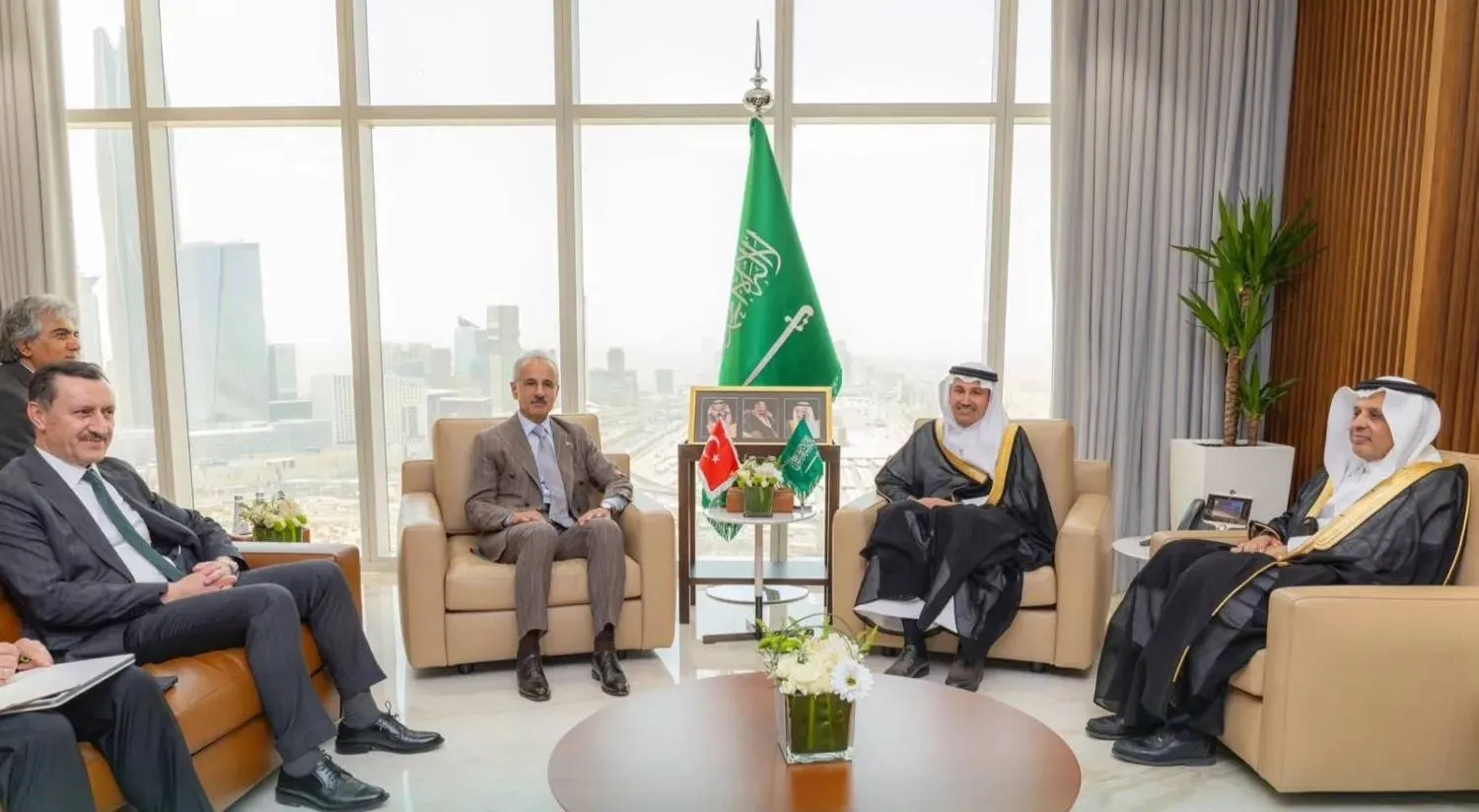
Saudi and Turkish transport ministers meet to strengthen cooperation (X)
TT

Saudi Arabia, Türkiye Strengthen Supply Chains with Land Corridor Bypassing Maritime Chokepoints

Saudi and Turkish transport ministers meet to strengthen cooperation (X)

At a time when the near-total closure of the Strait of Hormuz and the escalating U.S.-Iran war have put global supply chains under complex geopolitical strain since late February, a strategic land corridor is emerging from the heart of the maritime blockade, promising to redraw the map of international transport and trade.

Between Riyadh and Ankara, a surge in logistics activity is moving beyond conventional bilateral cooperation. It is shaping a secure, sustainable overland alternative for energy, goods and regional food supplies bound for global markets.

The official signing on Tuesday by Saudi Minister of Transport and Logistics Services Saleh Al-Jasser and his Turkish counterpart, Abdulkadir Uraloğlu, of comprehensive memorandums of understanding on railways, logistics operations and technology laid the operational foundation for that shift.

The agreements go beyond easing the immediate movement of goods. They aim to build a cross-border connectivity system that can serve as an operational line of defense against the current maritime crises.

According to the Turkish minister, the rail link rests on infrastructure that already exists in both Saudi Arabia and Türkiye. He said the Saudi side had completed its section up to the Jordanian border, while Türkiye’s rail network extends into Syrian territory. Iraq could later join the project, he added.

How the network connects

Technically and operationally, the corridor is taking shape as a connected rail network built around geography. The line starts in Istanbul, linking Türkiye’s advanced network to the Arab interior. It crosses Türkiye’s southern border into Syria through Aleppo, then runs south to Damascus, the project’s central anchor.

From the Syrian capital, the route crosses into Jordan, passes through Amman and reaches the Saudi border at the Haditha crossing. That strategic point is where the Syrian and Turkish networks meet the advanced infrastructure of Saudi Arabia Railways (SAR).

Inside Saudi Arabia, the route takes on major development weight. Its main and branch lines pass through major projects, such as the Port of Neom, which is seen as a future logistics corridor linking Red Sea ports. It then connects Makkah and Medina before integrating with the unified Gulf railway network.

That Gulf extension opens the way for the line’s long-term goal of reaching Oman and the Arabian Sea, giving it the profile of a comprehensive intercontinental land corridor that bypasses traditional maritime choke points.

Turning the kingdom into a transit hub

Logistics expert Nashmi Al-Harbi told Asharq Al-Awsat that the signed memorandums “translate in practical terms the vision of creating a land corridor that directly links the Gulf to Europe through Jordan, Syria and Türkiye.”

Al-Harbi said Saudi Arabia’s two maritime outlets, on the Red Sea and the Arabian Gulf, combined with Türkiye’s position as Europe’s natural land gateway, “turn Saudi Arabia from a logistics endpoint into a genuine strategic transit hub connecting three continents.”

“The added value for supply chain resilience lies in drawing on the lessons of Red Sea disruptions, which proved that diversifying corridors has become an urgent necessity, not an economic luxury,” he said.

He said the project would create alternative land routes that strengthen transport resilience between Asia and Europe, away from the impact of maritime chokepoint closures or swings in marine insurance costs. Required investment in the line is estimated at about $5.5 billion, he added.

Al-Harbi said the project “fully aligns with the National Transport and Logistics Strategy, which aims to consolidate the kingdom’s position as a global hub.”

It also supports regional connectivity and the localization of the railway industry, he said, building on a strong base after the kingdom ranked fifth globally in container handling speed.

He said the project’s practical impact, including the exchange of best practices in freight, last-mile services and joint logistics centers, would cut cargo transit times between the Gulf and Europe from more than 30 days on traditional sea routes to less than two weeks by land once completed.
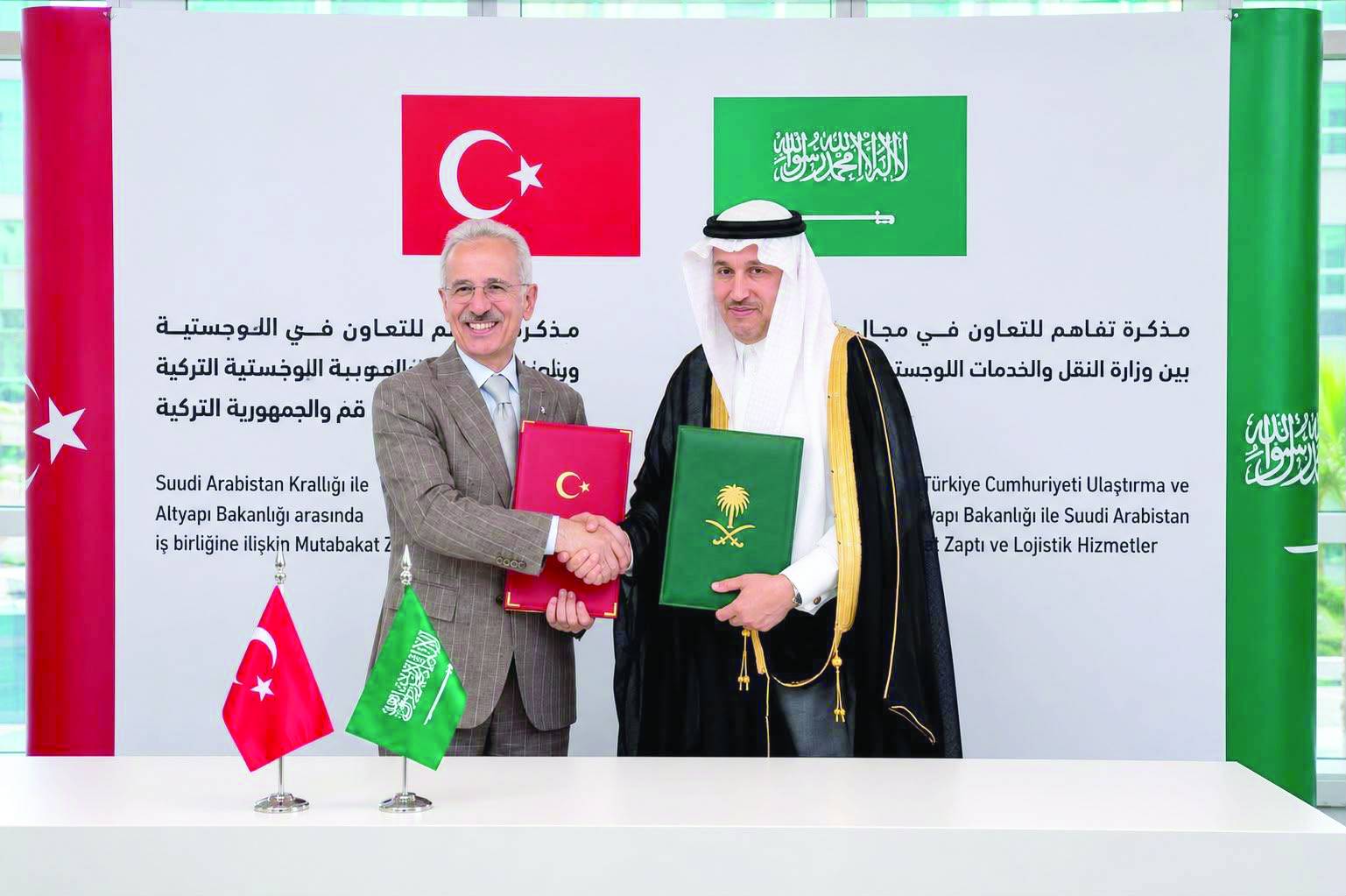
Al-Jasser and Uraloğlu shake hands after signing the two memorandums of understanding (X)

Alternatives as shipping costs soar

Logistics expert Hassan Al-Hilal told Asharq Al-Awsat the Saudi-Turkish memorandums represent “a strategic step that strengthens the kingdom’s role as a major center for re-exporting and distributing goods.”

He said the move comes at a critical moment for global trade. “Geopolitical disruptions in vital maritime corridors in recent months have caused record jumps in shipping and marine insurance costs, exceeding 300% compared with pre-crisis levels, as ships have been forced to take longer and riskier alternative routes,” he said.

Al-Hilal said the Saudi-Turkish logistics corridor gives suppliers and exporters “multimodal transport options, combining maritime shipping through Saudi ports with land and rail transport extending through Türkiye toward European and Central Asian markets.”

“This operational diversity directly helps reduce costs linked to storage and rehandling, and limits reliance on a single maritime route,” he said. “It ensures the stable flow of goods and products with high competitive efficiency, maximizing the benefits of the kingdom’s large investments in its port infrastructure.”

Key differences

Comparing the route with the India-Middle East-Europe Economic Corridor, or IMEC, Al-Harbi identified three key differences that he said gave the Saudi-Turkish route the edge.

“The first is the geographic route, which passes through Syria and Jordan to Türkiye, rather than IMEC’s passage through Israel. The second is the nature of implementation, as the current project is based on signed memorandums with a clear technical road map, compared with IMEC, which has been suspended since 2023. The third difference lies in the geopolitical dimensions. Türkiye, which had previously criticized the corridor for bypassing its territory, is returning through this new route strongly to the heart of the strategic Eurasian connectivity map,” he said.

Al-Hilal added what he called a decisive operational difference. IMEC, he said, is “a long-term strategic project that requires massive structural investment,” while current Saudi-Turkish cooperation is based on “maximizing the use of infrastructure that already exists” and on immediate operational links between two advanced logistics networks.

That makes it capable of delivering tangible results in the foreseeable term and at a much faster pace to meet current market needs, he said.

Joseph Salem, partner and head of travel, transport and hospitality at Arthur D. Little Middle East, said: “Reviving the Hejaz Railway is one of the most prominent infrastructure projects in the region’s modern history. The two memorandums of understanding signed in Riyadh between Saudi Arabia and Türkiye, one covering logistics services and the other railway technology, bring the project one step closer to implementation.”

He said an operational line would give the Gulf a direct overland trade corridor to Europe, reducing reliance on sensitive maritime passages at a time when supply chain resilience has become a growing strategic priority.

“The most important challenge remains implementation, whether in terms of financing, the stability of transit routes, or turning feasibility studies expected to be completed by the end of the year into actual investments,” Salem said.

“The importance of these two memorandums stems from the fact that they address the essential pillars of any cross-border railway project, including the standardization of technical specifications, signaling standards and regulatory alignment,” he added.

“If these elements are in place, the Hejaz Railway could regain its position within the next decade as one of the most important strategic land corridors linking Europe and the Gulf.”

Reviving a century-old legacy

The emerging land artery is not new. It is an ambitious revival, with a modern investment mindset, of a legacy dating back more than a century. It is an extension of the Hejaz Railway, which began operations in 1908 and linked Istanbul with Medina and Mecca through Syria and Jordan.

At the time, Damascus was a main anchor point, with lines branching north and south, as well as vital extensions to Lebanon, especially Beirut, and the historically Palestinian port of Haifa. The railway formed an integrated regional network before it broke apart during World War I.

From Neom to the border

The agreements follow advanced operational steps by the parties to the route. Ankara announced the activation of a trilateral memorandum of understanding with Syria and Jordan to modernize networks and connect the rail line between Türkiye and Aleppo, before integrating the Aleppo-Damascus-Jordan line.

Saudi Transport Minister Saleh Al-Jasser said the Saudi rail network already extends to the Jordanian border via the Haditha crossing, giving the project significant implementation flexibility. Joint technical studies will be completed by the end of this year to strengthen a sustainable land transport system, he said.

According to technical information, the new route will pass through the Port of Neom, linking the kingdom’s giga-projects to the heart of Europe through Türkiye.

International financing and operational pressure

In a related move that strengthens the corridor’s readiness, the Asian Infrastructure Investment Bank, or AIIB, approved a 645.83 million euro loan, equivalent to about $750 million, as a first package to help finance a new 127-km green railway line in Türkiye.

The strategic project, known as the Northern Istanbul Railway Crossing Project, aims to bypass Istanbul’s congested urban area and provide a high-capacity land link for freight and passengers across the Istanbul Strait. It would help ease bottlenecks in international supply chains and connect Türkiye’s two largest airports to the rail network.

The Turkish project’s total strategic cost is estimated at about $8.27 billion, with participation from the World Bank and other international financing institutions to raise the share of Eurasian rail transport.

In the final analysis, the joint rail push lays the groundwork for an unprecedented shift in regional shipping by removing the time and geographic obstacles imposed by maritime disruption. Cutting goods delivery times to less than two weeks would redirect investment toward this emerging land artery, at the expense of traditional routes and suspended alternatives.




SpaceX on Cusp of Record IPO that Could Make Musk a Trillionaire

FILE - SpaceX's mega rocket Starship prepares for a test flight from Starbase in Boca Chica, Texas, Monday, Nov. 18, 2024. (AP Photo/Eric Gay, File)
TT

SpaceX on Cusp of Record IPO that Could Make Musk a Trillionaire

FILE - SpaceX's mega rocket Starship prepares for a test flight from Starbase in Boca Chica, Texas, Monday, Nov. 18, 2024. (AP Photo/Eric Gay, File)

SpaceX enters the final stretch Thursday before its expected trading on Wall Street as part of the biggest initial public offering in history, which could propel co-founder Elon Musk to trillionaire status.

The company will be the first out of the gates among the tech and AI giants eyeing public markets, with OpenAI and Anthropic expected to follow, as both have filed with regulators for their own market debuts, AFP said.

If all goes as expected, the space and rocket company co-founded by Musk in 2002 will begin trading on the Nasdaq exchange on Friday morning, with all eyes on how Wall Street will absorb the blockbuster IPO that could send tremors across global markets.

For high-profile companies, the first day of trading traditionally sees executives ring the opening bell to mark the start of the session -- in this case at New York's Times Square, home of the Nasdaq.

The IPO is Musk's biggest financial gamble yet, with his xAI company and the X social media platform (formerly Twitter) also included in the SpaceX offering after the multi-billionaire folded them into the company earlier this year.

The company will offer more than 555 million shares at an expected $135, placing SpaceX among Wall Street's most elite companies with a valuation of around $1.8 trillion.

The operation will become official on Thursday, including the pricing, with questions swirling over whether the company will raise its offer price amid reports that it attracted more than four times the available shares, according to Bloomberg.

Thirty percent of the shares will be reserved for retail investors, triple the amount that is typically allocated in IPOs, giving Musk fans a chance to fork over for a slice of the company.

- Data centers in space -

The success of the IPO rests squarely on investors' faith in Musk as a visionary entrepreneur. The tech multi-billionaire will serve as chief executive, chief technology officer and board chairman of the newly traded company.

The IPO is expected to mint thousands of new millionaires and many billionaires, with former and current employees -- and a long list of investors -- from the company's near quarter-century history looking to cash in.

The financials of the company are giving some on Wall Street pause, as the valuation largely depends on Musk delivering on promises worthy of science fiction, including putting data centers in space as well as people on Mars using as yet unproven technology.

While the company is growing fast -- revenue hit $18.7 billion in 2025 -- it is also losing money, producing a net loss of $4.9 billion.

In an extraordinary prediction, SpaceX's filing claims it can pull in over $28.5 trillion in revenue from its various markets.


ECB Set for 'Insurance Hike' as Iran War Fans Euro Zone Inflation

FILE PHOTO: Dark clouds are seen over the building of the European Central Bank (ECB) in Frankfurt, Germany, June 6, 2024. REUTERS/Wolfgang Rattay/File Photo
TT

ECB Set for 'Insurance Hike' as Iran War Fans Euro Zone Inflation

FILE PHOTO: Dark clouds are seen over the building of the European Central Bank (ECB) in Frankfurt, Germany, June 6, 2024. REUTERS/Wolfgang Rattay/File Photo

The European Central Bank is all but certain to raise interest rates on Thursday in the hope of nipping higher inflation in the bud before a surge in energy costs triggered by the Iran war spreads more broadly across the euro zone economy.

The well-telegraphed move would come as inflation in the 21-country currency bloc is already above 3%, well in excess of the ECB's 2% target, and economic growth is very weak - a backdrop that has economists split over the case for tighter policy.

ECB policymakers, some of whom had already pushed for action in April, are nonetheless expected to press ahead, seeking to keep a lid on inflation expectations and to safeguard their credibility after being slow to react to a post-pandemic inflation spike in 2022.

"The ECB needs to hike ‌to protect credibility ‌and prevent inflation expectations from de-anchoring, but it is still operating around neutral rather ‌than ⁠moving decisively into restrictive ⁠territory," Annalisa Piazza at MFS Investment Management said.

Thursday's hike would be the first in nearly three years and take the ECB's benchmark deposit rate to 2.25% from 2.0%. Sources have told Reuters the ECB is unlikely to commit to further rate rises this week but financial markets expect another two over the coming year, with the next move seen as soon as September.

The bank's new economic projections are also likely to hint at further rate hikes.

"New staff projections are likely to be consistent with three hikes and (ECB President) Lagarde is unlikely to dismiss this as unreasonable," JPMorgan's Greg Fuzesi said. "That would give the meeting a ⁠clear hawkish feel, even if the communication is likely to be more consistent with ‌the next move in September."

AN 'INSURANCE HIKE' THAT UNDERPINS EXPECTATIONS

Several ECB watchers have ‌characterized the expected move as an "insurance hike" - a precautionary step that could be reversed if price pressures fade.

Supporting the case for action, ‌the ECB is likely to raise its quarterly inflation projections on Thursday, bringing them closer to its "adverse" scenario published ‌in March, which saw inflation peaking at 4.2% in the final quarter of this year before falling back sharply in 2027. Consumers, companies and financial investors have revised their own views about price hikes, although medium-term expectations remain close to the ECB target and far from their levels in the aftermath of Russia's invasion of Ukraine.

"Two hikes this year thus looks like a minimum," Anatoli Annenkov at Societe ‌Generale said. "Markets are likely to start pricing in the next hike in July... but we still think a majority of governors would prefer to wait for more ⁠data and new forecasts in September."

HEADING ⁠FOR A POLICY MISTAKE?

Not all economists are convinced. Some warn the ECB risks tightening into an economy that is already paying a high price for the Iran war.

Berenberg's Holger Schmieding said the ECB was "heading for a policy mistake" given a stagnant labor market and weak consumer demand.

"Amid the ongoing destruction of demand, the inevitable temporary surge in prices ... seems unlikely to turn into a protracted inflation problem that would need to be addressed by higher rates," he wrote in a note. A Reuters analysis of earnings call transcripts by euro zone companies showed just 40% of those outside the financial sector had raised prices or were planning to do so, roughly half the share seen as the Ukraine war pushed up energy prices in 2022.

Eric Dor, director of economic studies at France's IESEG School of Management, said the ECB was overestimating its ability to influence household and business expectations, particularly in a situation where inflation is driven by fuel costs rather than domestic demand. But the ECB has sharpened its messaging in support of tighter policy. Chief Economist Philip Lane - typically seen as an inflation "dove" - has said the Iran-related shock may be broader in scope than the Ukraine crisis, as it affects global energy markets rather than primarily Europe.


Gold Rebounds from 6-month Low; Inflation Data in Focus

A vendor displays gold bracelets for sale at a gold shop in Istanbul's Grand Bazaar (AFP)
TT

Gold Rebounds from 6-month Low; Inflation Data in Focus

A vendor displays gold bracelets for sale at a gold shop in Istanbul's Grand Bazaar (AFP)

Gold prices rebounded from a six-month low on Thursday, as investors bought the metal at bargain prices while awaiting a key US inflation report that could shed more light on the Federal Reserve's policy outlook.

Spot gold rose 0.5% to $4,095.64 per ounce by 0558 GMT, after hitting its lowest since November 21 at $4,022.09 earlier in the day. US gold futures for August delivery were ⁠down 0.4% at $4,116.20, Reuters reported.

"With ⁠prices hurtling towards $4,000, it's an obvious level of support that could prompt bears to book a quick profit or tempt battered bulls from the sideline," said Matt Simpson, a senior analyst at StoneX.

"The US dollar index failed to gain much ground following Wednesday's CPI report. So, unless ⁠there are any nasty surprises in PPI (Producer Price Index) - gold could be due a technical bounce over the near term."

US consumer inflation increased at its fastest pace in three years in May, boosted by surging prices for energy products amid the Middle East conflict.

The May US PPI data is due at 1230 GMT.

Traders are pricing in a more than 70% chance of a US rate hike by December, according to the CME FedWatch tool.

The United ⁠States and ⁠Iran traded air attacks on Thursday for a second straight day, with US President Donald Trump vowing further strikes if Tehran did not immediately agree to a peace deal.

Oil prices climbed on Thursday, after Iran declared the closure of the Strait of Hormuz following US strikes.

Elevated crude oil prices can accelerate inflation, and while gold is viewed as a hedge against inflation, higher interest rates tend to weigh on the non-yielding metal.

Spot silver rose 0.4% to $63.95 per ounce, platinum gained 0.4% to $1,671.09, and palladium climbed 2.9% to $1,248.45.