

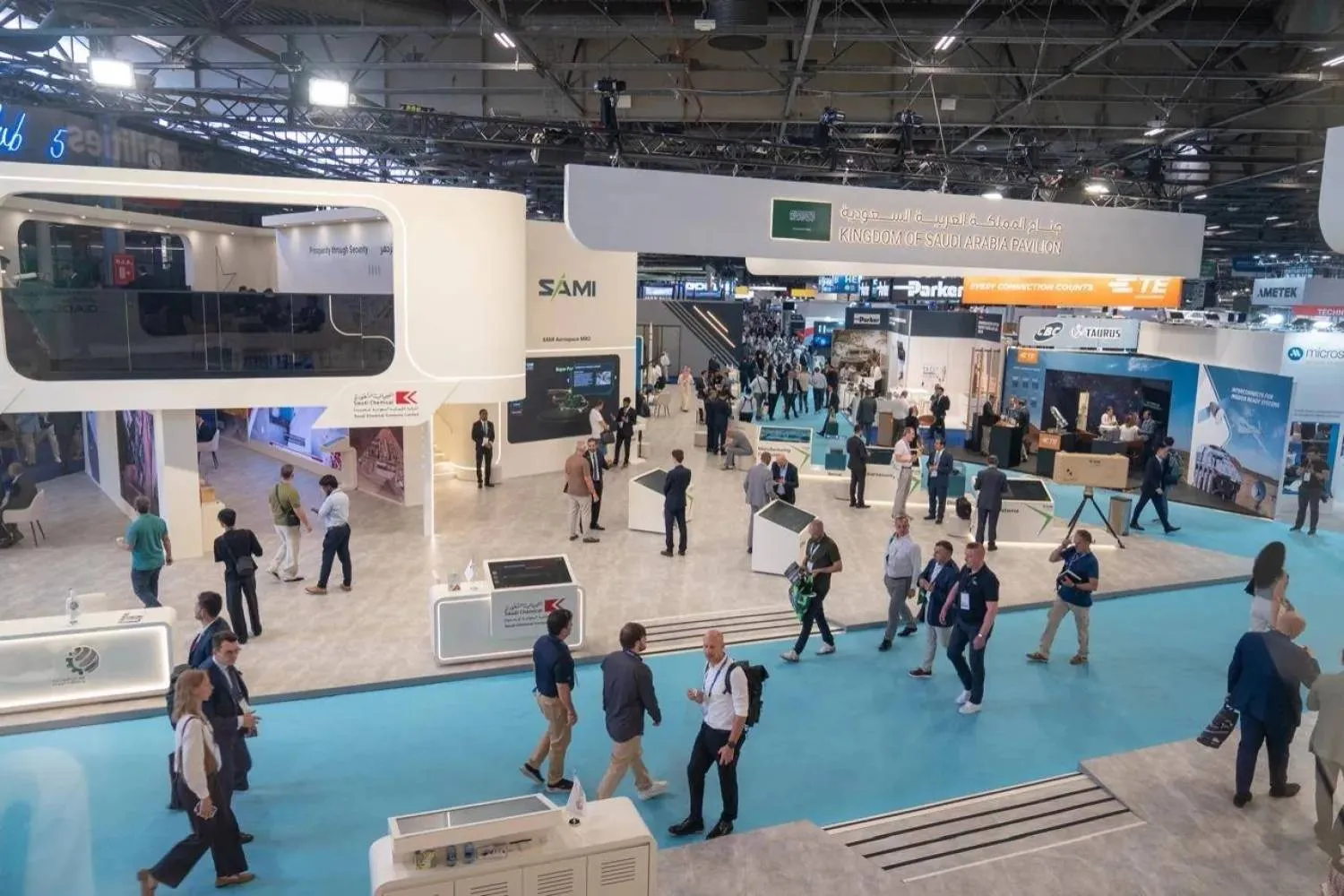

Saudi Arabia Expands Investment Prospects in Military Industries

The Saudi pavilion reinforced the Kingdom’s position as a leading investment destination in the military industry sector. (Asharq Al-Awsat)
TT

Saudi Arabia Expands Investment Prospects in Military Industries

The Saudi pavilion reinforced the Kingdom’s position as a leading investment destination in the military industry sector. (Asharq Al-Awsat)

Saudi Arabia used the Eurosatory 2026 defense and security show to open new investment horizons, showcasing promising opportunities and a regulatory environment designed to attract capital.

The participation helped sharpen the appeal of the Kingdom’s military industries and drew the attention of major global companies seeking strategic partnerships that support Saudi localization targets.

The Saudi pavilion, held at the Paris exhibition from June 15 to 19, reinforced the Kingdom’s position as a leading investment destination in the military industry sector.

Organized by the General Authority for Military Industries (GAMI), the pavilion brought together 10 government and private entities alongside the authority.

The participation underlined Saudi Arabia’s welcome to investors from around the world seeking opportunities in the military industries sector. It also highlighted the Kingdom’s efforts to localize more than 50% of military spending by 2030.

On the sidelines of the exhibition, GAMI Governor Ahmad Al-Ohali met Patrick Pailloux, French Director General for Armament (DGA), as well as representatives of major global defense companies.

The meetings focused on ways to strengthen cooperation in military industries and exchange expertise, supporting the development of a sustainable sector, improving the readiness of military equipment, boosting self-sufficiency and contributing to the national economy.

The Saudi participation also saw the signing of several agreements and memorandums of understanding, part of GAMI’s efforts to develop military industries, strengthen supply chains and enable strategic partnerships.

The authority organized a workshop titled “Developing Supply Chains in Military Industries,” which discussed how an attractive investment environment for local and international investors can help build a diversified and prosperous economy in the sector.

The pavilion showcased the integration of government efforts, national industrial and service capabilities, and the innovative technologies presented by participating Saudi companies. It also highlighted the country’s attractive investment environment and the rapid growth of its military industries sector.

The sector’s contribution to GDP rose from 2.2 billion riyals, or about $587 million, in 2021 to 6.6 billion riyals, or about $1.76 billion, in 2024. The localization rate of military spending also climbed to nearly 25% in 2024, as the Kingdom works toward localizing more than 50% of military spending by 2030.

GAMI said the Saudi pavilion’s participation strengthened the Kingdom’s position as a trusted international partner, expanded its network of relations with major global companies and enabled national firms to showcase their capabilities while exploring opportunities for growth and expansion in global markets.



UK Economic Growth Revised Up to 0.5 Percent in Q2

The British capital, London (Reuters)
TT

UK Economic Growth Revised Up to 0.5 Percent in Q2

The British capital, London (Reuters)

Britain's economy grew more than initially estimated in the second quarter, revised data showed Wednesday, offering a boost to Prime Minister Andy Burnham ahead of next month's annual budget update, AFP said.

Gross domestic product increased 0.5 percent in the April-June period, up from a first estimate of 0.4 percent, the Office for National Statistics said.

The figure still marked a slowdown from the 0.6 percent expansion recorded in the first quarter.

"Stronger services growth in the latest quarter means the economy is now slightly larger than previously estimated," ONS director of economic statistics Liz McKeown said in a statement.

Burnham, who has made easing the cost of living a key focus for his Labor government, has set the stage for difficult decisions to be made in the October 28 budget presentation.

With inflation rising and government bond yields reaching multi-decade highs this month, Finance Minister John Healey, who will unveil the budget, has pledged to maintain strict fiscal discipline.

"Growth has come in marginally better than initially expected, but it remains difficult to come by as households and businesses contend with high borrowing costs, inflationary pressures and a cooling labor market," said Richard Carter, head of fixed interest research at Quilter Cheviot.

He noted that since the second quarter, "the outlook has become more uncertain" following a recent surge in energy prices and borrowing costs.


Russia Extends Diesel Export Ban until End of October

FILE -Diesel prices are displayed at a gas station Thursday, Sept. 10, 2026, in Carlsbad, Calif. (AP Photo/Gregory Bull, File)
TT

Russia Extends Diesel Export Ban until End of October

FILE -Diesel prices are displayed at a gas station Thursday, Sept. 10, 2026, in Carlsbad, Calif. (AP Photo/Gregory Bull, File)

Russia has extended its ban on diesel exports for fuel producers until the end of October, the government said on Wednesday, adding further strain to a global energy market already rattled by ongoing conflicts and supply shortages.

Global fuel shortages and sharp price increases have been in focus, especially in ‌the United ‌States, where diesel prices ‌have shot ⁠to records over $6.50 ⁠a gallon as the wars in Iran and Ukraine constrain deliveries of fuel, a political risk for US President Donald Trump ahead of the midterm elections, Reuters reported.

The price of ⁠diesel at the pump in ‌the United ‌Kingdom has hit record highs due to the ‌US-Israeli war on Iran, motoring body ‌RAC said on Monday.

Russia has repeatedly imposed curbs on gasoline and diesel exports to rein in rising fuel prices and ‌tackle shortages triggered by Ukrainian drone attacks on oil refineries.

In ⁠late ⁠August, Moscow extended a ban on diesel exports until the end of September while allowing supplies to countries such as former Soviet republics and Mongolia under intergovernmental agreements.

Usually the world's second-largest exporter of diesel after the United States, Russia had already reduced its exports in summer before imposing the overseas supply.


HUMAIN: Saudi Arabia Allocates 14 GW for AI Factories

A panel discussion at the forum (Asharq Al-Awsat)
TT

HUMAIN: Saudi Arabia Allocates 14 GW for AI Factories

A panel discussion at the forum (Asharq Al-Awsat)

Saudi Arabia is betting on abundant energy supplies and expanding digital infrastructure to build an integrated artificial intelligence ecosystem, allocating about 14 gigawatts of power capacity to support what HUMAIN calls “AI factories.”

The move comes as companies and countries race to secure the computing capacity needed to train and operate advanced models amid growing constraints on the availability of energy, chips and data centers.

HUMAIN CEO Tareq Amin said the Kingdom has the resources needed to build such an ecosystem, explaining that the company is focusing not only on providing computing capacity and infrastructure, but also on developing software and systems in-house. This would allow it to build an integrated chain extending from energy and data centers to models and applications.

Speaking at Servcorp’s inaugural economic forum in Riyadh, Amin said his previous experience in the energy sector had given him early insight into the scale of the challenges involved in securing advanced computing capacity. Access to graphics processing units could in some cases take several months, he noted, prompting him to consider building an integrated AI ecosystem within Saudi Arabia.

14 GW to Support Infrastructure

Amin explained that since its establishment, HUMAIN has focused on building “AI factories” by providing the ecosystem’s core components, including energy, computing and digital infrastructure, alongside developing software, models, applications and consulting services and investing in startups.

He added that cooperation with the Energy Ministry and several government entities had helped accelerate the allocation of land and infrastructure required for the project, noting that about 14 GW of power capacity had been allocated to the site the company is working on.

Infrastructure development is proceeding in parallel with efforts to attract global companies to make use of it, Amin noted. The company has signed agreements with international companies, including Amazon, while work on a joint project with AMD is progressing. Other companies are also being attracted to operate within the AI ecosystem being developed in Riyadh.

Beyond Generative AI

Amin said current uses of AI still represent only a limited portion of the technology’s available potential. Global attention is currently focused on generative AI and its applications within companies, while AI applications connected to the physical world, industry and infrastructure remain at an early stage.

The next phase will require greater computing capacity, energy and data center infrastructure, he explained, predicting a significant expansion in the scope of AI use as the supporting infrastructure develops.

Amin added that the company has managed, in about 15 months, to build operations spanning several sectors, stressing that fully harnessing AI is not simply a matter of adding new technological tools, but requires redesigning how organizations operate.

From Buying Software to Developing It In-House

Amin noted that the biggest challenges the company faced were not so much technological as related to changing corporate culture and working methods. HUMAIN made a strategic decision not to buy off-the-shelf software and instead to develop its systems internally.

The approach has included building agentic workflows, systems of record and a number of applications used in daily operations. Amin said the future of work will gradually move toward models in which users need only specify the task they want performed, while intelligent models automatically carry out the necessary steps and procedures.

He stressed that these changes are not intended to eliminate employees, but rather to increase their productivity and enable them to perform their work more efficiently. Some employees, he noted, are now able to complete tasks that previously required much larger teams.

The experience has also extended to human resources and other departments, where team members are now able to develop workflows and AI agents themselves without having to rely entirely on IT departments.

AI and Geopolitics

Amin’s remarks came during Servcorp’s inaugural economic forum, which brought together about 150 business leaders, investors and policymakers to discuss shifts reshaping the economies of Saudi Arabia, the Middle East, North Africa and Türkiye.

Opening the forum, Walid Abukhaled, chairman of EMIR in Saudi Arabia, said the global economy faces a combination of overlapping challenges, including geopolitical tensions and accelerating technological change, noting that Saudi Arabia’s importance is growing given its pivotal position in the global energy sector.

He added that AI has become a major factor reshaping the labor market as automation and modern technologies expand across manufacturing, consulting and programming, creating new challenges related to the skills that will be required in the future.

For his part, David Godchaux, Servcorp’s CEO for the Middle East, Europe and the Americas, said Saudi Arabia has undergone a major transformation in recent years, moving from an emerging market to a major economy with growing global influence.

He explained that the abundance of information has not made decision-making easier, but has instead increased the need to distinguish valuable information from the noise generated by the vast flow of data. One of the forum’s objectives, he noted, is to provide a platform that helps business leaders and investors interpret economic trends more clearly and make more precise decisions.