


After the Fracture: How Britain’s Financial Industry Recovered from Brexit

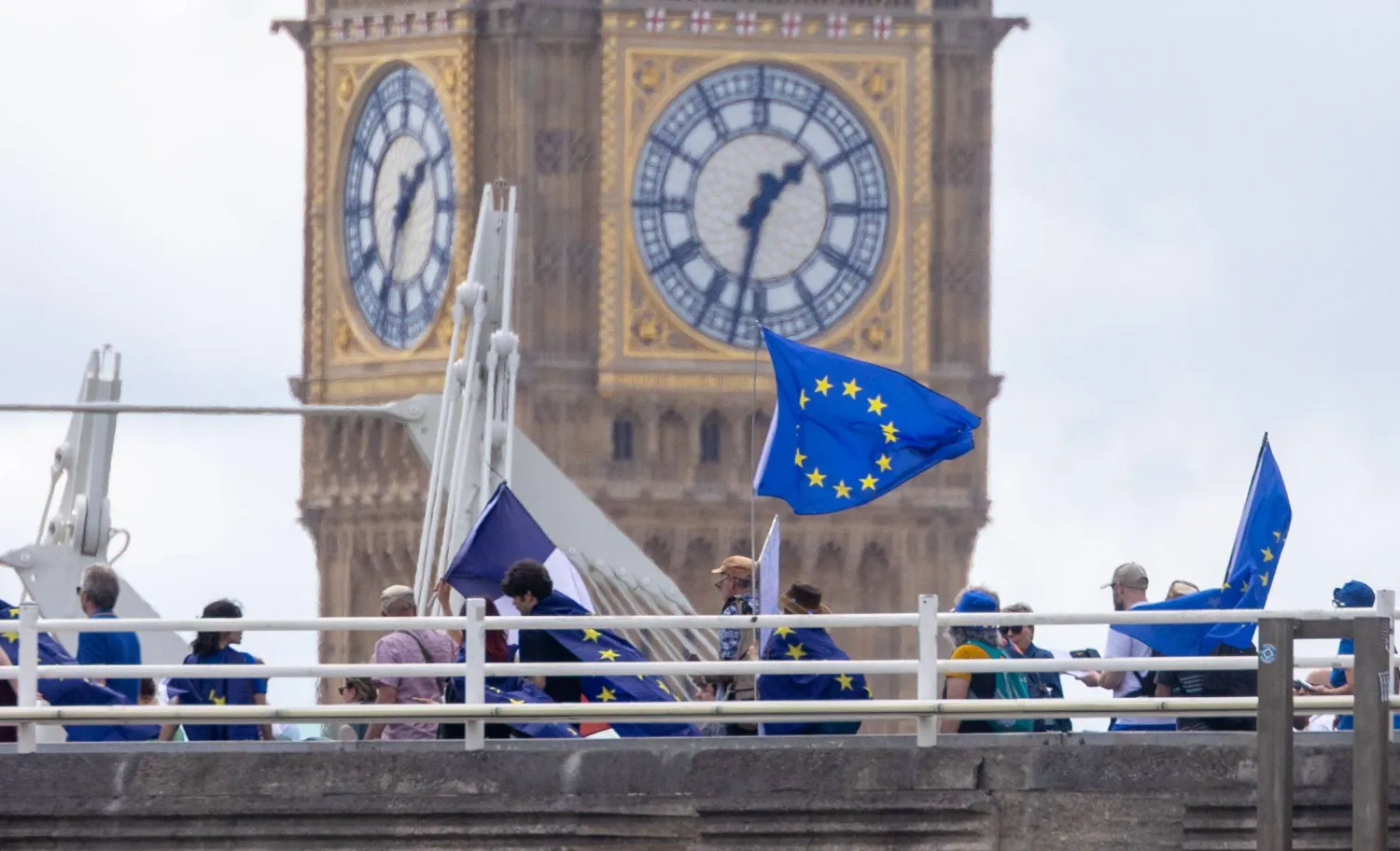
People take part in the "National Rejoin March IV" to show support for the UK to re-join the European Union in London, Britain 20 June 2026. (EPA)
TT

After the Fracture: How Britain’s Financial Industry Recovered from Brexit

People take part in the "National Rejoin March IV" to show support for the UK to re-join the European Union in London, Britain 20 June 2026. (EPA)

In the buildup to 2016's Brexit referendum, JPMorgan CEO Jamie Dimon said the US bank could shift 4,000 jobs from Britain, joining a chorus of executives who warned a vote to leave the European Union would ravage the country's finance industry.

A decade later, the Wall Street giant plans to build a tower in London's Canary Wharf that it says could house up to 12,000 employees - a commitment hailed as "a multi-billion-pound vote of confidence" by finance minister Rachel Reeves.

Other signs too suggest the British financial industry has weathered Brexit better than many expected: employment in the City of London financial district is near an all-time high, and banks are posting record profits.

But interviews with executives and data reviewed by Reuters paint a more nuanced picture, of Britain as a financial center whose dominance has been eroded while the country itself has become less attractive for some investors.

"Brexit undeniably weakened the City's position," said Michael Mainelli, who led the financial district as Lord Mayor in 2023 and 2024, citing relocation of jobs from London to cities like Paris and Dublin.

"Yet Europe too is weaker. Both the EU and the UK have been losing out to the enormous growth in Asian financial markets."

To keep serving clients across the 27-country EU, British firms that lost so-called passporting arrangements moved about 40,000 jobs to European financial hubs, according to estimates from the City of London Corporation, the municipal body for the "Square Mile", which speaks for the sector more broadly.

Britain remains second only to the United States as a destination for ‌foreign capital, hosting ‌more than £12 trillion ($16 trillion) in foreign direct investment, portfolio investment and cross-border deposits at the end of 2025 according to IMF data ‌cited by ⁠Barclays.

Its share has ⁠declined, however, from 8.6% in 2015 to 7% in 2025. In the same period, the US share of foreign capital has increased to 25% from around 20%, thanks mainly to demand for US stocks.

Since 2015 Britain has lost market share in 10 out of 12 categories of international finance, including foreign exchange trading, stock offerings and assets under management, according to research company New Financial.

"The impact of Brexit on the City has been like the UK breaking its own arm - it has not been fatal but nor has it been great, and there was a degree of self-injury," New Financial's founder William Wright said.

RISING RATES, DEREGULATION HELPED UNDERPIN FINANCIAL SECTOR

This month, Dimon said JPMorgan will extend its $1.5 trillion Security and Resiliency Initiative to Britain, helping companies in critical industries raise money.

As well as a landmark new London HQ, the bank is expanding its campus in Bournemouth on England's south coast at a cost of £300 million to £350 million. Citigroup has likewise said it is investing £1.1 billion in its UK operations.

Across town from Canary Wharf, the British ⁠capital's centuries-old financial heart appears thriving: according to the Corporation, there are 676,000 workers in the City of London, up more than 25% since ‌2019.

"I did believe the City would have another life after Brexit, but I didn't know it would be so quick ‌and so strong," said Soren Jessen, whose 1 Lombard Street restaurant faces the Bank of England.

Sales are better than ever, he said.

Britain formally left the EU on January 31, 2020, just weeks before COVID-19 lockdowns ‌began. The pandemic and a string of tumultuous events since - including the Ukraine and Middle East wars and US President Donald Trump's upending of trade and security arrangements - make Brexit impacts ‌hard to isolate.

While rival hubs have chipped away at London's market share, global and national developments have helped underpin the financial services sector.

A post-COVID inflation spike prompted the BoE and other central banks to hike interest rates, turbocharging the returns to banks from lending.

After winning power in 2024, the Labour Party government accelerated deregulation, arguing that rules put in place after the 2007-2008 global financial crisis had stifled growth.

Charged by Reeves with supporting the government's growth agenda, banks also swerved fresh taxes and won concessions from regulators on capital requirements.

Britain's freedom to tweak the EU's Solvency II rules by cutting administrative costs and easing capital constraints such as the buffers ‌insurers must keep against losses has meanwhile boosted the insurance sector.

According to the London Market Group of insurers, gross written premiums have doubled in the last decade, to $187 billion. London has become a center for financial technology, too: digital bank Revolut is now Europe's most ⁠valuable fintech firm, valued at $75 billion in a November ⁠share sale.

BRITAIN MAY BE A LESS ATTRACTIVE PLACE TO INVEST

The broader economy has struggled to grow, however, lagging the United States, where consumer spending and a tech-sector boom have driven growth, and even the sluggish euro zone.

Britain's long-run economic productivity will be 4% lower after Brexit than if the country had stayed in the EU, with much of the damage done already, the government's budget forecasters have estimated.

"You can point to the day in June 2016 where the UK became, in reality, a less attractive place to invest," said Premier Miton CIO Neil Birrell, who has significant UK holdings but has been reducing them.

Britain's bond yields are now among the highest of major advanced economies, not helped by political instability that has seen six prime ministers in the decade since the Brexit vote.

Higher government borrowing costs in turn push up the price of credit for businesses and households. Lending to small businesses as a share of GDP has fallen from just above 8% in 2016 to 6.5% in the year to date, BoE data shows.

A recent Boston Consulting Group report identified "a self-reinforcing credit trap" where businesses don't seek credit because they expect to be rejected and lenders pull back because they see insufficient demand.

Reforms to boost investment by domestic pension funds in British growth stocks from just 0.1% of their assets could help Britain prosper in the next decade, New Financial's Wright said, as could more participation by retail investors.

Brexit has increased administrative burdens such as customs paperwork for businesses and disrupted supply chains. The current Lord Mayor has nevertheless argued against a return to regulatory alignment with the EU, which could give greater access to its single market over time.

Former City of London chief Mainelli said the EU itself had failed to take advantage of Brexit opportunities in finance, noting that plans to unify an untidy patchwork of national markets remain unrealized, holding back the bloc's growth.

"As the EU ... hasn't moved forward much in the past decade, the UK hasn't lost much," Mainelli said. "The City remains the capital markets gateway to Europe."



Bolivia Approves $1.9 Billion IMF Deal, Eliminates Diesel Subsidies

A person is counting dollars in La Paz, Bolivia, 10 July 2026. (EPA)
TT

Bolivia Approves $1.9 Billion IMF Deal, Eliminates Diesel Subsidies

A person is counting dollars in La Paz, Bolivia, 10 July 2026. (EPA)

Bolivian lawmakers approved a $1.9 billion loan agreement with the International Monetary Fund on Friday, delivering the conservative government a key victory in its efforts to ease the country's deep economic crisis as unions threatened renewed protests.

Just hours after Congress approved the loan, President Rodrigo Paz announced an immediate end to subsidies for the diesel powering Bolivia’s trucks, buses and tractors — a step toward meeting IMF demands. Gasoline, used mainly in private cars, would remain subsidized for now, though Paz had already scaled back that support in recent months, The Associated Press said.

The Senate ratified the IMF agreement a day after the lower house approved it, clearing the final legislative hurdle for the three-year financing program aimed at replenishing dwindling foreign reserves and stabilizing the ailing economy marked by high inflation and weak growth. The IMF first announced the staff-level agreement in July after months of negotiations with Paz’s market-friendly government, which took power last year after nearly two decades of socialist rule as part of a wave of new Latin American leaders allied with the Trump administration.

The program still requires approval from the IMF’s executive board before funds can be disbursed. Economy Minister Christian Morales told senators that the deal would give other lenders, including the World Bank and the Inter-American Development Bank, greater confidence in the government and help it secure about $5 billion in additional financing.

But the assistance is conditioned on tough economic measures, including the elimination of fuel subsidies, that threaten to reignite unrest in Bolivia, where weeks of road blockades in June and July paralyzed much of the South American nation as demonstrators demanded Paz’s resignation. Congress on Thursday extended for another 90 days a state of emergency that Paz had declared to clear roads during the protests. It allows for military intervention and the suspension of some civil liberties.

The Bolivian Workers’ Central, the country’s main labor federation, and other unions have voiced fierce opposition to the IMF loan, warning that the government spending cuts required under the deal would drive up living costs and deepen hardship for struggling families.

Although Paz’s Christian Democratic Party lacks a majority in Congress, the centrist and right-wing lawmakers that dominate both chambers rallied behind the deal. The Movement Toward Socialism, the party that dominated Bolivian politics after the former coca growers’ union leader Evo Morales won the presidency in 2005, now holds just two of the 130 seats in the lower house and none in the 36-member Senate.

Declining natural gas exports have deprived Bolivia of dollars needed to import gasoline and diesel, contributing to chronic fuel shortages that began in 2023 and have persisted under Paz. The Iran war has pushed up global fuel costs, making fuel subsidies an even greater burden on public finances.

“No one can buy something expensive and sell it cheap,” Paz said in his late-night declaration that diesel in Bolivia would now be sold at international prices.

To cushion the blow, he announced about $79 million in cash assistance for 2.9 million Bolivians, along with loans on preferential terms for truckers, small businesses and producers facing higher diesel costs. He pledged to redirect subsidy spending toward schools, hospitals and roads.


IMF Says Lebanon Economic Activity to Contract Sharply in 2026 as Conflict Weighs

FILE PHOTO: A view of the International Monetary Fund logo at its headquarters in Washington, D.C., US, November 24, 2024. REUTERS/Benoit Tessier/File Photo
TT

IMF Says Lebanon Economic Activity to Contract Sharply in 2026 as Conflict Weighs

FILE PHOTO: A view of the International Monetary Fund logo at its headquarters in Washington, D.C., US, November 24, 2024. REUTERS/Benoit Tessier/File Photo

The International Monetary Fund said on Friday that Lebanon's economic activity is expected to contract significantly in 2026 ‌as the ‌conflict in ‌the ⁠Middle East and broader ⁠regional security tensions continue to damage economic activity, infrastructure ⁠and living conditions, Reuters reported.

The ‌IMF ‌said inflation ‌remained in ‌the double digits and the country's current account deficit ‌had widened, largely due to higher ⁠energy ⁠costs, while infrastructure damage, internal displacement, and deteriorating living standards had added to economic pressures.


Oil Prices Fall on Easing Fears Over Saudi Supply Disruption

FILE PHOTO: Vessels near the Strait of Hormuz, as seen from Musandam, Oman, September 2, 2026. REUTERS/Stringer/File Photo
TT

Oil Prices Fall on Easing Fears Over Saudi Supply Disruption

FILE PHOTO: Vessels near the Strait of Hormuz, as seen from Musandam, Oman, September 2, 2026. REUTERS/Stringer/File Photo

Oil prices fell 2% on Friday, extending losses for a third straight session as easing concerns over Saudi supply disruptions outweighed anxiety about a widening of conflict across the Middle East.

Brent crude futures fell by $2.14, or 2%, to $102.68 a barrel by 0806 GMT. US West Texas Intermediate futures fell $1.83, or 1.8%, to $100.08, Reuters reported.

Benchmark Brent prices are on track for their first weekly loss in three.

Prices climbed to close to four-month highs earlier in the week after sources said crude loadings ⁠at Saudi Arabia's Red Sea export hub of Yanbu had been suspended and Riyadh cancelled some deliveries to Europe after its East-West pipeline was damaged in an attack last week.

However, prices have cooled since on reports that Saudi Arabia was seeking to restore about half the capacity of its East-West oil pipeline within days.

Saudi Arabia has sold about 60 million barrels of crude from its Gulf port of Ras Tanura inside the Strait of Hormuz for loading via ship-to-ship transfer at the Omani port of Sohar this month and next, multiple trade sources said on Friday.

The rebound in Saudi Aramco's exports from inside the Gulf to between 1 million to 1.5 million barrels per day on average, similar to or slightly higher than August's levels, has cooled global oil prices as it could make up for some of the ⁠volume lost at its port of Yanbu.

Chinese and South Korean refiners are among the top buyers of the spot supplies, while some volumes will be going to India and Japan, said the sources, who spoke on condition of anonymity.

"Recent efforts ‌to restore Saudi export capacity have reduced some of the immediate supply ‌anxiety," said Priyanka Sachdeva, head of market insights at Phillip Nova.