


Oil Set for Big Weekly Losses as Tankers Exit Strait of Hormuz

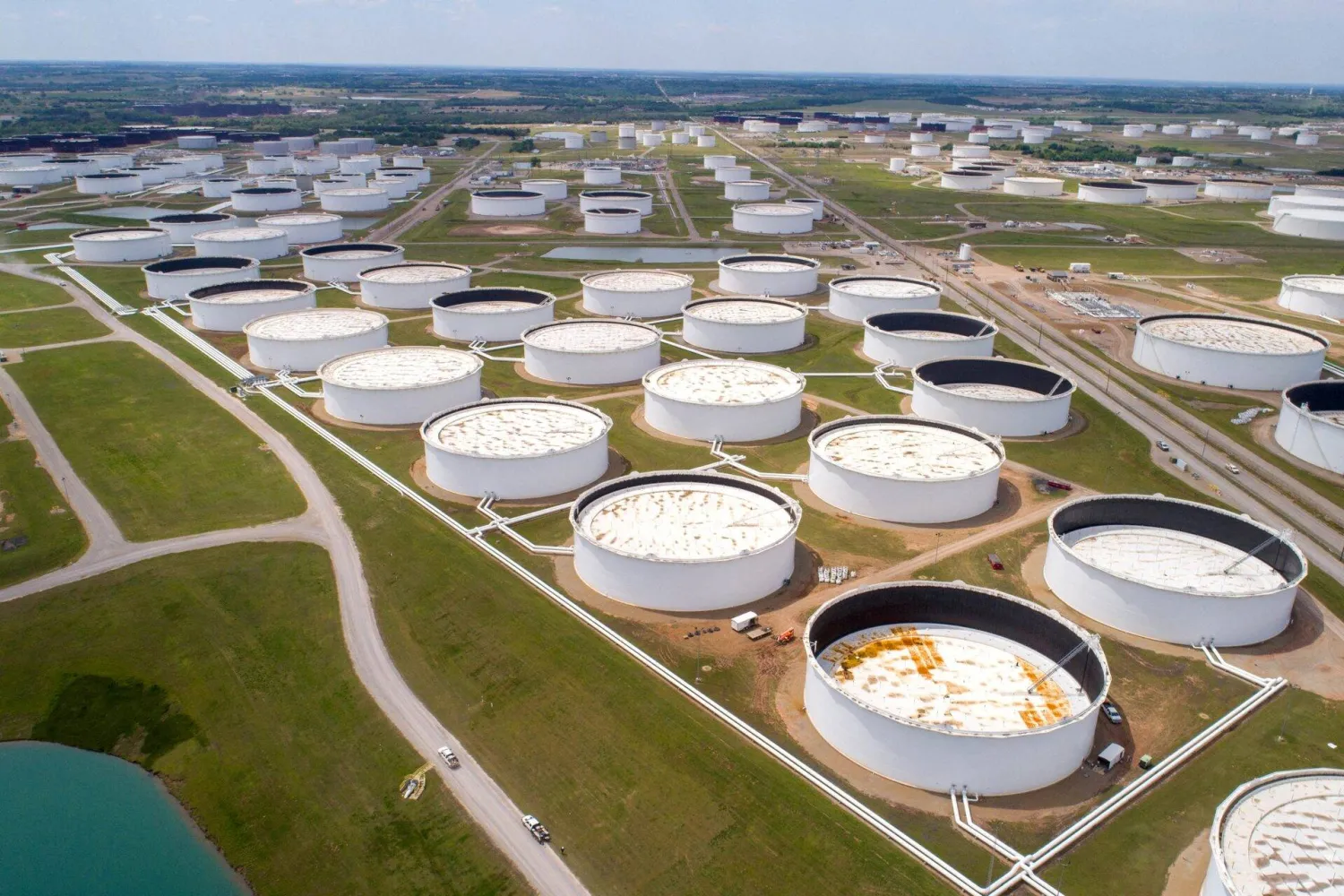
Crude oil storage tanks at the Cushing hub in Oklahoma, USA (Reuters)
TT

Oil Set for Big Weekly Losses as Tankers Exit Strait of Hormuz

Crude oil storage tanks at the Cushing hub in Oklahoma, USA (Reuters)

Crude prices plunged by about 3% on Friday, on course for steep weekly losses, as more oil tankers exited the Strait of Hormuz, easing supply concerns, even though a cargo vessel was hit near Oman on Thursday.

Brent crude futures fell $2.42, or 3.2%, to $72.84 a barrel by 1323 GMT. US West Texas Intermediate lost $1.97, or 2.7%, to $69.95.

The Brent benchmark was heading for a weekly decline of about 9.7%, while WTI traded around 8.8% lower than its close last Thursday before the market closed for a public holiday last Friday, Reuters reported.

"The predominant view, it appears, remains one of imminent oversupply," said PVM analyst Tamas Varga.
Refining giant Saudi Aramco resumed oil loading on Friday at its Ras Tanura terminal in the Gulf after a nearly four-month halt, shipping data from LSEG showed.

Two Very Large Crude Carriers, which can load cargoes of 2 million barrels, loaded crude at the terminal while another waited nearby, the data showed.

"There is a general selloff as the market reacts to the increased flows exiting the Strait of Hormuz and China not yet picking up crude demand," said June Goh, senior oil market analyst at Sparta Commodities.

UNKNOWN PROJECTILE HITS VESSEL

Both benchmark contracts jumped more than 2% on Thursday after a cargo vessel was hit by an unknown projectile near Oman, prompting the UN's shipping agency to suspend its voluntary evacuation scheme.

Two US officials told Reuters that Iran fired on the cargo ship as it attempted to pass through the strait. Iranian authorities said the security of vessels passing outside designated Hormuz routes is not guaranteed. Iran on Friday reasserted its right to control shipping through the Strait of Hormuz. Data on Thursday showed that crude shipments through the strait rose this week to their highest since the US-Israeli conflict with Iran began at the end of February.

Despite the ceasefire deal that reopened the waterway, overall traffic is far below the pre-war daily average.

"If the number of transits does not increase more strongly next week either, scepticism in the market is likely to grow, so that the oil price is likely to rise again," Commerzbank analysts said on Friday. Meanwhile, Russian authorities are considering a diesel export ban for several months, state news agency TASS said on Friday. Although a major diesel exporter, Russia faces fuel supply issues after Ukrainian drone attacks have caused extensive damage to its oil refineries and other energy infrastructure.



Gold Heads for Biggest Weekly Loss in Six as Middle East War Fans Inflation Worries

16 March 2023, Bavaria, Munich: Gold bars and coins lie on the table at the Precious metal dealership Pro Aurum. (dpa)
TT

Gold Heads for Biggest Weekly Loss in Six as Middle East War Fans Inflation Worries

16 March 2023, Bavaria, Munich: Gold bars and coins lie on the table at the Precious metal dealership Pro Aurum. (dpa)

Gold was on track for its biggest weekly loss in six on Friday, as escalating US-Iran clashes lifted oil prices, adding to inflationary pressures and strengthening the case for higher US interest rates.

Spot gold was up 0.8% at $4,002.39 per ounce by 0624 GMT, having touched its lowest since July 1 earlier ‌in the day. US ‌gold futures for August delivery gained ‌0.4% ⁠to $4,006.10.

The metal has ⁠lost 3% so far this week, its largest decline since June 1, with the Middle East conflict outweighing support from softer June US inflation figures released this week.

"Gold is making tentative steps higher today after the sight of the metal slipping below $4,000 attracted some bargain hunting," said Tim Waterer, chief market analyst at ⁠KCM Trade.

However, "geopolitical risks in the Middle East ‌are still present, with inflation and yield ‌concerns being the dominant forces holding gold back," Waterer said.

Oil prices ‌have climbed about 12% this week as the escalating US-Iran conflict ‌raised supply concerns.

The surge in oil prices risks reigniting inflation worries and increasing the likelihood of interest rate hikes. Non-yielding gold typically struggles in a high-interest-rate environment, as investors gravitate towards assets offering higher returns.

Dallas Federal ‌Reserve President Lorie Logan became the first of Fed Chairman Kevin Warsh's new colleagues to ⁠call publicly for ⁠a rate hike.

Fed Vice Chair Philip Jefferson also suggested he would be open to raising rates if there is no near-term improvement in inflation.

Traders are pricing in a 73% chance of a rate hike in December, according to the CME FedWatch Tool.

Gold discounts in India widened to a one-month high this week as hopes of lower prices kept buyers on the sidelines, while premiums in China were largely steady.

Elsewhere, spot silver rose 0.6% to $55.83 per ounce, while platinum lost 1% to $1,602.02 and palladium eased 0.4% to $1,244.84. All three metals were headed for a weekly loss.


Al-Jasser to Asharq Al-Awsat: Saudi Arabia is a Vital Artery for Global Trade

One of the agreements signed at Jeddah Islamic Port. Asharq Al-Awsat
TT

Al-Jasser to Asharq Al-Awsat: Saudi Arabia is a Vital Artery for Global Trade

One of the agreements signed at Jeddah Islamic Port. Asharq Al-Awsat

Saudi Minister of Transport and Logistics Services Saleh Al-Jasser told Asharq Al-Awsat that the recent crisis involving the Strait of Hormuz demonstrated the Kingdom's strong infrastructure and substantial investments, many of which have been implemented in partnership with the private sector.

He said the crisis also highlighted the flexibility of Saudi Arabia's logistics system and its ability to respond to changing circumstances by redirecting trade flows as needed, stressing that the Kingdom serves as a vital artery for global trade.

His remarks came during the signing of several agreements at Jeddah Islamic Port, including the launch of Bahri Logistics' bonded storage zone. The facility belongs to Bahri Logistics, a business unit of Saudi shipping firm Bahri, and was inaugurated in cooperation with the Zakat, Tax and Customs Authority and the Saudi Ports Authority (Mawani).

Al-Jasser said Saudi Arabia has been undergoing a rapid logistics transformation since Crown Prince and Prime Minister Mohammed bin Salman launched the National Transport and Logistics Strategy.

He noted that the current regional crisis provides a real opportunity to assess the progress made since the strategy's launch, adding that it has clearly demonstrated the sector's enhanced preparedness.

Al-Jasser explained that before 2023, most of Saudi Arabia's trade activity was concentrated on the Kingdom's western coast, with approximately two-thirds of trade passing through eastern ports.

However, disruptions in the Red Sea during 2023 prompted the transfer of a significant share of Saudi trade to the eastern coast. With the emergence of the latest regional crisis, trade has now been redirected back to the western coast.

He stressed that this logistical flexibility benefits not only Saudi Arabia's own trade but also that of neighboring countries, adding that reforms implemented across the sector are now beginning to produce tangible results.

Commenting on the newly established truck logistics zone, Al-Jasser said it reflects the speed of response and the integrated coordination between the transport sector, customs authorities, and the private sector.

He explained that the sharp increase in the number of ships and trucks created the need for the facility, which is designed to improve logistics efficiency, particularly as operational capacity has expanded significantly.

The new zone will streamline truck entry and exit procedures, provide a safer and more organized environment for truck drivers, improve traffic management, and reduce congestion caused by the tens of thousands of trucks entering Jeddah Islamic Port each day.

Al-Jasser also announced the signing of seven contracts for new logistics zones at the port.

Among them is the largest overseas investment by Chinese company JD Logistics, which will establish operations inside the port.

Another agreement covers a logistics project in the Al-Khumrah area south of Jeddah, while five leading Saudi companies have also signed agreements to develop additional logistics zones.

He noted that the number of logistics zones across Saudi ports has now reached 34, supported by approximately SAR15 billion in private-sector investments.

Saudi Ports Authority (Mawani) President Suliman Al-Mazroua told Asharq Al-Awsat that additional investments are expected in the Al-Khumrah area as part of a major economic zone designed to attract further investment, noting that several promising opportunities are currently under development.

Al-Mazroua said the real value of logistics hubs lies not simply in serving as cargo transit points, but in the integrated services they provide, transforming Saudi ports into value-added platforms that enhance the competitiveness of global supply chains.

He explained that shipping companies increasingly choose to call at Jeddah Islamic Port because of the value-added services offered by its logistics centers, which remain the port's primary competitive advantage.

Al-Mazroua added that Jeddah Islamic Port has evolved beyond being merely a point of arrival and departure for ships. It has become a preferred destination for international shipping companies thanks to its advanced logistics infrastructure.

Saudi Arabia now operates 34 logistics centers, including 17 located within Jeddah Islamic Port itself, underscoring the port's central role in the Kingdom's national transport and logistics network.

The newly inaugurated bonded logistics zone is Bahri's first fully integrated logistics facility of its kind. It offers a range of advanced logistics solutions that support Saudi Arabia's ambition to establish itself as a global logistics hub capable of attracting cargo, facilitating international trade, and strengthening global supply chains.


Dollar Set for Weekly Drop as Traders Trim Wagers on Rate Hikes

A person is counting dollars in La Paz, Bolivia, 10 July 2026. (EPA)
TT

Dollar Set for Weekly Drop as Traders Trim Wagers on Rate Hikes

A person is counting dollars in La Paz, Bolivia, 10 July 2026. (EPA)

The dollar held steady on Friday but was poised for a weekly decline as a tame US inflation report this week led traders to cut bets on imminent rate hikes from the Federal Reserve, although escalating attacks in the Middle East soured sentiment.

Iran and the United States exchanged intensifying fire in a week-long escalation that has largely unraveled last month's truce, spurring safe haven bids for the dollar and leading oil prices near one-month highs.

In currency markets, the euro was at $1.1437, set for a 0.2% rise in the week. Sterling fetched $1.3476, on course for a 0.56% gain in the week, its third straight week of gains on fading concerns over Britain's fiscal outlook.

The Japanese yen was fetching 162.39 per US dollar, rooted ‌near the 40-year ‌low of 162.84 it touched at the start of the month. Traders ‌remained ⁠wary of official ⁠intervention from Tokyo after Japanese Finance Minister Satsuki Katayama reiterated the government's readiness to take decisive action.

The dollar index, which measures the US currency against six other units, was at 100.72, set for a weekly drop of 0.24%. The index hit a one-month low earlier this week on easing chances of a near term rate hike but safe-haven flows have helped support the greenback.

"The USD remains the highest-yielding safe-haven currency in the G10 complex," OCBC strategists said in a note.

"Near-term FX price action is likely to continue reflecting the 'USD smile' framework, under which ⁠the greenback tends to outperform when markets price either stronger US growth ‌and higher rates or a rise in global risk aversion," they ‌wrote.

Data on Thursday showed US retail sales rose slightly in June as lower gasoline prices weighed on receipts at ‌service stations, but online spending surged, prompting economists to upgrade their second-quarter growth estimates.

The economy's resilience was ‌underscored by other data also showing labor market stability. Economists believe the Federal Reserve would keep interest rates unchanged later this month after data showed consumer price inflation had cooled in June.

Karen Manna, portfolio manager for fixed income at Federated Hermes, said: "It is far too early to conclude that a renewed disinflation trend has taken hold or that inflation ‌concerns have been fully resolved."

Policymakers are also wary of banking too heavily on one month of improvement after months when inflation moved in the wrong direction.

Chances ⁠for a Fed hike ⁠in July stood at 11%, versus a 25% implied probability last week, according to the CME FedWatch tool. Traders are pricing in 26 basis points of hikes by December.

"I don’t think July is live for rate hikes," said Tani Fukui, senior director of global economic and market strategy for MetLife Investment Management. "We expect neither rate hikes nor cuts in 2026."

In other currencies, the Australian and New Zealand dollars were poised for a third straight week of gains. The Aussie was 0.24% softer on the day at $0.6981 as risk-off sentiment prevailed. The kiwi was at $0.5838.

China's yuan weakened from a one-month high against the dollar, but remained on track for its third straight week of gains.

Markets mostly shrugged off comments from President Donald Trump after he renewed accusations that China meddled in US elections, a move that could complicate his fragile truce with Chinese leader Xi Jinping.

Investor focus next week will be on the policy decision from the European Central Bank where it is expected to hold interest rates steady, according to a Reuters poll. But a rate hike next month is increasingly likely, economists say.