


War Wipes Out Third of Lebanon’s Private-Sector Jobs

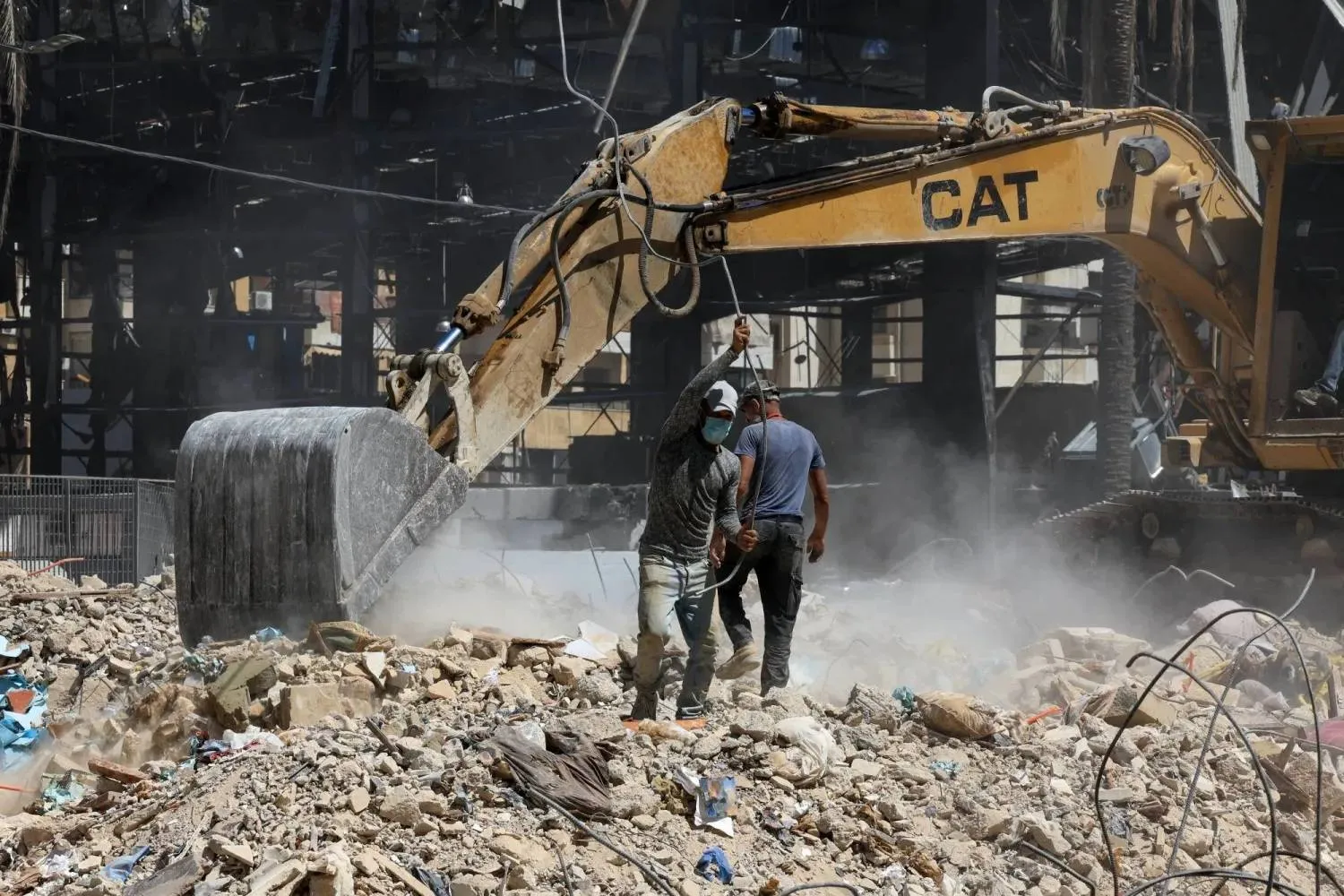
Workers clear rubble from buildings destroyed by Israeli strikes in Beirut’s southern suburbs (Reuters)
TT

War Wipes Out Third of Lebanon’s Private-Sector Jobs

Workers clear rubble from buildings destroyed by Israeli strikes in Beirut’s southern suburbs (Reuters)

An international survey has found sharp job losses, falling incomes and growing job insecurity in Lebanon, where the crisis and war have badly disrupted the labor market and underscored the need to put employment at the heart of recovery efforts.

The crisis and war are not only destroying buildings and infrastructure, but also jobs, incomes, and the fragile foundations of many people’s lives, said Dr. Ruba Jaradat, the International Labor Organization’s regional director for Arab States.

The field survey found that about one-third of private-sector workers had lost their jobs. Average labor income is estimated to have dropped by 40.4% when job losses and wage cuts are combined.

The ILO report, prepared in partnership with the General Labor Confederation and the National Federation of Workers’ and Employees’ Trade Unions in Lebanon, found that 33% of surveyed private-sector workers were no longer employed at the time of the survey. Of those, 28.2% had become unemployed and 4.7% had left the labor force.

The survey was carried out in May and covered 2,485 wage workers and self-employed workers in the private sector, across different activities, sectors and governorates. All had been working before the renewed armed conflict between Hezbollah and Israel in March.

Job losses were most severe in conflict-hit areas of southern Lebanon. They reached 76.5% among residents of Nabatieh governorate and 43.2% among residents of South governorate. But the damage was not confined to frontline areas, with workers elsewhere also hit by weak demand, lower business activity, inflationary pressure and wider market disruption.

Displacement

Displacement, which has affected more than one million people, was a key driver of job losses. The rate rose to an average of two-thirds among displaced workers. Among surveyed workers who were still displaced at the time of the survey, 37.4% said they were out of work, while 14.2% said they had been displaced during the conflict and later returned home.

The report said the crisis hit hardest those already facing deeper vulnerability. Job loss was especially high among persons with disabilities, at 71.4%; women, at 44.3%; young people aged 15 to 24, at 42.4%; Syrian refugees, at 39.4%; and wage workers in informal jobs, at 37.7%. Workers without written contracts, those with lower education levels and those employed by small enterprises were also more likely to lose their jobs.

Average labor income falls

The impact went beyond job losses. Average labor income fell 14.8% among workers who kept their jobs. Across all surveyed individuals, average labor income is estimated to have fallen 40.4% when the total loss of income among those who lost their jobs is included.

Workers who found new jobs often accepted worse terms. On average, they earned 30.7% less than before, with most moving into informal work or self-employment.

Households relied heavily on their own resources to cope. Savings were the most common coping tool, while more than 40% of Lebanese, Syrian and Palestinian workers said they had delayed paying loans or bills. Many also cut food spending, pointing to growing pressure on household welfare and food security.

Recovery needs remain large. About 45.5% of survey participants said help finding stable work was their main need, while 37.7% said they needed support to secure higher or more regular income.

The report called for a response that combines humanitarian measures and immediate labor market action with longer-term investment in job creation, social protection, skills development, enterprise recovery and decent work.

It urged labor-intensive recovery programs, targeted wage support, emergency assistance for women, persons with disabilities, self-employed workers and micro, small and medium-sized enterprises. It also called for wider social protection, legal support for migrant domestic workers and stronger labor market governance.

In the medium and long term, the report recommended stronger labor market data systems, activation of the National Employment Office, local economic development approaches, investment in skills and vocational training, support for a gradual shift to the formal economy, unemployment protection and a comprehensive national employment policy.

The ILO said it is working with the government, employers, workers and partners to support Lebanon’s labor market recovery.

Its work includes protecting workers, supporting income and employment, strengthening social protection, producing reliable and up-to-date data and analysis, helping enterprises retain workers, and ensuring the most vulnerable groups are not pushed further into informal work, poverty and exclusion.



Damascus, Paris Forge New Economic Partnership for Reconstruction

 Macron attends a meeting with al-al-Sharaa in Damascus (EPA)
Macron attends a meeting with al-al-Sharaa in Damascus (EPA)
TT

Damascus, Paris Forge New Economic Partnership for Reconstruction

 Macron attends a meeting with al-al-Sharaa in Damascus (EPA)
Macron attends a meeting with al-al-Sharaa in Damascus (EPA)

Syria is moving to reshape its investment landscape and turn the page on the legacy of war, driven by complex geopolitical shifts that have redrawn trade and energy routes across the Middle East.

At the forefront is the crisis caused by the closure of the Strait of Hormuz amid the conflict with Iran, a development that has renewed international focus on Syria’s geography as a “safe corridor and vital alternative” for global trade flows.

At the People’s Palace in Damascus, Syrian President Ahmed al-Sharaa and French President Emmanuel Macron laid the groundwork for what officials described as a “strategic shift” by launching a broad economic partnership for reconstruction.

The initiative took shape at a roundtable that brought together senior officials, investors, and leaders of French business during Macron’s first official visit since the end of the civil war in 2024.

The visit aims to move bilateral ties into a new phase based on mutual respect and equal partnership.

Despite security explosions caused by explosive devices that targeted the heart of Damascus and shook the city center near the hotel where the French president spent the night during the talks, the French delegation pressed ahead with activating the partnership.

The high-level French presence, which included major players in shipping, energy and industry, reflected a decisive French and European decision to move beyond security challenges and build an equal partnership based on mutual interests rather than slogans.

In his extended opening remarks, al-Sharaa welcomed leading French industrialists and business figures, saying there was a comprehensive road map for reconstruction and partnership.

He stressed Syria’s geopolitical advantage, saying: “Syria has a strategic location linking the Mediterranean to the Gulf and Iraq, and is only a few hours by sea from Marseille. After the Strait of Hormuz crisis, the world understood the value of safe and stable corridors.”

“Here lies the importance of Syrian geography, which has today regained its vital role as an indispensable hub in the global corridors market. We want France to be our first partner on this path.”

Al-Sharaa outlined the sectors covered by the investment map, saying: “We are talking about an integrated system, from renewing our air fleet, operating our airports and modernizing air navigation systems, to energy exploration in our territorial waters, upgrading electricity and water networks, and developing university hospitals, food industries, digital infrastructure and the civil registry.”

He added: “Syrian industrial cities are ready to serve as a launchpad for your factories. Supporting this is our reliance on Syria’s revival through a sovereign decision. We are building a modern investment environment governed by laws and institutions.”

He concluded by saying the strategic partnership was the model Damascus wanted with Europe and the world because it is “built on interests that serve the peoples of both countries, not on slogans.”

Logistics cooperation

Logistics and shipping emerged as strategic sectors, with the talks resulting in greater commercial influence for the French global shipping group CMA CGM.

Al-Sharaa cited the successful partnership with the group, saying it had signed a contract 14 months earlier to develop the port of Latakia with an investment of 230 million euros, and that within a year, it had decided to inject an additional 200 million euros to raise the port’s capacity.

In that context, CMA CGM Chief Executive Rodolphe Saadé stressed the importance of investment opportunities in Syria, saying: “Today we are reactivating the port of Latakia, and we expect important partnerships with Damascus in various fields.”

Syrian Economy and Industry Minister Nidal al-Sha’ar said Syria was looking for an active French presence in industry, transport, infrastructure, education and health in a way that would add value to both economies.

He said the country had “chosen to open a new page in its economic approach so that it becomes more competitive and more able to integrate into the global economy.”

Talal al-Hilali, head of the Syrian Investment Authority, echoed that view, describing the meeting as “a pivotal stop in Syria’s path toward building a modern economy and investment partnerships.”

Oil meetings

Energy also emerged as one of the most important areas of French engagement. TotalEnergies Chief Executive Patrick Pouyanné met Syrian officials to discuss signing a formal oil exploration contract.

The meetings build on a memorandum of understanding signed by the French company in May with Syria’s General Petroleum Corporation, granting TotalEnergies the right to explore a historically unexplored offshore block in the Mediterranean.

Pouyanné said his company had entered into an alliance with other companies to conduct preliminary studies and analyze technical data for the targeted block, with the aim of converting the memorandum of understanding into a formal contract binding on both parties.

In his assessment of the available technical opportunities, Pouyanné said TotalEnergies usually preferred to find crude oil, but added that the nature of historical discoveries in the eastern Mediterranean, as in Cyprus and Israel, showed that the stronger indicators pointed toward natural gas.

Pouyanné described Syria as strategically important because it is a key transit state at the “crossroads of the Middle East,” enabling the transport of Iraqi oil to the Mediterranean and bypassing the Strait of Hormuz.

He referred to Iraq’s April announcement that it had begun transporting its oil overland by truck through Syrian territory, as well as to talks between Damascus and Baghdad to establish mechanisms for energy transit and to rehabilitate the shared oil pipeline.

But his view was marked by cautious realism. He acknowledged that the current security situation did not allow for immediate fieldwork, saying his visit was aimed at building trust and establishing initial logistical contacts.

He urged investors to show some patience and give the government enough time to impose full control after a civil war that lasted more than 13 years and ended in 2024.

He called on the international community and investors to be patient, giving the Syrian government enough time to consolidate full control and stability.

For his part, the French president said Paris was ready to build trust and enter into partnerships in several fields, including energy, banking, and infrastructure.

He said the two sides had agreed to form joint, expanded economic committees to support efforts to rebuild Syria, adding that there would be a close partnership with Gulf countries within this framework.

Macron acknowledged that Damascus faced many challenges, but said there were also promising opportunities for partnership. He renewed his pledge that France would always stand by the Syrian people to help create a safe and stable investment environment.

As part of supporting financial measures, the Elysee Palace announced the start of formal procedures with Damascus to return 51 million euros, about $58.29 million, to the Syrian state. The funds had been seized from Rifaat al-Assad, the uncle of former President Bashar al-Assad.

The meetings were capped by strong political statements from the leaders of both countries outlining the features of a “new Syria.”

Addressing French business leaders, the Syrian president said the People’s Palace was opening its doors to anyone wishing to contribute to building the future. He stressed that the world had recognized the value of safe and stable trade corridors through Syria after the Strait of Hormuz crisis.


Saudi Banks Maintain Resilience, Credit Growth Offsets Interest Rate Pressures

A view of the King Abdullah Financial District in Riyadh. (Public Investment Fund)
TT

Saudi Banks Maintain Resilience, Credit Growth Offsets Interest Rate Pressures

A view of the King Abdullah Financial District in Riyadh. (Public Investment Fund)

The Saudi banking sector has once again demonstrated its robust financial fundamentals and high capacity to adapt to geopolitical challenges and global fluctuations, supported by strong momentum in financing and lending, alongside the continuation of Vision 2030 projects.

Conversely, banks have begun facing a new phase characterized by declining interest rates, intensifying competition for deposits, and rising operating costs - all of which exert growing pressure on margins and profitability.

However, experts believe that strong asset quality, improved liquidity, sustained credit growth, and the diversification of income streams will provide banks with a broader buffer to maintain their performance in the coming period.

The "Saudi Banks Pulse" report by Alvarez & Marsal showed a shift in financing and liquidity trends during the first quarter of 2026; customer deposits grew by 3.9 percent, surpassing the net financing growth of 1.6 percent, after several quarters where the pace of lending exceeded deposit growth.

This shift contributed to reducing the loan-to-deposit ratio to 104.1 percent, compared to 106.5 percent in the previous quarter, indicating an improvement in liquidity levels and a decrease in the financial pressures faced by banks as credit growth accelerated in recent periods.

In remarks to Asharq Al-Awsat, Hazim Almegren, Managing Director of Alvarez & Marsal in the Middle East, attributed the robustness of the institutional lending to "structural and investment-driven rather than cyclical" motivations.

He explained that the continued implementation of the Vision 2030 projects, along with the strength of the banking sector's fundamentals, have been two key factors in maintaining the momentum of financing demand.

He added that the slowdown in loan growth, which coincided with the escalation of geopolitical tensions at the end of the first quarter, is expected to be temporary, likely with state-backed investment continuing to play a pivotal role in stabilizing the demand for financing.

He expected the effects of these pressures to gradually recede during the third quarter unless the region witnesses new escalations.

Competition for low-cost deposits

Despite the improvement in liquidity levels, the report said that the strong growth in deposits was largely driven by an increase in term deposits, amid intensified competition among banks to attract funding sources.

Almegren expected that the next phase will see a greater focus on maintaining current account and savings account (CASA) deposits, as they are the most stable and least costly source of financing.

The ability of banks to protect these deposits will be one of the most prominent determinants of profitability over the next 12 to 24 months, along with maintaining asset quality and enhancing fee and commission income, thereby limiting the impact of declining interest margins, he told Asharq Al-Awsat.

Profitability formula and interest margin

In terms of consolidated gross profitability, the Alvarez & Marsal report showed that the sector's net profits grew by 1.2 percent on a quarterly basis, compared to growth of only 0.2 percent in the last quarter of last year.

This stability in profitability coincided with banks maintaining a strong rate of return on assets, which stabilized at 2.0 percent, while the rate of return on risk-weighted assets remained stable at 2.7 percent. This reflects the banks' efficiency in managing the risks of their financing portfolios despite the surrounding challenges.

Almegren said the Saudi banking sector has entered a new phase with the return of benchmark interest rates to normal levels, which has begun to gradually put pressure on the profit margins of a number of banks.

According to the report, six of the ten largest listed banks recorded a decline in net interest margins, but the sector as a whole maintained a stable net interest margin (NIM) of 2.84 percent, supported by a decrease in the cost of funding to 3.2 percent, which partially offset the decline in the return on credit to 7.8 percent.

Almegren predicted that credit growth supported by Vision 2030 projects will be the most prominent and influential driver of gross profits for the current year compared to margin expansion.

In order to protect investment returns in the second half of the year after the return on shareholders' equity declined slightly to 14.7 percent, the current banking strategy is moving towards improving the asset mix and focusing on sectors with attractive risk-adjusted returns, instead of chasing after maximizing the volume of abstract lending, in parallel with diversifying sources of profits and increasing non-interest income, he added.

A view of the King Abdullah Financial District. (Public Investment Fund)

High liquidity does not imply cash hoarding

While the sector's liquidity coverage ratio reached approximately 172 percent, and rose to 312 percent at the Saudi National Bank (SNB), Almegren ruled out that this indicates liquidity hoarding driven by caution over geopolitical developments.

He explained that these levels reflect a mix of strategic considerations related to balance sheet management, alongside bank-specific market conditions, rather than a general defensive stance within the sector.

Credit quality and the decline in the cost of risk

One of the most prominent highlights reflecting the sector's financial resilience in the first-quarter report is the qualitative leap in banking asset quality. The non-performing loan (NPL) ratio stabilized at a record low of 0.9 percent, reflecting the sustained quality of credit portfolios and a reduced need for new provisioning.

Perhaps the primary driver supporting net profits during this quarter was the sharp and record decline in the cost of risk, which dropped to just 0.15 percent from 0.40 percent in the previous quarter, driven by credit portfolio recoveries.

Despite this drop in direct credit costs, Saudi banks maintained their strict precautionary policies, boosting the non-performing loan coverage ratio to 162.6 percent. This provides solid and sustainable supplementary buffers to protect balance sheets against any unexpected fluctuations.

In a feature reflecting the financial markets' positive outlook toward the sector, the report revealed that Saudi banks' valuations remained attractive and compelling for investors at the end of the first quarter of 2026. The sector's shares traded at a price-to-earnings (P/E) ratio of 10.8 times.

This indicator reflects low investment risk and rapid returns by measuring the relationship between a stock's market price and the bank's annual earnings, meaning that an investor can recover the value of their investment in just about 11 years based on current profitability levels.

This attractiveness was further reinforced by shares trading at a price-to-tangible book value (P/TBV) ratio of 1.6 times. This metric compares the bank's market value to its real, physical assets on the ground after excluding intangible assets like goodwill. This close ratio shows that markets value the banks at a safe pricing level that grants investors a high "margin of safety." At the same time, it confirms the soundness of the financial positions and the robust capital value of Saudi banks in the face of fluctuations.

Emerging challenges and investments securing tomorrow’s profitability

Despite precautionary buffers and positive indicators, the Alvarez & Marsal report identified signs of operational challenges beginning to cast a shadow over performance. The combined operating income of the banks declined by 2.3 percent to reach 40.4 billion riyals, impacted by a sharp 13.2 percent drop in non-interest income. This pressured revenues and overshadowed the modest growth in net interest income.

The most prominent current pressures include escalating operating expenses, which pushed the cost-to-income ratio up to 30.1 percent. This coincided with intensifying competition among banks to attract liquidity through high-cost time deposits, as well as loan repricing challenges following the initial decline in benchmark interest rates - all of which was reflected in a decrease in the yield on credit to 7.8 percent.

Almegren placed these operational figures within their strategic framework. He explained that the notable rise in expenses is primarily driven by continuous and heavy capital expenditure by banks on technological infrastructure, digital transformation, and artificial intelligence applications.

This increase represents "long-term investments" rather than transient operational pressures, he explained. These investments are strongly expected to boost productivity, enhance operational efficiency, and sharpen the competitive edge of Saudi banks over the medium and long term, transforming today’s expenditures into key drivers for bank profitability in the coming years.

Indicators suggest that Saudi banks are entering a new phase where the impact of interest rates as a primary driver of earnings is receding. In its place, the roles of asset quality, operational efficiency, technology investments, and the diversification of income streams are growing increasingly vital in supporting profitability and sustainable growth.


Gold Slips as Stronger Dollar Weighs; Focus on Fed Minutes and Gulf Tensions

FILE PHOTO: Gold bangles are displayed inside a jewelry store in the old quarters of Delhi, India, May 11, 2026. REUTERS/Bhawika Chhabra//File Photo
TT

Gold Slips as Stronger Dollar Weighs; Focus on Fed Minutes and Gulf Tensions

FILE PHOTO: Gold bangles are displayed inside a jewelry store in the old quarters of Delhi, India, May 11, 2026. REUTERS/Bhawika Chhabra//File Photo

Gold slipped for a second consecutive session on Tuesday as a stronger US dollar weighed, while investors awaited Federal Reserve meeting minutes and monitored tensions in the Gulf.

Spot gold fell 0.8% to $4,129.36 per ounce at 0918 GMT. Prices rose more than 2% last week, ending a four-week losing streak ‌following a ‌weak US jobs report.

US gold futures ‌for ⁠August delivery eased ⁠0.6% to $4,140.90, Reuters said.

The dollar rose 0.1% against a basket of currencies, making dollar-denominated gold costlier for overseas buyers.

"Today's price action appears to be more of a consolidation than a significant reversal of last week's positive sentiment, with traders waiting for the release of the latest FOMC minutes on Wednesday before ⁠making more decisive moves," said ActivTrades analyst Ricardo ‌Evangelista.

Traders will focus on ‌the Fed's views regarding inflation, labor market conditions and any potential divergence ‌of opinion from within the body, added Evangelista.

Investors now ‌see about a 58% chance of a US rate increase in September, according to the CME FedWatch tool.

Geopolitical tensions remained in focus as Trump renewed threats of military action against Iran, while ‌Iran's foreign minister said negotiations on a final peace deal will not continue unless Washington ⁠abandons its ⁠threats.

Crude prices edged higher on traders' nervousness about a lack of progress on peace talks.

Higher energy prices fueled inflation concerns, bolstering expectations of higher-for-longer US interest rates and weighing on non-yielding gold.

Meanwhile, China's central bank maintained gold purchases for a 20th straight month, with its reserves hitting 75.44 million fine troy ounces at the end of June, up from 74.96 million a month earlier.

Hong Kong launched a central clearing system for gold on Tuesday and also revived dollar gold futures trading.

Spot silver slipped 1.9% to $60.93 per ounce, platinum eased 0.1% to $1,630.23, and palladium rose 0.2% to $1,270.63.