
Japan Secures Enough Crude Oil Supplies as US-Iran War Spirals

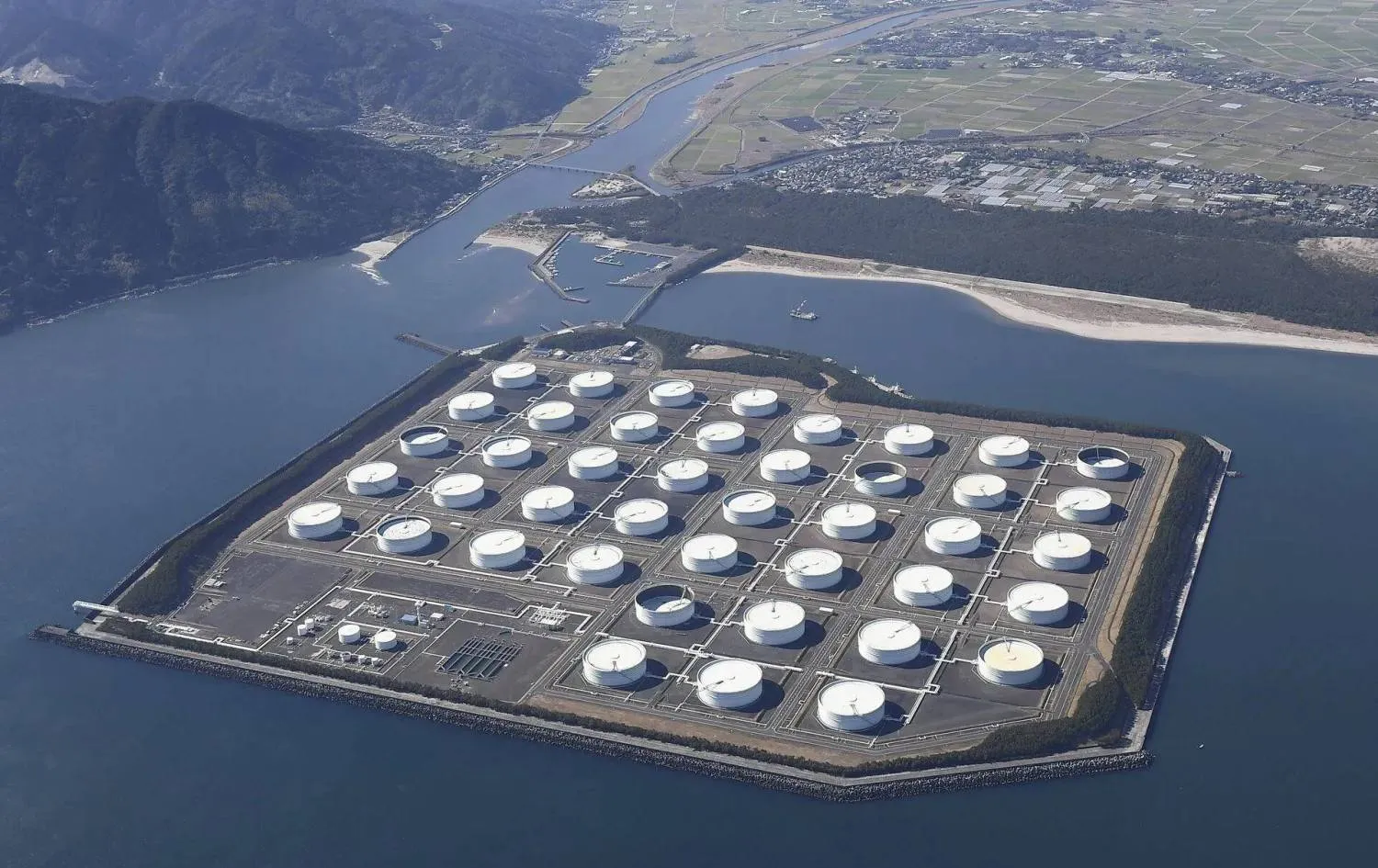
An aerial view shows Shibushi National Petroleum Stockpiling Base in Kagoshima prefecture, Japan January 18, 2019, in this photo taken by Kyodo. Mandatory credit Kyodo/via REUTERS
TT

Japan Secures Enough Crude Oil Supplies as US-Iran War Spirals

An aerial view shows Shibushi National Petroleum Stockpiling Base in Kagoshima prefecture, Japan January 18, 2019, in this photo taken by Kyodo. Mandatory credit Kyodo/via REUTERS

Japan’s Prime Minister Sanae Takaichi on Saturday reiterated that enough crude oil supplies have been secured in the country for the time being.

In response to a renewed deterioration in the situation in the Middle East, the prime minister said in a post on X that the necessary amount of crude oil for this month is expected to be procured and that the government will not release its oil stockpiles, according to The Japan Times.

She explained that procurement for next month is also on track, expressing her determination to continue efforts to secure the amount necessary for Japan as a whole.

A temporary truce between the US and Iran collapsed earlier this month after the two sides traded strikes, reflecting on global oil prices, which hovered around $100 a barrel Friday.

Earlier this month, Takaichi said Japan has secured stable oil supplies through the end of March 2028 despite the Iran war through a combination of alternative crude imports and stockpile releases.

Japan has no plans to release additional oil reserves this month, she told a cabinet meeting.

Crude Oil Stocks

Japan’s strategic crude oil stockpiles fell by the equivalent of four days of consumption in June, following drops of five days in May and 27 days in April.

As of July 3, combined reserves, including public, private and jointly held stocks with oil producing-countries, had recovered to the equivalent of 200 days of domestic consumption and ⁠are unlikely to ⁠decline significantly in July, Narumi Hosokawa, deputy director-general for immediate crisis management at the METI, told reporters.

Iran has begun talks with Japanese companies under a US sanctions waiver allowing it to resume oil sales, though prospective buyers are seeking a longer waiver and reassurances about ship safety, three Iranian and Western sources said.

Oil and Yen

The yen on Friday poised for its largest weekly percentage decline in more than two months as the currency languishes at 40-year lows despite Japan's pledges to buttress the currency.
Verbal efforts to support the yen have seen muted results.

The yen’s decline is driven by surging oil prices. Also, the yen is a low-yielding currency facing a terms-of-trade shock with higher oil prices.

Japan's Finance Minister Satsuki Katayama once again reiterated on Friday the government's readiness to take action in the foreign exchange market.

Some analysts see another intervention by Japanese officials as likely to have only a short-lived effect, similar to recent interventions in the currency, without coordinated steps such as a more aggressive path of rate hikes by the Bank of Japan (BOJ).

The US Treasury Department on Thursday joined calls for rate hikes by the BOJ, warning that excessive currency volatility was undesirable.

Markets have completely priced out any chance of a rate hike from the BOJ at its policy meeting next week, according ⁠to LSEG data.


Asian Shares Mostly Rise amid Market Optimism about AI, Despite Iran Worries

A financial data screen in the dealing room of Hana Bank shows the Korea Composite Stock Price Index (KOSPI) after South Korean shares closed higher in Seoul, South Korea, 23 September 2026. EPA/YONHAP SOUTH KOREA OUT
TT

Asian Shares Mostly Rise amid Market Optimism about AI, Despite Iran Worries

A financial data screen in the dealing room of Hana Bank shows the Korea Composite Stock Price Index (KOSPI) after South Korean shares closed higher in Seoul, South Korea, 23 September 2026. EPA/YONHAP SOUTH KOREA OUT

Asian shares mostly rose in early Thursday trading amid investor interest in technology-related issues, despite ongoing worries about the war in Iran.

Japan's benchmark Nikkei 225 jumped 2.4% in morning trading to 68,355.81. Australia's S&P/ASX 200 lost 1.7% to 8,638.10. South Korea's Kospi edged up 0.5% to 6,873.06. Hong Kong's Hang Seng added 0.4% to 24,613.27, while the Shanghai Composite gained 0.3% to 3,842.19.

In Tokyo trading, issues expected to get a boost from the solid demand in computer chips and AI-related growth have been rising in recent sessions, including Advantest Corp., Tokyo Electron and SoftBank Group Corp.

US stocks mostly fell Wednesday, despite indications that the US economy remains strong. On Wall Street, the S&P 500 slipped 0.3% to close out its third losing month in the last four. The Dow Jones Industrial Average dropped 443 points, or 0.9%, and the Nasdaq composite added 0.2%.

The report that said inflation wasn’t as bad across the United States last month as economists expected. It said the cost of living for US consumers was 3.4% higher overall in August than a year earlier. That was not as high as the 3.7% inflation rate that economists expected, even if it remained worse than the Fed’s 2% target.

In energy trading, benchmark US crude lost 0.56% to $89.91 a barrel. Brent crude, the international standard, fell 0.35% to $97.69 a barrel.

Oil prices have been swinging wildly in recent months amid uncertainty about when the war with Iran will allow the flow of crude to be fully restored. Iranian officials indicated Wednesday they have received an official US response to Tehran’s latest proposal to end the seven-month war. The officials did not say what the latest response contained and whether it was a rejection.

US President Donald Trump publicly rejected Iran's proposal just days earlier to reopen the Strait of Hormuz within a week if the US meets certain conditions.

The yield on the 10-year Treasury, which is the centerpiece of the bond market, rose to 5.29%, up from 5.26% late Tuesday, and it’s back to where it was more than two decades ago in 2002.

The 30-year Treasury yield, which takes into account expectations for inflation and economic growth many years down the line, climbed to 5.64% from 5.59% late Tuesday.

All told, the S&P 500 fell 19.30 points to 7,651.54. The Dow Jones Industrial Average dropped 443.87 to 50,906.05, and the Nasdaq composite added 63.52 to 26,861.06.

In currency trading, the US dollar rose to 158.17 Japanese yen from 157.33 yen. The euro cost $1.1328, down from $1.1334.


Gold Firms as Softer US Inflation Dims October Fed Hike Bets

UK gold bullion bars are stacked at Baird & Co in Hatton Garden in London, Britain, October 8, 2025. REUTERS/Hiba Kola/File Photo
TT

Gold Firms as Softer US Inflation Dims October Fed Hike Bets

UK gold bullion bars are stacked at Baird & Co in Hatton Garden in London, Britain, October 8, 2025. REUTERS/Hiba Kola/File Photo

Gold rose on Thursday after a softer-than-expected US inflation report tempered expectations for a Federal Reserve rate hike this month, with markets looking to upcoming jobs data for further policy signals.

Spot gold gained 0.8% to $4,187.43 per ounce by 0625 GMT, starting the month on a positive note after a more than 6% fall in September. US gold futures for December delivery firmed 0.7% to $4,217.50, Reuters reported.

Data on Wednesday showed US inflation rose ⁠less than expected in ⁠August, while price pressures were revised lower for the prior month.

The data reduced expectations of a rate hike in October, with markets pricing in a 36% chance, down from 45% before the release. Traders, however, still see an 89% probability of an increase in December.

Higher interest rates reduce the ⁠appeal of gold, which does not pay interest.

"Incoming data is going to be important... to see how the market deals with it and shapes rate-hike expectations," said Ilya Spivak, head of global macro at Tastylive.

"We are in a situation where the market is dealing with a lot of conflicting forces."

The crucial US nonfarm payrolls report for September is scheduled for release on Friday.

Limiting gains for gold, the US dollar drifted higher. A stronger greenback makes dollar-priced metals costlier for holders of ⁠other currencies.

All ⁠of gold's "September losses are unlikely to be recovered, but there are reasons to believe that the worst of the correction is over for now and that there is a case for higher prices," said Bart Melek, global head of commodity strategy at TD Securities.

On the geopolitical front, Iran said on Wednesday it had received a US response to its latest proposal to resurrect the collapsed ceasefire, days after US President Donald Trump said he had rejected it.

Spot silver rose 1.4% to $61.23, platinum climbed 1.2% to $1,727.18 and palladium gained 0.6% to $1,210.75.


Trump Says He Is Still Considering Diesel Export Ban

 A semi drives past a sign advertising the price of diesel along Interstate 5 in Williams, California, US, September 28, 2026. (Reuters)
A semi drives past a sign advertising the price of diesel along Interstate 5 in Williams, California, US, September 28, 2026. (Reuters)
TT

Trump Says He Is Still Considering Diesel Export Ban

 A semi drives past a sign advertising the price of diesel along Interstate 5 in Williams, California, US, September 28, 2026. (Reuters)
A semi drives past a sign advertising the price of diesel along Interstate 5 in Williams, California, US, September 28, 2026. (Reuters)

US President Donald Trump said on Wednesday that he has conversations about banning diesel exports "every day" as the White House races to curb soaring energy prices.

Speaking from the Oval Office, Trump said an export ban would "have a negative impact on gasoline" prices, but could lower diesel costs.

He said Russia's war in Ukraine, with strikes ‌from either side ‌impacting energy production and exports, is ‌the ⁠main cause of ⁠rising diesel prices.

He added: "We think we're in a very good place."

Gasoline prices have jumped more than 40% over the past year and diesel climbed to a record of $6.53 a gallon a week ago, according to AAA data. The price spike ⁠is largely driven by a combination of ‌a reduction in supply ‌due to the Iran war and interruptions to refining, in ‌part because of Ukraine's attacks on Russian energy ‌facilities.

The Trump administration and Republican candidates have been under pressure to bring down fuel costs as November's midterm elections approach and Trump's economic approval ratings remain under strain.

Energy Secretary ‌Chris Wright said the disruptions were more widespread.

"We've lost some diesel exports from the ⁠Middle ⁠East, although we're restoring those, and we've lost diesel exports from China," he said. "So that's a lot of interruptions."

He said the administration expected announcements soon from Europe about new diesel supplies.

The White House has urged the European Union to release emergency diesel stocks to help ease prices, Reuters reported.

The Trump administration has also weighed a blanket diesel export ban, voluntary export limits by refiners and allowing broader sales of tax-exempt diesel.