


Oil Prices Gain and Asian Shares are Mostly Lower as Investors Sell AI Stocks

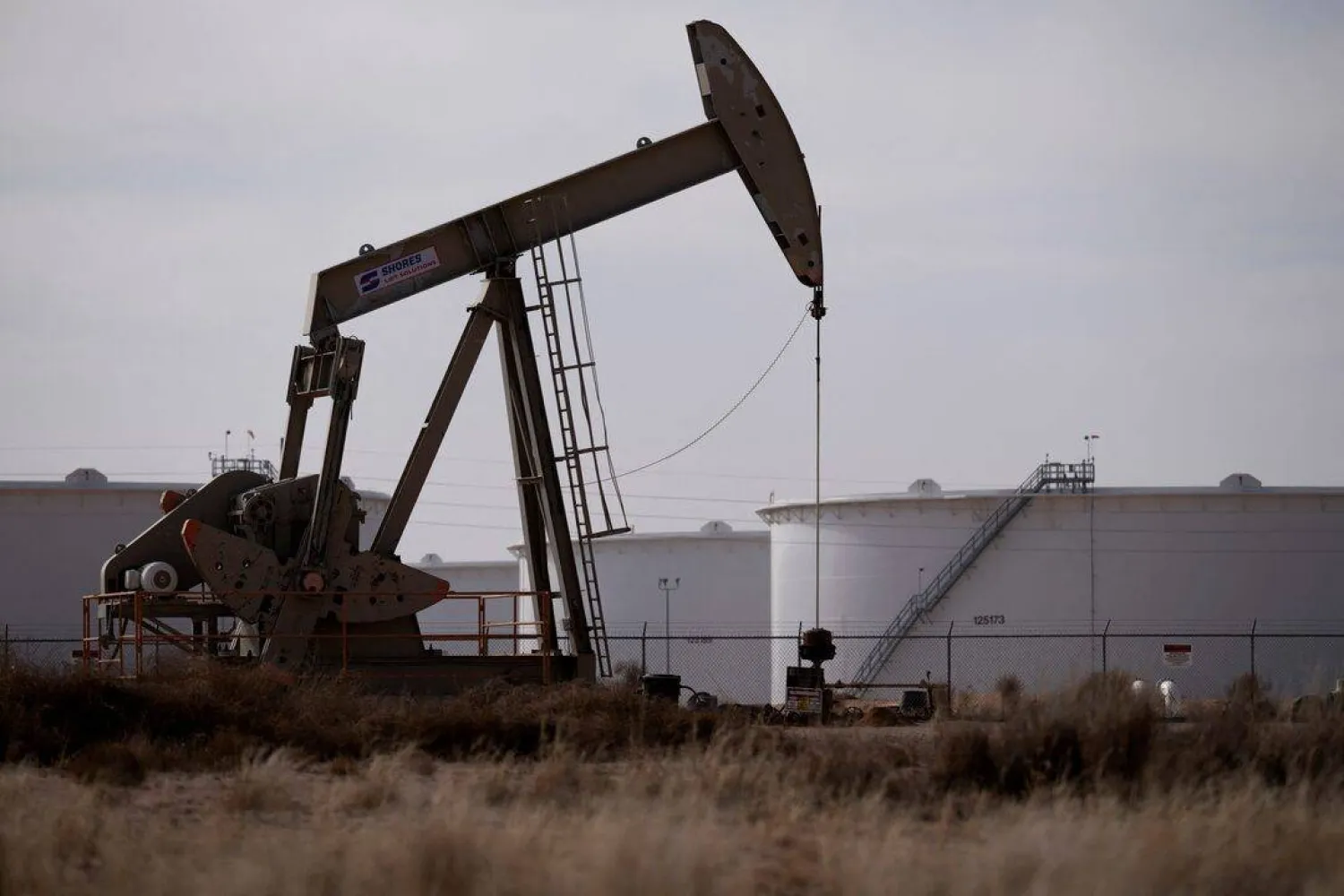
A rig operates in the Permian Basin oil field in Texas, USA (Reuters)
TT

Oil Prices Gain and Asian Shares are Mostly Lower as Investors Sell AI Stocks

A rig operates in the Permian Basin oil field in Texas, USA (Reuters)

Oil prices gained Wednesday and Asian shares were mostly trading lower as South Korea’s Kospi extended its losses after falling more than 16% over the past two days led by artificial intelligence-related stocks.

Crude prices remain volatile after the US said early Thursday it had conducted a “heavy wave” of strikes against Iran, responding to an attack on a US base, The Associated Press said.

US futures edged higher after losses on Wall Street.

In South Korea, recent drops in its benchmark Kospi, a big beneficiary of the global boom in AI, have been seen by some analysts as a reflection of broader doubts about massive investments by technology giants in expanding AI capacity.

The Kospi was swinging on Thursday and ended 1.2% lower at 5,593.56, after falling 10.8% on Tuesday and nearly 6% on Wednesday. The benchmark has fallen more than 38% from its all-time closing high of more than 9,100 in June, though it's still up nearly 30% so far this year.

Samsung Electronics fell 0.7%, even after the South Korean technology giant reported a record operating profit for the latest quarter, largely in line with estimates.

Chipmaker SK Hynix lost 5.6% after sinking more than 9% on Wednesday, when it also reported a record quarterly operating profit, which ballooned nearly sixfold. That was still lower than what analysts had expected, and disappointed investors dumped its shares.

In Tokyo, the Nikkei 225 gained 0.7% to 61,867.43, recovering some of its losses after falling 1.5% a day earlier. Open-AI investor SoftBank Group fell 2.5%. But computer chip equipment maker Tokyo Electron climbed 4.5%. Memory chipmaker Kioxia Holdings added 2.9%.

Taiwan’s Taiex, which was also lifted by the AI boom, closed 0.3% lower. Its leading chipmaker TSMC edged up 0.2%.

AI stocks including in South Korea, Taiwan and Japan have faced volatility over doubts about tech firms' massive spendings on AI infrastructure and if that can generate sustainable returns, said Chi Lo, senior market strategist of Asia-Pacific at BNP Paribas Asset Management, in a commentary Thursday.

The recent realization “of China’s AI as a serious competitor to the current AI market leaders has triggered (and) aggravated these concerns again,” he said.

Hong Kong’s Hang Seng edged up 0.2% to 25,857.11. The Shanghai Composite index lost 0.7% to 3,801.67.

In Australia, the S&P/ASX 200 slipped 0.8% to 8,967.70.

India’s Sensex was less than 0.1% higher.

Oil prices were higher after falling earlier Thursday as the US and Iran resumed exchanging attacks. US President Donald Trump said the US would hit Iran “very hard,” after it targeted a US base in Jordan. Maritime traffic in the Strait of Hormuz, a crucial waterway for oil transport, remains limited, putting pressure on global supplies.

Brent crude, the international standard, rose 0.6% to $88.60 per barrel. It was trading around $72 a barrel in late February, before the war began.

Benchmark US crude was 0.3% higher at $84.70 per barrel.

In the US on Wednesday, the benchmark S&P 500 dropped 1.5% to 7,316.15. The Dow Jones Industrial Average fell 2.2% to 51.594.14, and the technology-heavy Nasdaq composite lost 1.7% to 24,442.94.

Several chipmaking big names fell. Nvidia lost 3.6% and AMD, or Advanced Micro Devices, shed 5.5%. Broadcom declined 2.8%.

The US stocks traded lower also after the Federal Reserve decided to hold interest rates steady even as some members on the policymaking committee wanted to raise rates.

The Fed’s chairman, Kevin Warsh, reiterated his commitment to get inflation back to 2% following years of faster-than-hoped increases in prices, but he also stuck to his plan of giving financial markets fewer clues about what the Fed may do with interest rates in the near future.

With less guidance from the Fed, financial markets may be set for more volatile trading amid the uncertainty.

“Did the Fed take an explicit change in its policy rate today?” Warsh asked rhetorically in a news conference following the Fed’s decision. “No, but I think that’s the beginning of the story.”

In the bond market, the yield of the US 10-year Treasury was at 4.68%, up from 4.61% late Tuesday.

In other dealings early Thursday, the US dollar rose to 163.60 Japanese yen from 163.41 yen. The euro was trading at $1.1443, down from $1.1467.



World Bank Projects Lebanon Economy to Contract by 6.4% Due to War

People inspect a damaged building after an Israeli airstrike on the village of Ansar, southern Lebanon, 15 August 2026. (EPA)
TT

World Bank Projects Lebanon Economy to Contract by 6.4% Due to War

People inspect a damaged building after an Israeli airstrike on the village of Ansar, southern Lebanon, 15 August 2026. (EPA)

The World Bank on Friday projected that Lebanon's economy would contract by 6.4 percent this year, as the latest Israel-Hezbollah war derailed the country's efforts at recovery.

Lebanon has been dealing with an unprecedented financial crisis since 2019 and was still reeling from the 2024 Israel-Hezbollah war when the Iran-backed group drew it into the Middle East conflict by attacking Israel in March.

Israel responded with a heavy air campaign and ground invasion that Lebanese authorities say have killed more than 4,300 people.

Due to the war, "real GDP is projected to contract by 6.4 percent in 2026, reflecting the collapse in tourism, weaker consumption, disrupted supply chains, heightened insecurity, and prolonged displacement," the World Bank said in a report.

Inflation is also expected to rise to 17.5 percent this year, according to the report.

The World Bank said Lebanon's economy had strengthened before the latest conflict, with an estimated real GDP growth of 4.2 percent in 2025, "the fastest since the onset of the 2019 financial crisis".

"Advancing reforms -- particularly on banking sector restructuring and fiscal management -- will be critical to restoring confidence, protecting stability, and mobilizing the financing needed for reconstruction and recovery," Dahlia Khalifa, the World Bank's Middle East director, said.

The international community has been demanding that Lebanese authorities enact financial reforms in order to secure much-needed economic aid.

Last week, parliament passed amendments to a bank resolution law aimed at restructuring troubled banks and addressing the country's banking crisis.

The International Monetary Fund welcomed the law, describing it as "a very good step that reflects Lebanon's commitment to aligning its legislation with the best international practices".

Lebanon has been in discussions with the IMF, which said it would resume its meetings in Beirut next month.


Tunisia Olive Oil Exports Surge 55%, Bringing in $1.6 billion

Tunisian olive oil producer, Mustapha Mtiraoui, displays olives to be pressed at his oil mill in Kairouan, Tunisia February 24, 2024. REUTERS/Jihed Abidellaoui
TT

Tunisia Olive Oil Exports Surge 55%, Bringing in $1.6 billion

Tunisian olive oil producer, Mustapha Mtiraoui, displays olives to be pressed at his oil mill in Kairouan, Tunisia February 24, 2024. REUTERS/Jihed Abidellaoui

Tunisia's olive oil exports surged 55.3% to a record 368,000 metric tons in the first nine months of the 2025/26 season, bringing in $1.6 billion in export revenue, up 44.4% from a year earlier, official data showed on Friday.

The surge in olive oil shipments, a vital source of foreign currency and Tunisia's top agricultural export, will provide a much-needed boost to the country's finances as the government grapples with persistent economic and fiscal pressure.

The jump in exports was driven by strong global demand during the first nine months of the season, which began in November.

Extra virgin olive oil accounted for 83.6% of total shipments, the National Observatory of Agriculture said, Reuters reported.

The European Union remained the biggest destination, taking 57.1% of Tunisian olive oil exports, while North America accounted for 24%. More than 70 countries imported Tunisian oil during the period.

Exports to other markets included Saudi Arabia, which took 4.6%, Jordan with 3.1% and African markets at 3.8%, with Egypt accounting for 3.3%.

Bottled olive oil exports rose 50.8% to 51,500 tons, but bulk oil still accounted for the vast majority of shipments, underscoring Tunisia's challenge in capturing more value from one of its most important export products.


South African Rand Hits Strongest Level since Start of Iran War

South African Rand coins are seen in this illustration picture taken October 28, 2020. REUTERS/Mike Hutchings/Illustration
TT

South African Rand Hits Strongest Level since Start of Iran War

South African Rand coins are seen in this illustration picture taken October 28, 2020. REUTERS/Mike Hutchings/Illustration

The South African rand strengthened on Friday to its strongest level since the United States and Israel launched attacks on Iran on February 28, as rising gold prices and a weaker dollar boosted the commodity-linked currency.

At 1229 GMT, the rand traded at 15.9925 against the dollar , about 0.8% stronger from its previous close.

Gold, one of South Africa's main exports, rose to a more than three-month high on Friday and was on track for a third straight weekly gain.

The precious metal was supported by a weaker dollar and the US Treasury's announcement that it would increase buybacks of longer-dated securities, Reuters reported.

US Treasury Secretary Scott Bessent said he may further increase the government's repurchases of Treasuries. That came after the Treasury said it would double the size of buybacks on longer-dated securities over the next quarter.

The US dollar was set to end a bumpy week lower, making greenback-priced bullion more affordable for buyers overseas.

Like other emerging market currencies, the rand has been at the mercy of global market sentiment, particularly since the start of the Iran war.

On the Johannesburg Stock Exchange, the Top-40 index was last up 2.2%.

South Africa's benchmark 2035 government bond was also firmer in early deals, as the yield fell 0.5 basis points to 8.56%.