


US Eyes European Gas Dominance through Balkans

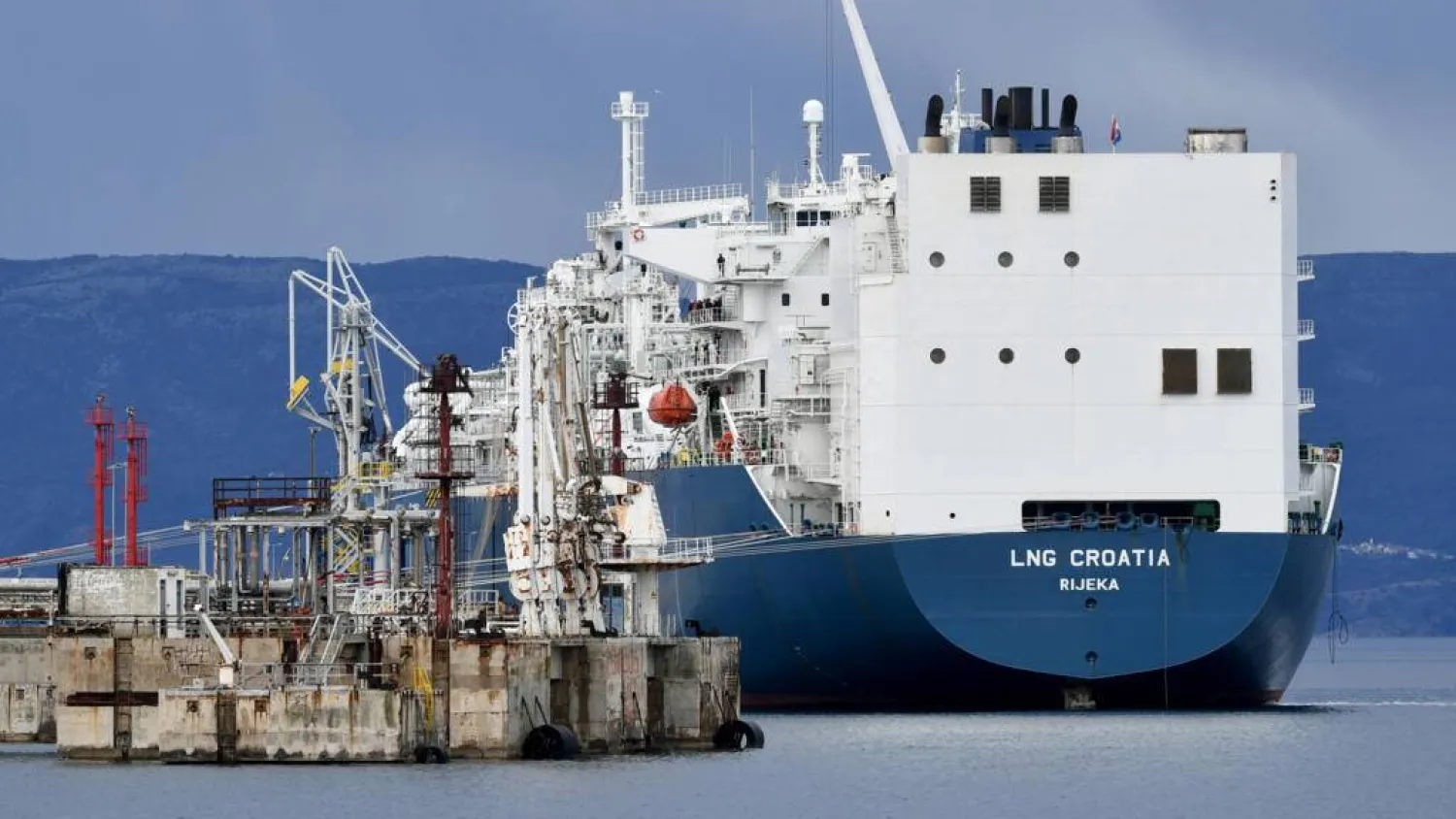
The new floating terminal for liquefied gas boosts Croatia's import capacity. DENIS LOVROVIC / AFP/File
TT

US Eyes European Gas Dominance through Balkans

The new floating terminal for liquefied gas boosts Croatia's import capacity. DENIS LOVROVIC / AFP/File

As Europe weans itself off Russian energy, Washington is fast emerging as its largest gas supplier, with experts suggesting Croatia's Adriatic gas terminal offers a pathway deeper into the continent.

Since Russia invaded Ukraine in 2022, gas supplies flowing from the east have become increasingly weaponized -- accelerating Brussels' plans to reduce its reliance on Moscow, said AFP.

Russia still supplies around 12 percent of the bloc's gas imports, according to the European Council, but by the end of 2027 it will ban them completely.

To meet this deadline, the European Union has spent billions of euros on infrastructure to be able to handle the needed volumes of liquefied natural gas (LNG), which will make the bloc the largest importer in the world.

- Balkan push -

One of the key sites is Croatia's floating LNG terminal off the island of Krk, which following a recent upgrade is now capable of handling around two percent of the EU's annual gas consumption at nearly 6.1 billion cubic meters.

Connecting pipelines link it to Hungary, allowing US gas to flow into central Europe.

But energy analyst Ivan Brodic said its future could be much bigger, as the terminal's largest supplier -- the United States -- looks to push Russia out of the market completely.

Already the EU's largest source of LNG, the US is forecasted to overtake Norway as bloc's largest natural gas supplier in 2026, according to the Institute for Energy Economics and Financial Analysis (IEEFA).

"Americans do not want Russian capital in the energy sector in this region anymore," Brodic told AFP.

"That is why they are pushing for the gas interconnection between Bosnia and Croatia."

The US-backed pipeline between the Balkan nations plans to link Bosnia to Krk, and loop it into Europe's gas network.

Some analysis suggests it could even offer the cheapest gas for a post-war Ukraine.

- 'Peace pipelines' -

Earlier this year, US Energy Secretary Chris Wright used a summit to promote the Trump Peace Pipelines Framework -- a plan to expand energy infrastructure across central and eastern Europe.

The US plan could turn Croatia into a major transit point for fuel imports, including oil, beyond the Balkans into other parts of Europe.

Alongside its LNG facility, Croatia also boasts oil pipelines connecting it to Bosnia, Hungary, Slovenia and Serbia -- capable of pumping nearly half a million barrels of crude per day.

"Energy dependence on Russia remains a strategic vulnerability in the region," said a State Department report submitted to Congress in May.

"Diversifying energy supplies, including with abundant US sources, enhances regional stability and prosperity."

- A Ukraine supply route -

For the EU and Croatia, the Krk terminal has already proven its value as its supply fully booked until 2036, according to LNG Croatia managing director Ivan Fugas.

"It was not only important for Croatia, but definitely also for the EU as it got an additional natural gas entry point," Fugas said.

The terminal, operating since 2021, was strongly supported by the US while Brussels funded nearly half of its more than 230 million euros cost.

The terminal's success has also been noticed in Kyiv.

Ukraine's underground storage operator, Ukrtransgaz, presented earlier this year an analysis showing that Croatia's LNG terminal could provide the cheapest route to supply the country.

Boasting one of Europe's largest underground gas storage networks, much of it dating back to the Soviet era, Ukraine could also solve a key problem of storing the large amounts of imported gas that could then also be sent elsewhere in Europe.

Ukrainian President Volodymyr Zelenskyy and Croatian Prime Minister Andrej Plenkovic met earlier this year to discuss energy supply and storage, but there have been no official announcements.

With major investments, it could become a shorter and cheaper route to Ukraine than existing options via Greece or Poland.

"But that does not mean anything if Croatia does not have the capacity," Fugas said, flagging the necessary pipeline upgrade for any new demand.



Oil Falls but on Track for 8% Weekly Gain on Supply Concerns; US Diesel Hits Record High

WHITING, INDIANA - SEPTEMBER 08: An aerial view shows the sprawling BP refinery on September 08, 2026 in Whiting, Indiana. (Photo by SCOTT OLSON / GETTY IMAGES NORTH AMERICA / Getty Images via AFP)
TT

Oil Falls but on Track for 8% Weekly Gain on Supply Concerns; US Diesel Hits Record High

WHITING, INDIANA - SEPTEMBER 08: An aerial view shows the sprawling BP refinery on September 08, 2026 in Whiting, Indiana. (Photo by SCOTT OLSON / GETTY IMAGES NORTH AMERICA / Getty Images via AFP)

Oil prices fell on Friday but remained on course for a weekly gain of more than 8% while US diesel prices hit a record high as attacks along Middle East shipping routes stoked concerns about prolonged supply disruptions.

Brent crude futures were down $3.45, or 3.21%, to $104.18 a barrel at 1132 GMT.

US West Texas Intermediate crude fell $2.96, or 2.89%, to $99.52 a barrel. Both benchmarks hit their highest levels since mid-May earlier in the session.

The benchmarks reversed early gains after the Financial Times reported that foreign ministers in the Middle East are trying to work out a temporary deal with Iran to manage shipping through the Strait of Hormuz.

Brent and WTI rose more than 6% on Thursday after an escalation in shipping attacks in the region.

"Some headlines of possible new talks in the Middle East are weighing moderately on oil prices today," said UBS energy analyst Giovanni Staunovo. "I keep seeing near-term risks to the upside for oil prices, but we should expect ongoing high price volatility too."

In a further potentially significant development for Riyadh, satellite imagery showed smoke on Thursday in the vicinity of Saudi Arabia's East-West Pipeline, which has become a vital means for the kingdom to divert its crude exports away from Hormuz.

Saudi Arabia's crude supply fell by 2.3 million barrels per day on the month to 6 million bpd in August, the lowest level in more than three decades, the International Energy Agency said on Friday, citing attacks on Saudi energy facilities.

Adding to concerns over regional oil flows, Yemen's Iran-aligned Houthis on Friday reached the island of Perim in the Bab el-Mandeb Strait, four Yemeni government sources told Reuters, potentially tightening their grip on one of the world's vital shipping routes.

Iran said it had attacked 10 ships near the Strait of Hormuz on Wednesday, after the US hit five Iranian oil tankers. Iran's Islamic Revolutionary Guard Corps said it would escalate its response to any further attacks.

Vessel transits at the Strait of Hormuz fell to seven on Thursday from 11 the previous day, preliminary ship-tracking data showed on Friday.

The strait handled about 125 commodity vessels and one-fifth of global daily oil and liquefied natural gas supplies before the Iran war began in late February.

Meanwhile, two European Central Bank policymakers opened the door on Friday to further interest rate increases if a war-fuelled rise in energy prices continues and pushes up other prices in the euro zone.

SUPPLY DISRUPTIONS LIFT FUEL PRICES

Oil supply disruptions due to the Iran war, along with Ukrainian attacks on Russia's refineries, pushed the US national average diesel price past $6 a gallon for the first time on Thursday, according to price tracker GasBuddy.

"Refined products, particularly diesel, are feeling a one-two punch right now," said Tim Waterer, chief market analyst at KCM Trade.

"As long as both the Gulf shipping constraints and Russian refining outages remain in play, diesel and other refined products are likely to show a higher upside tendency than the broader crude market," he added.

Commerzbank raised its year-end Brent crude forecast to $85 a barrel from $75, while increasing its diesel forecast to $1,200 a ton from $950 and its jet fuel forecast to $1,230 a ton from $980.


Gold Gains on Softer Oil; US Inflation Data in Focus

A view of smelted gold bars at a smelting facility in Accra, Ghana, August 22, 2024. REUTERS/Francis Kokoroko/
TT

Gold Gains on Softer Oil; US Inflation Data in Focus

A view of smelted gold bars at a smelting facility in Accra, Ghana, August 22, 2024. REUTERS/Francis Kokoroko/

Gold prices rose on Friday, but were headed for a weekly loss, as oil slipped from multi-month highs and assuaged some inflationary concerns, as investors awaited key US economic data for clues on the Federal Reserve's monetary policy path.

Spot gold rose 0.6% to $4,339.46 per ounce by 1105 GMT. It was down nearly 3% for the week so far.

Prices fell on Thursday after the US Producer Price Index data showed prices increased in line with expectations in August amid a rebound in the cost of energy products.

US gold futures dropped 0.6% to $4,381.30.

The precious metal is benefiting from "softer oil prices on hopes a Monday meeting between GCC ministers and Iran can yield some results regarding the passage of oil through the Strait," said Ole Hansen, head of commodity strategy at Saxo Bank. "In addition, buyers once again emerged ahead of a key support area around $4,300," said Hansen.

Oil prices were set to end the week above $100 a barrel.

Higher oil prices stoke inflation fears and bolster expectations of the Fed raising interest rates. While gold is typically seen as an inflation hedge, higher interest rates diminish the appeal of non-yielding bullion.

Traders are now pricing in a 67% chance of a rate hike at the central bank's policy meeting next week, up from 62% before the data, according to the CME FedWatch Tool. The US consumer price inflation report is due at 1230 GMT.

Elsewhere, gold demand in India was subdued this week as volatile prices discouraged buyers, while investment demand remained strong in top consumer China.

Among other metals, spot silver rose 0.4% to $63.80 per ounce, but was down 3% for the week.

Platinum climbed 0.9% to $1,792.07 and palladium gained 2.4% to $1,312.90. However, both metals were on track for a weekly loss.


France Lowers Growth Forecast, Will Miss Deficit Target

French Minister for Economy, Finance, and Industrial, Energy and Digital Sovereignty Roland Lescure gestures as he speaks during a press conference to update the governments growth and fiscal deficit forecasts for the 2027 budget, at the Bercy Economy and Finance Ministry in Paris, France, September 11, 2026. REUTERS/Stephanie Lecocq
TT

France Lowers Growth Forecast, Will Miss Deficit Target

French Minister for Economy, Finance, and Industrial, Energy and Digital Sovereignty Roland Lescure gestures as he speaks during a press conference to update the governments growth and fiscal deficit forecasts for the 2027 budget, at the Bercy Economy and Finance Ministry in Paris, France, September 11, 2026. REUTERS/Stephanie Lecocq

France's economy will grow less than expected this year and the government will miss its budget deficit target, Finance Minister Roland Lescure said on Friday.

The downgraded outlook complicates the government's task of getting its 2027 budget passed in the coming months in a deeply divided parliament, where parties have hardened their positions before an April-May two-round presidential election.

Lescure told journalists he was lowering the government's 2026 economic growth forecast to 0.5% from 0.7% previously, but stuck with a ⁠projection of 1.0% ⁠for next year.

"This year has been marked by extreme crises involving four different types of shocks," Lescure told reporters, according to Reuters.

Slower growth will make it more difficult for the government to trim its fiscal budget deficit as planned to 5.0% of economic output this year.

"The ⁠reality is that the budget was built on a 5% assumption. And the reality is that, today, 5% is no longer an option," Lescure said.

The minister did not give a new deficit target.

The economic fallout from the war in the Middle East and summer heatwaves and drought that hit agriculture output have dragged down growth and put the government's fiscal targets out of reach.

"I think it is reasonable to say that economic ⁠uncertainty has ⁠never been greater than it is today," Lescure said. "We are operating under tight budgetary constraints; there is no more fat to trim."

Further complicating the picture, French borrowing rates have surged in recent weeks as investors have identified France as one of the weaker links in a global bond selloff due to its weak public finances and serial slippage on its deficit-reduction plans.

Lescure stressed that France had no difficulties in issuing debt, but acknowledged that it now cost more.
