Saudi Arabia Targets 18 Water Products in Supply Security, Export Push

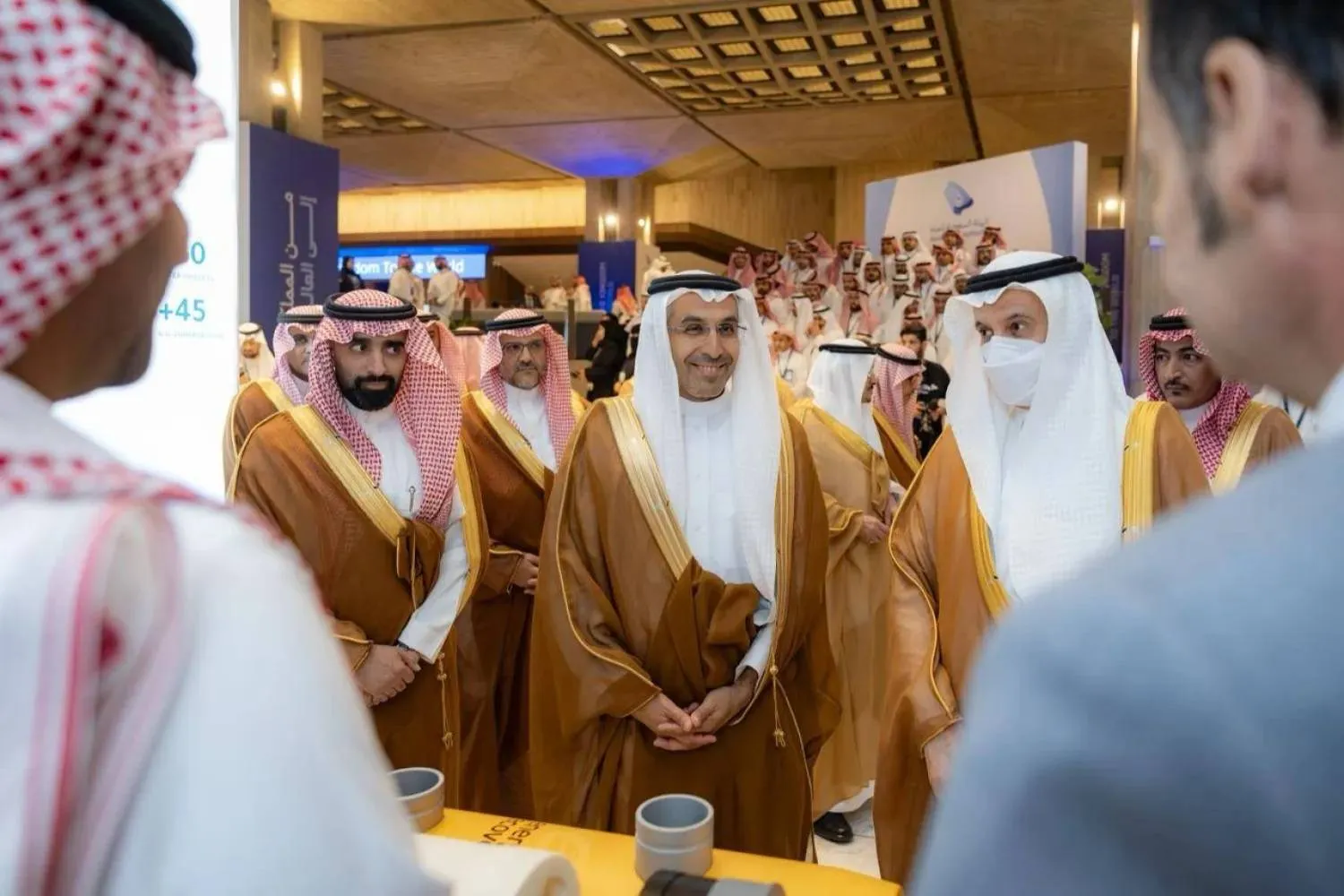
Saudi Water Authority President Abdullah Al-Abdulkarim, left, accompanies Environment, Water and Agriculture Minister Abdulrahman Al-Fadley on a tour of the event’s facilities. (Asharq Al-Awsat)
TT

Saudi Arabia Targets 18 Water Products in Supply Security, Export Push

Saudi Water Authority President Abdullah Al-Abdulkarim, left, accompanies Environment, Water and Agriculture Minister Abdulrahman Al-Fadley on a tour of the event’s facilities. (Asharq Al-Awsat)

Saudi Arabia is moving to localize 18 strategic water-sector products in a drive to secure critical supplies, cut reliance on foreign supply chains and build an export-ready industry.

Drawing on decades of operational expertise, the kingdom aims to become a regional hub for developing, manufacturing and exporting water technologies.

Supply security was central to selecting the 18 products, Saudi Water Authority President Abdullah Al-Abdulkarim told Asharq Al-Awsat, saying geopolitical tensions and global shifts had increased the need for stable supply chains and reliable, sustainable services.

Speaking at a news conference in Riyadh on Wednesday on the sidelines of the “Localizing the Water Industry: Knowledge Transfer and Capacity Building” ceremony, Al-Abdulkarim said the authority had worked with relevant government bodies since early 2024 to identify the products.

They include key components used across Saudi Arabia’s water production, transmission and distribution system. The initiative is part of a broader effort to unlock the economic and knowledge-based value the sector has built over decades, he said.

$4 billion domestic market

Saudi Arabia’s market for the 18 products is expected to reach about 15 billion riyals ($4 billion) by 2033, Al-Abdulkarim said. Across the Middle East and North Africa, the market is estimated at around 65 billion riyals ($17.3 billion).

The opportunity could boost the water sector’s contribution to the kingdom’s trade balance, attract new industrial investment and increase local content.

Saudi Arabia was once one of the world’s largest water consumers. Today, it has become an experienced operator with advanced technical expertise built through managing one of the most complex water systems in the world, Al-Abdulkarim said.

That expertise is no longer limited to running the system. It is now helping drive the development of equipment and technology.

The sector is developing advanced tools and indicators to track equipment performance and improve efficiency. Each machine is monitored against as many as 17 indicators daily, allowing operators to identify improvements early and raise operational efficiency.

The 18 products are also closely tied to other industrial and service sectors through their inputs and requirements. Localizing them could therefore support national economic growth and deepen domestic value chains, Al-Abdulkarim said.

Developing the next generation

“Saudi Arabia was the largest water consumer and has now become an expert operator. It then became a source of expertise for manufacturers of the system’s various components, bringing us to a new stage in which we become a partner in developing the next generation of technologies,” Al-Abdulkarim said.

The kingdom is now entering a new phase of supply-chain localization, targeting a 90% domestic supply reliability rate for key components.

The goal is to strengthen the sector’s ability to withstand geopolitical and global disruptions while making the national water system more resilient and sustainable.

The integrated approach could transform Saudi Arabia from a consumer of water technology into a regional platform for its development, manufacture and export, expanding the sector’s economic impact and strengthening the kingdom’s presence in regional and global markets.

Localization is not solely about meeting the sector’s current needs, Al-Abdulkarim said. It is also intended to build an industrial and knowledge base capable of innovation, product development and exports.

That would position the water sector as a driver of economic growth, income diversification and Saudi competitiveness in water technology.

Seven factories planned

Marking the shift from identifying opportunities to delivering projects, the Saudi Water Authority announced that six investment opportunities had entered the industrial implementation phase, including five new opportunities.

The announcement came during a ceremony attended by ministers, senior government officials, ambassadors and chief executives.

Three industrial localization agreements were signed and two factories inaugurated. The agreements provide for seven factories, with total investment across the six opportunities reaching 2.8 billion riyals ($746.6 million).

The projects move the localization program from presenting opportunities to building domestic industrial and technical capacity.

The initiative is being carried out with the Local Content and Government Procurement Authority, which oversees the contracting mechanism for industrial localization and knowledge transfer, and with support from the industry and mineral resources and investment sectors.

It seeks to turn the water sector’s purchasing power into a manufacturing and investment engine by matching project requirements and future demand with domestic production opportunities.

This gives investors and international manufacturers greater visibility over the scale of demand, encouraging them to transfer knowledge and technology and establish production in Saudi Arabia.

The kingdom already has at least 70% of the production inputs required for the targeted components.

Its water-sector supplier base has expanded from 739 companies in 2022 to 3,441 in 2026. Local content rose from 45% in 2020 to 68.27% in the first half of this year.

Those gains strengthen Saudi Arabia’s position as an industrial base capable of rapid growth and regional and international expansion.

Specialized jobs

Localization will go beyond transferring production lines. It will include research and development, technology and knowledge transfer, and the skills needed to operate these industries and improve their products.

The agreements require Saudi nationals to account for at least 70% of workers in specialized positions, linking industrial investment directly to the development of national engineering and technical talent.

Products being localized through the contracting mechanism for industrial localization and knowledge transfer include reverse-osmosis membranes, antiscalants and membrane-cleaning chemicals.

The Saudi Water Authority has also worked to meet its localization targets for energy-recovery devices, high-pressure pumps, distributed control systems and supervisory control and data acquisition systems, known as SCADA.

Together, they will form an interconnected industrial and technological chain supporting water production and facility operations.

Several of the components can also be used in energy, mining, agriculture and food processing, extending the impact of localization across multiple value chains.

Global manufacturers

The projects underscore Saudi Arabia’s growing place on the global water-technology manufacturing map and the reach of its strategic partnerships.

They include four Italmatch Chemicals factories across Wa’ad Al-Shamal, Jubail and Jeddah. The Wa’ad Al-Shamal facilities will form the company’s largest industrial complex outside Italy. All four factories are scheduled to begin production in 2028.

The projects also include Torishima’s high-pressure pump factory in Jeddah and Energy Recovery’s energy-recovery device factory in Dammam — the company’s only manufacturing facility outside the United States.

Alfanar will operate a distributed control systems factory in Riyadh, bringing the total number of factories linked to the opportunities now under implementation to seven.

From the first quarter of 2027, Energy Recovery’s Saudi factory is expected to supply about one-third of the company’s customers worldwide.

Spread across several regions of the kingdom, the projects are expected to strengthen value-chain integration and increase the export potential of Saudi-made products.


OPEC, Non-OPEC Ministers Stress Critical Importance of Safeguarding Int’l Maritime Routes

Saudi Minister of Energy and Minister of Industry and Mineral Resources Prince Abdulaziz bin Salman bin Abdulaziz (L) at the Riyadh meeting on Monday. (SPA)
TT

OPEC, Non-OPEC Ministers Stress Critical Importance of Safeguarding Int’l Maritime Routes

Saudi Minister of Energy and Minister of Industry and Mineral Resources Prince Abdulaziz bin Salman bin Abdulaziz (L) at the Riyadh meeting on Monday. (SPA)

Ministers of OPEC and non-OPEC Participating Countries in the Declaration of Cooperation (DoC) met on the sidelines of the 17th IEF ministerial meeting and the 25th WPC Energy Congress in Riyadh on Monday.

The ministers reviewed market conditions and agreed to continue consultation with all OPEC+ countries, through already established mechanisms, including the Joint Ministerial Monitoring Committee (JMMC) and the OPEC and Non-OPEC Ministerial Meetings (ONOMM).

They reaffirmed their commitment to the decisions made on June 7, 2026 (41stONOMM) to achieve and sustain a stable oil market.

The ministers stressed the critical importance of safeguarding the international maritime routes to ensure the uninterrupted flow of energy.

They noted that the current interruption of energy flows has elevated the cost of shipping and insurance, which have reached unprecedented levels of more than one third of the commodity value, impeding the timely and efficient movement of crude oil and products, and placing additional inflationary pressures on the global economy.

These exceptionally elevated costs are ultimately transmitted across the oil value chain, increasing and prolonging the cost burden on producing and consuming countries and impacting global economic growth, they remarked.

The ministers will continue monitoring the situation and will engage with governments, industry stakeholders, and international organizations such as the IEF, IEA, and others to improve global shipping conditions.


Saudi Energy Minister Signs MoUs on Energy Cooperation with Mongolia, Tanzania, Cyprus, and Mauritius

Saudi Minister of Energy and Minister of Industry and Mineral Resources Prince Abdulaziz bin Salman bin Abdulaziz and Cyprus’s Minister of Energy, Commerce and Industry Michael Damianos during the signing ceremony in Riyadh on Monday. (SPA)
TT

Saudi Energy Minister Signs MoUs on Energy Cooperation with Mongolia, Tanzania, Cyprus, and Mauritius

Saudi Minister of Energy and Minister of Industry and Mineral Resources Prince Abdulaziz bin Salman bin Abdulaziz and Cyprus’s Minister of Energy, Commerce and Industry Michael Damianos during the signing ceremony in Riyadh on Monday. (SPA)

Saudi Minister of Energy and Minister of Industry and Mineral Resources Prince Abdulaziz bin Salman bin Abdulaziz signed in Riyadh on Monday four memoranda of understanding with ministers from Mongolia, Tanzania, Cyprus and Mauritius to strengthen cooperation across a range of energy fields.

The MoUs were signed on the sidelines of the 25th WPC Energy Congress, hosted by Saudi Arabia through October 15 under the theme “Pathways to an Energy Future for All."

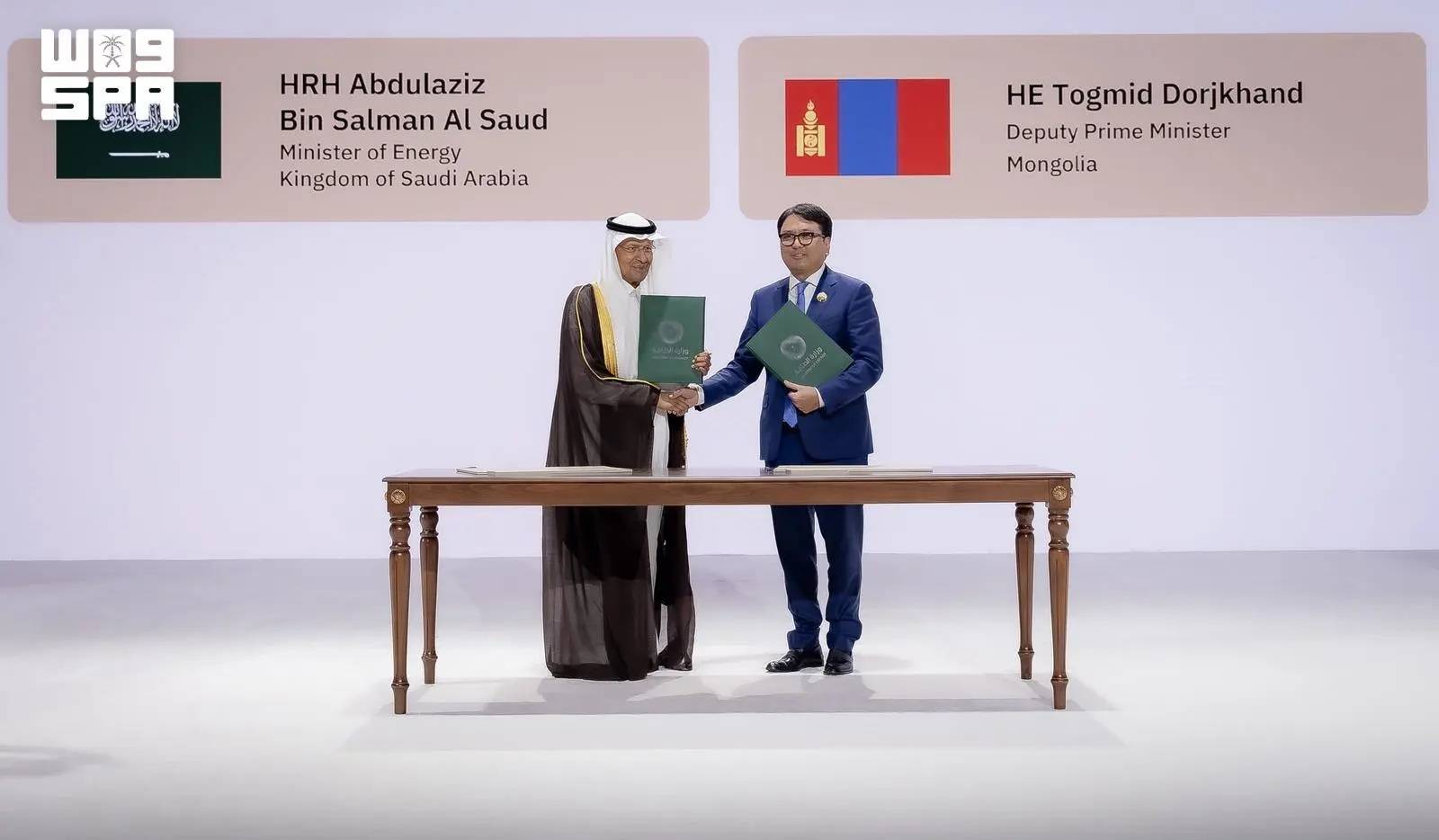
Prince Abdulaziz and Mongolia’s Deputy Prime Minister Togmid Dorjkhand signed an MoU to strengthen cooperation between the two countries in oil and gas and their derivatives, refining, petrochemicals, electricity, power interconnection, renewable energy, energy efficiency, energy storage, and technologies and solutions related to climate change mitigation, including Circular Carbon Economy solutions.

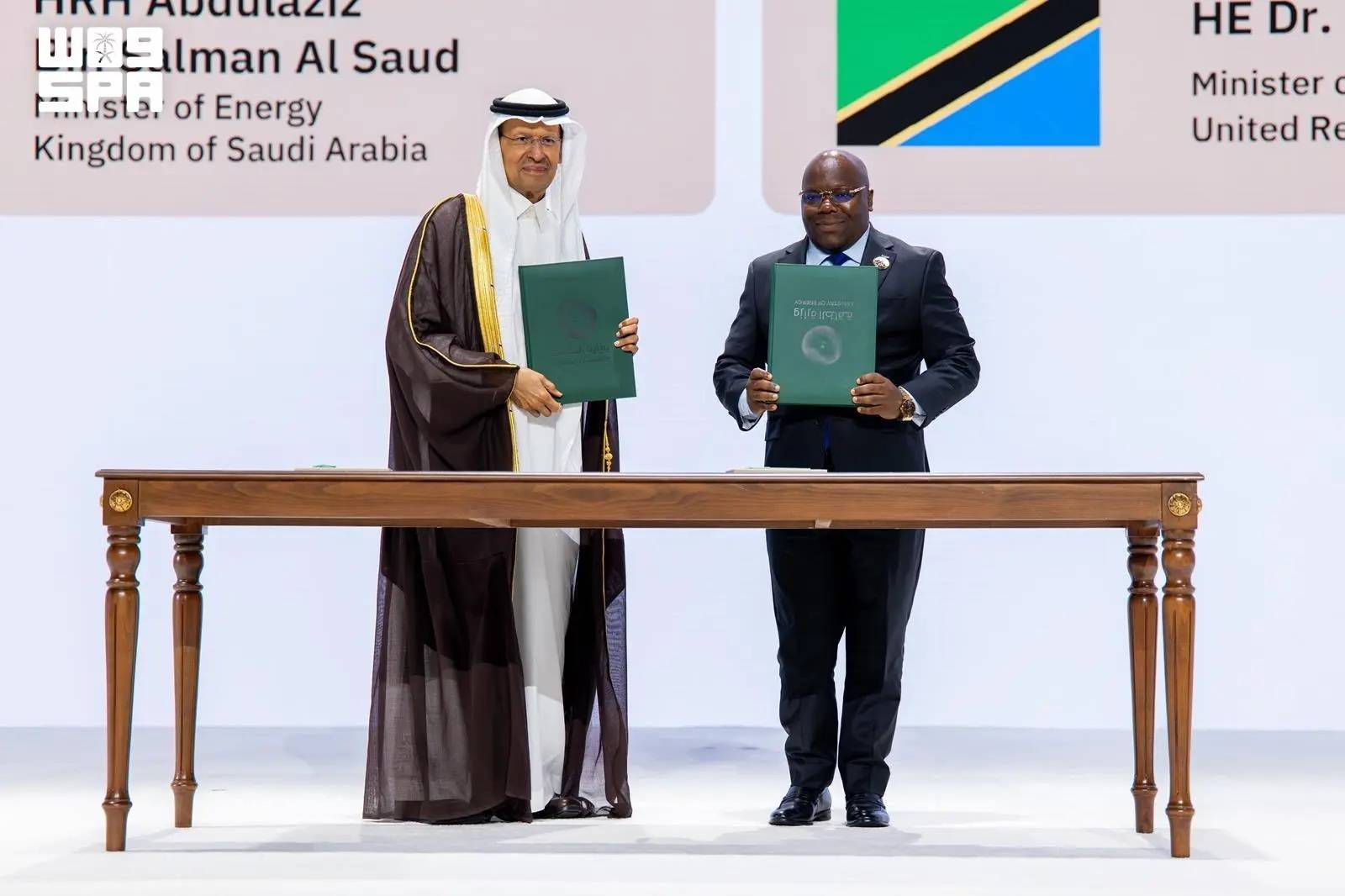
Saudi Minister of Energy and Minister of Industry and Mineral Resources Prince Abdulaziz bin Salman bin Abdulaziz and Tanzania’s Minister for Energy Juma Zuberi Homera during the signing ceremony. (SPA)

The MoU covers cooperation in digital transformation, innovation, cybersecurity applications and artificial intelligence in the energy sector. It seeks to develop strategic partnerships between the two countries to secure materials, products and services across energy sectors and their supply chains and technologies; promote the development and use of sustainable petrochemical materials in construction and other sectors; strengthen cooperation between energy companies; and support them in implementing large-scale electricity projects and harnessing renewable energy in both countries.

Prince Abdulaziz signed an MoU with Tanzania’s Minister for Energy Juma Zuberi Homera to strengthen cooperation between the two countries in the supply of refined petroleum products and explore opportunities related to associated infrastructure, assess opportunities in liquefied natural gas, exchange technical expertise in oil and gas exploration, and explore opportunities in petrochemical production.

The MoU covers electricity, renewable energy, energy efficiency, and the exchange of technologies and solutions related to climate change mitigation, including clean cooking solutions and Circular Carbon Economy technologies and solutions. It further includes exploring opportunities related to the Oil Sustainability Program and transport and fuel infrastructure, as well as cooperation in digital transformation, innovation, cybersecurity applications and artificial intelligence in the energy sector.

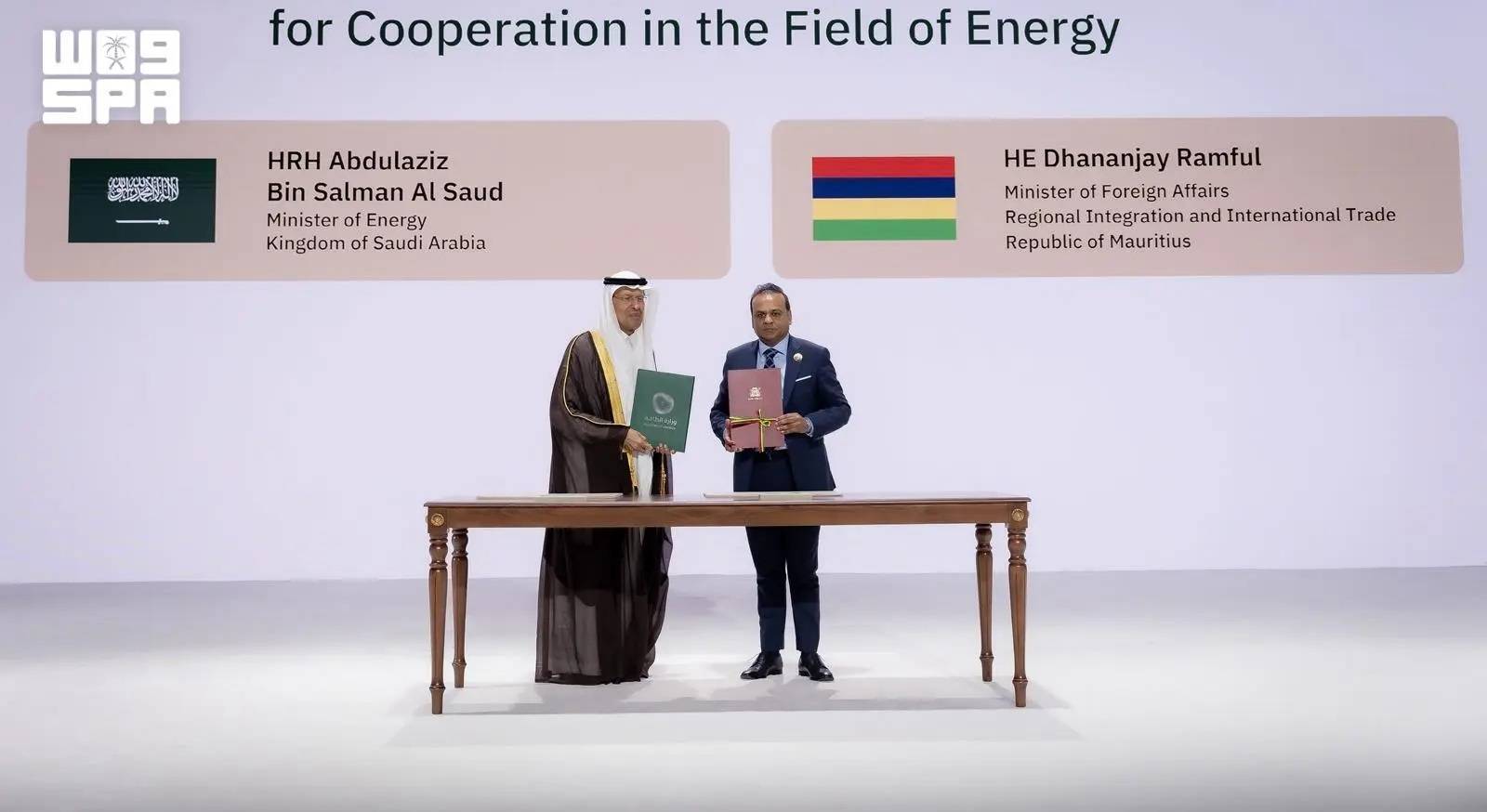
Saudi Minister of Energy and Minister of Industry and Mineral Resources Prince Abdulaziz bin Salman bin Abdulaziz and Mauritius’s Minister of Foreign Affairs, Regional Integration and International Trade Dhananjay Ramful during the signing ceremony. (SPA)

Prince Abdulaziz and Cyprus’s Minister of Energy, Commerce and Industry Michael Damianos signed an MoU establishing a framework for cooperation in oil and gas and their derivatives, refining, petrochemicals, electricity, clean hydrogen and its derivatives, renewable energy, energy efficiency, energy storage, and technologies and solutions related to climate change mitigation, including Circular Carbon Economy technologies and solutions.

The MoU covers cooperation in digital transformation and cybersecurity applications in the energy sector, as well as efforts to advance and support shared international policy priorities through relevant multilateral negotiations, including under the United Nations Framework Convention on Climate Change, the Paris Agreement and the international legally binding instrument on plastic pollution.

It further provides for cooperation on the development and use of sustainable petrochemical materials in construction and other sectors, the development of appropriate infrastructure to expand energy access, and cooperation between companies operating in energy-related fields.

Saudi Minister of Energy and Minister of Industry and Mineral Resources Prince Abdulaziz bin Salman bin Abdulaziz and Mongolia’s Deputy Prime Minister Togmid Dorjkhand. (SPA)

Prince Abdulaziz signed an MoU with Mauritius’s Minister of Foreign Affairs, Regional Integration and International Trade Dhananjay Ramful covering cooperation in oil and gas and their derivatives, refining, petrochemicals, electricity, clean hydrogen and its derivatives, renewable energy, energy efficiency, energy storage, and technologies and solutions related to climate change mitigation, including Circular Carbon Economy technologies and solutions.

The MoU also covers cooperation in digital transformation and cybersecurity applications in the energy sector.

It provides for efforts to advance and support shared international policy priorities through relevant multilateral negotiations, including under the United Nations Framework Convention on Climate Change, the Paris Agreement and the international legally binding instrument on plastic pollution.

It covers cooperation on the development and use of sustainable petrochemical materials in construction and other sectors, as well as the development of appropriate infrastructure to expand energy access.


Minister of Finance Leads Saudi Delegation to 2026 IMF-World Bank Annual Meetings

Saudi Minister of Finance Mohammed Aljadaan. (SPA file)
TT

Minister of Finance Leads Saudi Delegation to 2026 IMF-World Bank Annual Meetings

Saudi Minister of Finance Mohammed Aljadaan. (SPA file)

Minister of Finance Mohammed Aljadaan is leading Saudi Arabia's delegation to the 2026 Annual Meetings of the International Monetary Fund (IMF) and World Bank Group (WBG) in Bangkok from October 12-17.

The Saudi delegation includes Governor of the Saudi Central Bank (SAMA) Ayman Alsayari; Deputy Chair of the International Monetary and Financial Committee (IMFC) Dr. Ryadh Alkhareif; Deputy Minister of Finance for International Relations Khalid Bawazier; CEO of the Saudi Fund for Development (SFD) Sultan Almarshad; CEO of the National Debt Management Center (NDMC) Hani Almedaini; and experts from the Ministry of Finance, SAMA, SFD, NDMC, and the Zakat, Tax and Customs Authority (ZATCA).

Aljadaan will participate in the IMF and Gulf Cooperation Council (GCC) High-Level Seminar; the IMF Managing Director's meeting with the Middle East, North Africa, Afghanistan and Pakistan; and the Arab Governors' meeting with the President of the WBG.

Aljadaan and Alsayari will participate in the Third G20 Finance Ministers and Central Bank Governors (FMCBG) Meeting, held under the US Presidency. Discussions will focus on key developments in the global economy, emerging challenges, and ways to strengthen international economic cooperation.

Aljadaan will chair the IMFC meeting, where members will exchange views on developments in the global economy, including growth prospects and emerging risks. Discussions will cover global economic policy priorities and the IMF's role in addressing these challenges through financial assistance, advice, and capacity development for its members.

He will also take part in the WBG Governor's Development Committee meeting to discuss the latest updates in the WBG's development strategies, including its role in helping to create jobs as a key economic driver, enabling the private sector, and supporting countries in reforming policies that attract investments and promote economic growth.

The Annual Meetings serve as a global platform that brings together finance ministers, central bankers, senior officials from international organizations, private sector executives, representatives from civil society organizations, and academics to discuss global issues, including the global economy, sustainable development, poverty eradication, and other economic and financial topics.