

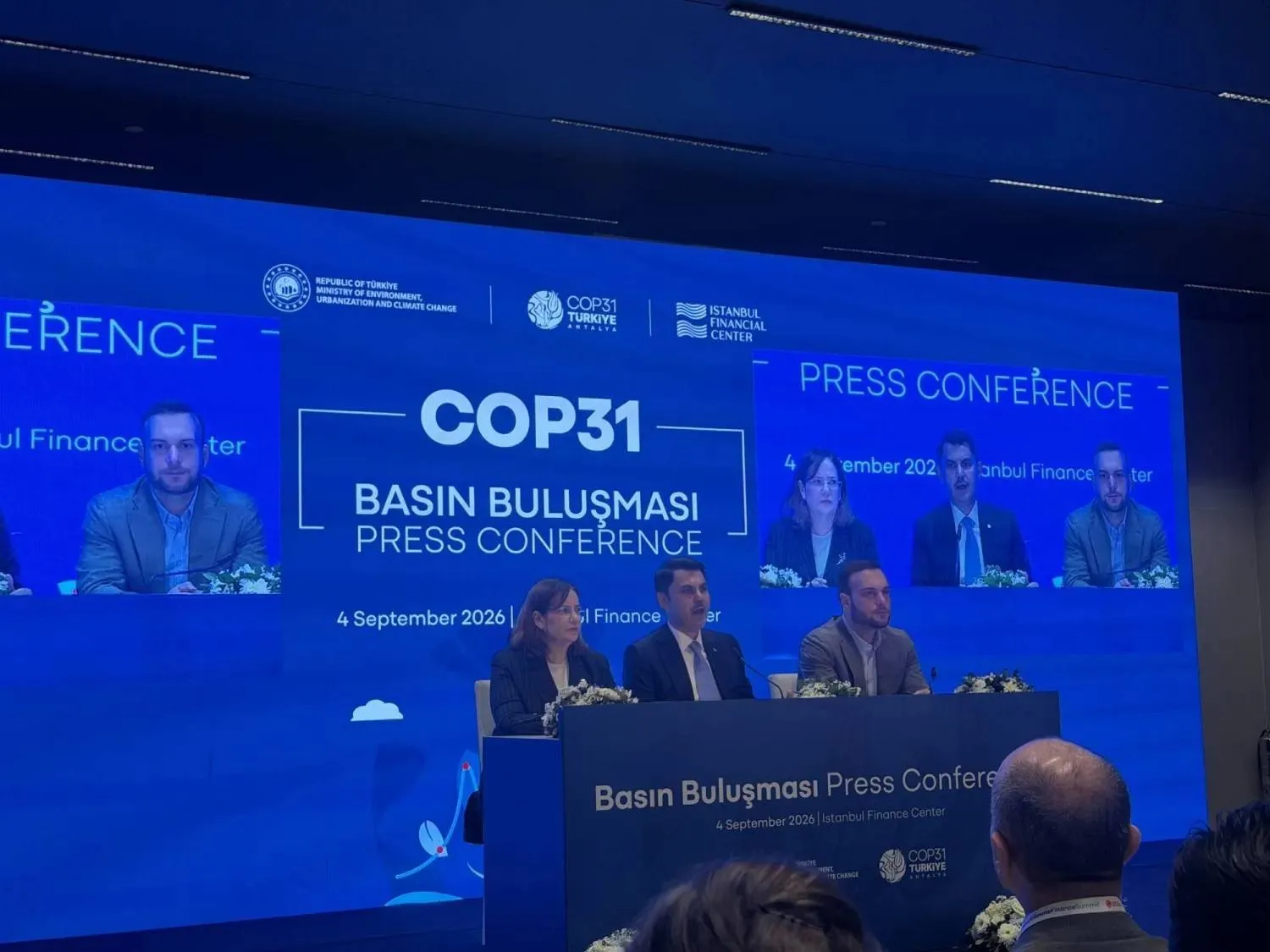

COP31 in Antalya: From Pledges to Investment

Murat Kurum, Turkish Minister of Environment, Urbanization and Climate Change and President of COP 31, during the press conference in Istanbul. (Asharq Al-Awsat)
TT

COP31 in Antalya: From Pledges to Investment

Murat Kurum, Turkish Minister of Environment, Urbanization and Climate Change and President of COP 31, during the press conference in Istanbul. (Asharq Al-Awsat)

Türkiye plans to make implementation of climate commitments and financing a central focus of its presidency of the UN COP31 climate conference, seeking to move negotiations from agreements and pledges toward concrete projects and investments as energy security, debt, extreme weather and the development needs of emerging economies increasingly intersect.

Türkiye’s presidency will pursue three main pillars, “dialogue, consensus and action”, Environment, Urbanization and Climate Change Minister and COP31 President Murat Kurum explained.

He stressed that success in Antalya would be measured not only by the decisions reached, but by the ability to turn them into viable projects, attract financing and deliver results people can see in their daily lives.

At a news conference Friday, Kurum noted that climate change could no longer be treated as a separate environmental issue, but had become closely linked to energy, industry, cities, trade, water and development, amid the growing impact of heat waves, extreme weather and threats to food and water security.

Communities, he added, want to see the impact of climate decisions on the ground, and the world must move from “words to implementation.” While the Paris Agreement established an important path for climate action, the challenge in its second decade is the speed with which decisions and commitments are carried out.

Dialogue, consensus and action

Kurum argued that lasting results require listening to different parties, finding common ground and translating consensus into practical steps.

Türkiye wants COP31 to become a turning point by “turning words into projects, projects into investments, and investments into results that affect people’s lives,” he added.

Ankara has begun broad consultations with the UN system, governments, financial institutions, cities and the private sector to identify obstacles to implementation. Those consultations helped shape an “Action Agenda” focused on areas including clean energy, electricity, cities, industry, youth and food.

Financing at the forefront

Kurum placed climate finance at the top of Türkiye’s priorities, emphasizing that the challenge is no longer limited to announcing how much money will be made available, but ensuring that it reaches the countries and projects that need it at the right time.

He pointed to delays in meeting the previous pledge to provide developing countries with $100 billion annually, noting that the experience showed that confidence in the financing system depends on pledged funds actually reaching projects.

COP29 in Baku concluded with an agreement to raise the financing target for developing countries to at least $300 billion a year by 2035, while working to increase climate finance flows from public and private sources to $1.3 trillion annually.

Kurum described a global paradox in which capital is seeking investment opportunities while climate investment needs are enormous, yet the two “do not always meet.”

Many developing countries, he explained, have potential and projects but need technical and technological support, as well as help preparing projects so they can attract financing.

Türkiye’s presidency is therefore working on mechanisms to turn climate needs into investable projects, particularly in cities, water and infrastructure, and connect them with financial institutions and investors.

Private sector and the most vulnerable countries

Kurum underscored Türkiye’s aim of securing strong private-sector participation in Antalya, particularly from companies with climate technologies and solutions.

At the same time, he stressed that the needs of least-developed countries and small island developing states must remain at the heart of discussions, especially in terms of access to financing.

Türkiye will also bring its domestic experience to COP31, including its 2053 net-zero target and policies on the circular economy, waste management, energy efficiency and renewable energy.

Kurum also cited Türkiye’s reconstruction of earthquake-hit areas, noting that the country had completed and delivered around 455,000 housing units over two years, with an emphasis on disaster resilience and energy efficiency.

Kurum outlined plans to link the Action Agenda to measurable goals through 2035, including raising electricity’s share of global energy consumption to 35%, reducing waste-related resource consumption by 25% and increasing the use of secondary and recycled materials in industry to 15%.

Türkiye wants COP31 to mark the beginning of a phase in which climate action shifts more decisively from negotiation to implementation, with success measured by the ability to turn “words into projects, projects into investments, and investments into results.”



US Ban on $1 Billion Worth of Canadian Imports Goes into Effect

Shipping containers in the Port of Montreal, Canada (Reuters)
TT

US Ban on $1 Billion Worth of Canadian Imports Goes into Effect

Shipping containers in the Port of Montreal, Canada (Reuters)

US-Canada relations, already tense, are likely to deteriorate further after the United States went ahead early Tuesday with a decision to ban nearly $1 billion worth of Canadian imports, including dairy products and motorcycles.

The ban amounts to barely a ripple in $880 billion worth of a two-way annual trade between the two northern neighbors. But it marks another ratcheting up of President Donald Trump’s second-term trade war with America’s longtime ally and trading partner.

The import ban “certainly won't do anything to help the trade tensions between the United States and Canada,'' said trade attorney Patrick Childress, a partner at Holland & Knight and a former US trade official.

The latest sparring began over the summer when Trump reached back to a Great Depression law to impose 50% tariffs on about $20 billion worth of Canadian imports, charging that Canada discriminates against US dairy and auto producers. Canada promptly counterpunched with tariffs of 15% and 25%, matching US imports dollar for dollar.

To punish Canada for retaliating against his tariffs, Trump decided to ban a list of Canadian products, effective 12:01 a.m. Eastern time Tuesday.

The economic impact is likely to be minimal. Childress noted that the products on the banned list were already facing Trump’s tariffs. “For a lot of these goods, the 50% was already acting as a de facto ban by making importation from Canada into the United States uneconomical,″ he said.

Jacob Jensen, director of trade policy at the center-right American Action Forum think tank, calculates that the ban would cover $967 million worth of Canadian imports, based on 2025 numbers.

“This marks yet another escalation in the trade war that may result in further retaliation on the Canadian side,” Jensen said. He expects Canadian exporters and US importers “impacted by these bans will be highly motivated’’ to demand that trade officials on both sides find some way to reach a “resolution of this whole ordeal.’’


Birol: IEA Member States Will Discuss Strategic Oil Reserve Releases if Needed

This photograph shows the entrance to the International Energy Agency (IEA) headquarters in Paris on March 11, 2026. (Photo by Ludovic MARIN / AFP)
TT

Birol: IEA Member States Will Discuss Strategic Oil Reserve Releases if Needed

This photograph shows the entrance to the International Energy Agency (IEA) headquarters in Paris on March 11, 2026. (Photo by Ludovic MARIN / AFP)

The International Energy Agency's member states may discuss whether more strategic oil reserves could be released on the market in the future, IEA head Fatih Birol said on Tuesday.

"We are ⁠following the markets ⁠very closely, especially the product markets, diesel and others. If there is a need, ⁠of course, we will discuss with our member governments to take the necessary steps," he told reporters in Dublin ahead of a meeting of EU energy ministers.

Birol declined to ⁠comment ⁠on proposals hinted at by French President Emmanuel Macron and others to release more strategic reserves in a bid to lower oil prices.


Saudi-Egypt Electricity Interconnection Nears Operation

Egyptian Electricity Minister Mahmoud Esmat during a seminar at the National Press Authority on Sunday evening (Electricity Ministry’s Facebook page)
TT

Saudi-Egypt Electricity Interconnection Nears Operation

Egyptian Electricity Minister Mahmoud Esmat during a seminar at the National Press Authority on Sunday evening (Electricity Ministry’s Facebook page)

The Saudi-Egypt electricity interconnection, one of the region’s largest and most ambitious energy projects, is nearing actual operation after an official Egyptian announcement that work on the Egyptian side has been completed and the project has entered trial operations.

The strategic project, with investments of about $1.8 billion and an exchange capacity of up to 3,000 megawatts, is not only a step toward improving the efficiency of the two countries’ national grids, but also represents a pivotal shift in the regional and international energy landscape.

By connecting the two largest electricity grids in the Arab world, the project lays the initial foundation for a common Arab electricity market and reinforces the two countries’ positions as key hubs for energy trading and transmission between Asia, Africa and Europe.

Egyptian Side Ready

Egyptian Electricity and Renewable Energy Minister Mahmoud Esmat said on Sunday that the project aims to exchange 3,000 MW of electricity along a 1,320-kilometer route.

He noted that the pace of implementation and progress accelerated between July 2024 and June 2025, bringing the project to the trial-operation stage.

Esmat confirmed that all engineering and construction work on the Egyptian side of the interconnection with Saudi Arabia had been completed, with only a small portion of work, technical testing and final preparations remaining on the Saudi side.

Work in Egypt included construction of the 500-kilovolt Badr converter station and the 320-kilometer Badr-Taba overhead line, as well as giant Suez Canal crossing towers rising more than 220 meters to ensure the smooth and safe transmission of electricity ahead of the start of actual exchanges between the two countries.

Esmat said during a Feb. 15 meeting with President Abdel Fattah al-Sisi that the interconnection would play an important role in stabilizing Egypt’s national electricity grid during the summer, when consumption peaks.

Technical Specifications

According to official Egyptian information, the project is one of the region’s largest electricity interconnection projects, with investments estimated at about $1.8 billion and an exchange capacity of up to 3,000 MW.

It consists of three major high-voltage converter stations: one east of Madinah and another in Tabuk, Saudi Arabia, and a third in Badr, east of Cairo.

The stations are connected by overhead lines extending about 1,350 kilometers, in addition to submarine cables crossing the Gulf of Aqaba.

Strategic Shift in Regional Energy Security

Khaled El-Shafei, an economist and head of the Capital Center for Economic Studies, said the interconnection represents a strategic shift in the region’s energy landscape and security.

He noted that the project strengthens energy security in both countries with a capacity of up to 3,000 MW through high-voltage direct-current lines extending 1,320 kilometers, equivalent to about 8 to 10 percent of Egypt’s total operating reserve capacity.

El-Shafei underlined that this would support the stability of the national grid without the need to operate additional generating plants with high operating costs. It would also reduce carbon emissions by millions of tons annually through optimal use of the two countries’ renewable-energy mix.

He continued that once the interconnection becomes fully operational, it would generate substantial economic savings in fossil-fuel consumption and power-plant maintenance costs.

Gateway to Europe

Esmat also discussed existing electricity interconnection projects with neighboring countries, including Sudan, Libya and Jordan, saying studies for interconnection projects with Greece and Italy are currently being finalized, which would make Egypt a bridge to Europe, according to a ministry statement.

On the regional level, El-Shafei said the Saudi-Egypt project’s entry into the operational phase is the essence for establishing a common Arab electricity market, as it connects the two largest electricity grids in the Arab region, which together account for more than 60 percent of total electricity generated in the Arab world.

The development also opens broad prospects for Egypt to capitalize on its unique geographical position as a key regional energy-trading hub. It would allow the Egyptian grid to manage a multilateral interconnection system extending to the Arab east through Saudi Arabia and Jordan, the Maghreb through Libya, and Africa through the existing interconnection with Sudan.

Egypt would also serve as a future gateway to Europe through interconnection projects being studied and implemented with Greece, Cyprus and Italy to transmit up to 2,000 MW, boosting direct economic returns and making the region a key pillar for regional and international energy stability and sustainability.