
Saudi Arabia and Serbia Expand Partnership in Energy, Technology and Trade

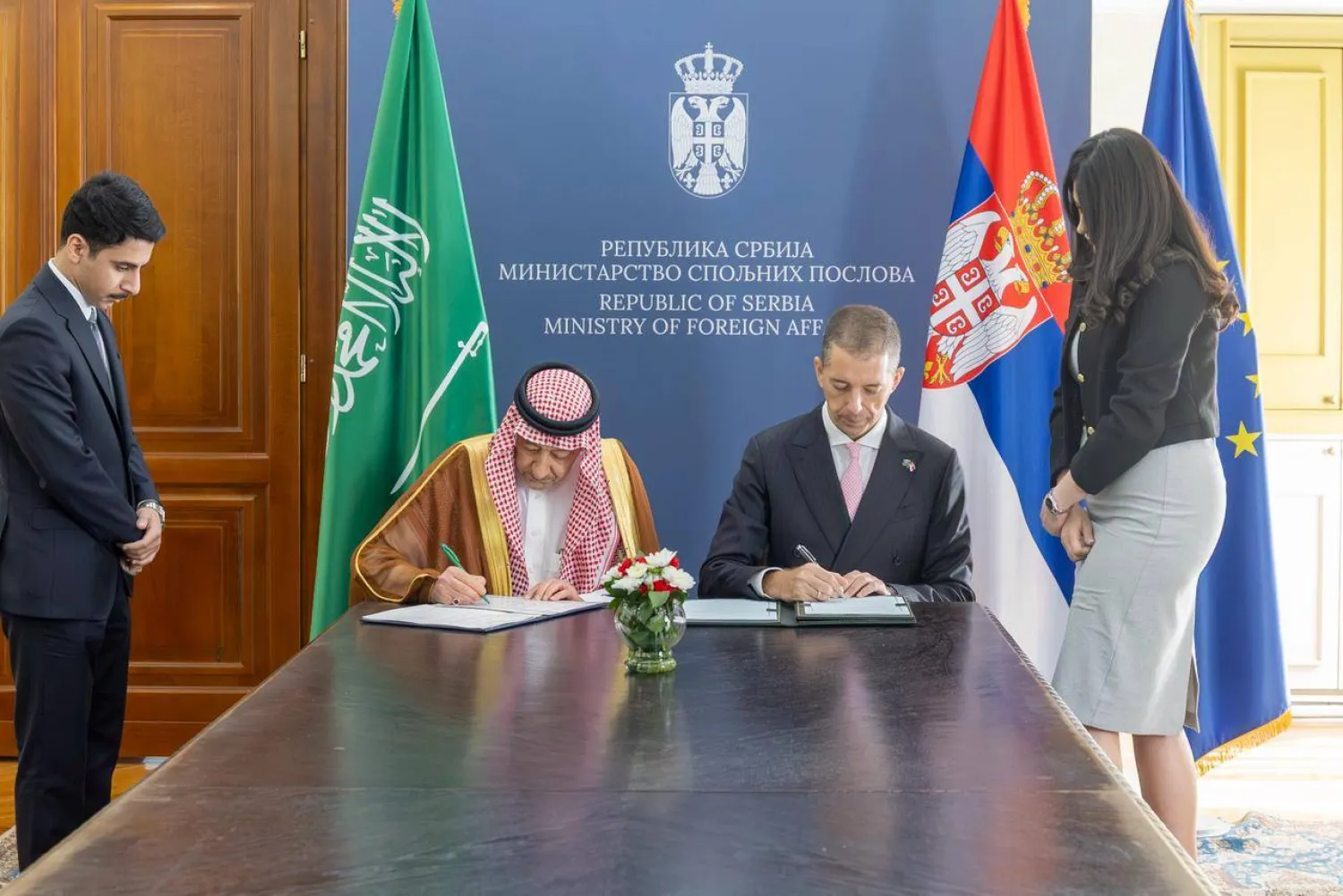
Serbian Foreign Minister and Saudi Deputy Foreign Minister sign an agreement waiving visa requirements for holders of diplomatic and official passports. (X)
TT

Saudi Arabia and Serbia Expand Partnership in Energy, Technology and Trade

Serbian Foreign Minister and Saudi Deputy Foreign Minister sign an agreement waiving visa requirements for holders of diplomatic and official passports. (X)

Saudi-Serbian relations are moving toward a new phase of economic and diplomatic cooperation, as Riyadh and Belgrade work to expand their partnership in the energy, technology, agriculture and food industries sectors, alongside rapid growth in trade between the two countries. This comes as the hosting of EXPO 2027 in Belgrade and EXPO 2030 in Riyadh by Serbia and Saudi Arabia, respectively, opens additional avenues for exchanging expertise and building new partnerships and projects.

A meeting held last week in Belgrade between Saudi Deputy Minister of Foreign Affairs Waleed A. M. Elkhereiji and Serbian Minister of Foreign Affairs Marko Đurić saw the signing of an agreement to cancel visa requirements for holders of diplomatic and official passports, in a step expected to support official contacts and strengthen cooperation between the two countries.

The two sides discussed ways to develop cooperation in the energy sector through joint projects, as well as in information and communications technology, advanced technologies, agriculture and the food industry. They also discussed strengthening the presence of Serbian companies in the Saudi market and increasing investment by Saudi partners in Serbia. Serbia is scheduled to participate in the Saudi Food exhibition in Jeddah later this month with more than 50 companies.

Three new initiatives for cooperation between the two countries were also launched during the meeting: "Digital Non-Aligned," the Film Festival of the Non-Aligned Movement, and an international seminar for young diplomats from member states of the movement. The initiatives are part of commemorations marking the 65th anniversary of the First Conference of the Non-Aligned Movement, which was hosted by Belgrade in 1961.

The meeting was held on the sidelines of a gathering marking the anniversary. Saudi Arabia was among the countries that participated in the founding conference and was represented at the time by Minister of Foreign Affairs Ibrahim bin Abdullah Al Suwaiyel, who planted the first "tree of peace."

Bizenic: Riyadh Is an Important Economic Partner

Serbian Ambassador to Saudi Arabia Dragan Bizenic told Asharq Al-Awsat that last Wednesday's meeting gave the Serbian foreign minister an opportunity to once again thank the relevant Saudi institutions for their "exceptional cooperation and support" during the evacuation of Serbian citizens from Riyadh following the recent events in the Middle East.

Bizenic affirmed his country's commitment to deepening comprehensive cooperation with Saudi Arabia, with a particular focus on the economic side. He said he was impressed by the results achieved by the Kingdom under Vision 2030, which he saw during his visit to Riyadh to participate in the Future Investment Initiative conference last year.

According to the Serbian foreign minister, Belgrade is interested in strengthening trade cooperation with Saudi Arabia, increasing exports of Serbian products, and benefiting from the expertise and knowledge of Saudi experts in the fields of science and technology. The two sides also discussed expanding partnership and cooperation through EXPO, in addition to increasing the volume of trade and mutual investments.

EXPO: A New Bridge for Partnership

Bizenic considers Saudi-Serbian cooperation through EXPO 2027 and EXPO 2030 to be a highly important area for deepening relations between the two countries, pointing to the meeting between Saudi Deputy Minister of Foreign Affairs Waleed Elkhereiji and Minister of Foreign Trade, Mrs. Jagodom Lazarevic, who is also the commissioner of the EXPO 2027 exhibition in Belgrade.

He explained that Belgrade and Riyadh hosting two world expos in the coming years, EXPO 2027 Belgrade and EXPO 2030 Riyadh, represents a unique opportunity to turn the experience, knowledge and networks the two countries will gain through these events into new forms of cooperation and concrete projects.

He revealed that Saudi Arabia has already signed a contract to participate in EXPO 2027 Belgrade and will have one of the largest national pavilions at the exhibition, in a prominent location at the entrance to the EXPO area. He said the pavilion will provide the Kingdom with an opportunity to showcase its development potential, innovations, culture and business opportunities, as well as promote EXPO 2030 Riyadh.
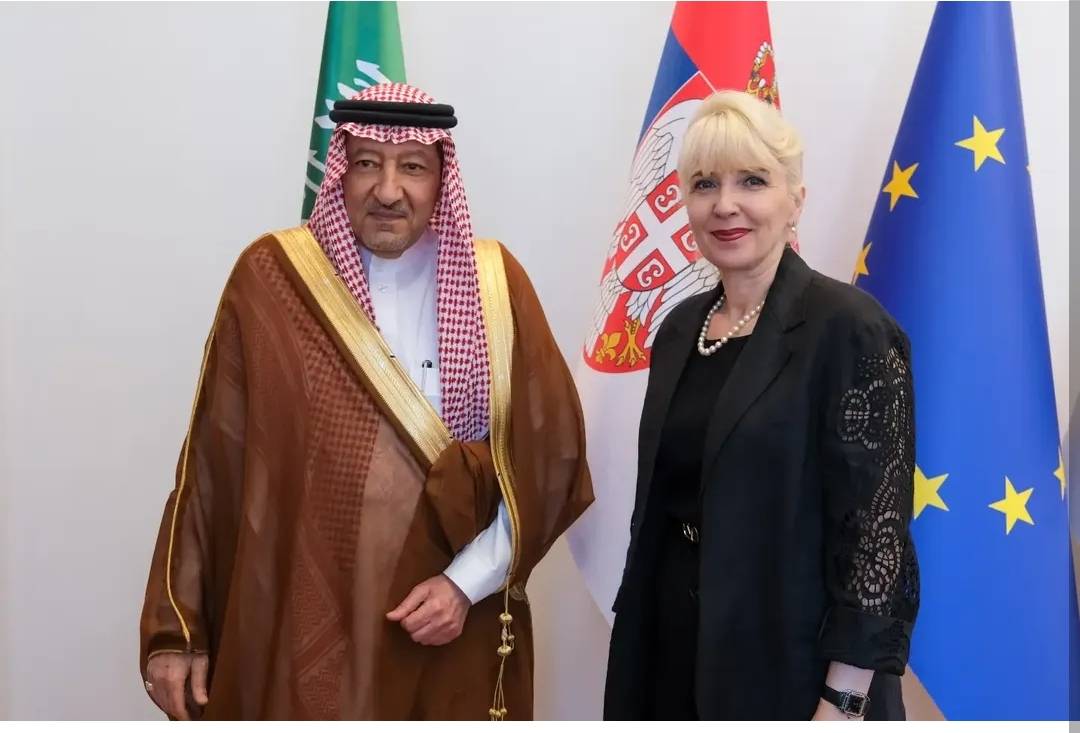
Saudi Deputy Foreign Minister during his meeting with Serbian Minister of Internal and External Trade Jagoda Lazarević (X)

Trade Surges 152%

Bizenic noted that the Serbian foreign minister affirmed during his Wednesday meeting in Belgrade with Elkhereiji that Saudi Arabia could be "one of Serbia's key economic and political partners in the Arab world," given its membership in the Group of Twenty and OPEC+, as well as its weight in global energy markets. Saudi Arabia holds about 16 percent of the world's oil reserves.

The ambassador believes that strengthening Saudi-Serbian relations, opening the way for more investments and business projects, and expanding contacts between the business communities of the two countries would bring significant benefits to Serbia and support its economic presence in the region.

As an indicator of the growing economic ties, Bizenic said trade between Serbia and Saudi Arabia has recorded significant growth in recent years, reaching $121 million at the end of 2025, nine times its 2012 level. Trade continued to grow this year, reaching $130.4 million in the first half of 2026, an increase of 152 percent compared with the same period last year.


Trump Says He Is Still Considering Diesel Export Ban

 A semi drives past a sign advertising the price of diesel along Interstate 5 in Williams, California, US, September 28, 2026. (Reuters)
A semi drives past a sign advertising the price of diesel along Interstate 5 in Williams, California, US, September 28, 2026. (Reuters)
TT

Trump Says He Is Still Considering Diesel Export Ban

 A semi drives past a sign advertising the price of diesel along Interstate 5 in Williams, California, US, September 28, 2026. (Reuters)
A semi drives past a sign advertising the price of diesel along Interstate 5 in Williams, California, US, September 28, 2026. (Reuters)

US President Donald Trump said on Wednesday that he has conversations about banning diesel exports "every day" as the White House races to curb soaring energy prices.

Speaking from the Oval Office, Trump said an export ban would "have a negative impact on gasoline" prices, but could lower diesel costs.

He said Russia's war in Ukraine, with strikes ‌from either side ‌impacting energy production and exports, is ‌the ⁠main cause of ⁠rising diesel prices.

He added: "We think we're in a very good place."

Gasoline prices have jumped more than 40% over the past year and diesel climbed to a record of $6.53 a gallon a week ago, according to AAA data. The price spike ⁠is largely driven by a combination of ‌a reduction in supply ‌due to the Iran war and interruptions to refining, in ‌part because of Ukraine's attacks on Russian energy ‌facilities.

The Trump administration and Republican candidates have been under pressure to bring down fuel costs as November's midterm elections approach and Trump's economic approval ratings remain under strain.

Energy Secretary ‌Chris Wright said the disruptions were more widespread.

"We've lost some diesel exports from the ⁠Middle ⁠East, although we're restoring those, and we've lost diesel exports from China," he said. "So that's a lot of interruptions."

He said the administration expected announcements soon from Europe about new diesel supplies.

The White House has urged the European Union to release emergency diesel stocks to help ease prices, Reuters reported.

The Trump administration has also weighed a blanket diesel export ban, voluntary export limits by refiners and allowing broader sales of tax-exempt diesel.


Saudi Arabia Earmarks $371 Bn in Spending for 2027 Budget

The Saudi finance minister at the 2026 Budget Forum (File photo — Asharq Al-Awsat)
TT

Saudi Arabia Earmarks $371 Bn in Spending for 2027 Budget

The Saudi finance minister at the 2026 Budget Forum (File photo — Asharq Al-Awsat)

Saudi Arabia projects spending of 1.392 trillion riyals ($371.2 billion) in 2027 against revenue of 1.202 trillion riyals ($320.5 billion), leaving a budget deficit of about 3.6% of gross domestic product as it funds economic growth and development and strategic priorities.

The Finance Ministry released its preliminary budget statement for fiscal 2027 on Wednesday as the kingdom presses ahead with economic transformation programs and expands non-oil activity. Its fiscal policy seeks to support growth while maintaining fiscal sustainability.

The ministry forecasts revenue rising to about 1.351 trillion riyals ($360.3 billion) by 2029, with spending increasing to about 1.544 trillion riyals ($411.7 billion).

The projections point to sustained spending on development and strategic priorities and projects with economic and social returns, backed by long-term fiscal planning designed to maintain sustainability across economic cycles.

Diversification initiatives and economic reforms have lifted non-oil revenue from about 166 billion riyals ($44.3 billion) in 2015 to 505 billion riyals ($134.7 billion) in 2025, strengthening revenue stability and broadening its sources.

Non-oil growth cushions oil slump

Saudi Arabia’s real GDP is expected to contract by 3.6% in 2026 as oil activity falls by 21.8%, according to preliminary estimates reflecting the impact of economic and geopolitical developments.

Non-oil activity is forecast to grow by 3.2%, cushioning the decline in the broader economy.

In the first half of 2026, non-oil activity grew by 1.8%, lifting its share of real GDP to a record 57.3%, driven by strong domestic demand and private investment inflows.

Saudi unemployment falls to 6.5%

Unemployment among Saudi nationals fell to 6.5% in the second quarter of 2026.

Inflation is estimated at about 2.1% for the full year, amid sustained domestic demand and developments in non-oil economic activity.

Government plans domestic and international financing

The government plans to continue raising funds domestically and internationally in 2027 and over the medium term under its medium-term debt strategy, through bond and sukuk issuance and loans.

It also plans to expand alternative government financing.

These channels include project and infrastructure financing and financing through export credit agencies, providing additional funding for projects and development priorities.

Finance Minister Mohammed Al-Jadaan said the preliminary 2027 budget estimates come amid persistent global economic uncertainty and accelerating geopolitical developments.

The kingdom continues to manage public finances with a long-term view, he said, strengthening its ability to respond to changing conditions and sustain spending on development and strategic priorities while preserving fiscal sustainability and financial strength.

The government is monitoring economic and geopolitical developments and assessing their potential impact on the global economy, supply chains and energy markets, he added. Flexible, proactive policies aim to support the economy and keep it on course toward Saudi Vision 2030 targets.

Al-Jadaan said economic transformation plans would continue to support growth and broaden the economic base, lifting non-oil revenue and making revenue more sustainable and stable over the medium and long term.

Deficit fits long-term fiscal policy

The projected 2027 deficit of 3.6% of GDP is part of a fiscal policy aimed at preserving financial strength and improving fiscal sustainability while maintaining spending on priority projects.

The Finance Ministry said the approach allows the government to pursue balanced fiscal policies across economic cycles, support growth, adapt to changing conditions and manage crises and emergency needs while keeping public debt sustainable and maintaining substantial fiscal reserves.

The government plans to continue domestic and international financing in 2027 and over the medium term under its medium-term debt strategy, issuing bonds and sukuk and securing loans at a fair cost.

It also plans to expand alternative government financing, including project and infrastructure financing and financing through export credit agencies.


Digital Spending Is Reshaping Saudi Consumer Habits

A woman shops at a retail and grocery center in Saudi Arabia (SPA)
TT

Digital Spending Is Reshaping Saudi Consumer Habits

A woman shops at a retail and grocery center in Saudi Arabia (SPA)

Saudi consumers are rapidly reducing their reliance on cash as digital payments expand across everyday sectors, from grocery shopping to entertainment and electronic gaming. The shift is being driven by a young population, widespread smartphone adoption, and increasingly advanced payments infrastructure.

Grocery shopping is emerging as one of the sectors benefiting most from this transformation. Digital spending in the sector grew by 18 percent over the past year, while spending on electronic gaming has surpassed global averages, pointing to the expanding reach of the digital economy and changing consumption patterns in the Kingdom.

The total value of digital transactions across the Gulf countries is expected to grow at an annual rate of 8.7 percent between 2024 and 2028, reaching $178 billion, according to Oxford Business Group (OBG). This growth comes amid wider adoption of digital wallets, money-transfer applications, and cashless payment methods.

Against this backdrop, Mohamed Nana, Mastercard's Senior Vice President for Digital Partnerships in Eastern Europe, the Middle East and Africa, told Asharq Al-Awsat that this growth is being driven by the digital transformation visions adopted by countries across the region.

He also pointed to the launch of Buna, the Arab regional payments system, which is fully owned by the Arab Monetary Fund and supported by Arab central banks. The system aims to reshape cross-border payments and strengthen economic integration both regionally and globally.

Nana said Mastercard has made its Mastercard Move money-transfer solutions available through Buna, in what he described as the first collaboration of its kind between the public and private sectors. In Saudi Arabia, he said, the company is focused on supporting the growth of the digital economy through technology, secure payments infrastructure, and local partnerships.

Saudi Consumers Expand Their Digital Payment Use

Nana said the adoption of a broader range of digital payment methods is accelerating in Saudi Arabia. In addition to becoming familiar with solutions such as digital wallets, money-transfer applications, biometric identification, and installment-payment services, consumers are becoming increasingly comfortable using them in their everyday lives.

They are also turning to more diverse ways of shopping, including through voice assistants and social media platforms.

He said the continuing shift away from cash is being driven by a young, tech-savvy population and widespread smartphone penetration. Speed, security, convenience, and a seamless payment experience are among the main factors encouraging consumers to adopt digital payments.

Maintaining this momentum, he added, requires giving consumers confidence in new payment methods through secure technologies and an interconnected digital payments ecosystem.

Grocery shopping stands out among the Saudi sectors that have experienced notable growth in digital payment use. The sector recorded annual growth of 18 percent over the past year, driven by the expansion of digital platforms, promotional pricing, delivery services, and integration with mobile devices.

Nana said the fashion and electronics sectors have also recorded strong performance, while digital spending on electronic gaming exceeds global averages. This reflects the strength of Saudi Arabia's esports economy, which is valued at $1 billion and is being developed under the National Gaming and Esports Strategy.

Local Infrastructure for Electronic Payment Processing

Alongside growing demand for digital payments, Mastercard is developing local infrastructure for processing electronic transactions in Saudi Arabia. Nana said the company, under the auspices of the Saudi Central Bank, SAMA, has launched technology infrastructure inside the Kingdom, powered by Mastercard Gateway, allowing e-commerce transactions to be processed locally.

He added that Mastercard Gateway has become part of Mastercard Merchant Solutions, a payments platform that brings together the company's services to help businesses manage their commerce operations. He noted that Mastercard received certification last December allowing it to process electronic transactions through SAMA's new e-commerce payment interface.

Artificial Intelligence

Nana said artificial intelligence has been a core part of Mastercard's ecosystem for nearly two decades. It helps make every digital experience more secure, intelligent, and personalized for consumers and businesses, while improving efficiency for customers and partners.

In Saudi Arabia, AI is a key component of the company's strategic collaboration with Riyadh Air, which aims to redefine the travel experience across multiple customer touchpoints. It is also central to the work of Mastercard's Cyber Resilience Center in Riyadh, strengthening its ability to detect and respond to sophisticated cyber threats and fraud attempts.

Data to Help Attract Visitors

Last August, the Saudi Tourism Authority and Mastercard signed a memorandum of understanding to cooperate in supporting the growth of the Kingdom's tourism sector and strengthening Saudi Arabia's position as a global tourism destination. The partnership involves campaigns and initiatives aimed at attracting international visitors from target markets, supporting the Kingdom's goal of receiving 150 million visitors by 2030.

Nana said the partnership with the Saudi Tourism Authority uses Mastercard data and insights to segment visitor groups, analyze spending, monitor travel trends, measure the impact of events, and conduct predictive analytics. These capabilities help inform marketing strategies and policy development.

He added that the company's goal is to design global campaigns and initiatives to attract international travelers from target markets, in conjunction with the Priceless platform, which promotes unique cultural experiences across the Kingdom.