

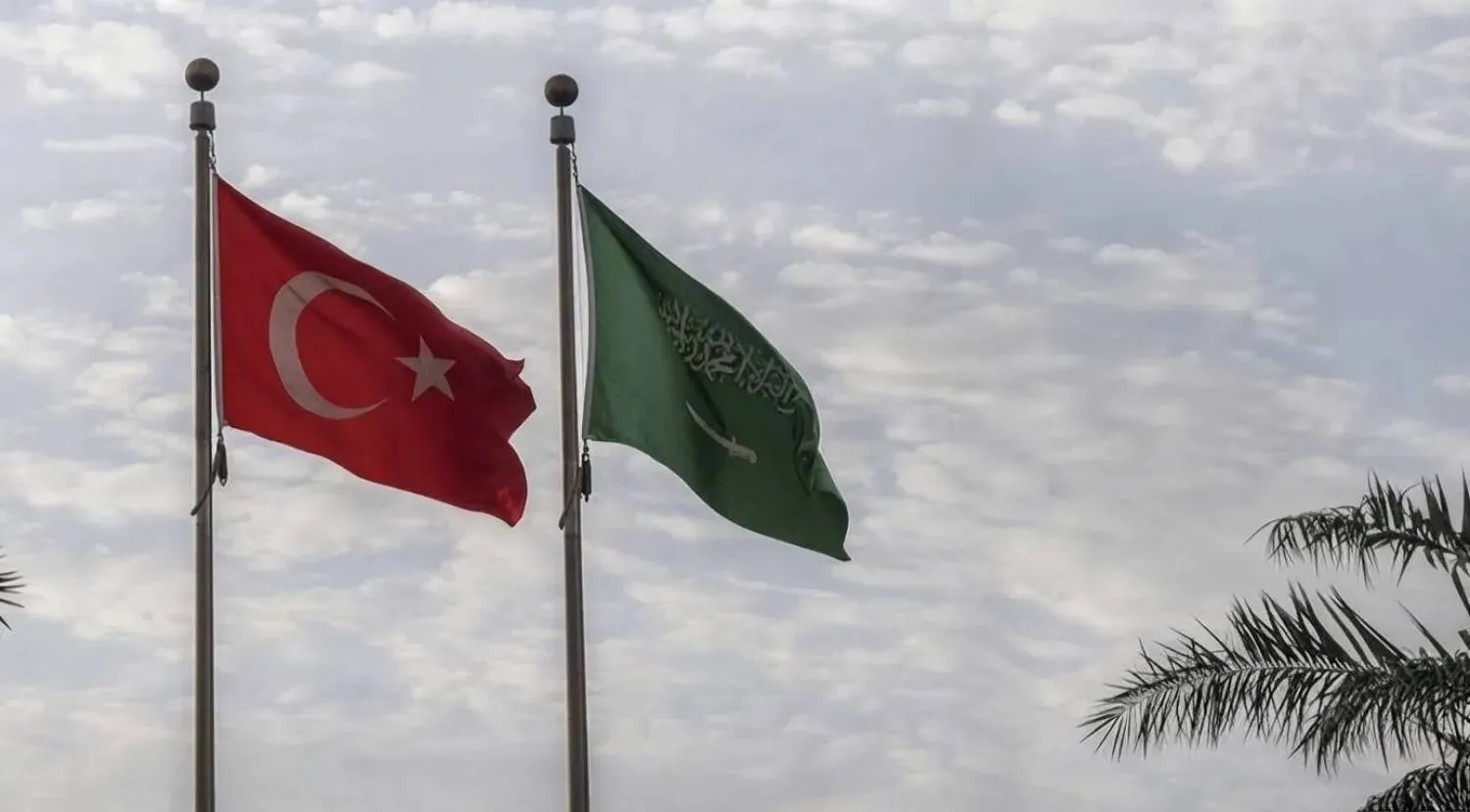

Ankara Seeks to Take Saudi Economic Ties to ‘Higher Levels’

Türkiye looks to expand economic ties With Saudi Arabia (Asharq Al-Awsat)
TT

Ankara Seeks to Take Saudi Economic Ties to ‘Higher Levels’

Türkiye looks to expand economic ties With Saudi Arabia (Asharq Al-Awsat)

Saudi Arabia and Türkiye are recasting their economic relationship, moving beyond trade and traditional investment flows to forge long-term industrial partnerships spanning renewable energy, defense, tourism and logistics.

The emerging model combines Saudi capital with Turkish expertise and technology, with both countries pursuing joint investment, technology transfer and localized production to build ties that can outlast fluctuations in trade.

The shift is gathering pace as Saudi investors show greater interest in Turkish assets and companies through funds, mergers and acquisitions. At the same time, Turkish companies are expanding in Saudi Arabia, seeking to capitalize on the kingdom’s megaprojects and Vision 2030 targets.

Energy and defense lead the sectors poised for deeper cooperation. Both countries are working to build an economic relationship based on joint investment, technology transfer and industrial localization, a model designed to make the Saudi-Turkish partnership more sustainable and less exposed to swings in trade.

Ahmet Burak Dağlıoğlu, president of the Investment and Finance Office of the Presidency of the Republic of Türkiye, said Saudi investment in Türkiye had changed markedly in recent years.

Investors are showing greater interest in mergers and acquisitions, buying stakes in Turkish companies and investing through funds, he said. Saudi capital also remains active in banking, financial services, manufacturing, real estate and family-owned businesses.

Speaking to Asharq Al-Awsat at a meeting with reporters in Istanbul, Dağlıoğlu said Turkish companies were also expanding in the Saudi market, tapping opportunities created by Vision 2030 and the kingdom’s megaprojects, particularly in manufacturing, services, healthcare, hospitals and logistics.

The meeting was organized by the Turkish presidency’s Directorate of Communications and its Investment and Finance Office on the sidelines of a climate finance conference in Istanbul.

More confidence

Dağlıoğlu said the improvement in relations between Riyadh and Ankara in recent years had given investors in both countries greater confidence, putting trade and investment on an upward path.

Bilateral relations are an important signal for companies weighing market entry and long-term investment decisions, he said.

The true scale of Saudi investment in Türkiye could also be larger than official figures suggest, Dağlıoğlu said. Some investments are made through funds and companies registered in international financial centers, meaning they are not always recorded as direct Saudi capital inflows.

The pattern reflects an evolution in the tools used by Saudi investors, who increasingly rely on funds and international investment structures to acquire stakes in companies or finance mergers and acquisitions, he said.

Renewable energy

Dağlıoğlu pointed to Saudi Arabia’s ACWA Power entering Turkish renewable energy projects as a key example of where investment relations are heading.

The sector offers substantial opportunities, he said, as Türkiye seeks to expand its clean-energy capacity and Saudi companies bring advanced expertise in developing, financing and operating major projects.

Dağlıoğlu cited investment commitments involving large-scale renewable energy projects and said further steps were expected to be announced as Türkiye prepares to host the COP31 United Nations climate conference in Antalya.

Energy could become a central pillar of the partnership, he said, as Saudi Arabia expands its international investments in renewable energy and Türkiye seeks to increase the share of clean energy sources in its energy mix.

Defense cooperation

Muttalip Tütüncü, secretary-general of the SAHA Istanbul defense and aerospace industry cluster, said defense cooperation between Saudi Arabia and Türkiye was moving beyond product sales and export deals.

The relationship is developing into a strategic partnership encompassing technology transfer, industrial localization and joint production capabilities, he said.

Saudi Arabia’s drive to localize defense manufacturing aligns with the industrial and technological capabilities Türkiye has built in recent years, opening the door to broader cooperation between companies and institutions in both countries.

Saudi Arabia is not merely seeking to buy defense equipment and systems, Tütüncü said. It also wants to acquire the technical knowledge and capacity to manufacture, develop and maintain them, in line with its targets for increasing local content in military industries.

“Turkish companies view the Saudi market as a long-term strategic partner, not merely as an export market,” he said.

Future cooperation could include joint manufacturing, technology transfer, workforce training and the creation of local supply chains, Tütüncü added.

He described the defense relationship as one of “industrial integration,” combining Saudi financial and investment capabilities with Turkish technical and industrial expertise.

That model could extend to aviation, unmanned systems, electronics and advanced technologies, he said.

Drone agreements between the two countries marked an important milestone in defense cooperation, Tütüncü said, but they were not the end of the process. Rather, they were the start of a broader phase that could include building industrial and production capabilities inside Saudi Arabia.

Seasonal tourism integration

In tourism, Dağlıoğlu said the two countries could build a model of seasonal integration.

Türkiye attracts large numbers of Saudi tourists during the summer, while Turkish companies and operators could benefit from Saudi Arabia’s winter tourism season and the kingdom’s new tourism and entertainment projects.

Turkish hospitality operators and tourism service companies could deploy their expertise and personnel in the Saudi market during periods of lower demand in Türkiye, helping meet the needs of Saudi projects while creating new opportunities for Turkish businesses.

Cooperation between Riyadh and Ankara is not limited to governments and large corporations, Dağlıoğlu said. It also involves connecting investors, entrepreneurs and small and medium-sized enterprises and making it easier for them to enter both markets.

Greater growth

The two Turkish officials expect mutual investment to grow further in the coming period, driven by improving relations, the expanding scale of Saudi projects and Saudi investors’ interest in Turkish assets and companies.

Ankara’s push to attract high-quality investment into industry, energy and technology is also expected to support that growth.

The course signals a shift in Saudi-Turkish relations: from rebuilding trade momentum to forging deeper economic and industrial interests based on joint investment, technology transfer and complementary capabilities.

That shift gives the relationship a more enduring foundation — one that extends beyond the fluctuations of traditional trade.



Riyadh Air Adds Two Flights to London Heathrow, Increases Service to Nine Weekly

Riyadh Air’s first two Dreamliners at King Khalid International Airport in Riyadh, June 5, 2026. (SPA)
TT

Riyadh Air Adds Two Flights to London Heathrow, Increases Service to Nine Weekly

Riyadh Air’s first two Dreamliners at King Khalid International Airport in Riyadh, June 5, 2026. (SPA)

Riyadh Air, Saudi Arabia’s national carrier, announced on Thursday that it will operate two additional flights between Riyadh and London Heathrow, expanding its service between the two cities to nine times weekly from the current daily service.

Following its successful launch to London Heathrow on June 10, the airline now flies eight aircraft to 14 destinations across Europe, the Middle East, and Asia and aims to be on sale to almost 30 destinations by the end of 2026.

Riyadh Air CEO Tony Douglas said: “Since launching our London service four months ago, we have continued to build our presence in the UK by launching flights to Manchester and now increasing two additional roundtrip flights to Heathrow.”

“The additional flights help us meet the growing demand on this important route while giving guests more choice and flexibility while strengthening the connection between Riyadh and London,” he added.

The additional return services are planned for Monday and Wednesday, with a daytime flight from Riyadh to London followed by an overnight departure to Riyadh and are scheduled to begin on November 2.

The expanded schedule will give guests more options for travel between the two cities, including business trips, short breaks and extended weekends.


Italian Official to Asharq Al-Awsat: We Will Work with Saudi Arabia to Enter Third Markets

Signing of a cooperation agreement between the Federation of Saudi Chambers and Italy's national promotional and development institution (X)
TT

Italian Official to Asharq Al-Awsat: We Will Work with Saudi Arabia to Enter Third Markets

Signing of a cooperation agreement between the Federation of Saudi Chambers and Italy's national promotional and development institution (X)

Riyadh and Rome are moving their economic relations toward a more practical track, with plans for joint cooperation in third markets, alongside expanding channels of cooperation between Saudi and Italian companies, particularly small and medium-sized enterprises.

The move comes as Italy's national promotional institution, Cassa Depositi e Prestiti (CDP), signed two agreements in Riyadh, one with Saudi Arabia's National Development Fund and another with the Federation of Saudi Chambers, aimed at expanding financing and investment cooperation and facilitating companies' access to opportunities in both countries.

A senior Italian official told Asharq Al-Awsat that cooperation between Riyadh and Rome is not limited to the Saudi and Italian markets, but also extends to working together in "third markets." He noted that Saudi Arabia's economic diversification offers broad opportunities for Italian companies, given Italy's diverse industrial base and expertise across multiple sectors.

On Wednesday, the Federation of Saudi Chambers and CDP signed an agreement in Riyadh aimed at activating the Saudi-Italian strategic partnership launched in AlUla, opening financing channels for joint projects, integrating small and medium-sized enterprises into cooperation between the two countries, and strengthening the federation's role as the institutional representative of the Saudi private sector in cooperation with its Italian counterpart.

The agreement provides a practical framework for strengthening partnerships between the business sectors of the two countries by supporting a business-matching platform that connects Saudi companies with their Italian counterparts, introducing projects and investment opportunities, and establishing communication channels to help Italian companies explore the Saudi market and facilitate their entry.

CDP is part of the Saudi-Italian strategic partnership launched in AlUla, while the agreement enables the Federation of Saudi Chambers and its Saudi-Italian Business Council to play a greater role in advancing private-sector cooperation between the two countries and turning partnership opportunities into joint projects and business ventures.

Joint Strategic Cooperation

Dario Scannapieco, President of CDP (Cassa Depositi e Prestiti), told Asharq Al-Awsat that cooperation between Italy and Saudi Arabia "is not limited to bringing the two countries closer together or working within the Saudi market, but also includes cooperation in other countries and third markets."

He explained that the Italian delegation's visit to Riyadh has several objectives, foremost among them meeting with investors and strengthening cooperation with Saudi institutions. He said the meeting with the National Development Fund was "very fruitful" and had paved the way for excellent cooperation with it in many fields.

He added that the agreement signed with the Federation of Saudi Chambers represents "a further step" toward moving from institutional cooperation to more operational cooperation, with the aim of helping Italian SMEs that want to explore the possibility of entering Saudi Arabia, providing them with direct contacts and facilitating their access to the market.

"We are launching and revamping a platform that will put Italian SMEs in contact with Saudi SMEs. So business opportunities may develop from this new opportunity. This is another signal that Italy and Saudi Arabia must cooperate more," Scannapieco said.

He noted that there are many opportunities for cooperation between Italy and Saudi Arabia through Cassa Depositi e Prestiti, Italy's national promotional institution, adding that CDP is working to foster this cooperation and expand its scope.

Regarding the agreement's details, Scannapieco said its first objective is to support and expand the business-matching platform, which will connect Saudi SMEs with Italian SMEs and help them identify potential partners.

"The second is the idea to work on selected projects here in Saudi Arabia and allow Italian companies to know about these projects. The Expo is one of this kind where clearly Italian projects may be involved," he said.

"The third is to create a contact point between these two organizations, so to iron out all the doubts and to clearly push developing this relationship." He explained that when an Italian company wants to enter the Saudi market, it needs support in obtaining authorizations and handling other requirements.

"So it's very concrete, goes in the direction to make easier the access to Saudi Arabia for Italian companies," he said.

On the extent to which the strategic relationship between the two countries can help address challenges that may arise in the region, Scannapieco said Italy has "a very diversified industrial base" and produces a wide range of products.

"We are the third most diversified industry after China and the United States," he said.

This diversity, he added, enables Italian companies to provide specialized technical expertise and become useful partners in efforts to diversify the Saudi economy. "We could be extremely valuable partners."

He said the next phase requires bringing the Italian business sector's presence in Saudi Arabia to a broader level. Many large companies are already present in the Kingdom, he noted, but "now is the time to also give the opportunity to SMEs to internationalize in this region," thereby expanding the base of economic cooperation between the two countries.

Saudi-Italian Partnership Moves Toward Implementation

Kamel Al-Munajjed, Chairman of the Saudi-Italian Business Council, told Asharq Al-Awsat that the agreement is a direct extension of the meeting held in AlUla in January 2025 between Crown Prince and Prime Minister Mohammed bin Salman and Italian Prime Minister Giorgia Meloni, which elevated relations between the two countries to the level of a strategic partnership and made economic relations one of its main pillars.

He added that the agreement signed Wednesday between CDP and the Federation of Saudi Chambers represents a practical step toward strengthening cooperation between the business sectors of the two countries and provides a new channel for turning existing relations into commercial and investment partnerships and projects.

Al-Munajjed said the agreement strengthens the partnerships built by the Saudi-Italian Business Council with Confindustria and CNA through delegations, forums, and direct business meetings. He noted that CDP's capabilities and the scope of the Federation of Saudi Chambers' work would help turn these links into more sustained business opportunities.

He said the agreement offers two main advantages. The first is CDP's business-matching platform, which allows Saudi and Italian companies to enter information about their capabilities and business interests and then identify potential partners whose needs match those capabilities.

The platform can shorten the path for companies seeking suitable partners. A Saudi industrial company looking for Italian technology, for example, can identify companies capable of meeting its needs, while an Italian company seeking to enter the Saudi market can search for a local partner. The federation and the business council will work to encourage companies to use the platform and follow up on cooperation opportunities that emerge through it.

The second advantage, Al-Munajjed said, is strengthening cooperation with SIMEST, a subsidiary of the CDP Group. Its presence in Riyadh and support for the international expansion of Italian companies could help more companies, particularly SMEs, establish and expand their businesses in Saudi Arabia.

He added that the joint channel provided by the agreement will enable Saudi companies seeking to trade, invest, or operate in Italy to reach suitable Italian partners and identify new opportunities. He called on the Saudi business community to take advantage of the partnership and work to turn it into sustainable projects and shared growth opportunities.

Al-Munajjed said Italian companies have specialized expertise in engineering, technology, and manufacturing, while Saudi companies provide knowledge of the local market and the ability to expand. Opportunities for cooperation extend to trade, infrastructure, telecommunications, industry, energy, tourism, and other sectors.

He added that Expo 2030 Riyadh represents an important opportunity to bring these capabilities together and open new areas for companies in both countries. He stressed that the priority now is to move to implementation by bringing companies onto the platform, identifying priority sectors, establishing clear points of contact, and following promising opportunities through to actual projects.


Oil Prices Rise 2% as China Suspends Fuel Exports

The Klesch oil refinery, formerly BP, produces petrol, diesel, and jet fuel in Gelsenkirchen, Germany, one day before the German government starts a fuel tax discount, Wednesday, Sept. 30, 2026. (AP Photo/Martin Meissner)
TT

Oil Prices Rise 2% as China Suspends Fuel Exports

The Klesch oil refinery, formerly BP, produces petrol, diesel, and jet fuel in Gelsenkirchen, Germany, one day before the German government starts a fuel tax discount, Wednesday, Sept. 30, 2026. (AP Photo/Martin Meissner)

Oil prices rose around 2% on Thursday after China suspended oil products exports, potentially tightening fuel markets already coping with supply shortages globally, while investors continued to assess renewed diplomatic efforts to end the US-Iran war.

The new front-month December Brent crude futures contract traded at $100.09 per barrel at 0829 GMT, up 2.1%, or $2.06, from Wednesday's close, Reuters reported.

The November contract expired on Wednesday, settling at $103.50 per barrel, marking a monthly gain of around 14% in September for the front-month contract.

US West Texas ⁠Intermediate crude was ⁠up $2.06, or 2.28%, to $92.48 a barrel.

Prices were volatile on Thursday, having slipped more than 1% in early trading, before rebounding.

Chinese refiners have suspended exports of oil products to regions beyond Hong Kong and Macau until further notice, four people briefed on the matter said on Thursday, a move that will further crimp war-constrained fuel markets.

"The Chinese export ban suggests concerns about domestic product availability," UBS analyst Giovanni Staunovo said, adding that it remains to ⁠be seen whether the measures will support higher crude imports after recent drawdowns in Chinese crude and fuel stocks.

Global diesel supplies have tightened as a result of falling refining capacity due to attacks linked to the Middle East and Ukraine wars, raising pressure on governments to intervene to shield consumers.

The Trump administration has told Germany and France to draw down emergency diesel inventories to help ease global fuel prices or face a potential US diesel export ban, three people close to the discussions said.

European diesel refinery profit margins were trading at around $80.05 per barrel at 0829 GMT, down around 4% from the previous session. The margin hit an all-time high of $95 per barrel on September 23.

Investors ⁠continued to watch ⁠diplomacy efforts and oil exports in the Middle East.

Saudi Arabia resumed oil tanker loadings from Yanbu, Reuters reported on Tuesday, after earlier restarting operations on its East-West Pipeline.

Iran said on Wednesday it had received a US response to its latest proposal to resurrect the collapsed ceasefire in the Gulf.

However, US President Donald Trump denied reports by Axios and CNN citing US officials as saying he was willing to give Iran sanctions relief and release frozen Iranian funds in return for "concrete" steps by Tehran on its nuclear program.