Alswaha Strengthens Saudi Arabia’s AI Partnerships, Expands Computing Infrastructurehttps://english.aawsat.com/business/5316740-alswaha-strengthens-saudi-arabia%E2%80%99s-ai-partnerships-expands-computing
Alswaha Strengthens Saudi Arabia’s AI Partnerships, Expands Computing Infrastructure
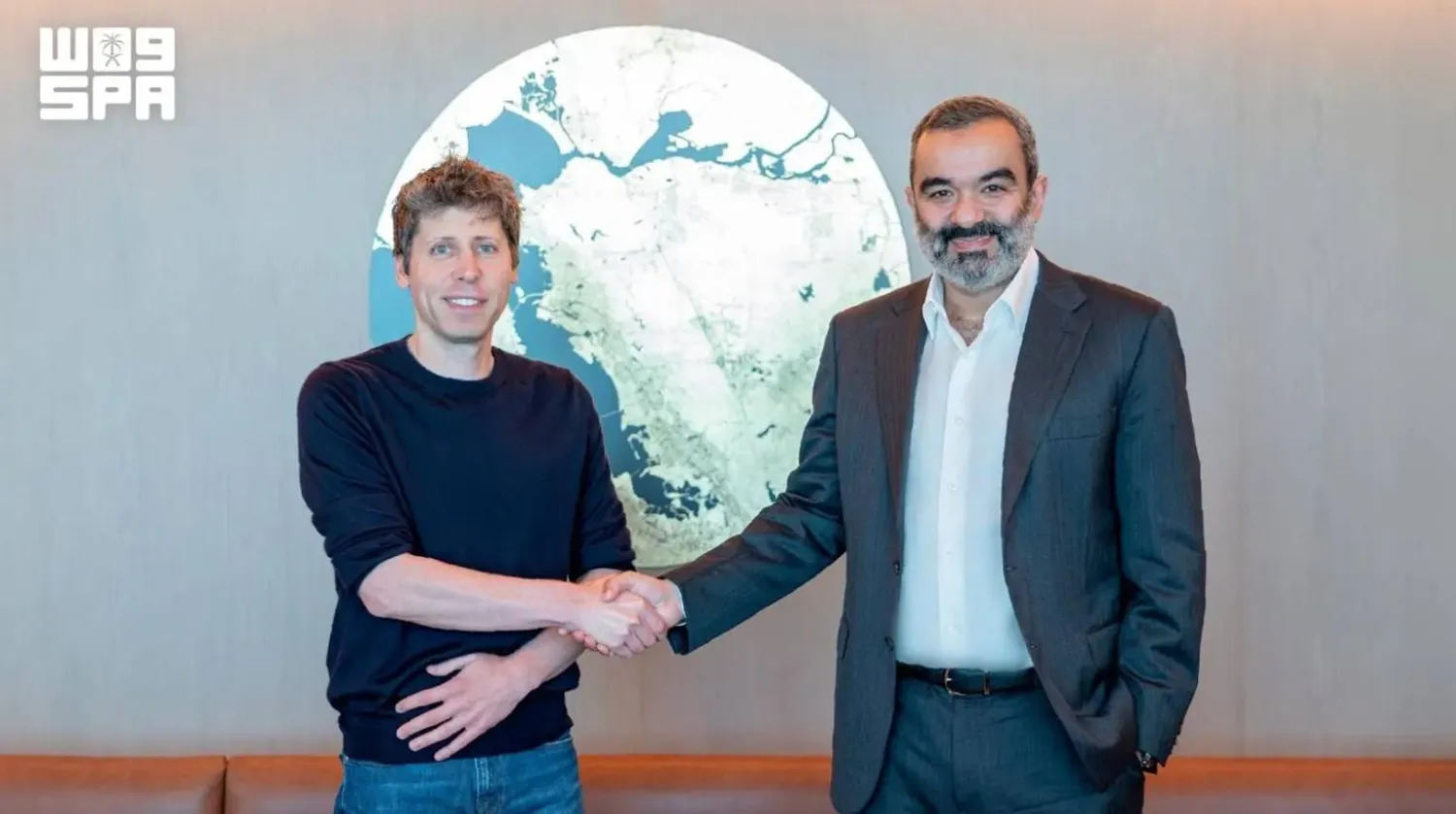
Minister of Communications and Information Technology Abdullah Alswaha's meetings are part of Saudi Arabia’s efforts to build an integrated AI ecosystem. SPA
Alswaha Strengthens Saudi Arabia’s AI Partnerships, Expands Computing Infrastructure
Minister of Communications and Information Technology Abdullah Alswaha's meetings are part of Saudi Arabia’s efforts to build an integrated AI ecosystem. SPA
Minister of Communications and Information Technology Abdullah Alswaha held a series of meetings with leaders of major global technology and investment companies during the second day of his visit to Silicon Valley.
The meetings focused on strengthening Saudi Arabia’s partnerships in artificial intelligence (AI), expanding computing capabilities and infrastructure, accelerating the development of advanced applications and robotics, and attracting high-value investments.
Alswaha met with OpenAI CEO Sam Altman and senior company executives to discuss expanding cooperation in advanced AI models, leveraging the computing capabilities and infrastructure being developed by HUMAIN to support the large-scale deployment of AI models, and accelerating the development of advanced national applications in priority sectors.
In the field of AI infrastructure, Alswaha met with Dell Technologies Chairman and CEO Michael Dell to discuss accelerating enterprise adoption of AI solutions, integrating Dell AI Factory solutions with HUMAIN’s computing capabilities to support the deployment of enterprise AI at scale, and advancing knowledge transfer and national capability development to support the transformation of key sectors in the Kingdom.
He also met with Cognition AI Co-Founder and CEO Scott Wu and senior company executives to discuss expanding the use of autonomous software engineering solutions, improving developer productivity, enabling the deployment of Devin and software agents through HUMAIN’s computing capabilities, and accelerating national capabilities in building and operating AI applications.
Alswaha also met with Solidigm Senior Vice President and Head of Global Operations Kyle Fukuda to discuss using advanced storage solutions in the computing infrastructure and data centers being developed by HUMAIN, improving data access efficiency and computing resource utilization, and supporting the expansion of AI applications in the Kingdom.
In the investment sector, Alswaha met with Social Capital Founder and CEO Chamath Palihapitiya to discuss attracting the firm’s investments into the infrastructure and computing capabilities being developed by the Kingdom, expanding investment in advanced technologies, and connecting global capital with high-value opportunities in Saudi Arabia.
These meetings are part of Saudi Arabia’s efforts to build an integrated AI ecosystem encompassing advanced models, computing capabilities, data centers, infrastructure, applications, robotics, and investment, further strengthening the competitiveness of the Kingdom’s digital economy and reinforcing its position as a global hub for technology, innovation, and AI.
Gulf, UK Officials Press for Action on Free Trade Deal as Investment Opportunities Beckonhttps://english.aawsat.com/business/5331691-gulf-uk-officials-press-action-free-trade-deal-investment-opportunities-beckon
Gulf, UK Officials Press for Action on Free Trade Deal as Investment Opportunities Beckon
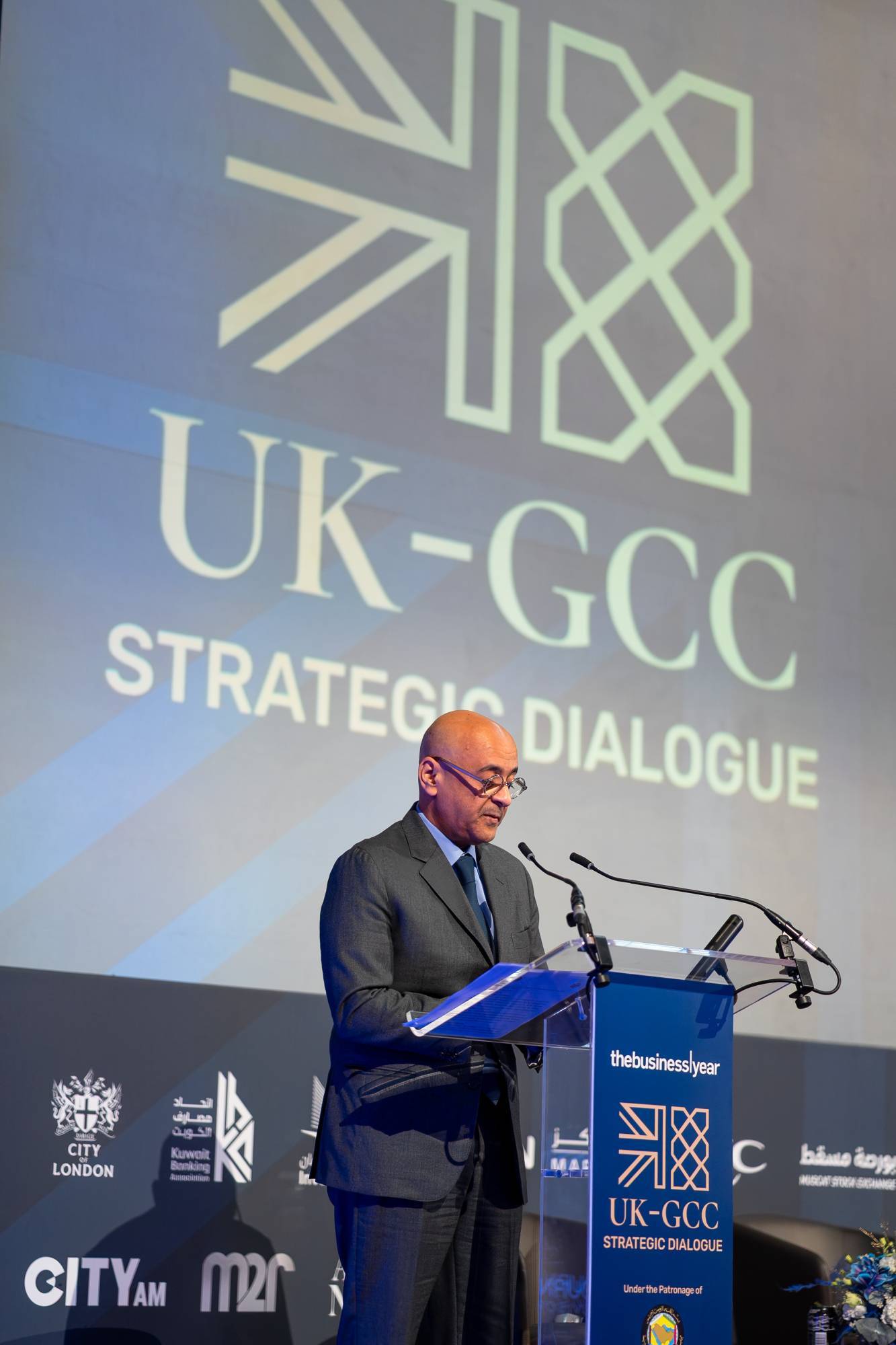
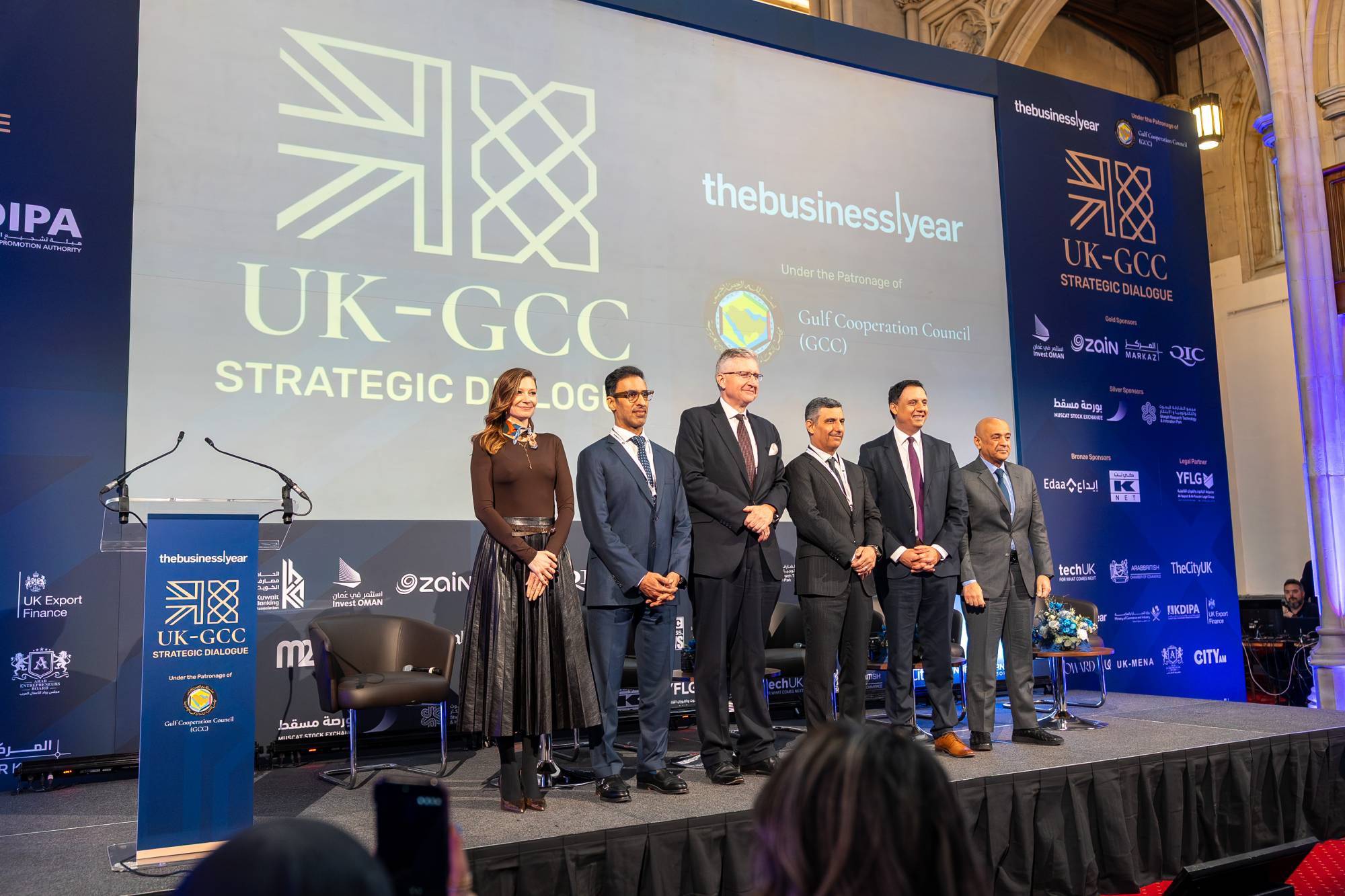
The UK-GCC Strategic Dialogue Forum was held in London on Tuesday. (UK-GCC Strategic Dialogue Forum)
Gulf and British officials on Tuesday called for swift action to translate a free trade agreement into tangible investments and economic gains after concluding negotiations, saying closer ties could help both sides navigate mounting challenges to global trade and supply chains.
At the UK-GCC Strategic Dialogue Forum in London, GCC Secretary-General Jasem Mohamed Albudaiwi said the agreement's success would be measured by the joint projects, productive investments and economic opportunities it generates.
He urged business leaders and investors to move beyond the agreement itself and focus on implementation, investment and shared prosperity.
British Minister of State for Trade Anas Sarwar said Britain was working with its Gulf partners to bring the agreement to signing and implementation, but stressed that businesses need not wait for those formalities to expand cooperation.
He urged companies and investors to accelerate existing trade and investment partnerships rather than wait for the signing, legislative procedures and implementation to be completed.
Growing economic partnership
Trade between the GCC and Britain reached about $70 billion in 2025, making the six Gulf states collectively Britain's 10th-largest trading partner, Albudaiwi said.
The combined value of investment assets and liabilities between the two sides stood at around $643 billion in 2024.
Albudaiwi said the figures underscored the strength of Gulf-British economic relations and the scope for further expansion.
With a combined gross domestic product of about $2.4 trillion, the GCC ranks among the world's 10 largest economies, while its foreign trade exceeds $1.8 trillion, he added.
The conclusion of free trade negotiations marked a strategic step toward strengthening those ties by easing trade, encouraging investment and opening new opportunities for private businesses.
Under the agreement, tariffs are expected to be eliminated on more than 99% of GCC exports to Britain, potentially boosting non-oil exports, particularly aluminum, fertilizers and manufactured goods.
Albudaiwi said the deal would also strengthen the Gulf's position as a global logistics hub and help small and medium-sized enterprises expand their operations and access the British market.
But its significance extends beyond trade gains, he said. The agreement could lay the foundation for a long-term economic and investment partnership spanning advanced manufacturing, the digital economy, artificial intelligence, clean energy, sustainability, financial and investment services, education, food security and logistics.
Albudaiwi said cooperation in those sectors could shift Gulf-British relations beyond traditional trade toward deeper economic integration, driven by joint investments, technology and knowledge transfers, and stronger production capabilities.
Britain sees Gulf states as strategic economic allies
Sarwar said Britain regarded the GCC states as more than trading markets, describing them as strategic economic allies and friends.
He said choosing the Gulf for his first international visit outside Europe since taking office as trade minister reflected the importance Britain placed on the partnership, particularly amid uncertainty and mounting challenges.
Sarwar stressed the value of solidarity and friendship during difficult times, saying individuals, communities and countries needed to know they could rely on their partners.
He called for a mutually beneficial relationship built on stronger two-way investment and trade, with British companies expanding into Gulf markets and Gulf businesses increasing their presence in Britain.
Opportunities also extended beyond each other's markets to joint investments in third countries, an area Sarwar said offered considerable potential.
He identified aviation and related industries, financial and legal services, defense and security, artificial intelligence, energy, food industries, education and scientific research as sectors with scope for expanded cooperation.
In aviation, Sarwar highlighted Britain's expertise in aircraft manufacturing, engines and security systems, alongside efforts to attract more direct flights from the Gulf to Britain.
He also urged closer cooperation between Gulf and British educational and research institutions, combining Britain's academic and research expertise with Gulf capabilities in energy and investment.
Sarwar said the British prime minister had tasked him with making the United Kingdom the world's most connected economy.
Achieving that goal, he said, would require boosting exports and investment while ensuring the benefits of economic growth reached regions across Britain.
He added that Gulf investment was not confined to London or northern England but extended across different parts of the United Kingdom.
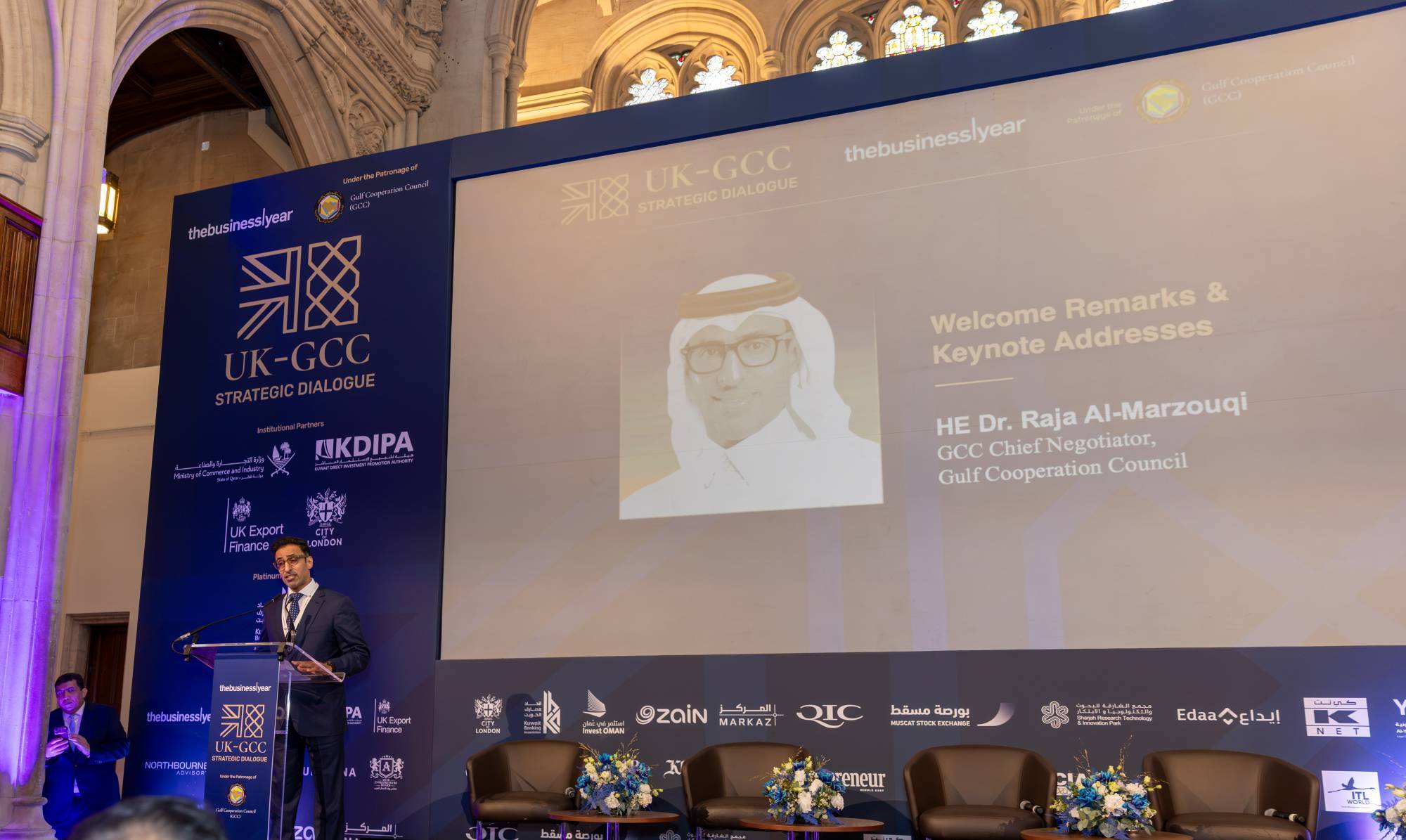
GCC chief negotiator and general coordinator for negotiations Raja Al-Marzouqi delivers his address at the forum. (UK-GCC Strategic Dialogue Forum)
More than 900 meetings over four years
GCC chief negotiator and general coordinator for negotiations Raja Al-Marzouqi said the two sides held more than 900 meetings over four years before reaching the wide-ranging agreement, adding that the negotiations were not easy.
He said the agreement sent a strong message to the international community about the resilience of trade and globalization at a time when the global economy faced challenges affecting the multilateral trading system.
Covering trade in goods and services, investment, rules of origin and digital trade, the agreement is expected to generate economic gains for both sides, according to economic assessments cited by Al-Marzouqi.
Britain's annual economic gains could reach approximately $4.7 billion, while the Gulf states are expected to benefit particularly from services, investment and improved productivity, he remarked.
Al-Marzouqi linked the agreement to the economic transformation underway across the GCC, where governments are seeking to move away from dependence on oil and public spending toward private sector-led growth.
That shift offered British businesses substantial opportunities to participate in projects and investments supporting Gulf economic diversification, he noted.
Gulf and British officials on Tuesday called for swift action to translate a free trade agreement into tangible investments at the UK-GCC Strategic Dialogue Forum in London. (UK-GCC Strategic Dialogue Forum)
From negotiations to results
Kuwait's Minister of State for Economic Affairs and Investment and Acting Minister of Commerce and Industry Abdulaziz Al-Marzooq said the next phase of Gulf-British relations should focus on deeper cooperation in trade, investment, technology, infrastructure, financial services and advanced industries.
He said the GCC offered Britain more than a market, given the Gulf states' established trade links with Asia and Africa.
Al-Marzooq urged both sides to move beyond dialogue and focus on implementation, turning available opportunities into projects, partnerships and measurable economic value.
He said the conclusion of free trade negotiations would give businesses greater certainty and the market access needed to turn investment intentions into action.
While participants agreed on the agreement's strategic importance, their remarks underscored that concluding negotiations was not the end of the process but the beginning of a new phase.
The focus now is on translating the agreement into tangible investments and projects while completing the formal procedures required for signing and implementation.
Saudi Stock Market Falls to Lowest Close Since April 2021https://english.aawsat.com/business/5331624-saudi-stock-market-falls-lowest-close-april-2021
Saudi Stock Market Falls to Lowest Close Since April 2021
A trader monitors stocks in Saudi Arabia (Reuters)
Saudi Arabia's benchmark Tadawul All Share Index (TASI) ended Tuesday's session down 1.7 percent, shedding 172 points to close at 9,952, its lowest closing level since April 2021, with total trading turnover reaching approximately SAR 3.8 billion.
The index fluctuated between an intraday low of 9,941 points and a high of 10,116 points. Since the beginning of the year, it has lost around 540 points, equivalent to 5.1 percent.
Several heavyweight stocks declined during the session, with Saudi Aramco falling 1 percent to SAR 25.48 and Al Rajhi Bank dropping by the same percentage to SAR 60.15.
Shares of Mobily, BSF and Yamama Cement fell between 1 and 3 percent, while Yansab dropped 7 percent.
SABIC Agri-Nutrients and Bank Albilad each declined 3 percent, closing at SAR 109.80 and SAR 21.47, respectively, following the release of their financial results for the third quarter of 2026.
Tihama led the session's decliners, falling 8 percent, while Azm topped the gainers with a 4 percent increase.
Ferrari: Saudi Arabia Has Become a Key Driver of Our Growth in the Middle Easthttps://english.aawsat.com/business/5331601-ferrari-saudi-arabia-has-become-key-driver-our-growth-middle-east
Ferrari: Saudi Arabia Has Become a Key Driver of Our Growth in the Middle East
Ferrari's new showroom in the Saudi capital, Riyadh (Asharq Al-Awsat)
Saudi Arabia has emerged as one of the main drivers of Italian luxury sports carmaker Ferrari's growth in the Middle East, fueled by an expanding population of high-net-worth individuals, a new generation of customers and growing interest in luxury sports cars.
Despite accelerating demand across the region, the company remains committed to a strategy centered on limited production and preserving the exclusivity of its brand.
Giorgio Turri, Regional Director of Ferrari Middle East, said Saudi Arabia is no longer simply a market experiencing rising demand, but has become a strategic market for Ferrari's presence, future growth and innovation in the Middle East.
Speaking to Asharq Al-Awsat, Turri explained that the economic and social transformations associated with Saudi Vision 2030 have contributed to a shift in the company's customer demographics, with growing numbers of younger buyers interested in sports cars, vehicle personalization and motorsports.
Riyadh Showroom Reflects Market's Importance
Turri said the opening of Ferrari's new showroom in Riyadh, the first in the Middle East and Asia to adopt the company's new corporate identity, reflects the growing importance of the Saudi market within its regional strategy.
He added that demand in the Kingdom continues on an upward trajectory among both existing and first-time customers.
Ferrari is seeking to broaden its customer base by developing new models, building on the success of vehicles such as the California, Roma and Purosangue, while looking ahead to the introduction of the Luce, its first fully electric vehicle and first five-seat model.
Growth Versus Exclusivity
Despite rising demand, Turri stressed that Ferrari does not pursue higher sales volumes as an end in themselves.
"We" do not seek to increase sales volumes as a goal in itself, he said, explaining that expansion requires carefully balancing market demand with the company's commitment to limited production.
He noted that Ferrari customers in the Middle East are among the youngest worldwide, a trend also evident in Saudi Arabia, where interest in vehicle personalization programs and participation in driving and racing activities is increasing.
Turri said the Kingdom is home to one of the most active Ferrari owners' clubs globally, while Saudi customers demonstrate detailed knowledge of vehicle specifications, technology and performance.
Saudi Arabia, UAE and Qatar Lead Regional Demand
Discussing regional market performance, Turri said economic transformation and growing wealth are supporting long-term demand for luxury vehicles.
He noted that demand is accelerating more rapidly in Saudi Arabia, the United Arab Emirates and Qatar than in other markets across the region.
More than 40 percent of new Ferraris delivered annually in the Middle East go to first-time buyers of the brand, he revealed, while the proportion exceeds 50 percent in the pre-owned vehicle market.
These trends coincide with Ferrari's plan to introduce an average of four new models annually between 2026 and 2030.
Regional Disruptions Force Changes to Shipping Routes
Addressing the impact of recent geopolitical disruptions, Turri said the main effects were felt in supply chains and logistics, after the closure of the Strait of Hormuz forced Ferrari to adjust shipping routes to Gulf markets.
He explained that the company managed the challenges during March and resumed its normal pace of operations in April by rerouting maritime shipments and using air freight when necessary.
Turri confirmed that showrooms and service centers continued operating and that demand had not changed significantly, with the economic and demographic factors supporting the Gulf market remaining intact.
An Ecosystem Beyond Car Sales
Turning to Ferrari's strategy in Saudi Arabia, Turri said the next phase would focus on expanding activities associated with vehicle ownership, including driving programs, racing events and exclusive customer experiences.
He explained that the Jeddah Corniche Circuit has been part of Ferrari's programs since 2023 and is scheduled to host the Ferrari Challenge championship for the first time in February 2027, amid growing participation by Saudi amateur drivers.
Turri also highlighted the company's first customer tour in AlUla in 2025, alongside other events organized during the holy month of Ramadan.
He said these activities have become an integral part of Ferrari's strategy to deepen customers' connection with the brand.
Turri emphasized that Saudi Arabia represents a significant growth opportunity in the coming years, driven not only by increasing demand for sports cars but also by an expanding customer base and growing interest in motorsports across the Kingdom.
لم تشترك بعد
انشئ حساباً خاصاً بك لتحصل على أخبار مخصصة لك ولتتمتع بخاصية حفظ المقالات وتتلقى نشراتنا البريدية المتنوعة