Asian Shares Mostly Rise amid Market Optimism about AI, Despite Iran Worries

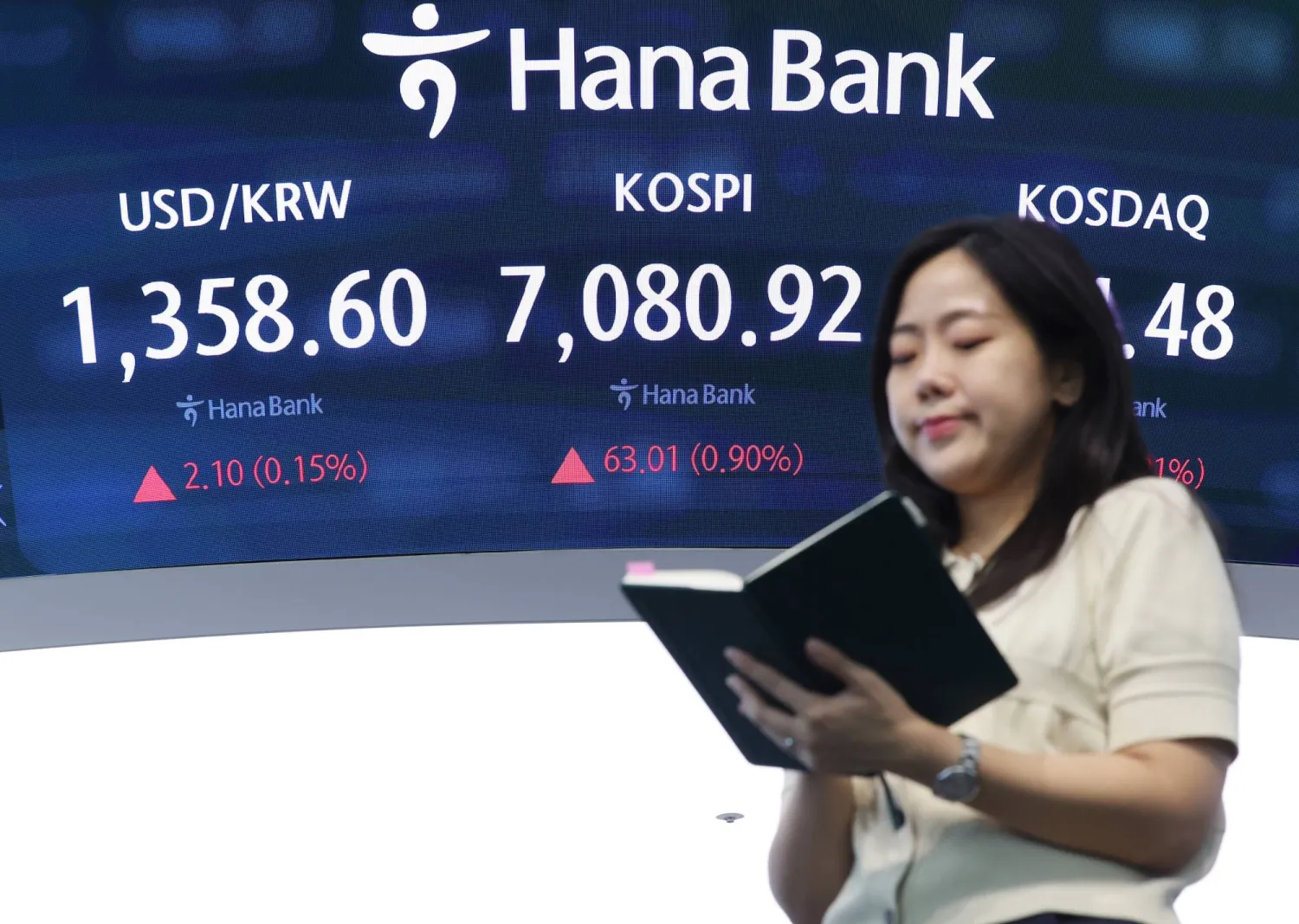
A financial data screen in the dealing room of Hana Bank shows the Korea Composite Stock Price Index (KOSPI) after South Korean shares closed higher in Seoul, South Korea, 23 September 2026. EPA/YONHAP SOUTH KOREA OUT
TT

Asian Shares Mostly Rise amid Market Optimism about AI, Despite Iran Worries

A financial data screen in the dealing room of Hana Bank shows the Korea Composite Stock Price Index (KOSPI) after South Korean shares closed higher in Seoul, South Korea, 23 September 2026. EPA/YONHAP SOUTH KOREA OUT

Asian shares mostly rose in early Thursday trading amid investor interest in technology-related issues, despite ongoing worries about the war in Iran.

Japan's benchmark Nikkei 225 jumped 2.4% in morning trading to 68,355.81. Australia's S&P/ASX 200 lost 1.7% to 8,638.10. South Korea's Kospi edged up 0.5% to 6,873.06. Hong Kong's Hang Seng added 0.4% to 24,613.27, while the Shanghai Composite gained 0.3% to 3,842.19.

In Tokyo trading, issues expected to get a boost from the solid demand in computer chips and AI-related growth have been rising in recent sessions, including Advantest Corp., Tokyo Electron and SoftBank Group Corp.

US stocks mostly fell Wednesday, despite indications that the US economy remains strong. On Wall Street, the S&P 500 slipped 0.3% to close out its third losing month in the last four. The Dow Jones Industrial Average dropped 443 points, or 0.9%, and the Nasdaq composite added 0.2%.

The report that said inflation wasn’t as bad across the United States last month as economists expected. It said the cost of living for US consumers was 3.4% higher overall in August than a year earlier. That was not as high as the 3.7% inflation rate that economists expected, even if it remained worse than the Fed’s 2% target.

In energy trading, benchmark US crude lost 0.56% to $89.91 a barrel. Brent crude, the international standard, fell 0.35% to $97.69 a barrel.

Oil prices have been swinging wildly in recent months amid uncertainty about when the war with Iran will allow the flow of crude to be fully restored. Iranian officials indicated Wednesday they have received an official US response to Tehran’s latest proposal to end the seven-month war. The officials did not say what the latest response contained and whether it was a rejection.

US President Donald Trump publicly rejected Iran's proposal just days earlier to reopen the Strait of Hormuz within a week if the US meets certain conditions.

The yield on the 10-year Treasury, which is the centerpiece of the bond market, rose to 5.29%, up from 5.26% late Tuesday, and it’s back to where it was more than two decades ago in 2002.

The 30-year Treasury yield, which takes into account expectations for inflation and economic growth many years down the line, climbed to 5.64% from 5.59% late Tuesday.

All told, the S&P 500 fell 19.30 points to 7,651.54. The Dow Jones Industrial Average dropped 443.87 to 50,906.05, and the Nasdaq composite added 63.52 to 26,861.06.

In currency trading, the US dollar rose to 158.17 Japanese yen from 157.33 yen. The euro cost $1.1328, down from $1.1334.


Port Security and Trade Continuity: A New Formula for Saudi Competitiveness

A panel discussion featuring Professor Waheed Sami Abu Shanab (Conference)
TT

Port Security and Trade Continuity: A New Formula for Saudi Competitiveness

A panel discussion featuring Professor Waheed Sami Abu Shanab (Conference)

Port competitiveness is no longer just about handling more ships and containers. Keeping trade moving and infrastructure secure against physical and cyber threats has become just as critical, as ports grow more reliant on digital systems and supply chains become increasingly complex.

The economic fallout from port disruptions and their impact on global trade took center stage at a session titled "Securing Infrastructure" during the Saudi Maritime and Logistics Congress 2026, which opened Wednesday in Jeddah with maritime and infrastructure security experts in attendance.

Discussions focused on threats facing ports and shipping companies, particularly cyberattacks capable of crippling operations and disrupting trade, and the need to strengthen port readiness to keep services running and limit economic losses.

Professor Waheed Sami Abu Shanab, a professor of marine engineering at King Abdulaziz University's Faculty of Maritime Studies, said Saudi ports now face a challenge that goes beyond expanding capacity: withstanding disruptions while keeping trade flowing at the lowest possible cost.

Speaking to Asharq Al-Awsat on the sidelines of the session, Abu Shanab said Saudi Arabia's ports on the Red Sea and Arabian Gulf gave the kingdom a strategic advantage as international trade routes shift. But making the most of that position requires greater investment in operational resilience, logistics connectivity and cybersecurity.

Investments top $3.7 billion

The challenges come as Saudi Arabia ramps up investment in port infrastructure. Its ports now have 34 logistics centers, including 17 at Jeddah Islamic Port, backed by investments exceeding 14 billion riyals ($3.7 billion), alongside projects to upgrade container terminals and boost handling capacity.

Abu Shanab said the investments include more than 2 billion riyals to develop a container terminal at Jubail Port and an initial 1.6 billion riyals for a fourth container terminal at Jeddah Islamic Port. Other projects involve upgrading cargo-handling equipment and expanding the use of modern operating systems.

He said future investment must focus on operational efficiency, reserve capacity and stronger links between ports, roads, railways and logistics hubs to absorb sudden surges in shipping volumes and redirect cargo when routes are disrupted.

Abu Shanab floated a preliminary proposal for an additional 10 billion to 20 billion riyals in investment over five years to strengthen strategic ports' readiness.

He stressed that the figure was a proposed planning scenario, not an official assessment of the sector's needs or an approved budget.

Cyberattacks threaten trade beyond ports

Abu Shanab warned that growing reliance on digital systems exposes ports to cyber threats whose economic impact could ripple through factories, markets and supply chains.

He pointed to the 2017 cyberattack on global shipping group Maersk, which the company estimated cost it between $200 million and $300 million after widespread disruption to its operations and systems.

A failure of digital systems managing containers, vessel schedules and cranes could leave cargo stranded, drive up delay and insurance costs, and undermine shipping companies' commitments and customer confidence, he said.

To illustrate the potential costs, Abu Shanab offered a hypothetical scenario: a delay affecting 5,000 twenty-foot equivalent units (TEUs), each incurring an additional 1,000 riyals in costs, would generate a direct bill of 5 million riyals before indirect losses.

He stressed that the calculation did not reflect actual losses at Saudi ports but illustrated the potential cost of disruptions. Investing in prevention and business continuity, he argued, could be cheaper than shutting down a strategic port.

Competitiveness goes beyond handling fees

Abu Shanab said regional ports should be judged not simply by their handling charges but by the total cost of getting goods from ships to markets, including customs clearance, storage, inland transport and schedule reliability.

Saudi ports overseen by the Saudi Ports Authority handled about 8.3 million TEUs in 2025, up 10.58% from a year earlier, highlighting growing activity and the need to expand capabilities without compromising service efficiency.

Artificial intelligence could help schedule vessel arrivals and allocate berths, while upgraded handling equipment could cut waiting times and fuel, storage and transportation costs, making services more reliable for shipping lines, he said.

"The most competitive port is not necessarily the one with the lowest fees, but the one offering the lowest total logistics cost, the greatest reliability and the fastest access to markets," Abu Shanab said.

Simulating crises before they strike

Abu Shanab called for a national simulation model using digital twins and artificial intelligence to test how ports and supply chains would respond to facility shutdowns or shifting maritime routes, and measure the time and cost of restoring operations.

He also urged stronger protection for critical infrastructure, including submarine cables, energy and telecommunications facilities, alongside improved vessel monitoring systems, disaster recovery centers and backup operating plans to keep essential services running.

Saudi Arabia's ports on two coastlines, coupled with expanding logistics services and transport networks, offer a foundation for more reliable supply chains, he said. But realizing that potential depends on matching existing investments with operational and technological readiness.

Protecting maritime infrastructure, Abu Shanab concluded, is no longer a standalone security or technical concern. It is central to port competitiveness and Saudi Arabia's ability to keep trade flowing, attract shipping lines and secure long-term investment.


Türkiye Cuts Key Interest Rate to 36%, First Cut in Months

Central Bank of Türkiye (Official Website)
TT

Türkiye Cuts Key Interest Rate to 36%, First Cut in Months

Central Bank of Türkiye (Official Website)

Türkiye's central bank cut its key interest rate on Thursday to 36 percent in the first cut in nine months, pointing to a recent slowdown in inflation.

At a policy meeting, the bank "decided to reduce the policy interest rate ... from 37 percent to 36 percent," it said in a statement.

It was the first cut since January when the bank cut the key rate from 38 to 37 percent, a rate which it held until Thursday's meeting.

"Despite monthly fluctuations, recent inflation figures and leading indicators confirm the downward trend," a bank statement said.

"Data on economic activity and the limited impact of supply shocks on domestic prices suggest that the weak trend in domestic demand continues," it added.

However, ongoing geopolitical tensions were keeping energy prices high, which could push inflation higher, it warned, saying the effects of such geopolitical developments "are being closely monitored".

Türkiye's annual inflation rate eased to 29.7 percent in September from 31.5 percent in August - the first time it had fallen below 30 percent in nearly five years, official figures showed.

At the time, Finance Minister Mehmet Simsek said it was at its lowest level since November 2021. "Disinflation is spreading across the board, excluding transportation," he wrote on X.

The official figures are disputed by the ENAG group of independent economists that publishes its own data, which said its figures showed year-on-year inflation stood at 46.6 percent in September.


Saudi Stock Market Drops 2.3% to Lowest Close Since 2021

A person stands in front of a screen showing falling stock prices (Reuters)
TT

Saudi Stock Market Drops 2.3% to Lowest Close Since 2021

A person stands in front of a screen showing falling stock prices (Reuters)

Saudi Arabia's benchmark stock index ended Thursday's session down 2.3 percent, shedding 231 points to close at 9,696, its lowest closing level since 2021, with total trading turnover reaching approximately SAR 4.9 billion.

The Tadawul All Share Index (TASI) fluctuated between an intraday low of 9,640 points and a high of 9,888 points.

Thursday's decline brought the index's weekly losses to more than 400 points, or 4.1 percent, marking its eighth consecutive week of declines.

Most stocks fell during the session, led by Saudi National Bank, which dropped more than 5 percent to SAR 34.62, with approximately 9 million shares traded.

Saudi Aramco and Al Rajhi Bank each declined 1 percent, closing at SAR 25.40 and SAR 59.80, respectively, while Maaden fell 5 percent to SAR 55.90.

Shares of Retal, Al Yamamah Steel, East Pipes, Jahez, Gulf Training and Saudi Steel Pipe ended the session with losses ranging from 5 to 9 percent.

Meanwhile, Electrical Industries, Abo Moati, Umm Al-Qura Cement, Saleh Al-Rashed, Wafrah, Saudi Vitrified Clay Pipe and Watani Iron Steel each fell 10 percent.

On the upside, Al-Etihad rose 10 percent to SAR 6.16, followed by JAZADCO with gains exceeding 9 percent. Shares of Al Arabia, UCIC and Saudi Kayan advanced between 1 and 3 percent.