

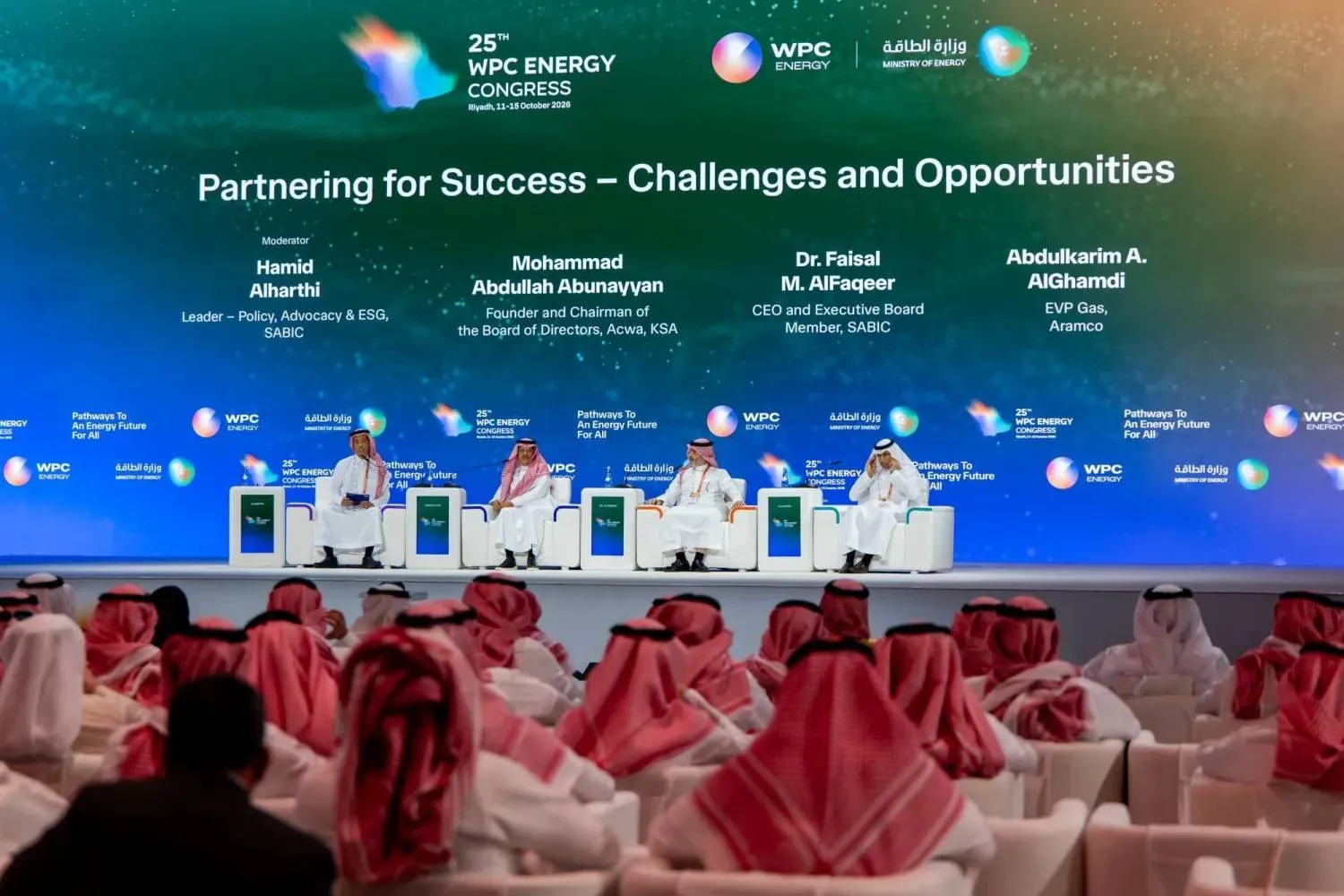

From Hydrogen to AI, Energy Leaders Map the Sector’s Global Future

A panel discussion examines challenges and opportunities at the World Petroleum Congress in Riyadh (Asharq Al-Awsat)
TT

From Hydrogen to AI, Energy Leaders Map the Sector’s Global Future

A panel discussion examines challenges and opportunities at the World Petroleum Congress in Riyadh (Asharq Al-Awsat)

Green hydrogen, artificial intelligence and strategic partnerships took center stage at the World Petroleum Congress in Riyadh, as sessions mapped the energy sector’s future amid rapid technological and industrial change.

Progress on clean energy projects, led by the NEOM Green Hydrogen Project, now 96% complete, intersected with the challenge of cutting emissions from transport, which accounts for about 30% of global energy demand.

The discussions highlighted a widening agenda: developing energy sources and reshaping how energy is produced and used to improve efficiency and sustain supplies.

Saudi Aramco said it plans to increase gas sales by 80% by 2030 compared with 2020 and 2021 levels, and to build and start operating six to seven gas and liquefied gas facilities between 2025 and 2027.

Decarbonization

Transport and logistics account for about 30% of global energy demand, Saudi Vice Minister of Transport and Logistics Services Rumaih Al-Rumaih told a conference session.

Decarbonization is a long journey that requires a broader energy mix, he said, stressing the need for available, reliable, affordable and safe supplies.

The Saudi Green Initiative provides a framework for reaching net-zero emissions by 2060, with transport playing a major role, Al-Rumaih said.

Saudi Arabia is expanding public transport and cutting urban emissions to meet its commitments, he added. The Riyadh Metro network spans 187 kilometers and has 85 stations.

Green hydrogen

National Development Fund Governor Abdulaziz Al-Arifi said the fund had provided financing and strategic support for the NEOM Green Hydrogen Project alongside local banks and other entities and organizations.

That support helped advance one of the clean energy sector’s leading projects, strengthening investment opportunities and local content, he told the conference.

ACWA Power Chairman Mohammad Abunayyan said local resources, knowledge and expertise accounted for about 90% of those used in new projects. He reaffirmed the company’s commitment to expanding investment and overcoming challenges on the ground in major global markets such as China.

At the same session, Saudi Aramco Executive Vice President of Gas Abdulkarim Al-Ghamdi discussed operational readiness and supply chains.

Resource localization under the company’s iktva program had reached levels ranging from more than 75% to 90%, he said, offering strong protection against external disruptions.

Saudi personnel and technological integration are the two pillars of sustained gas-sector growth and future resilience, he said.

Artificial intelligence

A panel at the 25th World Petroleum Congress explored how energy powers artificial intelligence, how the two sectors interact and how AI can sharpen decisions, improve operations and raise energy efficiency.

Speakers said development of the energy and electricity sectors under Vision 2030 aims to meet demand and attract investment, including in AI data centers that need reliable, competitively priced electricity.

The approach involves anticipating sectors’ needs and connecting them with investors. Speakers stressed the need to integrate infrastructure, data, technology and human expertise, drawing on Saudi Arabia’s strengths to develop solutions and bring them to global markets.

Smart meters

AI can improve forecasts of electricity loads and demand and detect grid faults early, helping planners respond faster, speakers said.

Smart meter data can track consumption, forecast bills, show electricity use by appliance and flag unusual usage.

In oil and gas exploration and resource development, particularly drilling, AI can analyze data in real time and combine engineering models with geological information.

This can speed up decisions, improve accuracy, shorten the gap between planning and execution, enhance safety and support risk assessments and investment decisions.

To expand these applications, companies must deliver tangible business value and integrate the tools into operations, speakers said.

They must also ensure data quality and timely collection, train personnel to assess outputs and keep people involved in final decisions, while using digital tools to reduce risks.


IEA to Speed up Oil Stocks Release Including Over 20 Million Barrels of Diesel

An aerial view shows the fuel depot of Aral at the Ruhr Oel petroleum refineries of BP Gelsenkirchen GmbH in Gelsenkirchen, western Germany on October 15, 2026. (AFP)
TT

IEA to Speed up Oil Stocks Release Including Over 20 Million Barrels of Diesel

An aerial view shows the fuel depot of Aral at the Ruhr Oel petroleum refineries of BP Gelsenkirchen GmbH in Gelsenkirchen, western Germany on October 15, 2026. (AFP)

The International Energy Agency agreed on Thursday to release over 20 million barrels of diesel to the market and any oil remaining from a record emergency reserves release pledged in March to boost supply and cool soaring prices.

US President Donald Trump has pressed European Union countries to draw down reserves or face a potential US diesel export ban as he seeks to lower prices ahead of November 3 midterm elections.

Diesel prices have surged to record highs in many markets due to disrupted supply ‌because of the ‌Iran war and the Russia-Ukraine conflict, posing inflation and cost-of-living threats ‌to ⁠governments and consumers.

The ⁠32-nation IEA's board met on Thursday to discuss the scale and timing of stock releases.

"The IEA governing board reaffirmed its commitment to continue delivering on the March 2026 Collective Action in response to the Strait of Hormuz crisis," it said in a statement after the meeting.

In March, countries had pledged to release more than 400 million barrels of crude and oil products as prices soared.

On Thursday, members "agreed to accelerate the release of the ⁠remaining volumes, with specific plans already in place, including over 20 ‌million barrels of diesel as soon as possible."

SOME ‌DISAPPOINTMENT OVER LACK OF EXTRA BARRELS

Reuters reported this month that EU governments were discussing a French ‌proposal for the release of 50 million barrels of diesel alongside 50 million ‌barrels of crude from IEA members.

"The IEA announcement is a step in the right direction, but falls short on the details the market was looking for," said Abhishek Kumar, an analyst at Sparta Commodities. "The 20+ million barrels of diesel appear to be an acceleration of existing commitments rather ‌than genuinely new volumes."

The IEA, which coordinates industrialized nations' releases of oil from emergency stocks, said some members had already released ⁠more than they ⁠pledged in March and that others planned to do so.

Members have released approximately 330 million barrels so far, the IEA said.

The US Energy Department said further IEA releases, with a focus on diesel, are under review and in progress, citing the IEA statement.

But the Trump administration "continues to hold European nations accountable for failing to fulfill their previous commitments to minimize supply disruptions in global energy markets and to help lower energy prices," the Energy Department spokesperson added.

The White House, when asked if it was unhappy with the IEA's commitment to draw down reserves, provided the IEA's statement from Thursday on the releases.

Spain said on Thursday it would release 4.4 million barrels from strategic reserves in October.

Spain has released 3.7 million of the 11.5 million barrels it pledged in March.


Al-Jadaan: Saudi Investments in Alternative Routes Ensure Continuity of Energy Supplies and Trade

General view of the Kingdom Tower in downtown Riyadh, Saudi Arabia, October 12, 2026. Picture taken with a mobile phone. REUTERS
TT

Al-Jadaan: Saudi Investments in Alternative Routes Ensure Continuity of Energy Supplies and Trade

General view of the Kingdom Tower in downtown Riyadh, Saudi Arabia, October 12, 2026. Picture taken with a mobile phone. REUTERS

Saudi Finance Minister Mohammed Al-Jadaan said the Kingdom’s investments in alternative routes have helped ensure the continuity of energy supplies and trade flows amid uncertainty.

He stressed that strengthening economic resilience requires diversifying sources of economic strength, protecting the foundations of growth, and maintaining the capacity to deal with recurring and prolonged disruptions.

Speaking at the third meeting of G20 Finance Ministers and Central Bank Governors under the US presidency, held Thursday in Bangkok, Al-Jadaan said the global economy had demonstrated an ability to adapt to repeated disruptions. He explained that resilience is fundamental to this adaptability, but strengthening it requires an understanding of its cost, how it can be developed, and how it should be financed.

He said the success of economic policies in confronting shocks is not limited to mitigating the impact of current challenges. It also depends on preserving the ability to support future ambitions and sustain the long-term path of economic transformation, while maintaining sufficient buffers to deal with any new developments that may arise.

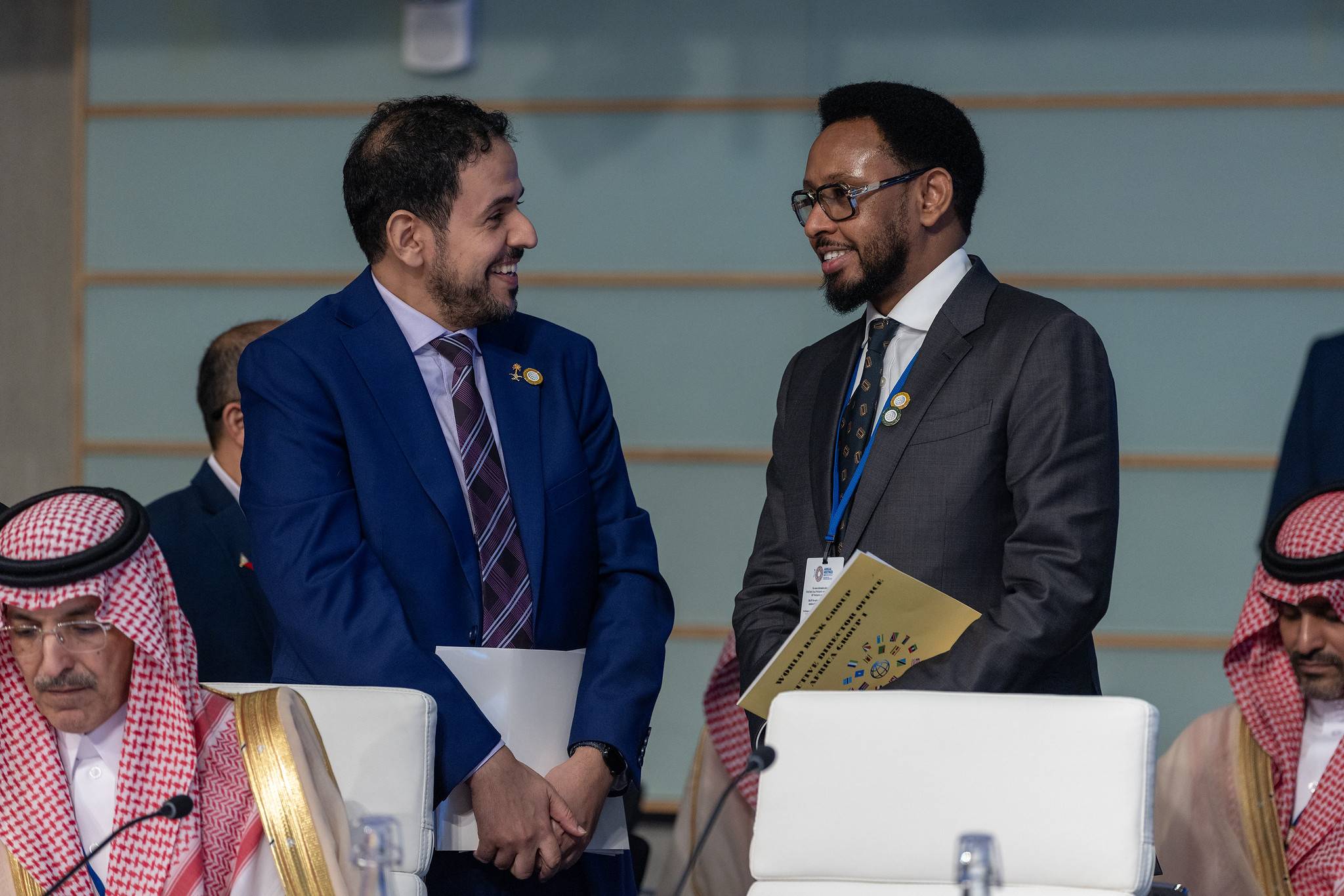
Al-Jadaan participates in one of the sessions at the annual meetings of the IMF and World Bank in Bangkok (IMF)

The Finance Minister stressed that fiscal policies must protect the foundations of growth, highlighting the importance of effective international cooperation in achieving economic stability.

He said access to reliable and affordable energy, along with the uninterrupted flow of essential goods, helps contain price pressures and ease the burden on national budgets, thereby strengthening countries’ ability to navigate uncertainty.

In this context, Al-Jadaan said the Kingdom, through its investments in alternative routes, has helped ensure the continuity of energy supplies and trade flows amid disruptions. This underscores the importance of infrastructure and transportation and supply routes in strengthening economies’ ability to withstand shocks and limiting their impact on markets and the flow of essential goods.

Managing Shocks and Strengthening Resilience

Discussing ways to enhance economic resilience, Al-Jadaan said dealing with prolonged shocks depends not only on the size of the buffers available to countries, but also on how these buffers are managed over time, while preserving sufficient capacity to respond to future developments.

He noted that strengthening economic resilience requires reducing exposure to risks through economic diversification, reinforcing energy and food security, and developing more resilient supply chains and infrastructure. These priorities have become increasingly important amid recurring disruptions affecting trade flows, the availability of essential goods, and the cost of obtaining them.

Al-Jadaan also addressed artificial intelligence, noting that it has evolved beyond a purely technological issue to become part of a broader agenda aimed at achieving sustainable growth and strengthening economic resilience. This reflects the expanding scope of policies required to build economies capable of adapting to change while preserving opportunities for long-term growth and transformation.

The Role of International Financial Institutions

The Finance Minister emphasized the important role played by multilateral financial institutions in helping economies that are most vulnerable to risk cope with financing pressures through financial and technical support programs and policy advice, thereby strengthening their ability to withstand shocks and maintain economic stability.

Al-Jadaan concluded his participation in the third meeting of G20 Finance Ministers and Central Bank Governors, held on the sidelines of the 2026 Annual Meetings of the International Monetary Fund and the World Bank Group in Thailand.

He met with a number of officials, heads of international financial institutions, and representatives of credit rating agencies. The meetings addressed developments in the global economy and policies aimed at supporting its stability, while also reviewing developments and reforms in the Saudi economy as part of the Kingdom’s efforts to strengthen its presence in international economic and financial dialogue.


Saudi Cybersecurity Market Tops $4.3 Billion in 2025

Employees working on computers (National Cybersecurity Authority). 
TT

Saudi Cybersecurity Market Tops $4.3 Billion in 2025

Employees working on computers (National Cybersecurity Authority). 

Saudi Arabia’s cybersecurity market reached SAR 16.3 billion ($4.3 billion) in 2025, recording a compound annual growth rate of 10.7% over the past three years, according to a new report by the National Cybersecurity Authority (NCA).

Government spending on cybersecurity products and services totaled SAR 5.1 billion, accounting for 31% of the market, while private sector expenditure reached SAR 11.2 billion, representing 69%.

The figures were released in the NCA’s report, Key Economic Indicators in Saudi Arabia’s Cybersecurity Sector 2026, which examines market size, the sector’s contribution to gross domestic product, workforce trends and other measures of growth.

Contribution to GDP

The cybersecurity sector contributed approximately SAR 20 billion to Saudi Arabia’s GDP at current prices in 2025, registering a compound annual growth rate of 13.2%, the authority reported.

Of that amount, SAR 9.7 billion represented the direct contribution of cybersecurity products and service providers, while indirect contributions totaled SAR 10.3 billion.

The sector accounted for 0.42% of the Kingdom’s overall GDP and 0.71% of non-oil GDP.

The cybersecurity workforce exceeded 22,000 specialists last year, reflecting a compound annual growth rate of 5.9%.

The report linked this expansion to specialized training initiatives and programs designed to meet the needs of vital sectors and support economic and social development.

Women accounted for 33% of cybersecurity professionals in Saudi Arabia, surpassing the global participation rate of approximately 22%.

Spending on products and services

Cybersecurity products accounted for 51% of total market spending, valued at SAR 8.3 billion, while services represented 49%, or SAR 7.9 billion.

The report identified key areas of spending, including endpoint security and management, cybersecurity systems integration, network security, data security and security operations solutions.

Public-private cooperation

The NCA highlighted efforts to strengthen competitiveness, encourage investment and innovation, and promote cooperation between the public and private sectors as key drivers of market growth.

The study classified cybersecurity offerings into 100 products and services, drawing on internationally recognized methodologies, standards and practices.

The NCA is Saudi Arabia’s designated cybersecurity authority and national reference body, tasked with protecting the Kingdom’s vital interests, national security, critical infrastructure, priority sectors, and government services and activities.

Its responsibilities also include stimulating industry growth, promoting innovation and investment, conducting research and development, and issuing periodic reports on cybersecurity at the national and sectoral levels.
