

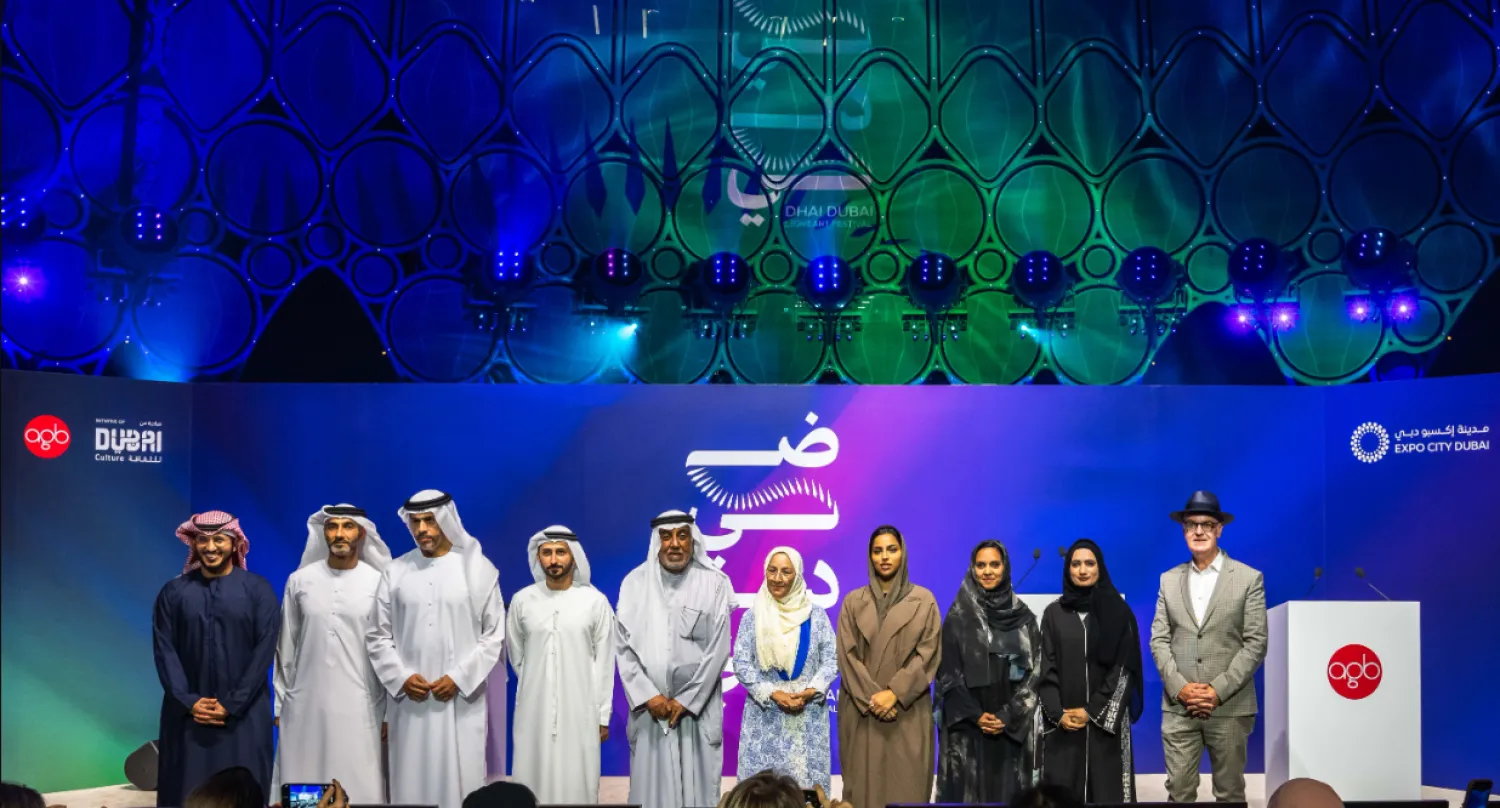

Expo City Dubai Launches 10-day Festival of Emirati Light Art, Culture

Dhai Dubai runs at Expo City Dubai from January 26 to February 4 - WAM
TT

Expo City Dubai Launches 10-day Festival of Emirati Light Art, Culture

Dhai Dubai runs at Expo City Dubai from January 26 to February 4 - WAM

Dhai Dubai, the first-ever Emirati-led light art festival, has launched its illuminating 10-day program at Expo City Dubai.

The event celebrates the rich artistic tapestry of Emirati through a series of awe-inspiring artistic projections, interactive installations, enlightening talks and creative workshops.

The free-to-attend festival is created and organized by Expo City Dubai, in partnership with AGB Creative and supported by Dubai Culture and Arts Authority and will run from January 26 to February 4, state news agency WAM reported.

Meanwhile, Al Wasl Plaza’s iconic dome, spanning 130 meters wide and 67.5 meters tall, with a 360-degree projection surface, will come to life with a series of special projection shows titled Sisters of the Desert.

The show is inspired by the exceptional work of the late Emirati artist, Dhabia Juma Lamlah, who embodied the resilient soul of Dubai. Dhabia Juma Lamlah defied her inability to use her right hand and communicate through speech, by expressing herself through more than 200 remarkable artworks.

Reflecting Dubai’s spirit of multicultural collaboration, the show also features special guests, Australian artist Rene Kulitja and South African artist Dr Esther Mahlangu, who weave together a narrative of resilience and cross-cultural connectivity, using art to bridge people separated by seemingly vast distances.

In keeping with Dubai’s dedication to humanitarianism, and Dhai Dubai’s firm belief in the transformational power of light, the festival has collaborated with the Expo Live award-winning Liter of Light initiative – a global, grassroots movement that uses affordable, accessible materials to provide high-quality solar lighting to those with limited or no access to electricity.

The festival will be supporting light lanterns to be distributed to the floating villages of Agusan Marsh in the Philippines. Festival visitors will also have the opportunity to pledge to contribute toward Liter of Light’s mission in communities across the Philippines, Kenya, Cameroon, and India.

The festival also encourages visitors to not only immerse themselves in art, but to interact with it through a series of striking installations. As part of the festival’s people-powered activities, skating turns into an art form at the Speed of Light skate park by XDubai, elevated by illustrations from prominent Emirati artist, Aysha Al Hamrani.


Saudi Arabia Holds Cultural Event in Moscow to Mark Centenary of Ties with Russia

The event marked 100 years of Saudi-Russian bilateral relations. SPA
TT

Saudi Arabia Holds Cultural Event in Moscow to Mark Centenary of Ties with Russia

The event marked 100 years of Saudi-Russian bilateral relations. SPA

The Saudi Ministry of Education, in cooperation with the Kingdom’s embassy in Russia, organized an academic and cultural event titled “A Century of Friendship and Cultural and Scientific Exchange between the Kingdom of Saudi Arabia and the Russian Federation” at the headquarters of the Peoples' Friendship University of Russia in Moscow.

The event marked 100 years of bilateral relations since 1926 and aimed to strengthen cultural and educational exchange, which has grown over the past decades.

The opening ceremony was attended by Saudi Ambassador to Russia Sami Al-Sadhan, Deputy Minister for International Cooperation Dr. Latifa Al-Faryan, and Rector of the Peoples' Friendship University of Russia Dr. Oleg Yastrebov, along with several academic and diplomatic officials from both sides, and broad participation from Saudi scholarship students and international students.

During the ceremony, Al-Faryan said that the ministry is continuing its plans to expand high-quality international partnerships, strengthen cooperation in higher education, scientific research, and innovation, and support academic exchange programs.

The scientific and cultural event in Moscow featured a series of academic sessions with leading scholars from Saudi and Russian universities, alongside the honoring of several individuals and institutions that contributed to advancing joint scientific and cultural cooperation.

Holding the event in Moscow reflects the Saudi Ministry of Education’s direction to consolidate academic partnerships between Saudi Arabia and Russia and to strengthen educational cooperation as a pillar of bilateral relations, supporting sustained knowledge exchange and the development of educational and research opportunities between the two countries.


Diving Robot Explores Mystery of France's Deepest Shipwreck

Marine Sadania, a maritime archaeologist in charge of scientific and heritage management for the PACA Coastal Observatory, observes the “ROV C 4000,” a remotely operated vehicle manufactured by the French company LD Travocean and designed for seabed exploration,  during its launch aboard the Jason (BSAA), chartered for an archaeological mission on the wreck of the CAMARAT 4 off the coast of Ramatuel, in southeastern France on April 7, 2026. (Photo by Thibaud MORITZ / AFP)
Marine Sadania, a maritime archaeologist in charge of scientific and heritage management for the PACA Coastal Observatory, observes the “ROV C 4000,” a remotely operated vehicle manufactured by the French company LD Travocean and designed for seabed exploration, during its launch aboard the Jason (BSAA), chartered for an archaeological mission on the wreck of the CAMARAT 4 off the coast of Ramatuel, in southeastern France on April 7, 2026. (Photo by Thibaud MORITZ / AFP)
TT

Diving Robot Explores Mystery of France's Deepest Shipwreck

Marine Sadania, a maritime archaeologist in charge of scientific and heritage management for the PACA Coastal Observatory, observes the “ROV C 4000,” a remotely operated vehicle manufactured by the French company LD Travocean and designed for seabed exploration,  during its launch aboard the Jason (BSAA), chartered for an archaeological mission on the wreck of the CAMARAT 4 off the coast of Ramatuel, in southeastern France on April 7, 2026. (Photo by Thibaud MORITZ / AFP)
Marine Sadania, a maritime archaeologist in charge of scientific and heritage management for the PACA Coastal Observatory, observes the “ROV C 4000,” a remotely operated vehicle manufactured by the French company LD Travocean and designed for seabed exploration, during its launch aboard the Jason (BSAA), chartered for an archaeological mission on the wreck of the CAMARAT 4 off the coast of Ramatuel, in southeastern France on April 7, 2026. (Photo by Thibaud MORITZ / AFP)

Deep below the surface of the Mediterranean off the French coast, the pincer of a remotely guided underwater robot delicately closes around a centuries-old jug lying near a 16th-century shipwreck.

"You have to be extremely precise so as not to damage the site, so as not to stir up sediment," says navy officer Sebastien, who cannot give his second name for security reasons.

A two-hour journey from the French Riviera, Sebastien is overseeing the first of several archaeological missions on the deepest shipwreck in French territorial waters.

A routine army survey of the seabed uncovered the 16th-century merchant ship by chance last year in waters off the coast of Ramatuelle, close to Saint-Tropez.

Archaeologists believe the ship was sailing from northern Italy loaded with ceramics and metal bars before it sank.

Now the French navy and the culture ministry's underwater archaeology department are back to inspect the surviving artifacts lost more than 2,500 meters (1.5 miles) below sea level.

- Cannon, piles of jugs -

The navy is keeping secret the location of the wreckage site, which they have dubbed "Camarat 4" -- even if most people would unlikely have the means to reach a site so deep.

The sun has barely risen when the mission's navy tugboat arrives on site, carrying an underwater robot and two large containers acting as makeshift offices for marine archaeologists.

Its crew lower the robot -- which is equipped with cameras as well as pincers -- into the water.

A navy officer guides the robot down, linked to the ship through a long cable, as experts monitor its slow descent on screens.

An hour later, the device -- which is designed to plunge as deep as 4,000 meters -- is gliding over piles of round pitchers on the sea floor.

Slowly, through its cameras, it reveals the wreck to the team sitting on deck, AFP reported.

It captures footage of a cannon, as well as hundreds of pitchers and plates, decorated with floral motifs, crosses and fish.

The robot shoots eight pictures per second for three hours, grabbing more than 86,000 images that will then be used to create a 3D model of the site.

Archaeologist Franca Cibecchini is delighted the water is so clear.

"The visibility is excellent. You almost can't tell it's so deep," she says.

"It is most likely a merchant ship carrying glazed pottery from Liguria," a region in the northwest of Italy, Cibecchini adds.

She says it could have been loaded on to the ship in the ports of Genoa or nearby Savona.

- 'Valuable information' -

Marine Sadania, the lead archaeologist on the underwater dig, says findings will be key to understanding trade routes at the time the ship sank.

"We don't have very detailed texts about merchant ships in the 16th century, so this is a valuable source of information on maritime history," she says.

The experts hold their breath as the robot lowers a pitcher into a case as gently as possible, so as not to break it.

A third of all ceramics extracted from sea digs end up breaking, Sadania says.

In total, the team hauls up several jugs and plates.

Back on land, in a laboratory in the southern port city of Marseille, Sadania runs water over one of the jugs.

Dark blue lines run across its rounded side, creating rectangles, some of which are colored in with turquoise blue or decorated with saffron-yellow symbols.

"It's one of the deepest objects ever recovered from a wreck in France," she says.


Philippine Museum Brings Deadly, Lucrative Galleon Trade to Life

This photo taken on April 23, 2026 shows visitors under the Galeon Espiritu Santo, a full-scale representation of a 17th century galleon, on display at the Museo del Galeon in Manila. (Photo by Jam STA ROSA / AFP)
TT

Philippine Museum Brings Deadly, Lucrative Galleon Trade to Life

This photo taken on April 23, 2026 shows visitors under the Galeon Espiritu Santo, a full-scale representation of a 17th century galleon, on display at the Museo del Galeon in Manila. (Photo by Jam STA ROSA / AFP)

A full-size replica of a Spanish galleon stares out into Manila Bay, the centerpiece of a museum that will transport visitors back to the 17th century, when conscripted Philippine mariners birthed the era of globalization.

The Museo del Galeon, which focuses on the hulking Espiritu Santo, aims to tell the story of Spain's 250-year-long Pacific galleon trade from the perspective of the Filipinos who built and crewed the towering vessels.

"This is a land with a great tradition of seafaring, but often under inhumane and degrading conditions," the museum's executive director Manuel Quezon told AFP, noting Filipinos still make up a quarter of the world's sailors.

"And it is one that we don't flinch from telling."

Built with forced labor in 1603, the Espiritu Santo was one of 181 treasure ships that made hundreds of trips between Manila and the Mexican port of Acapulco between 1565 and 1815 under harrowing conditions that historians say killed one in three crewmen.

"It was the first global trade, connecting three continents," said Francis Navarro, director of archives at the Ateneo de Manila University.

"It made the world smaller."

This photo taken on April 21, 2026 shows an interior view of the Galeon Espiritu Santo, a full-scale representation of a 17th century galleon, on display at the Museo del Galeon in Manila. (Photo by Jam STA ROSA / AFP)

Sailing west across the Pacific for three months, the ships brought silver coins from Spain's American colonies to Manila, where they would be exchanged for luxury goods like silk, porcelain and jade from China.

The return voyage lasted as long as a year, with cargo then transported across Mexico by mule before heading to Spain, completing a trade loop between the old and new worlds.

The galleons brought more than silver to the Philippines. They brought ideas, disease, food, religion, fashion and more -- the things that "made us who we are", Quezon said.

The colonial trade also ravaged the archipelago's forests and wrecked communities, with able-bodied men required to offer 40 days of unpaid service to fell trees and build ships under Spanish foremen.

Others were forced into service as sailors for up to 10 years at a time.

Cramped inside vessels overladen with precious cargo, crewmembers subsisted on a miserable diet of hardtack, an unleavened bread, and salted meat and fish that routinely spoiled and left many gravely ill.

"You had an astounding mortality rate of about 30 percent per voyage," Quezon said.

Deadly rebellions were sparked in some areas where galleons were built, Navarro added, including on the Cavite coast along Manila Bay.

The multi-continent trade would only end with Mexico's fight for independence from Spain.

Fourteen years after its conception, museumgoers will starting May 1 be able to walk the replica ship's decks, immersed in a giant, wrap-around LED display of star-studded night skies.

Artifacts from voyages line exhibits surrounding the vessel, including part of a Chinese tomb that once served as ballast in the hold of a galleon.

"We're filling the blanks in with this museum," Quezon told AFP on a tour ahead of its opening.

"The child who comes through, we want them to realize that many of the things that they take for granted have absolutely amazing stories behind them."

Funding for the "billion-peso" ($16.5 million) project came from the Philippines' wealthiest families after bids to secure financing from the government and a Mexican billionaire faltered.

But while the Espiritu Santo is a physical marvel, it will never set sail.

Early in the process, Quezon, a historian and grandson of a former Philippine president, learned to his dismay that the local hardwood and water-resistant species used to build the galleons had long been wiped out.

A wooden galleon of Espiritu Santo's size would have required 800 trees that could now only be found in the forests of Myanmar, said Quezon.

While the museum representation is scrupulously faithful to what is known of the original vessel's design and dimensions, it was built largely with fibreglass and other man-made materials.

"In those days, you would have levelled entire forests just to be able to produce a single galleon," he said.

"That would have been irresponsible, particularly because it wasn't meant to float."
