

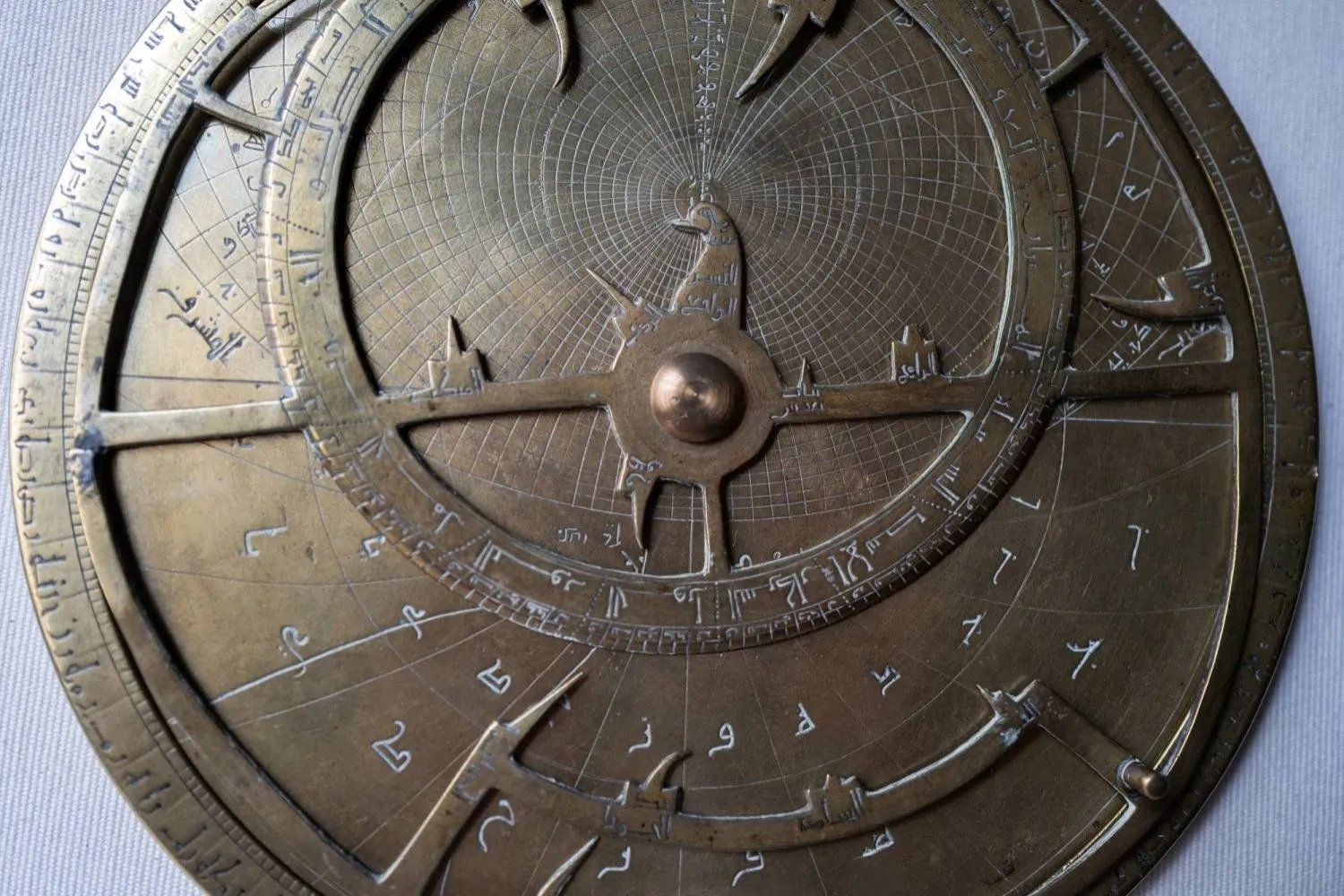

Astrolabe: A Powerful Record of Scientific Exchange Between Muslims, Jews and Christians

Astrolabes are believed to have been around at the time of Apollonius of Perga. The New York Times
TT

Astrolabe: A Powerful Record of Scientific Exchange Between Muslims, Jews and Christians

Astrolabes are believed to have been around at the time of Apollonius of Perga. The New York Times

By Franz Lidz and Clara Vannucci


For 2,000 years, celestial observers mapped the heavens with astonishingly precise instruments called astrolabes.

Resembling large, old-fashioned vest pocket watches, astrolabes allowed users to determine time, distances, heights, latitudes and even (with a horoscope) the future.

Recently, an astrolabe dating to the 11th century turned up at the Fondazione Museo Miniscalchi-Erizzo in Verona, Italy.

A historian first noticed it in a corner of a photograph while searching online for an image of a 17th-century collector whose miscellany was housed in the museum.

The historian, Federica Gigante of the University of Cambridge, learned that the museum staff had very little information about the piece. So she went to Verona for a closer look.

At the museum, a curator brought her to a side room, where she stood by a window and watched the sunlight illuminate the relic’s brass features.

She made out Arabic inscriptions and, seemingly everywhere, faint Hebrew markings, Western numerals and scratches that looked like they had been keyed.

“In the raking light, I realized that this wasn’t just an incredibly rare, ancient object but a powerful record of scientific exchange between Muslims, Jews and Christians over nearly a millennium,” Dr. Gigante said.

Astrolabes are believed to have been around at the time of Apollonius of Perga, a Greek mathematician from the third-century B.C. known as the Great Geometer.

Islamic scholars improved the gadgets, and by the ninth century A.D. the Persians were using astrolabes to locate Makkah and ascertain the five periods of prayer required each day, as stated in the Quran.

The tool reached Europe through the Moorish conquest of much of Spain.

By analyzing the Verona astrolabe’s design, construction and calligraphy, Dr. Gigante narrowed its provenance to 11th century Andalusia, where Muslims, Jews and Christians had worked alongside one another, particularly in the pursuit of science.

“As the astrolabe changed hands, it underwent numerous modifications, additions and adaptations,” Dr. Gigante said.

The original Arabic names of the signs of the zodiac were translated into Hebrew, a detail that suggested that the relic had at one point circulated within a Sephardi Jewish community.

One side of a plate was engraved in Arabic with the phrase “for the latitude of Cordoba, 38° 30’”; on the other side “for the latitude of Toledo, 40°.”

A handful of latitude values were corrected, some multiple times. Another plate was etched with North African latitudes which indicated that, during the instrument’s travels, it might have been used in Morocco or Egypt.

A series of Hebrew additions led Dr. Gigante to conclude that the astrolabe had eventually reached the Jewish diaspora in Italy, where Hebrew, rather than Arabic, was used.

“Basically, carving in the revisions was like adding apps to your smartphone,” Dr. Gigante said.


The New York Times


Hadrami Dan Added to UNESCO’s Intangible Cultural Heritage of Humanity List

The Hadrami Dan included on the Representative List of the Intangible Cultural Heritage of Humanity following a long and diligent process. Photo: X
TT

Hadrami Dan Added to UNESCO’s Intangible Cultural Heritage of Humanity List

The Hadrami Dan included on the Representative List of the Intangible Cultural Heritage of Humanity following a long and diligent process. Photo: X

The Intangible Cultural Heritage Committee of UNESCO, during its ongoing 20th session in New Delhi, included the Hadrami Dan on the Representative List of the Intangible Cultural Heritage of Humanity.

Hadrami Dan is a traditional performance and community gathering that combines spontaneous poetry, music and dance, widespread practiced across Hadhramaut Governorate. A typical Hadrami Dan gathering includes at least one singer and poet, with the audience seated in rows or circles.

Yemen’s Ambassador to UNESCO Mohammed Jumaih said the Hadrami Dan deserves this recognition, following a long and diligent process to reach this goal.

Jumaih thanked the Ministry of Culture and its staff, and the National Commission for Education, Culture, and Science.

He offered special gratitude to the Hadhramaut Foundation for Culture, which undertook the preparation and financing of the nomination file.

He also expressed his appreciation to the Intangible Cultural Heritage Committee, its Chairperson (India’s Ambassador to UNESCO, Vishal Sharma), the committee members, its secretariat, and the Evaluation Body experts for their efforts.

Minister of Information, Culture, and Tourism Muammar Al-Eryani in the Yemeni government said this achievement represents “a well-deserved international recognition of one of the most important creative expressions in Hadhramaut and Yemen in general.”

The Hadrami Dan embodies the depth of Yemeni cultural identity, which successive generations have preserved despite the harsh transformations the country has undergone, he said.

Al-Eryani added that it is the result of a joint national effort involving the Ministry of Culture and the Hadhramaut Foundation for Culture, alongside the prominent role played by Jumaih in following up on the issue within UNESCO.


Saudi Arabia: Najran Cultural Tent Contributes to Passing Cultural Heritage Across Generations

As part of the festival’s broader activities, the cultural tent aims to preserve folk heritage. SPA
TT

Saudi Arabia: Najran Cultural Tent Contributes to Passing Cultural Heritage Across Generations

As part of the festival’s broader activities, the cultural tent aims to preserve folk heritage. SPA

The cultural tent at Najran Al-Ruqsh Festival has emerged as one of the event’s most prominent attractions, drawing visitors of all ages, particularly those interested in the region’s rich cultural heritage and historical legacy, the Saudi Press Agency reported.

The tent featured a dedicated corner for activities, stories, and traditional narratives, where elderly community members shared their experiences and memories with younger generations, SPA said on Saturday.

Through these interactions, they highlighted aspects of local heritage and recounted stories from the past that reflected daily life, social values, and inherited customs that have shaped Najran’s identity over generations.

As part of the festival’s broader activities, the cultural tent aims to preserve folk heritage, strengthen its presence in the community’s collective memory, and present it to current and future generations in a manner that balances authenticity with modernity, thereby promoting the region’s cultural identity.


Jeddah Book Fair Highlights Saudi Manga and Comics’ Rise from Hobby to Professionalism

Manga zone at Jeddah Book Fair captivates visitors with creative content, comics. (SPA)
TT

Jeddah Book Fair Highlights Saudi Manga and Comics’ Rise from Hobby to Professionalism

Manga zone at Jeddah Book Fair captivates visitors with creative content, comics. (SPA)

A dialogue session held on the main stage of the Jeddah Book Fair 2025, organized by the Literature, Publishing and Translation Commission, discussed the rapid transformations taking place in the manga and comics sector in the Kingdom of Saudi Arabia, under the title "The Saudi Manga and Comics Wave: From Hobby to Professionalism."

The session began by outlining the features of the creative renaissance in these art forms, explaining how they evolved in just a few years from individual initiatives and youthful hobbies to a mature artistic movement and a cultural vision embraced by institutions, the Saudi Press Agency reported.

The session highlighted the development of manga and comics in Saudi Arabia and the challenges and opportunities artists face as they transition from hobby to professional practice. It reviewed the local scene, which has seen a broad presence, bolstered by media platforms that support Saudi productions and help spread this art form among the public.

The session explained that manga and comics in Saudi Arabia have developed a clear artistic identity that reflects Saudi cultural values such as generosity, courage, and humanity. It emphasized that professionalism depends on an integrated system encompassing concept, story writing, illustration, and design.

The session concluded by highlighting the most prominent professional challenges in this field, while stressing that human creativity remains the key factor of manga and comics production and the true engine of this art form's development.
