


At Birthplace of Olympics, Performers at Flame-Lighting Ceremony Feel a Pull of the Ancient Past 

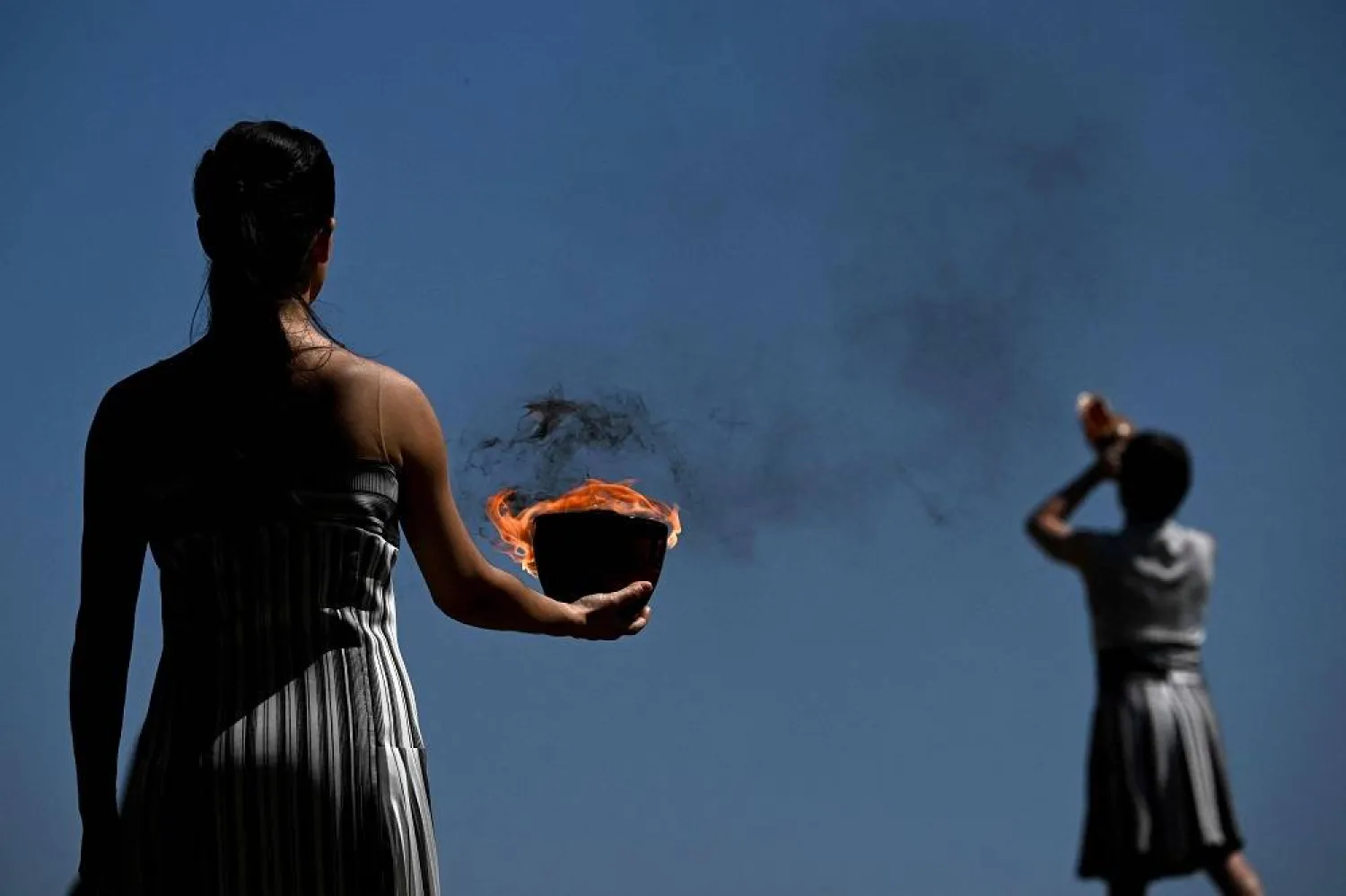
A woman in the role of a priestess holds the Olympic flame after lighting it during the rehearsal of the flame lighting ceremony for the Paris 2024 Olympics Games at the ancient temple of Hera on the Olympia archeological site, birthplace of the ancient Olympics in southern Greece, on April 15, 2024. (AFP)
TT

At Birthplace of Olympics, Performers at Flame-Lighting Ceremony Feel a Pull of the Ancient Past 

A woman in the role of a priestess holds the Olympic flame after lighting it during the rehearsal of the flame lighting ceremony for the Paris 2024 Olympics Games at the ancient temple of Hera on the Olympia archeological site, birthplace of the ancient Olympics in southern Greece, on April 15, 2024. (AFP)

No one knows what music in ancient Greece sounded like or how dancers once moved.

Every two years, a new interpretation of the ancient performance gets a global audience. It takes place in southern Greece at the birthplace of the Olympic Games.

Forty-eight performers, chosen in part for their resemblance to youths in antiquity as seen in statues and other surviving artwork, will take part Tuesday in the flame-lighting ceremony for the Paris Olympics.

Details of the 30-minute performance are fine-tuned — and kept secret — right up until a public rehearsal Monday.

The Associated Press got rare access to rehearsals that took place during weekends, mostly at an Olympic indoor cycling track in Athens.

As riders whiz around them on the banked cycling oval, the all-volunteer Olympic performers snatch poses from ancient vases. Sequences are repeated and re-repeated under the direction of the hyper-focused head choreographer Artemis Ignatiou.

“In ancient times there was no Olympic flame ceremony,” Ignatiou said during a recent practice session.

“My inspiration comes from temple pediments, from images on vases, because there is nothing that has been preserved — no movement, no dance — from antiquity,” she said. “So basically, what we are doing is joining up those images. Everything in between comes from us.”

Ceremonies take place at Olympia every two years for the Winter and Summer Games, with the sun’s rays focused on the inside of a parabolic mirror to produce the Olympic flame and start the torch relay to the host city.

Women dressed as priestesses are at the heart of the ceremony, first held for the 1936 Olympics in Berlin. Leading the group is an actress who performs the role of high priestess and makes a dramatic appeal to Apollo, the ancient god of the sun, for assistance moments before the torch is lit.

Over the decades, new ingredients have been progressively added: music, choreography, new colors for the costumes, male performers known as “kouroi” and subtle style inclusions to give a nod to the culture of the Olympic host nation.

Adding complexity also has introduced controversy, inevitably amplified by social media. Criticism this year has centered on the dresses and tunics to be worn by the performers, styled to resemble ancient Greek columns. Faultfinders have called it a rude departure from the ceremony’s customary elegance.

Organizers hope the attire will create a more positive impression when witnessed at the ruins of ancient Olympia.

Counting out the sequences, Ignatiou controls the music with taps on her cell phone while keeping track of the male dancers at the velodrome working on a stop motion-like routine and women who glide past them like a slowly uncoiling spring.

Ignatiou has been involved with the ceremony for 36 years, as priestess, high priestess, assistant and then head choreographer since 2008. She takes in the criticism with composure.

She’s still moved to tears when describing the flame lighting, but defers to her dancers to describe their experience of the five-month participation at practices.

Most in their early twenties, the performers are selected from dance and drama academies with an eye on maintaining an athletic look and classic Greek aesthetic, the women with hair pulled back in neat double-braids.

Christiana Katsimpraki, a 23-year-old drama school student who is taking part at Olympia for the first time, said she wants to repay the kindness shown to her by older performers.

“Before I go to bed, when I close my eyes, I go through the whole choreography — a run through — to make sure I have all the steps memorized and that they’re in the right order,” she said. “It’s so that the next time I can come to the rehearsal, it all goes correctly and no one gets tired.”

The ceremony is performed to sparse music, and final routine modifications are made at Olympia, in part to cope with the pockmarked and uneven ground at the site.

Dancers describe the fun they have in messaging groups, the good-natured pranks played on newcomers and fun they have on the four-hour bus ride to the ancient site in southern Greece — but also the significance of the moment and the pull of the past.

“I’m in awe that we’re going there and that I’m going to be part of this whole team,” 23-year-old performer Kallia Vouidaski said. “I’m going to have this entire experience that I watched when I was little on TV. I would say, ’Oh! How cool would it be if I could do this at some point.’ And I did it.”

The flame-lighting ceremony will start at 0830 GMT Tuesday. A separate flame-handover ceremony to the Paris 2024 organizing committee will be held in Athens on April 26.



Saudi Pavilion at Makkah's Global Village Showcases the Kingdom’s Culture

Saudi Pavilion at Makkah's Global Village Showcases the Kingdom’s Culture
TT

Saudi Pavilion at Makkah's Global Village Showcases the Kingdom’s Culture

Saudi Pavilion at Makkah's Global Village Showcases the Kingdom’s Culture

The Saudi pavilion at Global Village in Makkah, part of the Makkah winter season, reflects the richness and uniqueness of the Kingdom's culture and heritage.

It features interactive and engaging sections that introduce visitors to the Kingdom’s cultural heritage, including live demonstrations of traditional handicrafts and artwork inspired by the local environment, SPA reported.

The pavilion’s presence at Global Village reflects ongoing efforts to highlight the nation’s cultural heritage, promote its civilizational legacy, and strengthen its cultural presence at major events.


Culinary Arts Commission Joins 17th Klija Festival in Buraidah as Strategic Partner

Culinary Arts Commission Joins 17th Klija Festival in Buraidah as Strategic Partner
TT

Culinary Arts Commission Joins 17th Klija Festival in Buraidah as Strategic Partner

Culinary Arts Commission Joins 17th Klija Festival in Buraidah as Strategic Partner

The Culinary Arts Commission is participating as a strategic partner in the 17th Klija Festival, held in the city of Buraidah and running until January 17, under the patronage of Qassim Region Governor Prince Dr. Faisal bin Mishaal.

The commission’s involvement comes as part of its strategy to support events and festivals specializing in Saudi culinary arts by highlighting national and regional dishes and showcasing the Kingdom’s culinary and cultural diversity, SPA reported.

The festival features several zones and interactive activities aimed at supporting families working in the cottage industry and local artisans who produce Klija, while introducing visitors to its history and authenticity as a regional dish of Qassim, in addition to offering live demonstrations and unique interactive experiences.

During the festival, the commission is also presenting a selection of books available for viewing and purchase.


Jeddah’s Red Sea Museum Announces January Cultural Program

The program's themes span traditional architecture, historical photography, music, travel literature, and the history of navigation and public health in the Red Sea. (SPA)
TT

Jeddah’s Red Sea Museum Announces January Cultural Program

The program's themes span traditional architecture, historical photography, music, travel literature, and the history of navigation and public health in the Red Sea. (SPA)

Jeddah's Red Sea Museum announced the launch of its public program for January 2026, featuring a series of artistic workshops, cultural talks, live performances, and family activities. The program aims to connect the Red Sea's cultural heritage with contemporary creative practices, catering to various segments of society.

The program's themes span traditional architecture, historical photography, music, travel literature, and the history of navigation and public health in the Red Sea. These activities are presented through a cultural and educational agenda held across the museum's facilities and venues in Historic Jeddah.

The program begins on Tuesday, with a workshop titled "Junior Cartographers" in the Discovery Room, where children aged 6 to 12 will explore the art of mapmaking and the fundamentals of navigation through an engaging, interactive approach. On January 15, the "Alchemy of Light: Albumen Prints" workshop will be held at the auditorium, highlighting the historical albumen printing technique using egg whites and silver salts, and exploring 19th-century photography aesthetics through a contemporary perspective.

On January 17, a talk about Historic Jeddah will discuss traditional architecture and its relationship to heritage and modernity. This will be followed on January 18, by the "Navigation from Past to Present" workshop at the auditorium, offering an interactive experience that explores the evolution of navigation methods through hands-on artistic and practical activities.

On January 22, the program includes the screening of the animated film "The Menace from Above" at the auditorium. Later that evening, Bab Al-Bunt Courtyard will host the Al Nour Wal Amal Orchestra, the world's only musical ensemble composed entirely of blind female musicians who perform using Braille musical notation, in a performance celebrating art, resilience, and diversity.

On January 23, an artist talk titled "The Gate of Gates" will be held in Historic Jeddah, documenting the transformations of the Bab Al-Bunt building and the human stories connected to this historic space. On January 28, the auditorium will host a talk titled "Encounters: Travel Literature," exploring journeys to Andalusia and Sicily and how Islamic heritage continues to live on through people and places.

The program concludes on January 31, with a lecture examining the development of quarantine systems and public health monitoring in the Red Sea, highlighting the historical role of Bab Al-Bunt as a quarantine center for pilgrims.

The Red Sea Museum's activities serve as a cultural and knowledge platform dedicated to documenting the Red Sea's tangible, intangible, and natural heritage, and presenting it through educational and interactive programs that foster dialogue between the past and the present, linking heritage with contemporary creative contexts from its headquarters in Historic Jeddah.