UAE Culture Ministry Partners with Publishing Entities to Support Grant Program

The UAE's Ministry of Culture has announced a collaboration with four publishing entities to empower and support creators within the National Grant Program for Culture and Creativity. WAM
TT

UAE Culture Ministry Partners with Publishing Entities to Support Grant Program

The UAE's Ministry of Culture has announced a collaboration with four publishing entities to empower and support creators within the National Grant Program for Culture and Creativity. WAM

The Ministry of Culture has announced its collaboration with the Emirates Literature Foundation, Kalimat Group, Fiker Institute and Magrudy Enterprises to empower and support creators within the National Grant Program for Culture and Creativity, launched by the Ministry last year, Emirates News Agency (WAM) reported Thursday.

“The initiative aligns with the UAE's commitment to developing and sustaining its cultural and creative sectors, and to capitalize on investment opportunities in creators who play a pivotal role in building a sustainable creative economy for future generations,” WAM said.

“Under these agreements, the four leading and prestigious entities in the field of literature will work to increase the impact of the program by creating opportunities to support its beneficiaries and introduce their work on local and international platforms within the cultural and creative industries sector, thus achieving sustainable impact,” the news agency added.

Undersecretary of the Ministry of Culture Mubarak Al Nakhi stressed the importance of signing partnership agreements with authorship and publishing institutions.

He said the agreements facilitate the exchange of expertise, enable access to specialists' experience, support the sector's growth sustainably, empower talented writers, including those with unique perspectives and distinguished literary works, and inspire them to pursue further creativity and innovation.

This will support the cultural movement and scene in the UAE and achieve its goals and strategies in spreading knowledge and culture and empowering creators with all tools and means, he added.


Historic Jeddah Showcases Cultural Heritage at Umrah and Ziyarah Forum

The pavilion highlighted the distinctive architectural features of Historic Jeddah - SPA
TT

Historic Jeddah Showcases Cultural Heritage at Umrah and Ziyarah Forum

The pavilion highlighted the distinctive architectural features of Historic Jeddah - SPA

Historic Jeddah participated in the Umrah and Ziyarah Forum to highlight its historical role as a key gateway for pilgrims to Makkah, while introducing visitors to its cultural status and the ongoing development projects that reinforce its status as a heritage destination, SPA reported.

The pavilion introduced visitors to the "Historic Hajj Trail" supported by the Ministry of Hajj and Umrah, designed as a sequential narrative that retraces the pilgrim’s journey from arriving at Bab Al-Bunt Port, now the Red Sea Museum, to Makkah Gate, passing through prominent historical sites that reflect Jeddah’s role in serving pilgrims.

The pavilion highlighted the distinctive architectural features of Historic Jeddah and its long-standing role as a major port for pilgrims since the 7th century CE and also featured interactive content showcasing the area’s cultural and social fabric.

This participation forms part of the "Revitalization of Historic Jeddah" project, led by the Ministry of Culture, within the framework of the National Culture Strategy and Saudi Vision 2030.


Geisha Spectacle in Japan’s Kyoto Celebrates Arrival of Spring

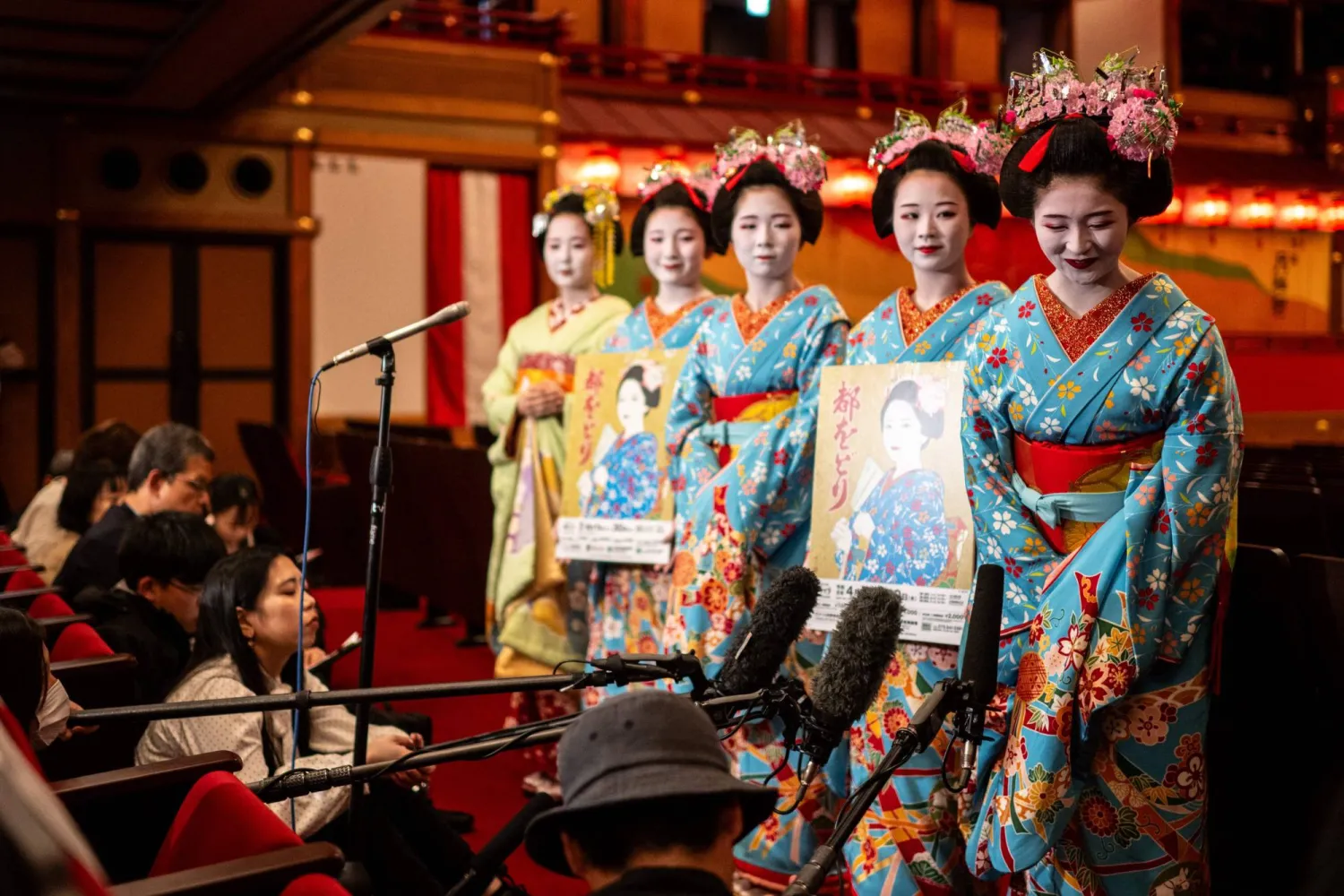
 Maiko (apprentice geisha) take part in a press interview ahead a rehearsal for the annual "Miyako Odori" -- which means "capital city dance" in Japanese, at the Gion Kobu Kaburenjo in Kyoto on March 31, 2026. (AFP)
Maiko (apprentice geisha) take part in a press interview ahead a rehearsal for the annual "Miyako Odori" -- which means "capital city dance" in Japanese, at the Gion Kobu Kaburenjo in Kyoto on March 31, 2026. (AFP)
TT

Geisha Spectacle in Japan’s Kyoto Celebrates Arrival of Spring

 Maiko (apprentice geisha) take part in a press interview ahead a rehearsal for the annual "Miyako Odori" -- which means "capital city dance" in Japanese, at the Gion Kobu Kaburenjo in Kyoto on March 31, 2026. (AFP)
Maiko (apprentice geisha) take part in a press interview ahead a rehearsal for the annual "Miyako Odori" -- which means "capital city dance" in Japanese, at the Gion Kobu Kaburenjo in Kyoto on March 31, 2026. (AFP)

Against a backdrop of blooming cherry blossoms, a group of geishas elegantly shuffle onto a stage in Japan's Kyoto city to begin a centuries-old performance celebrating the arrival of spring.

Dressed in sky blue kimonos emblazoned with flowers, the dancers twist and twirl in unison in front of hundreds of spectators eager to see the annual "Miyako Odori" in the nation's spectacular ancient capital.

Geishas, known as geikos in Kyoto, and apprentices called maikos have been donning elaborate costumes and fluttering fans since the Miyako Odori -- or "capital city dance" -- first started in 1872.

"Just as cherry blossoms bloom when spring approaches, the Miyako Odori is a spring tradition in Kyoto," Kyoko Sugiura, head of the Yasaka Nyokoba Gakuen, a school for geishas in Kyoto's Gion district, told AFP.

In Japanese, the word geisha means "person of the arts", and can refer to a woman or man trained in traditional Japanese performing arts.

In the popular imagination geishas are often confused with courtesans but their work as trained masters of refined old artforms does not involve selling sex.

Their performances are usually small and private, and take place at high-class establishments which operate a no first-time customer policy.

"That's why it is often thought of as a very exclusive world," Sugiura said.

"But the Miyako Odori is a one-hour show in which geisha and maiko have the opportunity to showcase the arts they practise daily," she said.

"Anyone and everyone with a ticket can enjoy the show."

The Miyako Odori began soon after Kyoto hosted Japan's first national expo -- an effort to revitalize the western city following the relocation of the capital to Tokyo in 1869.

The format of the performance has not changed much, Sugiura explained, although the music and dance moves are sometimes switched up.

Maria Superata, a geisha expert who has worked with them as an interpreter, explained that the show "combines all of the traditional performing arts that you can see in Japan".

"For example, elements from kabuki (classical Japanese theatre), elements from traditional dance. So they have to act, they have to sing, they have to play the instruments, everything all in one," she said.

"That's why it's so special."

But the number of geishas, who once made a living through performing for Japan's wealthy elite, is in decline.

Superata said that fewer young Japanese want a life that demands huge discipline and comes with a strict practice schedule.

"Nowadays, young Japanese people... are not very interested that much in traditional art and in kimono."


Danish Warship Sunk by Nelson’s British Fleet Discovered After 225 Years

 Morten Johansen, head of maritime archaeology at Denmark's Viking Ship Museum, shows a metal insignia recovered from the wreck of Danish flagship "Dannebroge" that sank during the Battle of Copenhagen in 1801, in Copenhagen, Denmark, Tuesday, March 31, 2026. (AP)
Morten Johansen, head of maritime archaeology at Denmark's Viking Ship Museum, shows a metal insignia recovered from the wreck of Danish flagship "Dannebroge" that sank during the Battle of Copenhagen in 1801, in Copenhagen, Denmark, Tuesday, March 31, 2026. (AP)
TT

Danish Warship Sunk by Nelson’s British Fleet Discovered After 225 Years

 Morten Johansen, head of maritime archaeology at Denmark's Viking Ship Museum, shows a metal insignia recovered from the wreck of Danish flagship "Dannebroge" that sank during the Battle of Copenhagen in 1801, in Copenhagen, Denmark, Tuesday, March 31, 2026. (AP)
Morten Johansen, head of maritime archaeology at Denmark's Viking Ship Museum, shows a metal insignia recovered from the wreck of Danish flagship "Dannebroge" that sank during the Battle of Copenhagen in 1801, in Copenhagen, Denmark, Tuesday, March 31, 2026. (AP)

More than 200 years after being sunk by Adm. Horatio Nelson and the British fleet, a Danish warship has been discovered on the seabed of Copenhagen Harbor by marine archaeologists.

Working in thick sediment and almost zero visibility 15 meters (49 feet) beneath the waves, divers are in a race against time to unearth the 19th-century wreck of the "Dannebroge" before it becomes a construction site in a new housing district being built off the Danish coast.

Denmark’s Viking Ship Museum, which is leading the monthslong underwater excavations, announced its findings on Thursday, 225 years to the day since the Battle of Copenhagen in 1801.

“It’s a big part of the Danish national feeling,” said Morten Johansen, the museum’s head of maritime archaeology.

A great deal has been written about the battle “by very enthusiastic spectators, but we actually don’t know how it was to be onboard a ship being shot to pieces by English warships and some of that story we can probably learn from seeing the wreck,” Johansen said. The Associated Press was the only international outlet given access to the site.

In the Battle of Copenhagen, Nelson and the British fleet attacked and defeated Denmark’s navy as it formed a protective blockade outside the harbor.

Thousands were killed and wounded during the brutal hourslong naval clash, considered one of Nelson’s “great battles.” The intention was to force Denmark out of an alliance of Northern European powers, including Russia, Prussia and Sweden.

At the center of the fighting was the Danish flagship, the Dannebroge, commanded by Commodore Olfert Fischer.

The 48-meter (157-foot) Dannebroge was Nelson’s main target. Cannon fire tore through its upper deck before incendiary shells sparked a fire aboard.

“(It was) a nightmare to be on board one of these ships,” Johansen said. “When a cannonball hits a ship, it’s not the cannonball that does the most damage to the crew, it’s wooden splinters flying everywhere, very much like grenade debris.”

The battle also is believed to have inspired the phrase “to turn a blind eye.” After deciding to ignore a superior’s signal, Nelson, who had lost sight in his right eye, reportedly remarked: “I have only one eye, I have a right to be blind sometimes.”

Nelson eventually offered a truce and a ceasefire was later agreed with Denmark’s Crown Prince Frederik.

The stricken Dannebroge slowly drifted northward and exploded. Records say the sound created a deafening roar across Copenhagen.

Marine archaeologists have discovered two cannons, uniforms, insignia, shoes, bottles and even part of a sailor’s lower jaw, perhaps one of the 19 unaccounted-for crew members who likely lost their lives that day.

The dig site will soon be enveloped by construction work for Lynetteholm, a megaproject to build a new housing district in the middle of Copenhagen Harbor that is expected to be completed by 2070.

Marine archaeologists began surveying the area late last year, targeting a spot thought to match the flagship’s final position.

Experts say the sizes of the wooden parts found match old drawings. Dendrochronological dating, the method of using tree rings to establish the age of wood, match the year the ship was built. They also say the darkened dig site is full of cannonballs, a hazard for divers navigating waters darkened by clouds of silt stirred up from the seabed.

“Sometimes you can’t see anything, and then you really have to just feel your way, look with your fingers instead of with your eyes,” diver and maritime archaeologist Marie Jonsson said.

Chronicled in books and painted on canvases, the 1801 battle is deeply embedded in Denmark’s national story.

Archaeologists hope their discoveries may help reexamine the event that shaped the Scandinavian country and perhaps uncover personal stories of those who went into battle on that day 225 years ago.

“There are bottles, there are ceramics, and even pieces of basketry,” Jonsson said. “You get closer to the people onboard.”