


Study Firms up Date of Famous Ancient Shipwreck off Cyprus 

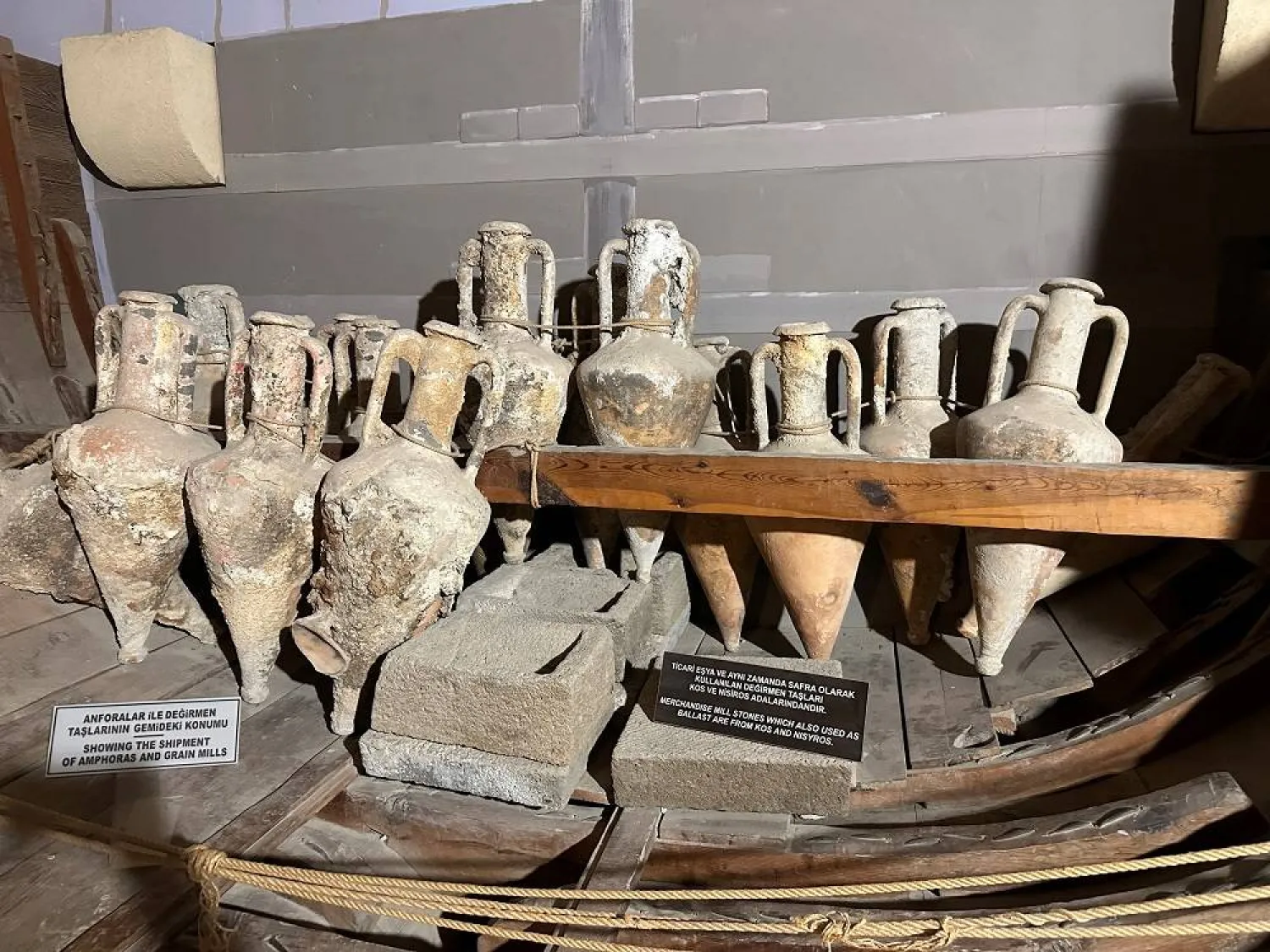
Amphoras and grain mills are seen in a museum dedicated to the ancient Kyrenia merchant ship that sank off the coast of Cyprus, at Kyrenia Castle in Cyprus, February 9, 2024. Adam Dunham/Handout via Reuters
TT

Study Firms up Date of Famous Ancient Shipwreck off Cyprus 

Amphoras and grain mills are seen in a museum dedicated to the ancient Kyrenia merchant ship that sank off the coast of Cyprus, at Kyrenia Castle in Cyprus, February 9, 2024. Adam Dunham/Handout via Reuters

When scientists in the 1960s excavated the wreck of an ancient Greek merchant ship off the northern coast of Cyprus, what they found was an amazing time capsule from a pivotal period in the Mediterranean world following the death of Alexander the Great.

But determining the date of the Kyrenia shipwreck with any sort of precision has proven difficult, and some previous scientific dating yielded conclusions that conflicted with the archeological evidence. Researchers have now calculated this timeline with new precision using improved techniques that they said can be applied to date other ancient shipwrecks as well.

By analyzing organic material from the wreck, including the vessel's wooden timbers, almonds from its cargo, and a gaming piece called an astragalus made from animal bone and used like dice, they concluded that the ship went down around 280 BC. That is a bit later than prior scientific dating estimates but a better match for the archeological evidence.

Sturt Manning, a Cornell University professor of classical archaeology, called the Kyrenia vessel an "iconic ship from the early Hellenistic period, central to the history of ancient maritime technology."

The ship, about 46 feet (14 meters) long, was built of wood with lead sheathing, with one mast bearing a square sail, and likely carrying a crew of four. It sank about a mile (1.6 km) off the coast. Aboard were nearly 400 amphoras - large two-handled pottery storage jars - some filled with almonds and others apparently with wine, along with heavy millstones as ballast.

"Likely it was going to or from Cyprus, and the cargo - amphora types - suggest it was trading in the Aegean and east Mediterranean area. The main cargo comprised amphora of a type associated with the island of Rhodes in the southeast Aegean," said Manning, lead author of the study published in the journal PLOS ONE.

Using various lines of evidence, the researchers determined that the ship had been constructed between about 345-313 BC and sank between about 286-272 BC.

The death in 323 BC of Alexander, who had conquered wide swathes of the Mediterranean region and beyond, led to regional scrambles for power. Cyprus became a contested area pitting successors of Alexander ruling in the Aegean region versus those in Egypt, with the latter winning control of the island.

The Kyrenia ship's remains are displayed at a museum in Cyprus.

"Ancient shipwrecks hold several unique sources of information for archaeologists to reconstruct the human past. In underwater sites like where the Kyrenia was buried, archaeological materials decay much more slowly. As a result, organic materials like wood, seeds or rope can be much better preserved than on land," said University of Georgia anthropology professor and study co-author Brita Lorentzen.

The discovery of a deepwater shipwreck off the coast of Israel, dating to roughly 1300 BC, was announced just last week.

"Ships were a critical source of transportation in the ancient world, which allowed people to move from one place to another, create social networks, and exchange trade goods and ideas. A shipwreck's contents can tell us specifically which items were being traded or exchanged, where and how people were moving around by sea, which groups of people were in contact with one another, and how they were impacted by these early social and economic networks," Lorentzen said.

This ship's timbers were embalmed decades ago using the chemical compound polyethylene glycol (PEG) to preserve the wood on land. This complicated the use of radiocarbon dating, a technique for determining an object's age based on the decay over time of a radioactive form of carbon.

"Adding PEG prevents ship timbers from drying out, shrinking and turning to dust out of the water. But it also contains petroleum, with lots of carbon from long-dead organic remains," Lorentzen said.

The researchers devised improved methods to remove PEG so radiocarbon dating could be used for the timbers. They also used radiocarbon dating on the almonds and astragalus.

Analysis of annual growth rings in trees also helps govern the dating of ancient wooden artifacts. The researchers found a discrepancy in a scientific standard used in analyzing wood from this time period to convert radiocarbon measurements into calendar dates for the northern hemisphere, and updated it.

"The work here is relevant to ancient shipwrecks generally," Manning said.


Saudi Arabia: Ship of Tolerance Initiative Promotes Cultural Dialogue in Jeddah

The Royal Institute of Traditional Arts (Wrth) will offer traditional craft workshops throughout Ramadan. SPA
TT

Saudi Arabia: Ship of Tolerance Initiative Promotes Cultural Dialogue in Jeddah

The Royal Institute of Traditional Arts (Wrth) will offer traditional craft workshops throughout Ramadan. SPA

The Saudi Ministry of Culture, in collaboration with the "Lenobadir" volunteer and community partnership program and the Athr Foundation, has launched the Ship of Tolerance initiative in Historic Jeddah during Ramadan.

The initiative aims to enhance shared human values through arts, and promote tolerance and coexistence among children and families. It provides an educational and cultural experience aligned with the area’s unique character as a UNESCO World Heritage site.

As part of this global art project, children will create artworks that represent acceptance and dialogue.

The Royal Institute of Traditional Arts (Wrth) will offer traditional craft workshops throughout Ramadan, linking the initiative's values with local heritage and enriching visitors' connection to the region's identity.

This effort supports cultural programs with educational and social dimensions in Historic Jeddah, activating local sites for experiences that combine art, crafts, and community participation. It aligns with the National Strategy for Culture under Saudi Vision 2030, focusing on heritage preservation and expanding culture's impact on daily life.


Oscar Contender ‘Hamnet’ Boosts Tourism at Shakespeare Heritage Sites 

A view of Shakespeare’s Birthplace, William Shakespeare's childhood home, in Stratford-upon-Avon, Britain, February 9, 2026. (Reuters)
TT

Oscar Contender ‘Hamnet’ Boosts Tourism at Shakespeare Heritage Sites 

A view of Shakespeare’s Birthplace, William Shakespeare's childhood home, in Stratford-upon-Avon, Britain, February 9, 2026. (Reuters)

On a cloudy winter's day, visitors stream into what was once William Shakespeare's childhood home in Stratford-upon-Avon and the nearby Anne Hathaway's cottage, family residence of the bard's wife.

Hathaway's cottage is one of the settings for the BAFTA and Oscar best film contender "Hamnet", and the movie's success is drawing a new wave of tourists to Shakespeare sites in the town in central England.

Shakespeare's Birthplace is the house the young William once lived in and where his father worked as a glove maker, while Hathaway's cottage is where he would have visited his future wife early in their relationship.

Typically, around 250,000 visitors, from the UK, Europe, the United States, China and elsewhere, walk through the locations each year, according to the Shakespeare Birthplace Trust. ‌The charity looks after ‌Shakespeare heritage sites, which also include Shakespeare's New Place, the site of ‌the ⁠Stratford home where the ⁠bard died in 1616.

Visitors are flocking in this year thanks to "Hamnet", the film based on Maggie O'Farrell's 2020 novel, which gives a fictional account of the relationship between Shakespeare and Hathaway, also known as Agnes, and the death of their 11-year-old son Hamnet in 1596.

"Visitor numbers have increased by about 15 to 20% across all sites since the film was released back in January. I think that will only continue as we go throughout the year," Richard Patterson, chief operating officer for the Shakespeare Birthplace Trust, said.

"They particularly want ⁠to look (at) Anne Hathaway's cottage and the specifics around how the family ‌engaged in the spaces and the landscape in and around ‌the cottage... you can see why he would have been inspired."

NEW ACCESS TO SHAKESPEARE

"Hamnet" has 11 nominations at ‌Sunday's British BAFTA awards, including best film and leading actress for Jessie Buckley, who plays Agnes. It ‌also has eight Oscar nominations, with Buckley seen as the frontrunner to win best actress.

"Hamnet" is set in Stratford-upon-Avon and London although it was not filmed in Stratford.

It sees Paul Mescal's young Shakespeare fall for Agnes while teaching Latin to pay off his father's debts. The drama, seen mainly through Agnes' eyes, focuses on their ‌life together and grief over Hamnet's death, leading Shakespeare to write "Hamlet".

"Shakespeare... is notoriously enigmatic. He writes about humanity, about feeling, about emotion, about conflict, ⁠but where do we understand ⁠who he is in that story?" said Charlotte Scott, a professor of Shakespeare studies and interim director of collections, learning and research at the Shakespeare Birthplace Trust.

"And that's driven people creative and otherwise for hundreds and hundreds of years. Where is Shakespeare's heart? And this is what the film I think has so beautifully opened up."

Little is known about how the couple met. Shakespeare was 18 and Hathaway 26 when they married in 1582. Daughter Susanna arrived in 1583 and twins Judith and Hamnet in 1585.

The film acknowledges the names Hamnet and Hamlet were interchangeable back then. While grief is a dominant theme, audiences also see Shakespeare in love and as a father.

"A lot of people will see this film not necessarily having... had any kind of relationship with Shakespeare," Scott said.

"So people will come to this film, I hope, and find a new way of accessing Shakespeare that is about creativity, that is about understanding storytelling as a constant process of regeneration, but also crucially, looking at it from that kind of emotive angle."


Culture Ministry Continues Preparations in Historic Jeddah to Welcome Visitors during Ramadan 

Historic Jeddah has emerged as a leading cultural tourism destination during Ramadan. (SPA)
TT

Culture Ministry Continues Preparations in Historic Jeddah to Welcome Visitors during Ramadan 

Historic Jeddah has emerged as a leading cultural tourism destination during Ramadan. (SPA)

The Saudi Ministry of Culture is continuing its efforts to revitalize Historic Jeddah in preparation for welcoming visitors during the holy month of Ramadan, offering cultural programs, events, and heritage experiences that reflect the authenticity of the past.

The district has emerged as a leading cultural tourism destination at this time of year as part of the “The Heart of Ramadan” campaign launched by the Saudi Tourism Authority.

Visitors are provided the opportunity to explore the district’s attractions, including archaeological sites located within the geographical boundaries of the UNESCO World Heritage-listed area, which represent a central component of the Kingdom’s urban and cultural heritage.

The area also features museums that serve as gateways to understanding the city’s rich heritage and cultural development, in addition to traditional markets that narrate historical stories through locally made products and Ramadan specialties that reflect authentic traditions.

These initiatives are part of the ministry’s ongoing efforts to revitalize Historic Jeddah in line with the objectives of Saudi Vision 2030 and aiming to transform it into a vibrant hub for arts, culture, and the creative economy, while preserving its tangible and intangible heritage.
