As Gaza War Rages, Palestinian Culture Stifled in Israel

A woman holds a key symbolizing the homes left by Palestinians in 1948, during a rally along the border east of Khan Yunis in the southern Gaza Strip on May 1, 2023 marking the 75th anniversary of the Nakba. (AFP)
TT

As Gaza War Rages, Palestinian Culture Stifled in Israel

A woman holds a key symbolizing the homes left by Palestinians in 1948, during a rally along the border east of Khan Yunis in the southern Gaza Strip on May 1, 2023 marking the 75th anniversary of the Nakba. (AFP)

Comedian Ayman Nahas said he has kept a "low profile" since October 7, fearing reprisals as an Arab artist in Israel while the country wages war in the Gaza Strip.

He is one of many Arab artists in Israel or annexed east Jerusalem who describe facing increasing hostility and harassment, and fearing looming funding cuts or arrests.

"You never know where your place is and that is not the right atmosphere to perform," said Nahas, who is also the artistic director at the Arabic-language Sard theater in Haifa, in Israel's north.

His theater depends on government subsidies "like 99 percent of cultural spaces" in Israel, he said, AFP reported.

But he fears the money could be cut, as happened in 2015 to Al-Midan, another theater in the mixed Arab-Jewish city of Haifa, after it put on a play inspired by the story of a prisoner jailed by Israel over an attack on troops.

One 25-year-old performer, who asked to use the pseudonym Elias to avoid a backlash, said he has put acting aside and became a swimming pool attendant because he was fed up with only getting stereotyped roles.

Other Arab actors say that since the war, they can no longer find work in Israel.

Elias has finally found a role in Berlin.

"I have had to go into exile to practice my art," he told AFP in a Tel Aviv cafe.

"I don't wear my 'Free Palestine' bracelet anymore and I take care about what I put on social media. I have friends who have been visited by the police."

Non-profit group Mossawa has documented an increase in human rights violations against Israel's Arab minority since October, including arrests, discrimination at work and harassment at schools, as well as curbs on the right to protest.

Singer Dalal Abu Amneh, who is also a neuroscientist, was detained for 48 hours for a social media post after Hamas's October 7 attack that said "the only victor is God".

Abu Amneh later said she had been harassed in her Jewish-majority hometown of Afula in northern Israel. Her lawyer said she had received hundreds of "death threats".

About 20 percent of Israel's 9.5 million inhabitants are Arab, and many of them identify as Palestinian.

They say they are frequently the targets of discrimination by the Jewish majority, and those complaints have grown through more than nine months of war between Israel and Palestinian militants in Gaza.

Huda Imam, who promotes Palestinian cultural sites in Jerusalem, said that "a cultural silence has taken hold since October 7".

"There has been a shock, an inability to produce out of fear and respect" for the war's victims, she added.

"There was a Palestinian cultural life before the war, especially in east Jerusalem," Imam said, referring to the sector Israel captured in 1967 and later annexed in a move never recognised by most of the international community.

"Now people don't go out."

And it is primarily exiles "who give a voice to Palestine", said Imam, highlighting the rapper Saint Levant who played at the Coachella music festival in the United States in April, and the European-based singer and flute player Nai Barghouti.

Palestinians still express themselves through their "living heritage, like drinking coffee or dancing dabkeh," a traditional dance, said artist Hani Amra.

Some artists wondered about the relevance of their work now.

"You turn on the television and you see the war live. The reality is more powerful than any artistic work," Amer Khalil, the director of east Jerusalem's Al-Hakawati, also known as the Palestinian National Theater.

The theater, founded in 1984, "has been closed more than 200 times in 40 years" and is again in the crosshairs of Israeli authorities, said Khalil.

"Running a theatre is always difficult, but after October 7 things became even more complicated," he said, adding that Al-Hakawati was preparing a play about that day.

"It is a game, like censorship, it comes and goes."


Qassim Region Principality Illuminated in Green in Celebration of Founding Day

The Qassim Region Principality illuminated in green marking Founding Day - SPA
TT

Qassim Region Principality Illuminated in Green in Celebration of Founding Day

The Qassim Region Principality illuminated in green marking Founding Day - SPA

The Qassim Region Principality building was illuminated in green in celebration of Founding Day.

The scene reflected pride in the historical roots of the Saudi state and embodied feelings of belonging on this cherished national occasion, SPA reported.

The illumination affirms the deep historical significance of Founding Day, marking 299 years since the establishment of the First Saudi State by Imam Mohammed bin Saud.

It also reflects the enduring principles upon which it was founded, including unity, stability, and state-building. These foundations culminate in the security, stability, and prosperity that the Kingdom of Saudi Arabia enjoys today under its wise leadership.


Prince Mohammed bin Salman Project Restores Century-Old Uqlat Al-Suqur Mosque in Qassim

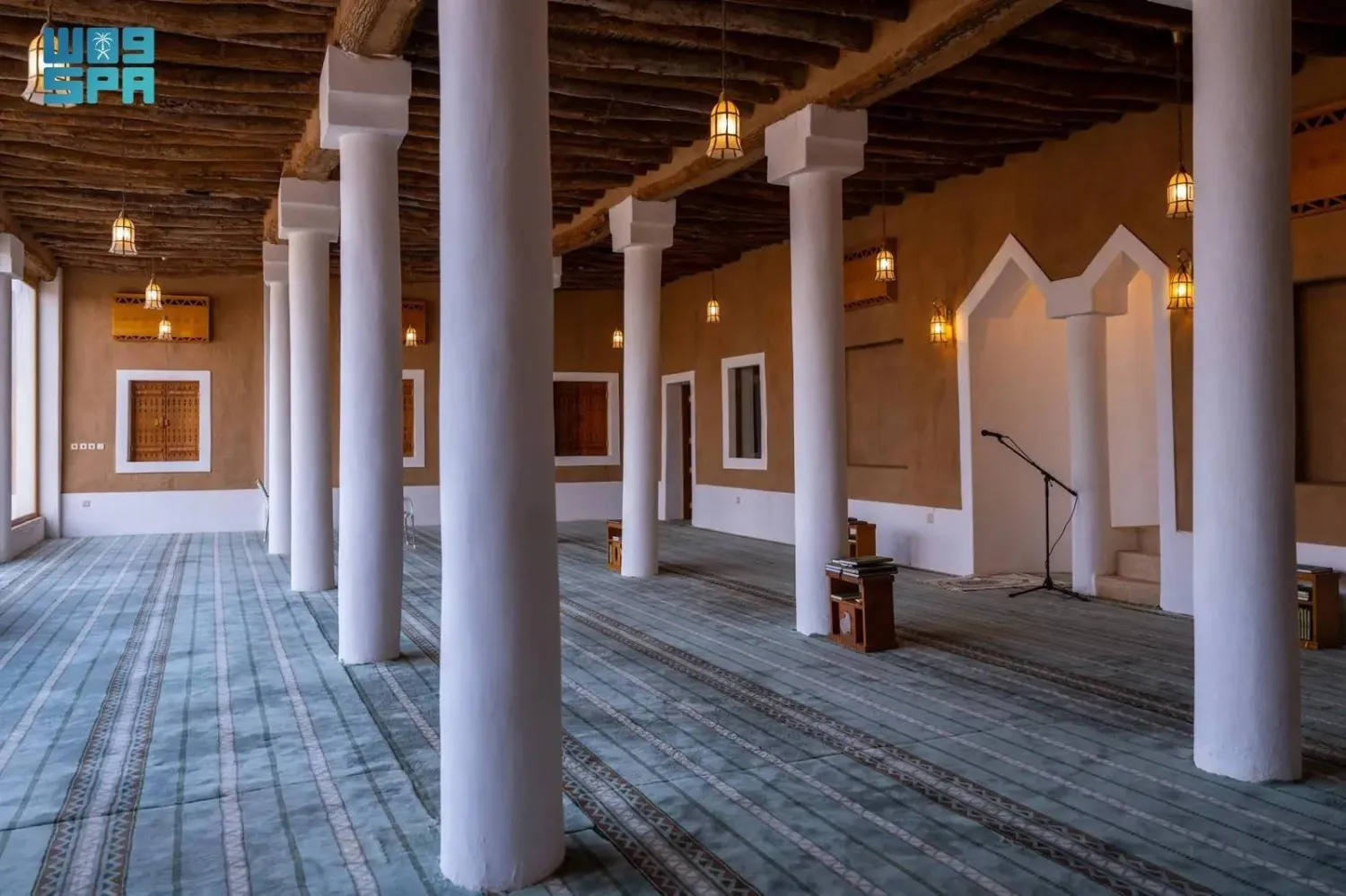
The renovation utilized traditional mud, stone, and wood to preserve the mosque's authentic Najdi architectural style. (SPA)
TT

Prince Mohammed bin Salman Project Restores Century-Old Uqlat Al-Suqur Mosque in Qassim

The renovation utilized traditional mud, stone, and wood to preserve the mosque's authentic Najdi architectural style. (SPA)

The Prince Mohammed bin Salman Project for the Development of Historical Mosques has completed the restoration of the Uqlat Al-Suqur Mosque in Qassim Region, revitalizing a heritage landmark dating back to 1922, reported the Saudi Press Agency on Saturday.

Originally the only mosque in the area, it served as a vital religious and social hub for education and community governance.

The renovation, executed by specialized Saudi firms, utilized traditional mud, stone, and wood to preserve its authentic Najdi architectural style.

The project increased the mosque's area to 544 square meters, expanding its capacity to 250 worshippers while maintaining its historical identity.

The initiative aligns with Vision 2030 to preserve the Kingdom's urban heritage and boost the cultural and religious significance of its historical mosques for future generations.


Tomb More Than 1,000 Years Old Found in Panama

This handout picture released by Panama’s Ministry of Culture shows an archaeologist working inside a pre-Hispanic tomb approximately 1,200 years old, discovered at the El Cano Archaeological Park in Cocle, Panama, on February 20, 2026. (Handout / Panama’s Ministry of Culture / AFP)
TT

Tomb More Than 1,000 Years Old Found in Panama

This handout picture released by Panama’s Ministry of Culture shows an archaeologist working inside a pre-Hispanic tomb approximately 1,200 years old, discovered at the El Cano Archaeological Park in Cocle, Panama, on February 20, 2026. (Handout / Panama’s Ministry of Culture / AFP)

Archaeologists have discovered a tomb more than a thousand years old in Panama containing human remains alongside gold and ceramic artifacts, the lead researcher told AFP on Friday.

The discovery was made at the El Cano site in the Nata district about 200 kilometers (124 miles) southwest of Panama City.

Scientists and archaeologists have already unearthed other remains of pre-Hispanic cultures in the region that has been excavated for two decades.

The skeletal remains were found surrounded by gold objects and pottery decorated with traditional motifs, pointing to these being "high-ranking" individuals, archaeologist Julia Mayo told AFP, adding that the tomb was built between 800 and 1000 AD.

"The individual with the gold was the one with the highest social status in the group," she said.

That body was found with two bracelets, two earrings, and pectoral jewelry that featured bats and crocodiles, she added.

The El Cano archaeological site is linked to the societies that inhabited the central provinces of Panama between the 8th and 11th centuries.

"This is where they buried their dead for 200 years," said Mayo.

Nine other tombs "similar" to the one found on Friday had already been found at the site, she added.

Panama's Ministry of Culture said the discovery was "of great importance for Panamanian archaeology and the study of pre-Hispanic societies of the Central American isthmus," referring to the land that connects North and South America.

According to experts, these excavations demonstrate that death did not represent an end for these societies, but a transition to another phase where social status remained important.