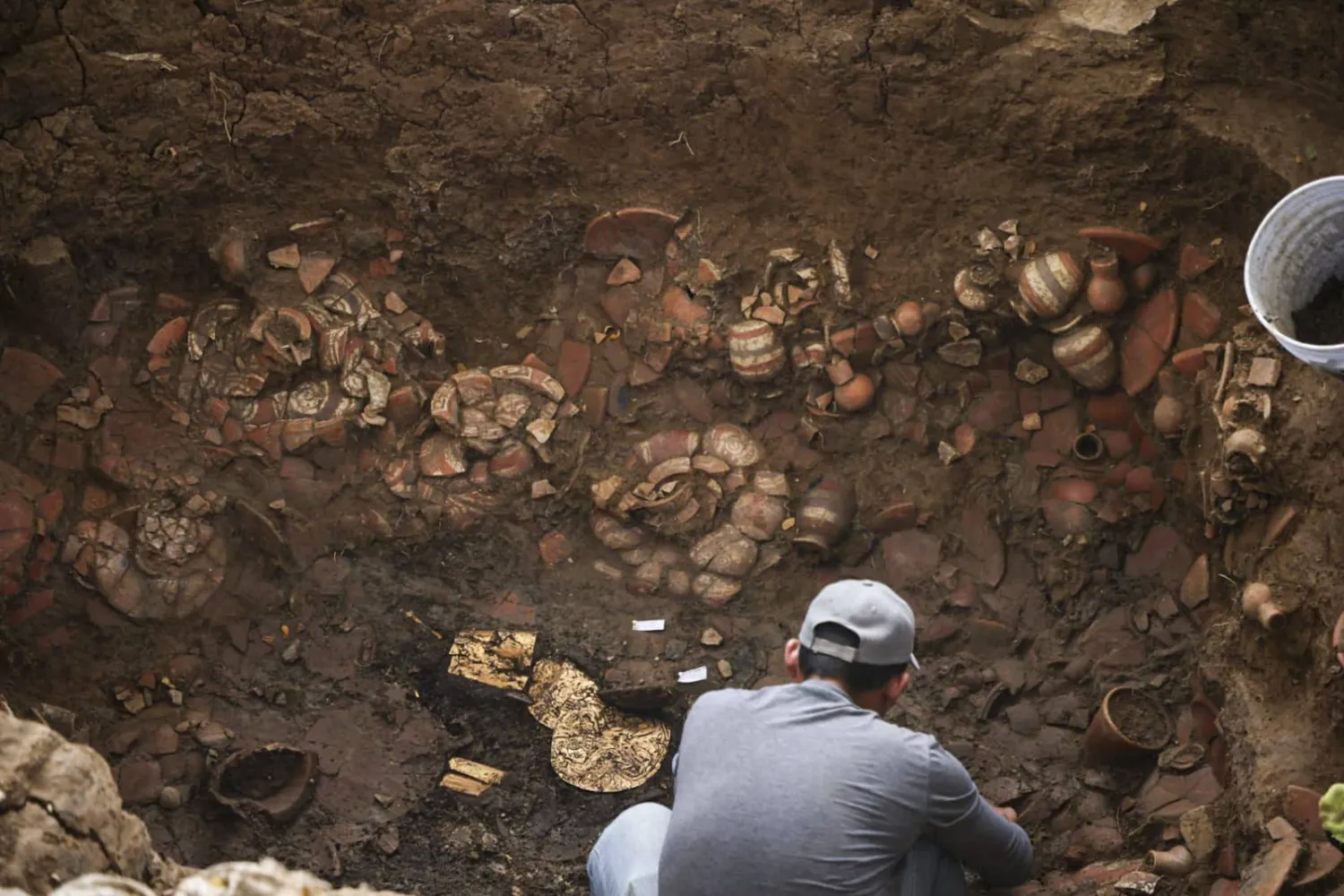
This handout picture released by Panama’s Ministry of Culture shows an archaeologist working inside a pre-Hispanic tomb approximately 1,200 years old, discovered at the El Cano Archaeological Park in Cocle, Panama, on February 20, 2026. (Handout / Panama’s Ministry of Culture / AFP)
TT
TT
Tomb More Than 1,000 Years Old Found in Panama
This handout picture released by Panama’s Ministry of Culture shows an archaeologist working inside a pre-Hispanic tomb approximately 1,200 years old, discovered at the El Cano Archaeological Park in Cocle, Panama, on February 20, 2026. (Handout / Panama’s Ministry of Culture / AFP)
Archaeologists have discovered a tomb more than a thousand years old in Panama containing human remains alongside gold and ceramic artifacts, the lead researcher told AFP on Friday.
The discovery was made at the El Cano site in the Nata district about 200 kilometers (124 miles) southwest of Panama City.
Scientists and archaeologists have already unearthed other remains of pre-Hispanic cultures in the region that has been excavated for two decades.
The skeletal remains were found surrounded by gold objects and pottery decorated with traditional motifs, pointing to these being "high-ranking" individuals, archaeologist Julia Mayo told AFP, adding that the tomb was built between 800 and 1000 AD.
"The individual with the gold was the one with the highest social status in the group," she said.
That body was found with two bracelets, two earrings, and pectoral jewelry that featured bats and crocodiles, she added.
The El Cano archaeological site is linked to the societies that inhabited the central provinces of Panama between the 8th and 11th centuries.
"This is where they buried their dead for 200 years," said Mayo.
Nine other tombs "similar" to the one found on Friday had already been found at the site, she added.
Panama's Ministry of Culture said the discovery was "of great importance for Panamanian archaeology and the study of pre-Hispanic societies of the Central American isthmus," referring to the land that connects North and South America.
According to experts, these excavations demonstrate that death did not represent an end for these societies, but a transition to another phase where social status remained important.
Saudi Arabia’s King Abdulaziz Public Library Showcases Rare Andalusian Heritage Collectionhttps://english.aawsat.com/culture/5316374-saudi-arabia%E2%80%99s-king-abdulaziz-public-library-showcases-rare-andalusian-heritage
The King Abdulaziz Public Library has worked to preserve Arab and Islamic heritage, including books, manuscripts, rare items, documents, photographs, and coins. (SPA)
TT
TT
Saudi Arabia’s King Abdulaziz Public Library Showcases Rare Andalusian Heritage Collection
The King Abdulaziz Public Library has worked to preserve Arab and Islamic heritage, including books, manuscripts, rare items, documents, photographs, and coins. (SPA)
Saudi Arabia’s King Abdulaziz Public Library has unveiled a rare collection of books and manuscripts on the history of Andalusia, highlighting the Arab-Islamic civilization Andalusia represented in Europe for more than eight centuries, from the conquest in 711 AD to the fall of Granada in 1492.
The library's Andalusian holdings span numerous subjects, including history, literature, poetry, agriculture, arts, culture, and biographies, and are written in Arabic, English, Spanish, French, German, and Latin, totaling 84 titles.
Rare Arabic books on Andalusia reached 13 titles, while rare foreign-language books totaled 71 titles.
Since its establishment in 1985, King Abdulaziz Public Library has worked to preserve Arab and Islamic heritage, including books, manuscripts, rare items, documents, photographs, and coins, providing a rich knowledge base for researchers worldwide.
Renoir Paintings Are Worth a Fortune, but Not When They’re Stolenhttps://english.aawsat.com/culture/5316288-renoir-paintings-are-worth-fortune-not-when-they%E2%80%99re-stolen
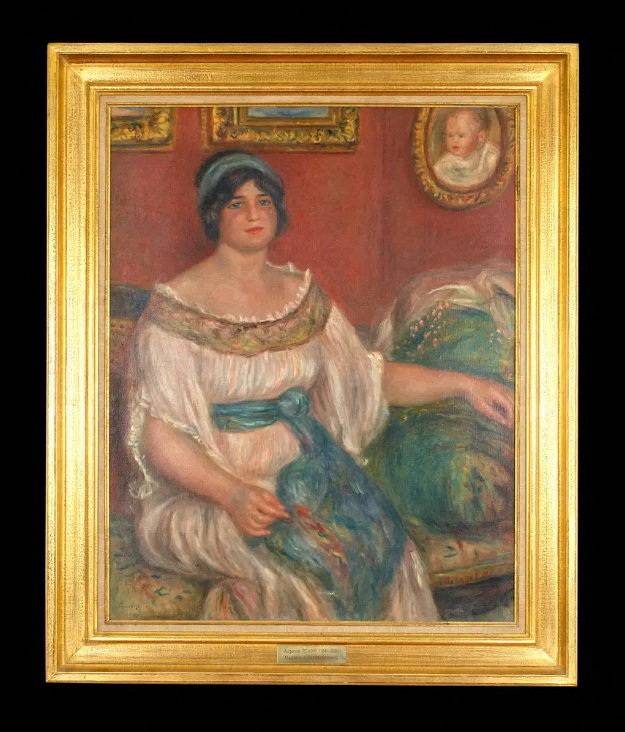
Painting of "Coco Reading" by French painter Pierre-Auguste Renoir, which was stolen from Renoir Museum in Cagnes-sur-Mer, France, but was later retrieved, September 8, 2026, in this screen grab obtained from a page on the Renoir Museum's website. (Musée Renoir/Handout via Reuters)
TT
TT
Renoir Paintings Are Worth a Fortune, but Not When They’re Stolen
Painting of "Coco Reading" by French painter Pierre-Auguste Renoir, which was stolen from Renoir Museum in Cagnes-sur-Mer, France, but was later retrieved, September 8, 2026, in this screen grab obtained from a page on the Renoir Museum's website. (Musée Renoir/Handout via Reuters)
Two Renoir paintings stolen from a small French museum have yet to be recovered but if the thieves are hoping to cash in on the artwork, they would be hard-pressed to find a buyer.
Selling well-known, stolen art is impossible to do at an auction house or through other public channels without raising eyebrows. Even under the table, the value plummets. And unlike other eye-catching artifacts such as jewels, paintings can't be chopped up and sold for parts without losing their entire worth.
Art crime experts stress that most buyers simply don't want the liability. In short, the reality looks nothing like the movies.
“People always think that there is this kind of ‘Dr. No’ type from the James Bond movie," said Arthur Brand, a private art detective based in the Netherlands. "But that’s Hollywood. In the real world, there are no collectors like that.”
Brand, who has investigated art crime for about 20 years, explains that often “nobody will touch” stolen art, particularly high-profile work. Sometimes that means paintings valued at millions of dollars are effectively “worth zero” once they're outside of the museum, he added, if not a small fraction of the price.
Tuesday's theft at the Renoir Museum — the last home of painter Pierre-Auguste Renoir in the French Riviera — marks the latest high-profile art crime targeting collections around the world, and experts warn there could be more.
Here's what we know.
Where the Renoirs could wind up
Cagnes-sur-Mer's mayor, Bryan Masson, said a group of “well-equipped” burglars stole a total of four Renoir paintings from the museum in his town on Tuesday. But they dropped two of them — Renoir’s “Portrait of Madame Pichon″ and “Coco Reading" — in the museum garden before they fled, the prosecutor’s office said in a statement.
Police are still searching for the perpetrators. In the meantime, Renoir's “Portrait of Madame Colonna Romano” and “Young Woman at the Well" remain missing.
Masson estimated the value of the combined Renoir works stolen Tuesday at 9 million euros ($10.5 million).
But the probability of profiting off such a heist is “extremely low,” said Erin Thompson, an art crime professor at the John Jay College of Criminal Justice in New York. In cases that end in arrests, the common takeaway is that “thieves are people who are good at stealing things and bad at thinking through the consequences,” she added.
Some may try to make money from heists in other ways, such as through demanding a ransom or looking for an insurance payout. But Thompson explains many museums don't have insurance because it's too costly. That's why the practice is so rare in the US, for example, and it would be difficult to negotiate with insurance companies elsewhere without the thieves incriminating themselves.
Painting of "Madame Colonna Romano" by French painter Pierre-Auguste Renoir, which was stolen from Renoir Museum in Cagnes-sur-Mer, France, September 8, 2026, in this screen grab obtained from a page on the Renoir Museum's website. (Musée Renoir/Handout via Reuters)
As a result, if not surrendered or otherwise recovered, stolen paintings may remain hidden or in some cases eventually destroyed to get rid of evidence, Thompson says.
Brand, who collaborates regularly with law enforcement in his art crime investigations, says that he's still seen limited cases of stolen paintings “floating around in the underworld” — perhaps as partial payments for products like drugs. And depending on country-by-country laws, he noted that the promise of returning the art has led to reduced sentences of other charges.
“Some more savvy criminal will acquire it as a get out of jail free card, sort of a bargaining chip,” added Christopher Marinello, a lawyer and founder of Art Recovery International. “So, if some drug dealer ever is arrested, he can bargain with the prosecutor and say, ‘Listen, give me a lesser sentence and I’ll show you where these Renoirs are.’ And that has always worked and it will work again.”
Paintings are harder to hide and sell than jewels
Stolen paintings are much more difficult to profit from than museums' other crown jewels — literally.
Jeweled and metal goods have increasingly become a target of theft because they can be melted down or broken down into parts. Last year, a handful of experts warned that could be the fate of the stunning heist of crown jewels at the Louvre Museum in Paris, for example, noting that, if done successfully, smaller pieces could later go up for sale as part of a new necklace, earrings or other jewelry without turning too many heads.
But of course, such pieces would lose their historical worth and, if actually sold, likely only go for a fraction of their original value. Experts also warn that it's far from a simple process overall and gems may still be identifiable by characteristics like clarity, for example.
Apart from an emerald-set imperial crown found outside the museum the day of the October 2025 heist, the stolen jewels remain unrecovered.
Paintings, in contrast, don't have the same commodity value that can potentially be parceled off. “It’s a canvas with some old oil paint on it,” said art theft expert James Ratcliffe, of the Art Loss Register. “You can’t touch it up. You can’t resell it other than for what it is.”
Uptick in art crime overall
Ratcliffe and others note that hasn't stopped thefts of famous paintings and other artwork from museums. Just earlier this year, three pieces by Renoir, Cézanne and Matisse worth millions of euros were stolen in Italy, for example, before being recovered last month.
Ratcliffe notes that smaller museums, in particular, are harder to secure because they might not have the funding necessary to invest in the latest technology or are located in historic buildings that may take more time and effort to install new guardrails.
Still, pressures are piling up, with some warning that future cases of art theft could be likely as vulnerabilities persist.
“We need to change the way we treat small and country house museums before we lose to our cultural heritage permanently,” said Marinello, who stresses that stronger security and enforcement is overdue. “We’re supposed to be preserving our cultural heritage, not allowing criminals to take what they want and using them as shopping malls.”
Massive Ancient Roman Bath Complex Opens to Visitorshttps://english.aawsat.com/culture/5316099-massive-ancient-roman-bath-complex-opens-visitors
A visitor views the restored south-western exedra of the Baths of Trajan, a monumental second-century AD hall believed to have served as a library or space for public readings, with the Colosseum seen in the background, in Rome on September 8, 2026. (AFP)
TT
TT
Massive Ancient Roman Bath Complex Opens to Visitors
A visitor views the restored south-western exedra of the Baths of Trajan, a monumental second-century AD hall believed to have served as a library or space for public readings, with the Colosseum seen in the background, in Rome on September 8, 2026. (AFP)
Rome's Baths of Trajan, an ancient bathing and leisure complex featuring giant frescoes and mosaics, is opening to visitors for the first time, the city's mayor said on Tuesday.
Inaugurated in 109 AD, the baths were built by the most famous architect of the time -- Apollodorus of Damascus -- and covered an area of 60,000 square meters (646,000 square feet).
The remains are located on top of the Colle Oppio near the Colosseum and the Roman Forum.
Visitors will be able to see a fresco entitled "The Painted City", depicting an unidentified city of the Roman Empire, as well as a large mosaic dubbed "The Muse and the Philosopher", whose colors are still vivid and whose figures are rendered with striking realism.
"These are the largest fresco and the largest mosaic of the Roman era ever discovered," mayor Roberto Gualtieri told reporters as he announced the site would open this weekend.
He called them "marvelous works that are truly unique in the world for their artistic beauty and their historical... significance".
The site also includes an exedra, a semicircular building whose precise purpose is unknown, which will in future host artistic and cultural events.
The area, which is still undergoing restoration, will initially open only at weekends for groups of no more than 15 people during September.
لم تشترك بعد
انشئ حساباً خاصاً بك لتحصل على أخبار مخصصة لك ولتتمتع بخاصية حفظ المقالات وتتلقى نشراتنا البريدية المتنوعة