


In Senegal, the Bastion of the Region’s Francophonie, French Is Giving Way to Local Languages

A man sits outside a stationary store with French signs in Dakar, Senegal, Thursday, Oct. 3, 2024. (AP)
TT

In Senegal, the Bastion of the Region’s Francophonie, French Is Giving Way to Local Languages

A man sits outside a stationary store with French signs in Dakar, Senegal, Thursday, Oct. 3, 2024. (AP)

For decades Senegal, a former French colony in West Africa, has been touted as the bastion of the French language in the region. Leopold Sedar Senghor, the country’s first president and a poet, is considered one of the founding fathers of the concept of Francophonie, a global alliance of French-speaking countries.

But many say a shift is underway. While French remains the country’s official language, inscribed into its constitution, its influence is waning. It is giving way to Wolof, the most widely spoken local language — and not just on the street, where the latter has always been dominant, but in the halls of power: government offices, university corridors and mainstream media.

As the French president hosts the annual Francophonie summit north of Paris, Senegal’s president is not attending in person. He sent the foreign minister as his representative instead.

“Wolof is on the rise because Senegalese people want to be seen,” said Adjaratou Sall, professor of Linguistics at the Cheikh Anta Diop University in Dakar, who began researching the Wolof language in 1998. “They want to detach themselves from the colonial heritage and reclaim their own cultural identity.”

There are 25 languages in Senegal. Six of them have the status of national languages, but Wolof is largely dominant. Out of the population of 17 million people, over 12 million speak Wolof, compared to around 4 million French speakers.

But like in most former colonies, French has traditionally been the language of Senegalese political and cultural elites. The vast majority of schools across the country and all universities are French speaking. All official documents are issued in French. With the education rate in Senegal at around 60%, this excludes a large part of the population.

President Bassirou Diomaye Faye, the youngest elected leader in Africa, was voted in six months ago on an anti-establishment platform, and his rise reflected the frustration of the Senegalese youth with the traditional, elderly political class. He has made a point in making all of his official speeches in both languages, French and Wolof, and pledged to give local languages the primary role in schools, with French introduced later.

The shift comes as most West African nations are rethinking their relationship with France, which is losing its clout in the region. In some cases, like in Burkina Faso and Mali, which are ruled by military juntas, the divorce with the French language has been abrupt: They dropped French as the official language and banned many French-speaking media outlets.

The decline of French in Senegal has been more subtle. But to a careful observer, the signs are everywhere: More and more billboards are either bilingual, or in Wolof. Although all university courses are still conducted in French, Sall said that professors and students speak Wolof to each other in the corridors, which would have been unthinkable when she started working. Some Senegalese writers are publishing their books in Wolof, and not in French.

“Surely, the nationalism which began to take root with the new government is playing a role,” said Fall. “But another important factor has been the revolution in the media, which started with Sud FM.”

Sud FM, the first private radio station in Senegal, started broadcasting programs in Wolof in 1994. The morning news program in Wolof now has over 2 million listeners, said its director, Baye Oumar Gueye.

“We replied to a real need: providing information to the population, who does not speak French,” Gueye said in an interview in his office. “They can now participate in the exchange of information.”

He added: “The use of the French language is decreasing. When you want to reclaim your sovereignty, the first thing is to have your own language.”

El Hadj Aip Ndiaye, who has been driving a taxi in Dakar for the past 45 years, said he remembers well the launch of Sud FM. “Everyone listened to it,” he recalled.

Ndiaye, who did not go to school and speaks a very limited French, said he listens to the radio everyday from 5 a.m. until midnight, as he drives across the dusty roads of Dakar in his yellow, rickety taxi.

“Before, all the news on the radio was in French,” he said. “I could not understand it. But with news in Wolof, you can understand what they are saying. You understand the world better, and you can take part in the conversation.”

“People are now proud to speak Wolof,” he said. “Before, when you spoke Wolof, you were judged as a peasant. But now, even our president speaks Wolof a lot, so people are not afraid to speak it.”

But even the biggest proponents of Wolof do not want a revolution. Fall, the linguistics professor, said she dreamed of university courses being held in Wolof, and children being taught in their local language, whether it would be Wolof, Serrer or Peul.

“We will get there, but it's a process,” she said. “And we need French as well. It is the language of openness, which allows us to communicate with others in the region.”

New Tools Rescue Old Art at Madrid’s Prado Museum

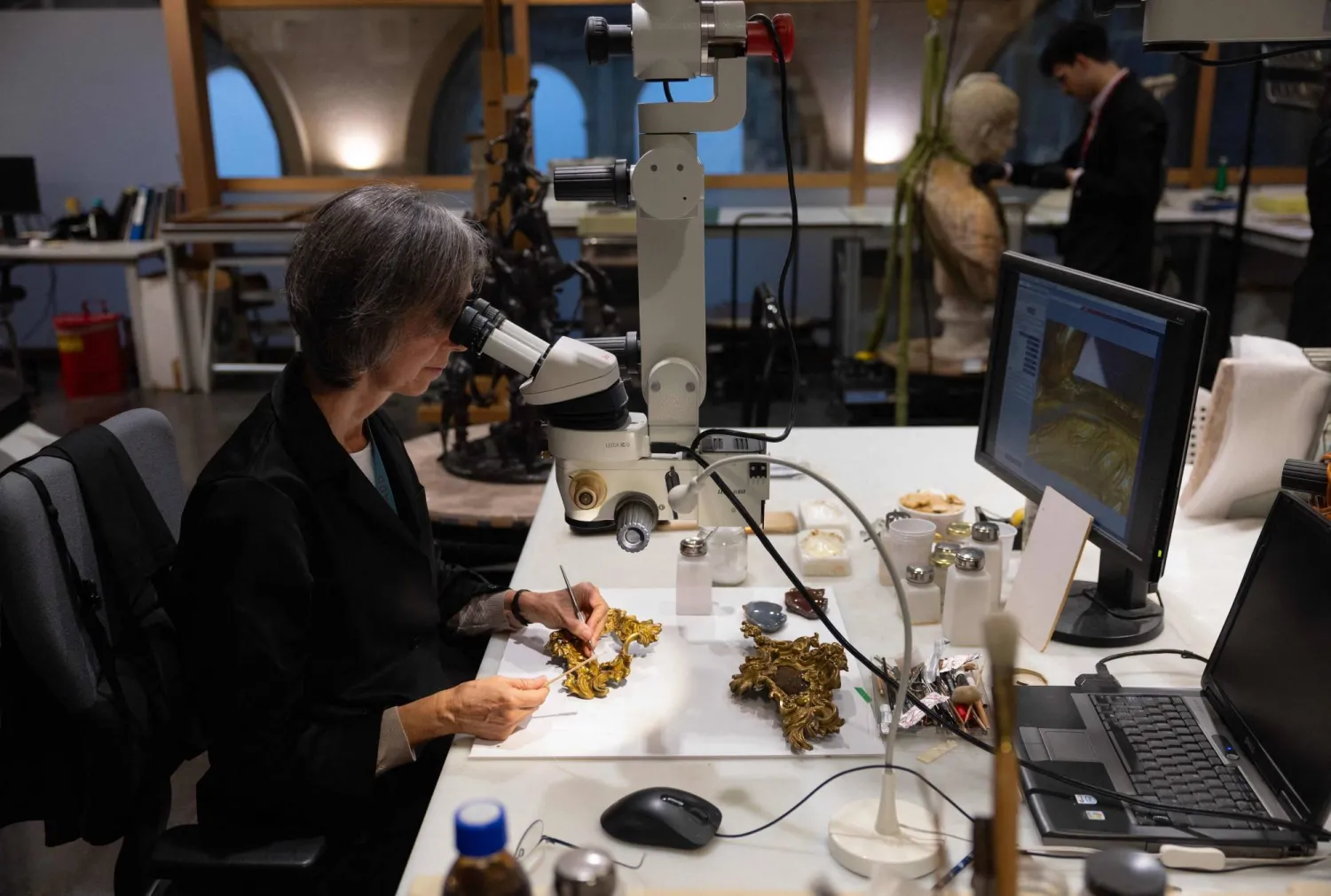
A conservator works on the restoration of gilded moldings at the Prado museum's sculpture restoration department in Madrid on October 23, 2025. (Pierre-Philippe Marcou/ AFP)
TT

New Tools Rescue Old Art at Madrid’s Prado Museum

A conservator works on the restoration of gilded moldings at the Prado museum's sculpture restoration department in Madrid on October 23, 2025. (Pierre-Philippe Marcou/ AFP)

In a quiet space secluded from the throngs of daily visitors to Madrid's Prado art museum, a team of experts perpetuate an ancient tradition of restoring centuries-old European cultural treasures.

Creations by some of art's most illustrious names -- Goya, Velazquez, Rubens, Caravaggio, Bosch and El Greco -- are conserved in the vast, bright space at one of the world's most-visited museums.

The Prado has always put an emphasis on the conservation and restoration of art since it opened to the public in 1819.

Cutting-edge technology and modern tools to analyze and treat paintings and sculptures allow Almudena, Marta, Maria, Alvaro, Alicia, Elena, Sonia and Eva to maintain the tradition.

The team is capable of caring for the museum's most prized collections as well as works from other institutions.

In February, the Prado launched the restoration of "Pablo de Valladolid", an emblematic portrait that Spanish master Velazquez produced in the 17th century.

But the work will first undergo a deep technical analysis by new equipment, the museum said in a statement.

Scanning technology will allow the experts to identify and locate the materials used by the artist, while multispectral infrared reflectography will reveal details invisible to the naked eye.

Everything contributes to a deeper understanding of the artist's technique, the work's state of conservation and preparing its restoration.


Saudi Culture Ministry Launches Nonprofit Cultural Sector Forum with Wide Participation from Experts, Entities

The Saudi Culture Ministry will oversee the national pavilion with participation from several entities
TT

Saudi Culture Ministry Launches Nonprofit Cultural Sector Forum with Wide Participation from Experts, Entities

The Saudi Culture Ministry will oversee the national pavilion with participation from several entities

Under the patronage of Saudi Minister of Culture Prince Bader bin Abdullah bin Farhan, the sessions of the Nonprofit Cultural Sector Forum, organized by the Ministry of Culture in Riyadh, kicked off on Wednesday, SPA reported.

The first day featured eight panel sessions with a group of local and international experts and specialists, discussing several strategic themes related to the nonprofit cultural sector.


The sessions addressed the sector’s role in shaping the future in light of modern trends, the importance of empowering nonprofit cultural organizations to build sustainable cultural and economic impact, and the role of social responsibility in developing the nonprofit sector.

The forum is also witnessing the signing of a number of agreements and memoranda of understanding, as part of enhancing partnerships and enabling nonprofit cultural organizations to expand their scope of work and achieve sustainable cultural and societal impact.


AlUla’s Maraya Hall Highlights Creative Fusion of Art and Landscape

Maraya Hall reflects one aspect of the cultural transformation witnessed in AlUla - SPA
TT

AlUla’s Maraya Hall Highlights Creative Fusion of Art and Landscape

Maraya Hall reflects one aspect of the cultural transformation witnessed in AlUla - SPA

In AlUla Governorate, features of human creativity are manifested in their finest form, as Maraya Hall hosts an exceptional artistic and architectural experience that blends art and nature, in a scene that embodies the presence of arts as a universal language that transcends borders and cultures.

Maraya Hall is considered the largest mirrored building in the world by Guinness World Records, with its structure covered by around 9,740 reflective panels designed to mirror the beauty of the surrounding sandstone cliffs, giving visitors a unique visual experience that appears as a natural extension of the desert landscape, SPA reported.

The hall includes multiple spaces and halls equipped with the latest technologies, accommodating around 500 seats, making it an integrated platform for hosting concerts, artistic performances, conferences, and various cultural events.

Maraya Hall reflects one aspect of the cultural transformation witnessed in AlUla, within an integrated cultural and artistic ecosystem that enhances the governorate’s presence on the global arts map, coinciding with the celebration of World Art Day, which falls on April 15 each year, highlighting the importance of arts in building cultural bridges and promoting human dialogue.