Saudi Arabia Museum of Contemporary Art Hosts 'Manga Hokusai Manga' Exhibition

The exhibition presents the works of the renowned Japanese artist Katsushika Hokusai - SPA
TT

Saudi Arabia Museum of Contemporary Art Hosts 'Manga Hokusai Manga' Exhibition

The exhibition presents the works of the renowned Japanese artist Katsushika Hokusai - SPA

In the presence of Japan's Ambassador to Saudi Arabia Yasunari Morino, the Saudi Arabia Museum of Contemporary Art (SAMoCA) at Jax District inaugurated on Wednesday the Manga Hokusai Manga exhibition. This exhibition, organized in collaboration with the Embassy of Japan and the Japan Foundation, will run until February 8, 2025.
This international exhibition, which has been on tour since 2016, is presented for the first time in an Arab country. Driven by its commitment to fostering cross-cultural exchange and dialogue, SAMoCA is hosting the exhibition at a significant time, as 2025 marks the 70th anniversary of the establishment of diplomatic relations between Saudi Arabia and Japan, SPA reported.
The exhibition presents the works of the renowned Japanese artist Katsushika Hokusai, a key figure in traditional Japanese art. It highlights his collection called Hokusai Manga, first published in 1814. With more than 4,000 sketches across 15 volumes, the collection depicts various aspects of daily life, landscapes, and whimsical creatures, signalling a new era in Japanese illustration art.
Hokusai's works became popular during the Edo period (1603–1868), and his volumes were published until 1834. Even after his passing in 1849, his work continued inspiring artists in Japan and globally, shaping modern manga art.
The exhibition aims to showcase the history and development of manga, highlighting how Hokusai's classical illustrations have impacted modern visual arts. It offers visitors a journey through the evolution of this art form, from its classical origins to its modern and innovative expressions.
The Saudi Arabia Museum of Contemporary Art is the first contemporary art museum in Saudi Arabia. It plays a significant role in the nation's cultural renaissance under Vision 2030, serving as a platform for local and international artists to exchange, connect, and grow, shaping the future of contemporary art in the Kingdom and beyond.
Tickets for the exhibition are available through WeBook.



Northern Arabia Archaeological Site Reveals 13,500-Year-Old Human Settlement

The study documented human settlement at the site dating back about 13,500 years. (Saudi Ministry of Culture)
TT

Northern Arabia Archaeological Site Reveals 13,500-Year-Old Human Settlement

The study documented human settlement at the site dating back about 13,500 years. (Saudi Ministry of Culture)

The Saudi Heritage Commission, one of 11 sector-specific commissions under the Ministry of Culture, announced findings documenting archaeological evidence of early human settlement in northern Arabia. The scientific study presenting the evidence has been published in the journal Nature.

The findings, presented in the scientific study titled “The Natufian Epipalaeolithic and Pre-Pottery Neolithic in the desert of northern Arabia,” are based on advanced excavation and scientific analysis conducted at the Sahout site, an archaeological site located on the southern edge of the Nefud Desert between the Arnan and Al-Misma mountains.

The site occupies a strategic geographic position linking internal desert environments with settlement networks connected to the Levant, making it a key location for understanding early human movement and dispersal in the region during the late Ice Age and the beginning of the Holocene.

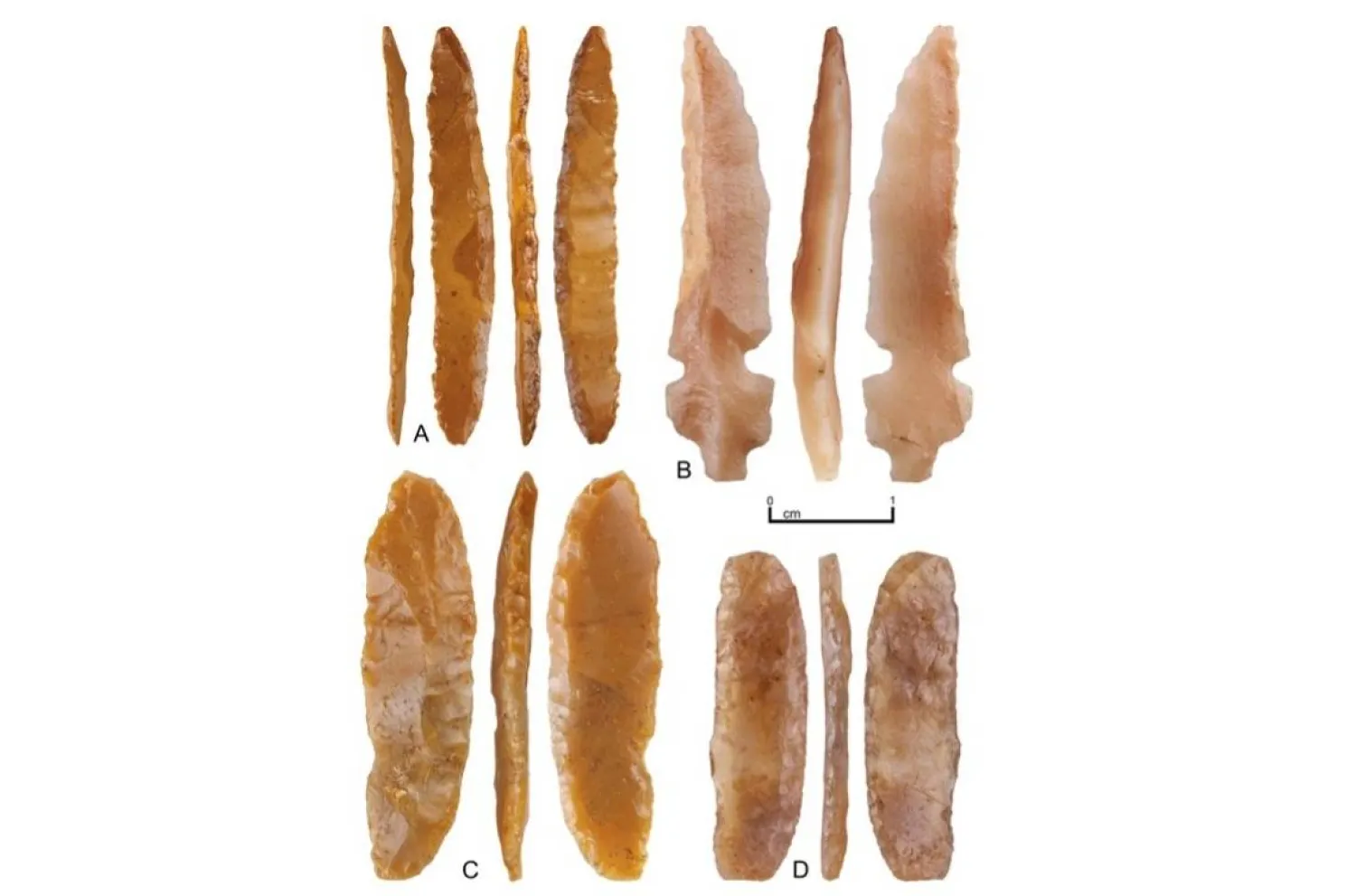
The study documented human settlement at the site dating back about 13,500 years. Stratified excavations uncovered distinctive stone tools, most notably Helwan bladelets - small, finely crafted stone implements used as arrowheads or as components of hunting tools.

These artifacts are important archaeological indicators associated with the Natufian culture. Their discovery at the Sahout site confirms the presence of human communities possessing advanced technical skills and the ability to adapt to desert environments. It also reflects the connection of the Arabian Peninsula to broader cultural networks extending to the Fertile Crescent during this early period.

The discovery also revealed a later settlement phase dating between approximately 10,300 and 8,700 years ago, characterized by greater settlement density and technological development in stone industries. Archaeologists discovered Abu Salem points, a type of finely crafted arrowhead used in hunting.

These findings provide important evidence of advanced human societies with sophisticated technological skills, reflecting a high level of organization and environmental knowledge during the Pre-Pottery Neolithic period and confirming the presence of developed human settlement in northern Arabia during that time.

Geochemical analyses of the obsidian used to manufacture the stone tools showed that the material originated from Jabal Al-Abyad in the Khaybar region, about 190 km south of the site. This indicates the existence of extensive communication and exchange networks, demonstrating that early communities were capable of traveling long distances to obtain resources from distant areas and highlighting advanced levels of cultural and technological interaction among populations in the region.

The study documented a direct link between human settlement and rock art at the site. Carving tools were found within dated archaeological layers alongside artistic elements depicting life-size camels and human figures.

These discoveries provide a precise chronological framework for the development of artistic expression in northern Arabia, confirming that artistic production was an integral part of the cultural life of the communities inhabiting the area during these early periods.

The findings reaffirm the Kingdom’s commitment to cultural preservation, historical understanding, and knowledge development.


Qasr Al-Shariah Mosque: An Architectural and Cultural Landmark

The Qasr Al-Shariah Mosque in Al-Haytham, Al-Kharj Governorate.(SPA)
TT

Qasr Al-Shariah Mosque: An Architectural and Cultural Landmark

The Qasr Al-Shariah Mosque in Al-Haytham, Al-Kharj Governorate.(SPA)

The Prince Mohammed bin Salman Project for Development of Historical Mosques focuses on preserving and restoring historical mosques across Saudi Arabia while enhancing their architectural integrity and highlighting their cultural and religious significance. The initiative aligns with Saudi Vision 2030 goals.

The Qasr Al-Shariah Mosque in Al-Haytham, Al-Kharj Governorate, exemplifies this effort. Closely tied to the governorate's history, it has served as a center for worship and community gatherings for decades, the Saudi Press Agency reported Sunday.

Built in 1338 AH during the reign of King Abdulaziz bin Abdulrahman, the mosque features traditional Najdi architecture, constructed from mud and stone with a roof made of tamarisk wood and palm fronds. Historically, it hosted Quranic classes and religious lessons.

Originally covering 314 square meters and accommodating around 90 worshippers, the mosque has been renovated to expand its area to 371 square meters and increase capacity to 150 worshippers, with the addition of essential facilities.

The project blends traditional building practices with modern techniques to ensure sustainability while preserving each mosque’s architectural identity. It also engages local heritage specialists under the supervision of Saudi engineers to achieve four key objectives: rehabilitating mosques for worship, restoring architectural authenticity, showcasing the Kingdom's civilizational heritage, and enhancing the cultural significance of historical mosques for future generations.


Royal Order Issued on Establishment of Riyadh University of Arts

Custodian of the Two Holy Mosques King Salman bin Abdulaziz. SPA
TT

Royal Order Issued on Establishment of Riyadh University of Arts

Custodian of the Two Holy Mosques King Salman bin Abdulaziz. SPA

A royal order has been issued approving the establishment of the Riyadh University of Arts, an independent educational institution headquartered in Riyadh under the supervision of the Ministry of Culture.

With legal personality and financial and administrative autonomy, the university is dedicated to specialized education in culture and the arts, aiming to cultivate national talent across creative disciplines through advanced academic programs aligned with global best practices and the objectives of Saudi Vision 2030.

The royal order authorizes the Minister of Culture to exercise the powers of the Board of Trustees until it is formally established, ensuring the swift completion of organizational procedures to begin operations.

To enhance its academic mission, the university will seek partnerships with prestigious international institutions to exchange expertise and develop high-level educational programs.

This initiative underscores the leadership's commitment to bolstering the Kingdom’s position as a regional cultural hub and fostering the growth of its creative industries.