


Northern Arabia Archaeological Site Reveals 13,500-Year-Old Human Settlement

The study documented human settlement at the site dating back about 13,500 years. (Saudi Ministry of Culture)
TT

Northern Arabia Archaeological Site Reveals 13,500-Year-Old Human Settlement

The study documented human settlement at the site dating back about 13,500 years. (Saudi Ministry of Culture)

The Saudi Heritage Commission, one of 11 sector-specific commissions under the Ministry of Culture, announced findings documenting archaeological evidence of early human settlement in northern Arabia. The scientific study presenting the evidence has been published in the journal Nature.

The findings, presented in the scientific study titled “The Natufian Epipalaeolithic and Pre-Pottery Neolithic in the desert of northern Arabia,” are based on advanced excavation and scientific analysis conducted at the Sahout site, an archaeological site located on the southern edge of the Nefud Desert between the Arnan and Al-Misma mountains.

The site occupies a strategic geographic position linking internal desert environments with settlement networks connected to the Levant, making it a key location for understanding early human movement and dispersal in the region during the late Ice Age and the beginning of the Holocene.

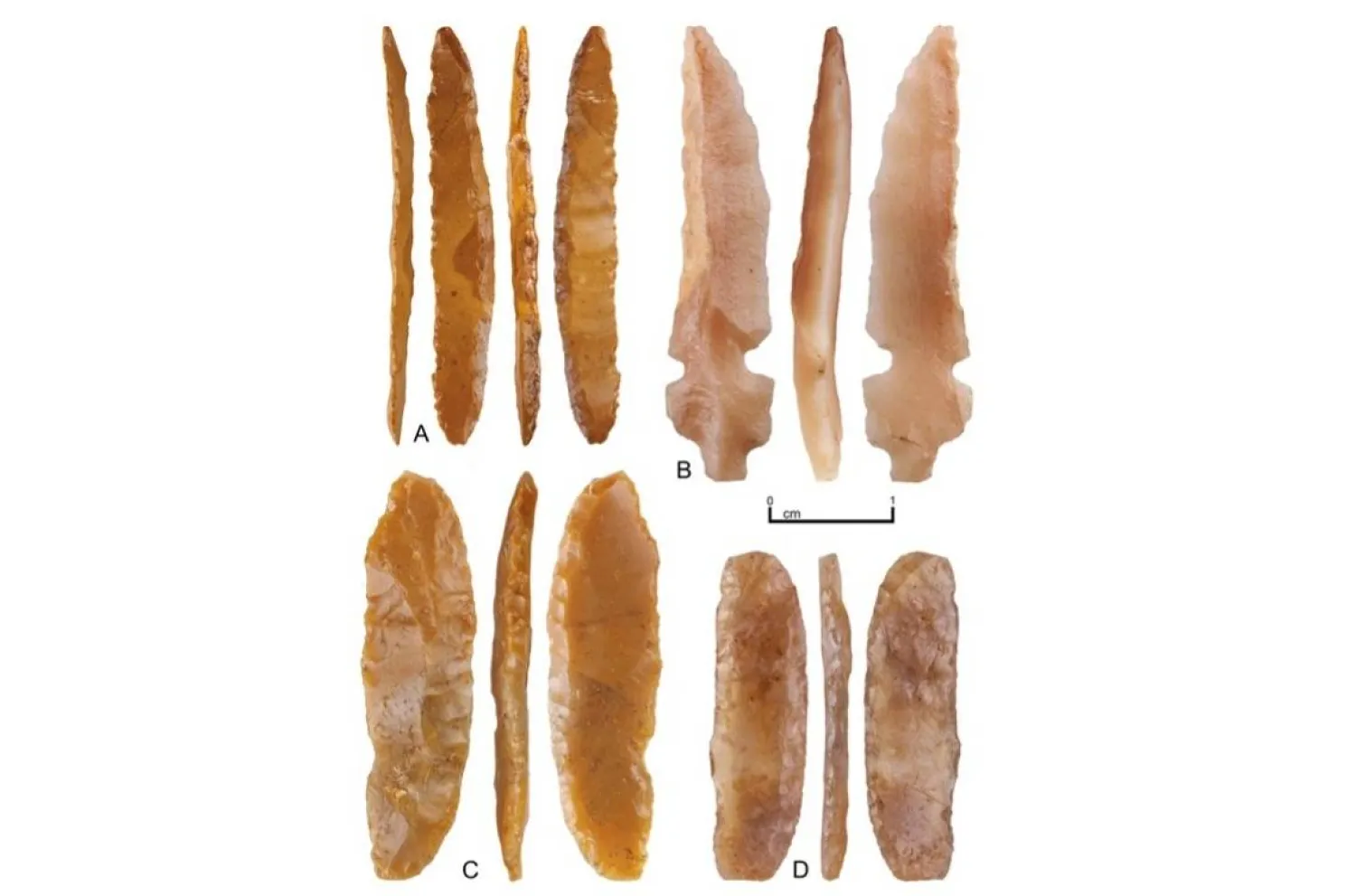
The study documented human settlement at the site dating back about 13,500 years. Stratified excavations uncovered distinctive stone tools, most notably Helwan bladelets - small, finely crafted stone implements used as arrowheads or as components of hunting tools.

These artifacts are important archaeological indicators associated with the Natufian culture. Their discovery at the Sahout site confirms the presence of human communities possessing advanced technical skills and the ability to adapt to desert environments. It also reflects the connection of the Arabian Peninsula to broader cultural networks extending to the Fertile Crescent during this early period.

The discovery also revealed a later settlement phase dating between approximately 10,300 and 8,700 years ago, characterized by greater settlement density and technological development in stone industries. Archaeologists discovered Abu Salem points, a type of finely crafted arrowhead used in hunting.

These findings provide important evidence of advanced human societies with sophisticated technological skills, reflecting a high level of organization and environmental knowledge during the Pre-Pottery Neolithic period and confirming the presence of developed human settlement in northern Arabia during that time.

Geochemical analyses of the obsidian used to manufacture the stone tools showed that the material originated from Jabal Al-Abyad in the Khaybar region, about 190 km south of the site. This indicates the existence of extensive communication and exchange networks, demonstrating that early communities were capable of traveling long distances to obtain resources from distant areas and highlighting advanced levels of cultural and technological interaction among populations in the region.

The study documented a direct link between human settlement and rock art at the site. Carving tools were found within dated archaeological layers alongside artistic elements depicting life-size camels and human figures.

These discoveries provide a precise chronological framework for the development of artistic expression in northern Arabia, confirming that artistic production was an integral part of the cultural life of the communities inhabiting the area during these early periods.

The findings reaffirm the Kingdom’s commitment to cultural preservation, historical understanding, and knowledge development.



Cultural Development Fund Reports Strong Q1 2026 Growth and Impact

Cultural Development Fund Reports Strong Q1 2026 Growth and Impact
TT

Cultural Development Fund Reports Strong Q1 2026 Growth and Impact

Cultural Development Fund Reports Strong Q1 2026 Growth and Impact

The Cultural Development Fund has announced its results for the first quarter of 2026, demonstrating significant growth in financial performance and developmental impact. This underscores the fund's role as a key financial enabler and center of excellence in developing a sustainable cultural sector, enhancing Saudi culture as a vital economic and social pillar, SPA reported.

Since its inception, the fund has provided over SAR770 million in financial support to 165 cultural projects across various sub-sectors and regions of the Kingdom. It has also benefited more than 1,630 creative individuals and entrepreneurs through developmental services aimed at building entrepreneurial capabilities.

The fund achieved a 30% increase in financial returns compared to the same period in 2025, contributing an estimated SAR4.1 billion to GDP and creating over 12,540 job opportunities.

Additionally, it has stimulated private sector involvement with approximately SAR1.1 billion in contributions, reflecting growing confidence in developing the cultural sector.

These figures highlight the fund's essential role in empowering the private sector and fostering innovative financial solutions that promote growth and enhance the quality of life, aligned with Saudi Vision 2030.


Historic Jeddah Showcases Cultural Heritage at Umrah and Ziyarah Forum

The pavilion highlighted the distinctive architectural features of Historic Jeddah - SPA
TT

Historic Jeddah Showcases Cultural Heritage at Umrah and Ziyarah Forum

The pavilion highlighted the distinctive architectural features of Historic Jeddah - SPA

Historic Jeddah participated in the Umrah and Ziyarah Forum to highlight its historical role as a key gateway for pilgrims to Makkah, while introducing visitors to its cultural status and the ongoing development projects that reinforce its status as a heritage destination, SPA reported.

The pavilion introduced visitors to the "Historic Hajj Trail" supported by the Ministry of Hajj and Umrah, designed as a sequential narrative that retraces the pilgrim’s journey from arriving at Bab Al-Bunt Port, now the Red Sea Museum, to Makkah Gate, passing through prominent historical sites that reflect Jeddah’s role in serving pilgrims.

The pavilion highlighted the distinctive architectural features of Historic Jeddah and its long-standing role as a major port for pilgrims since the 7th century CE and also featured interactive content showcasing the area’s cultural and social fabric.

This participation forms part of the "Revitalization of Historic Jeddah" project, led by the Ministry of Culture, within the framework of the National Culture Strategy and Saudi Vision 2030.


Geisha Spectacle in Japan’s Kyoto Celebrates Arrival of Spring

 Maiko (apprentice geisha) take part in a press interview ahead a rehearsal for the annual "Miyako Odori" -- which means "capital city dance" in Japanese, at the Gion Kobu Kaburenjo in Kyoto on March 31, 2026. (AFP)
Maiko (apprentice geisha) take part in a press interview ahead a rehearsal for the annual "Miyako Odori" -- which means "capital city dance" in Japanese, at the Gion Kobu Kaburenjo in Kyoto on March 31, 2026. (AFP)
TT

Geisha Spectacle in Japan’s Kyoto Celebrates Arrival of Spring

 Maiko (apprentice geisha) take part in a press interview ahead a rehearsal for the annual "Miyako Odori" -- which means "capital city dance" in Japanese, at the Gion Kobu Kaburenjo in Kyoto on March 31, 2026. (AFP)
Maiko (apprentice geisha) take part in a press interview ahead a rehearsal for the annual "Miyako Odori" -- which means "capital city dance" in Japanese, at the Gion Kobu Kaburenjo in Kyoto on March 31, 2026. (AFP)

Against a backdrop of blooming cherry blossoms, a group of geishas elegantly shuffle onto a stage in Japan's Kyoto city to begin a centuries-old performance celebrating the arrival of spring.

Dressed in sky blue kimonos emblazoned with flowers, the dancers twist and twirl in unison in front of hundreds of spectators eager to see the annual "Miyako Odori" in the nation's spectacular ancient capital.

Geishas, known as geikos in Kyoto, and apprentices called maikos have been donning elaborate costumes and fluttering fans since the Miyako Odori -- or "capital city dance" -- first started in 1872.

"Just as cherry blossoms bloom when spring approaches, the Miyako Odori is a spring tradition in Kyoto," Kyoko Sugiura, head of the Yasaka Nyokoba Gakuen, a school for geishas in Kyoto's Gion district, told AFP.

In Japanese, the word geisha means "person of the arts", and can refer to a woman or man trained in traditional Japanese performing arts.

In the popular imagination geishas are often confused with courtesans but their work as trained masters of refined old artforms does not involve selling sex.

Their performances are usually small and private, and take place at high-class establishments which operate a no first-time customer policy.

"That's why it is often thought of as a very exclusive world," Sugiura said.

"But the Miyako Odori is a one-hour show in which geisha and maiko have the opportunity to showcase the arts they practise daily," she said.

"Anyone and everyone with a ticket can enjoy the show."

The Miyako Odori began soon after Kyoto hosted Japan's first national expo -- an effort to revitalize the western city following the relocation of the capital to Tokyo in 1869.

The format of the performance has not changed much, Sugiura explained, although the music and dance moves are sometimes switched up.

Maria Superata, a geisha expert who has worked with them as an interpreter, explained that the show "combines all of the traditional performing arts that you can see in Japan".

"For example, elements from kabuki (classical Japanese theatre), elements from traditional dance. So they have to act, they have to sing, they have to play the instruments, everything all in one," she said.

"That's why it's so special."

But the number of geishas, who once made a living through performing for Japan's wealthy elite, is in decline.

Superata said that fewer young Japanese want a life that demands huge discipline and comes with a strict practice schedule.

"Nowadays, young Japanese people... are not very interested that much in traditional art and in kimono."