


French Artist Begins Giant ‘Cave’ Art Inflation Over Paris’ Oldest Bridge

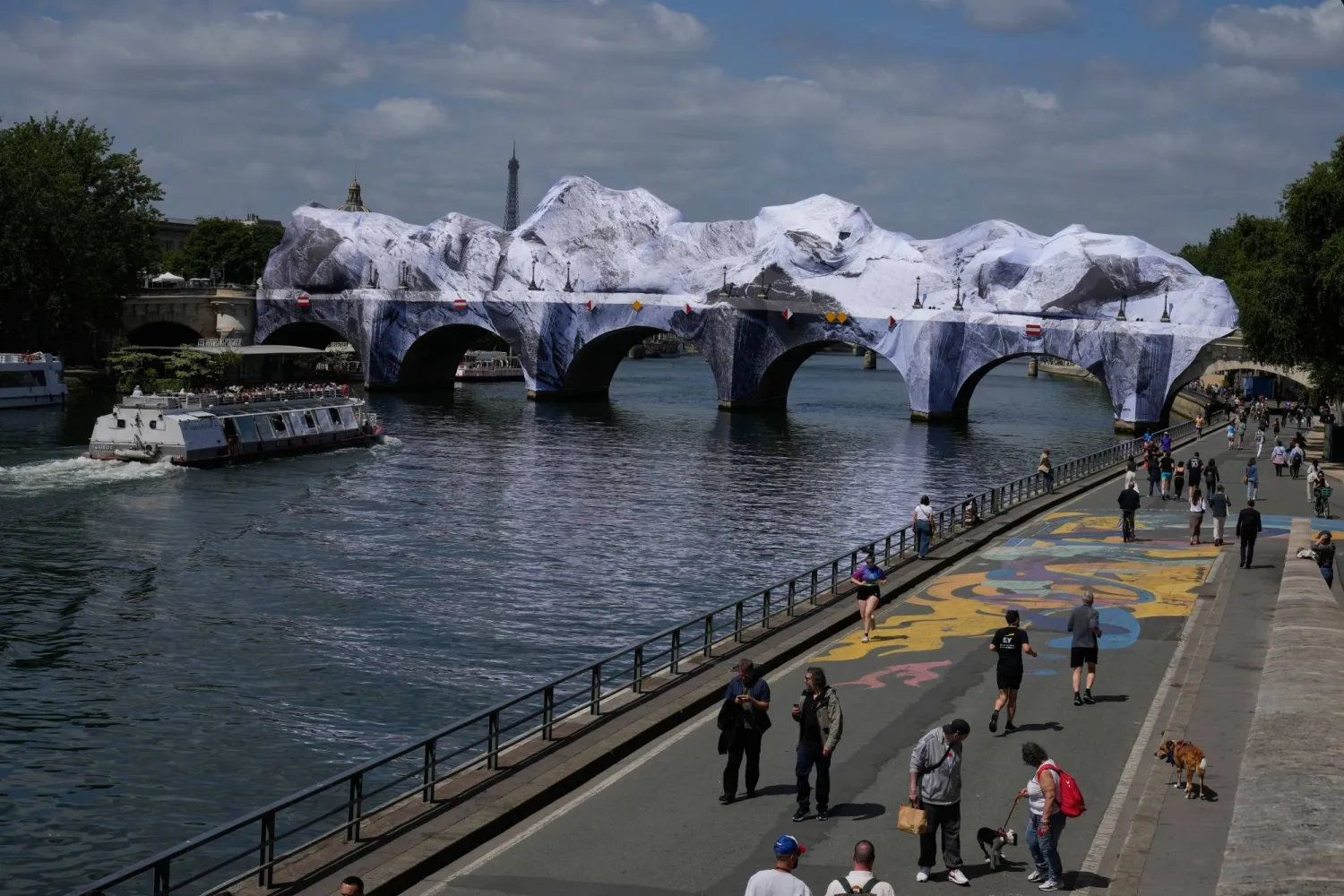
People walk along the Seine river next to "The Pont Neuf Cave," an inflated art installation by French street artist JR, on Paris' oldest bridge, the Pont Neuf, Thursday, May 21, 2026, which will be open to the public from June 6-28. (AP Photo/Michel Euler)
TT

French Artist Begins Giant ‘Cave’ Art Inflation Over Paris’ Oldest Bridge

People walk along the Seine river next to "The Pont Neuf Cave," an inflated art installation by French street artist JR, on Paris' oldest bridge, the Pont Neuf, Thursday, May 21, 2026, which will be open to the public from June 6-28. (AP Photo/Michel Euler)

The oldest bridge in Paris has begun to vanish this week, as the artist JR — who is known as the “French Banksy” — began inflating a giant “cave” over the Pont Neuf.

The monumental, rocky illusion is swallowing the 17th-century landmark, which has carried Parisians across the Seine for more than 400 years. By Thursday, it looked as if a prehistoric cliff had risen in the heart of the city.

The inflation process, which was carried out overnight — after being delayed by bad weather — is the most dramatic stage yet of a project more than a year in the making.

One of the most ambitious public artworks Paris has seen in decades, which has been funded by the sale of JR’s work and a handful of corporate partners, does not open to the public until June 6.

“We’re about to leave something pretty incredible in the middle of Paris,” JR told The Associated Press earlier this year at his studio in the city’s east, wearing his trademark hat and shades.

The transformation of the bridge has been documented by the AP since March with time-lapse cameras, including one fixed on a rooftop terrace high above the river, watching the bridge slowly disappear day by day.

From the outside, the installation looks like a rocky mass that “literally” breaks the landscape, said JR, who is famous for pasting enormous photographs on buildings, walls and rooftops around the world. This time he wanted Parisians to do something unusual on their busiest bridge: stop.

Visitors will be able to walk for free through a long, dark tunnel that lets in no daylight and where, according to JR, people “will lose track of time.”

The numbers are startling. The structure is 120 meters (393 feet) long and 18 meters (59 feet) tall — which is as high as a six-story building.

Yet it is built almost entirely from air — 80 fabric arches filled with 20,000 cubic meters of it — and weighs only about five tons. The fabric was hand stitched by 25 artisans in a village in Brittany.

Nothing digs into the historic stone.

Cut the air and the cliff would sink like a held breath — a collapse JR’s engineers spent weeks rehearsing in a hangar at Orly airport to be sure that if the power ever failed, the rock would come down gently.

The artwork, called La Caverne du Pont Neuf, is a tribute to a Parisian artistic legend.

In 1985, artist Christo and his wife, Jeanne-Claude, wrapped the same bridge in pale golden fabric — 13 kilometers of rope, a decade of arguing with city hall, three million visitors in two weeks. The act helped invent the idea of monumental art in modern cities.

A square beside the bridge now carries their names.

“It’s pretty hard to go after them,” JR said.

His idea, he said, is to bring “mineral and nature” back to the heart of the city. He is not covering the bridge but undressing it — sending the dressed stone back to the limestone quarries from which Paris itself was cut.

The cave is also a warning. JR built it as a nod to Plato’s allegory, in which prisoners mistake shadows on a wall for the real world.

“What are our caves today? Our phones,” he said. “Because we believe that our algorithm on social media is the reality.”

Then he walks straight into the contradiction: to enter his cave about screens, visitors raise their phones.

The tech company Snap has built an augmented-reality layer that shows what the eye cannot.
The sound is a low, mineral hum from Thomas Bangalter, formerly of Daft Punk — who was 10 the year Christo wrapped the bridge.

The cave will be open around the clock from June 6-28, closing the bridge to traffic and visible from the quays, from passing boats, even from the top of the Eiffel Tower.

It will coincide with Paris Fashion Week, World Music Day and the all-night Nuit Blanche arts festival.

When it comes down, the fabric will be reused or recycled. Air, JR likes to say, leaves no scar.
Then, like the golden wrapping 40 years before, the cave will be gone — and the Pont Neuf, older than the republic and older than the revolution, will reappear exactly as it was.


Students Discover 1,800-Year-Old Roman Villa Beneath School Gym

Students' curiosity uncovered what had lain hidden beneath the earth for centuries. (Special Superintendency of Rome)
TT

Students Discover 1,800-Year-Old Roman Villa Beneath School Gym

Students' curiosity uncovered what had lain hidden beneath the earth for centuries. (Special Superintendency of Rome)

Archaeologists in Rome have uncovered the remains of a luxury Roman residence dating to the second century CE beneath a high school near the Colosseum, after students' curiosity about mysterious underground rooms led to a formal excavation of the site.

According to Live Science, students at Liceo Scientifico Cavour, located just steps from the Colosseum, had long shared stories about hidden chambers beneath the school's gymnasium. What began as rumors ultimately led to a remarkable archaeological discovery.

During unofficial explorations of the underground spaces, students came across evidence of an ancient structure beneath the school.

After informing a teacher, who alerted the relevant authorities, archaeologists were called in to investigate the site. Excavations carried out earlier this year revealed that the dark passageways and partially lit rooms formed part of an elaborate Roman residence dating back nearly 1,800 years.

Liceo Scientifico Cavour occupies a building near the Colosseum that originally served as the headquarters of a Catholic missionary organization. When the complex was constructed in the late nineteenth century, preliminary excavation work uncovered part of an ancient domus, the term used for a large Roman urban residence.

The area is among the most historically significant parts of ancient Rome. Prominent figures including Cicero, Pompey and Octavian, later known as Augustus, are known to have lived there. Yet the district remains only partially understood by archaeologists because layers of modern construction cover much of the ancient landscape.

Researchers say the discovery offers a rare opportunity to study a section of ancient Rome that has remained largely inaccessible, while shedding new light on the city's residential life during the height of the Roman Empire.


Saudi, Malaysian Translation Associations Sign MoU to Promote Cultural Exchange

The MoU aims to enhance cooperation in the fields of translation and publishing, promote cultural and knowledge exchange, and support scientific and academic efforts of mutual interest. SPA
TT

Saudi, Malaysian Translation Associations Sign MoU to Promote Cultural Exchange

The MoU aims to enhance cooperation in the fields of translation and publishing, promote cultural and knowledge exchange, and support scientific and academic efforts of mutual interest. SPA

The Saudi Arabian Translation Association and the Malaysian Translators Association have signed a memorandum of understanding (MoU) at Saudi Arabia's pavilion, the guest of honor at the 2026 Kuala Lumpur International Book Fair.

The MoU aims to enhance cooperation in the fields of translation and publishing, promote cultural and knowledge exchange, and support scientific and academic efforts of mutual interest.

It also seeks to facilitate the exchange of expertise and specialized consultations, contributing to advancing the translation sector and strengthening its presence on the international cultural scene.

The memorandum represents an important step toward building sustainable professional and cultural partnerships that contribute to strengthening civilizational dialogue between Saudi Arabia and Malaysia, while opening the door to joint projects and initiatives that support translation activities and expand the exchange of literature and knowledge between the two languages.

The MoU comes as part of the cultural momentum witnessed by the Kingdom’s pavilion at the 2026 Kuala Lumpur International Book Fair, led by the Literature, Publishing and Translation Commission through a diverse cultural and knowledge-based program that highlights the growing stature of Saudi culture and its presence in international forums.

This underscores the importance of international book fairs as effective platforms for enhancing cultural cooperation and signing agreements and partnerships that contribute to expanding prospects for joint work among cultural and knowledge institutions around the world.


Saudi Heritage Commission Uncovers Over 1,700 Artifacts at Ancient Al-Juhfah Miqat Site

Discoveries included diverse fragments used in daily life, six pottery kilns, a water channel - SPA
TT

Saudi Heritage Commission Uncovers Over 1,700 Artifacts at Ancient Al-Juhfah Miqat Site

Discoveries included diverse fragments used in daily life, six pottery kilns, a water channel - SPA

Saudi Arabia's Heritage Commission completed the first season of its joint scientific mission with the University of Exeter at the ancient Al-Juhfah Miqat site, uncovering more than 1,700 artifacts, including pottery, glass, stone pieces, shells, and worked objects, confirming the site's significance along the Egyptian pilgrimage route.

Discoveries included diverse fragments used in daily life, six pottery kilns, a water channel believed to have served pilgrims and travelers, and 13 tombstones dating to the Umayyad and Abbasid periods. Some finds originated from the Levant, Egypt, and Ethiopia, reflecting the diverse origins of pilgrims who passed through this miqat, SPA reported.

Al-Juhfah Miqat is located 187 kilometers northwest of Makkah and has been an established miqat since the early Islamic period, associated with the Prophet's migration, and is known to have flourished in the second Hijri century, with water facilities and shops serving pilgrims.

These works are part of the Heritage Commission's efforts to survey and document archaeological sites along the Hijrah route between Makkah and Madinah, using advanced technologies to reveal the historical and civilizational depth of the Kingdom.
