


A Look at UNESCO and Its Work as the US Decides Again to Leave the Cultural Agency

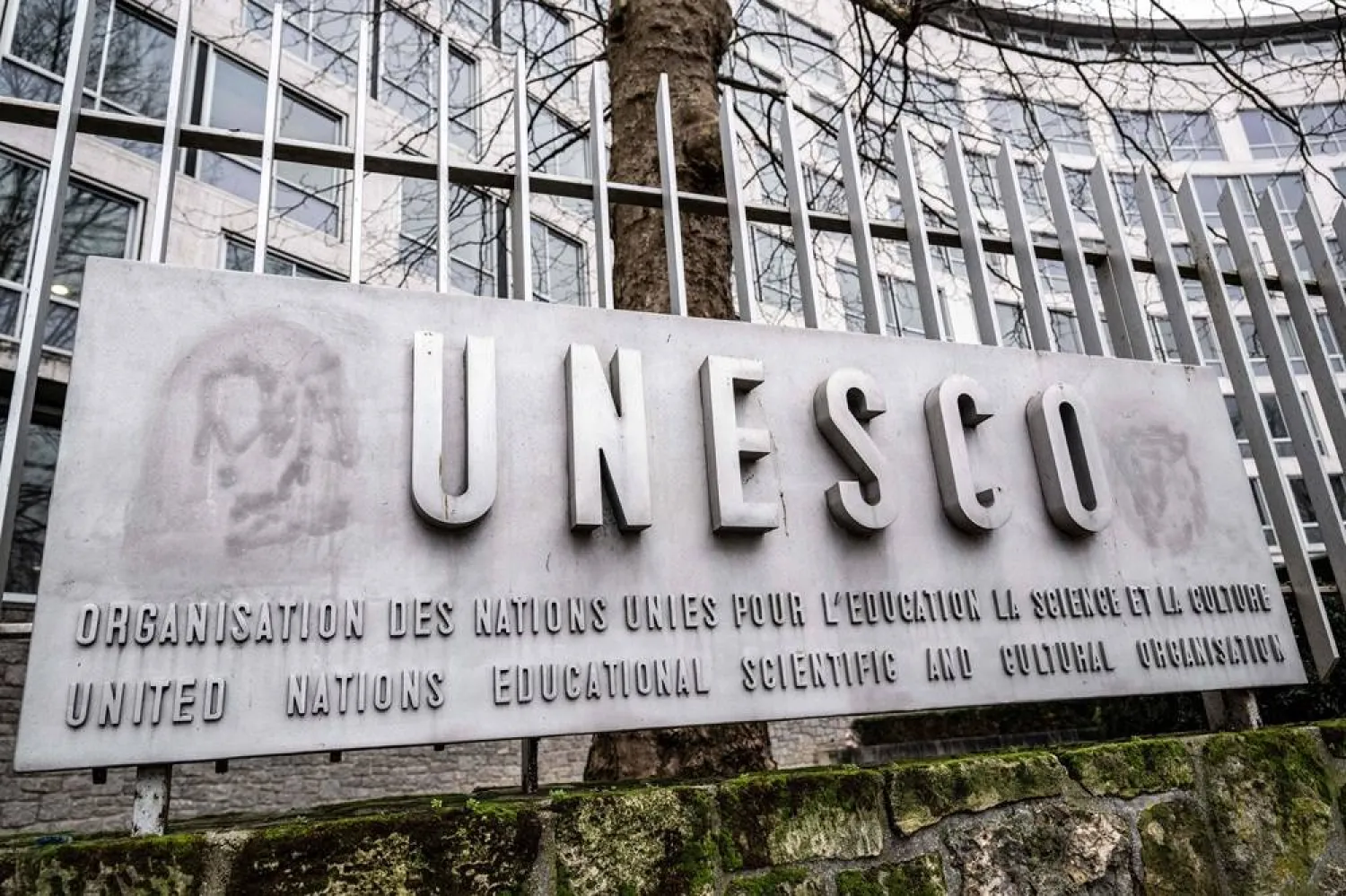
This photograph shows the logo of the United Nations Educational, Scientific and Cultural Organization (UNESCO) headquarters in Paris on January 17, 2025. (AFP)
TT

A Look at UNESCO and Its Work as the US Decides Again to Leave the Cultural Agency

This photograph shows the logo of the United Nations Educational, Scientific and Cultural Organization (UNESCO) headquarters in Paris on January 17, 2025. (AFP)

With the support of international partners and $115 million in funding, the UN cultural agency UNESCO recently helped rebuild the Iraqi city of Mosul after it was devastated by the ISIS group.

The restoration of the historic city's iconic Al-Nouri Mosque and Al-Hadba Minaret was just one of many programs run by the UN Educational, Scientific and Cultural Organization, which is in the spotlight because the United States is leaving it once again, reported the Associated Press.

The decision to pull US funding and participation from UNESCO will deal a blow to its work preserving cultural heritage around the world. US President Donald Trump exited the agency during his first term, accusing it of promoting anti-Israel speech. The administration of US President Joe Biden had rejoined UNESCO in 2023 after citing concerns that China was filling the gap left by the US in UNESCO policymaking.

Here’s a look at the work UNESCO does:

World Heritage Sites UNESCO names World Heritage sites, including landmarks like the Great Wall of China, the Egyptian pyramids, the Taj Mahal and the Statue of Liberty, and gives them special protection under its World Heritage Sites program.

Its World Heritage Committee each year designates sites considered “of outstanding value to humanity” and intervenes when sites are in danger of destruction or damage. The program provides countries with technical assistance and professional training to preserve the sites.

A World Heritage site designation is coveted and seen as a boost to tourism.

Another UNESCO convention created in 2003 protects “intangible” heritage such as folk songs and traditional dances, crafts and cooking in its lists.

Holocaust Education: Like the rest of the UN, UNESCO was created in response to the horrors of World War II, and particularly Nazi crimes. Amid concerns that the agency’s Arab members have used UNESCO to pass anti-Israel resolutions, UNESCO has worked in recent years on Holocaust awareness projects. That includes educational materials and organizing visits to former Nazi concentration camps.

Empowering Girls: UNESCO works to improve literacy, with a special focus on girls in countries hit by war or disasters who get little or no schooling though programs such as the Malala Fund for Girls’ Right to Education. In Tanzania, for instance, over 2,500 girls benefited from the creation of safe spaces in 40 secondary schools. The agency provides teacher training and materials and encourages programs for girls to pursue careers in science.

Climate Change: One of the agency's goals is coordinating climate knowledge and improving international education about how global warming occurs and affects people around the world. Over 30 UNESCO programs are designed to help its members adapt to climate change and favor sustainable development.

Ethics of Artificial Intelligence: UNESCO adopted in 2021 what it calls “the first and only global standard-setting instrument on the ethics of artificial intelligence.” Applying to all 194 member states, the recommendation emphasizes the protection of human rights and dignity, grounded in principles like transparency, fairness, and human oversight of AI systems.

Operating without the US: UNESCO director general Audrey Azoulay said the US decision to leave was expected and that the agency has prepared for it. While the US had previously provided a notable share of the agency’s budget, UNESCO has diversified its funding sources.

“Thanks to the efforts made by the organization since 2018, the decreasing trend in the financial contribution of the US has been offset, so that it now represents 8% of the organization’s total budget compared with 40% for some United Nations entities,” Azoulay said.

She added that the agency's overall budget has increased and that it has the steady support of "a large number of member states and private contributors.”




Diriyah Art Futures to Launch 'Of the Earth: Earthly Technologies to Computational Biologies' Exhibition 

Diriyah Art Futures to Launch 'Of the Earth: Earthly Technologies to Computational Biologies' Exhibition 
TT

Diriyah Art Futures to Launch 'Of the Earth: Earthly Technologies to Computational Biologies' Exhibition 

Diriyah Art Futures to Launch 'Of the Earth: Earthly Technologies to Computational Biologies' Exhibition 

Diriyah Art Futures (DAF) announced on Wednesday the opening date of its fourth major exhibition, titled "Of the Earth: Earthly Technologies to Computational Biologies."

The exhibition will run in Diriyah from January 14 to May 16.

Curated by DAF’s Director of Exhibitions Irini Papadimitriou, the exhibition is organized into four thematic areas. It examines how technology is often viewed as a tool for controlling nature, while also addressing the environmental impact of digital systems on a planet with finite resources. The artworks will showcase how these technologies are constructed from the earth's own materials.

The collaborations between art, technology, and science provide creative ways to address urgent issues and challenge technological power structures. They propose pathways toward caring ecosystems, reimagining technology shaped by interspecies, collective, and planetary intelligence that serves more than just human needs.

A public program featuring panel discussions, practical workshops, and masterclasses will accompany the exhibition.


France's Louvre Museum Remains Shut as Workers Extend Strike

FILED - 07 December 2018, France, Paris: A View of the inner courtyard with the glass pyramid of the Louvre Museum in Paris. Photo: Christian Böhmer/dpa
TT

France's Louvre Museum Remains Shut as Workers Extend Strike

FILED - 07 December 2018, France, Paris: A View of the inner courtyard with the glass pyramid of the Louvre Museum in Paris. Photo: Christian Böhmer/dpa

Staff at France's Louvre museum in Paris on Wednesday unanimously voted in favor of extending a strike over pay and working conditions that began on Monday, leaving the world's most visited museum closed until further notice.

The museum is routinely closed on Tuesdays.

The strike comes after a spectacular jewel heist in October, as well as recent infrastructure problems, including a water leak that damaged ancient books, which have exposed glaring security gaps and revealed the museum's deteriorating state.

Unions have said that staff at the Louvre are overworked and mismanaged, and they are calling for more hiring, pay increases and a redirection of spending.

Louvre director Laurence des Cars, who has faced intense criticism since burglars in October made off with crown jewels worth 88 million euros ($103.14 million), is due to answer questions from the French Senate on Wednesday afternoon. 

Des Cars has acknowledged an “institutional failure” following the heist but has come under renewed scrutiny after admitting she only learned of a critical 2019 security audit after the robbery.

France’s Court of Auditors and a separate administrative inquiry have since criticized delays in implementing a long-promised security overhaul.

The Culture Ministry announced emergency anti-intrusion measures last month and assigned Philippe Jost, who oversaw the Notre Dame restoration, to help reorganize the museum. The move was widely seen as a sign of mounting pressure on Louvre leadership.


New Rome Metro Stations Showcase Ancient Treasures After Years of Delays

People examine artifacts on display during the inauguration of the Colosseo Fori Imperiali stop on Metro Line C in Rome, Italy, 16 December 2025. (EPA)
TT

New Rome Metro Stations Showcase Ancient Treasures After Years of Delays

People examine artifacts on display during the inauguration of the Colosseo Fori Imperiali stop on Metro Line C in Rome, Italy, 16 December 2025. (EPA)

After years of delays and spiraling costs, Rome inaugurated two new metro stations on Tuesday, including one by the Colosseum, showcasing archaeological discoveries that might become tourist attractions in their own right.

The driverless Metro C line now stretches from the Italian capital's eastern suburbs to Porta Metronia and the Colosseum, extending its reach into the historic city center.

Future plans will take it even deeper under Rome's baroque heart, beneath the river Tiber and onto the Vatican, though the next stop at Piazza Venezia is not expected to open before 2032.

Excavations for the new stations revealed remarkable finds, which slowed work as archaeologists painstakingly preserved layers of ancient Rome they hadn't known were there.

At Porta Metronia, drilling rigs uncovered a military barracks dating back 2,000 years, as well as a residential house, complete with frescoed rooms and mosaics, which are preserved in a museum within the station.

During the Colosseum excavations, workers discovered 28 ancient wells and hundreds of everyday artifacts, including hairpins, oil lamps, irrigation pipes, knives, and statues, many of which are on show.

"These two stations will travel around the world," Transport Minister Matteo Salvini said on Tuesday, predicting they would soon flood social media.

"Beyond serving commuters and Romans, anyone who comes here from Italy or from abroad will stop in these stations. They might take the metro even if they don't need it, just to enjoy the ride," he added.

LONG DELAYS, COST HIKES

Rome's Metro C was meant to link the city's two main Basilicas by the year 2000. Instead, the line only reached the imposing San Giovanni Basilica in 2018, and the Vatican station near St. Peter's Basilica won't be ready for at least another decade.

The initial plan to build 24 stations to the Colosseum was priced at 2.23 billion euros ($2.63 billion), but costs have surged past 3 billion euros, and the entire line could exceed 6 billion by the time the final seven stations are completed.

Engineers say Rome is among the most challenging cities in the world for metro construction, due to buried archaeological sites that require safeguarding and concerns that vibrations could damage the heritage above ground.

At the next stop, at Piazza Venezia, a construction team is digging an 85-meter deep (280 feet) ring around the site which will be filled with reinforced concrete to protect the six underground floors of the station that are being dug out.

Rome Mayor Roberto Gualtieri said it was worth the effort.

"Without these major works, we would never have discovered the barracks at Porta Metronia, we would never have found these wells, and today we would have known far less about our extraordinary past," he said.

Metro C is intended to carry 600,000 passengers a day, easing Rome's notorious traffic and speeding tourists between major landmarks. At present it carries 41,000 daily, but the new openings should see numbers climb.