


Thousands of Animals, Rare Specimens Stolen from Sudan Museum

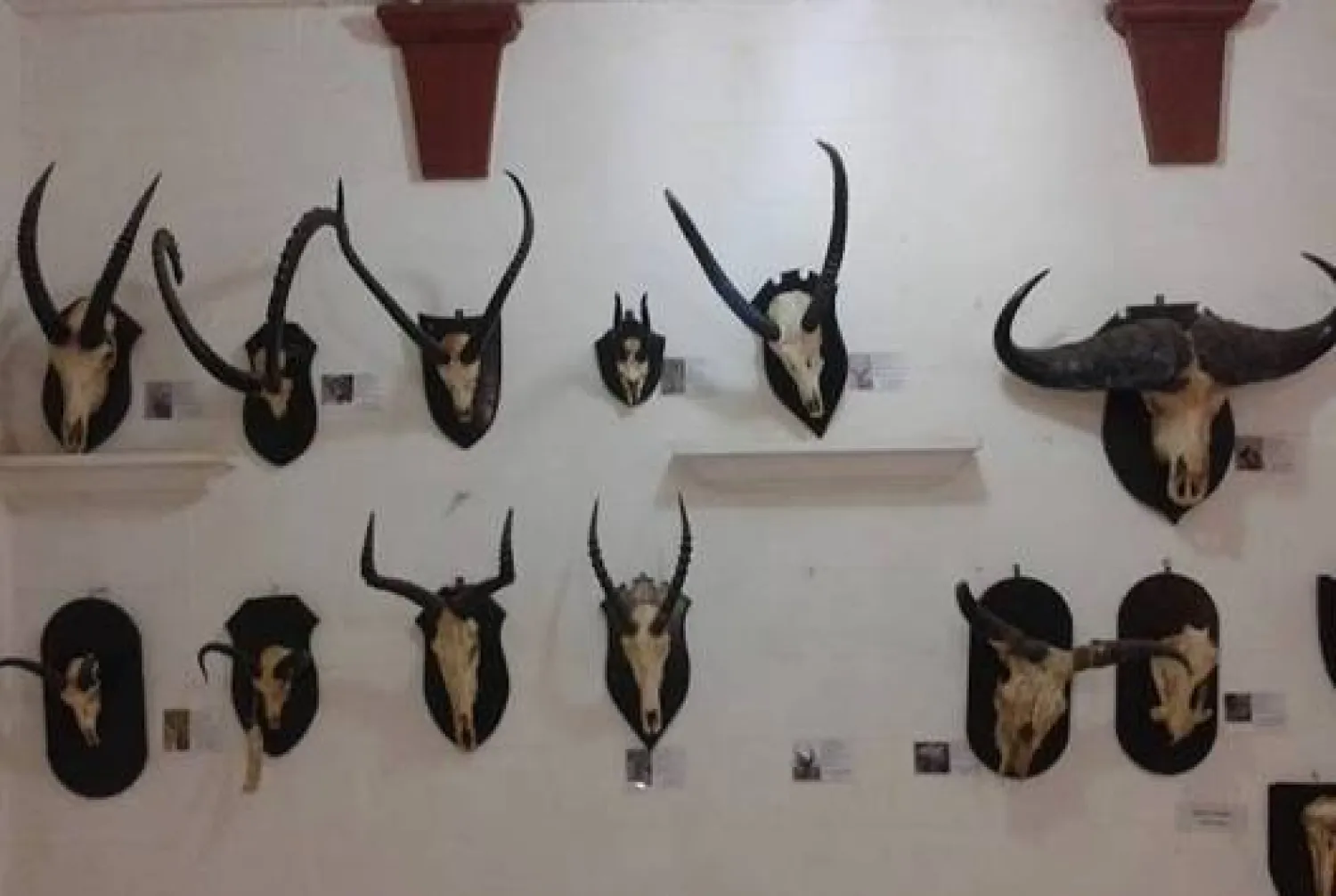
Skulls of several mammals before the destruction (Asharq Al-Awsat)
TT

Thousands of Animals, Rare Specimens Stolen from Sudan Museum

Skulls of several mammals before the destruction (Asharq Al-Awsat)

“Everything is over.” With that short and painful phrase, a Sudanese government official summed up the loss of nearly a century and a half of history after war destroyed the headquarters of the Sudan Natural History Museum in central Khartoum, stripping the country of thousands of taxidermied and live endangered animals, as well as rare reference specimens.

In the first days after fighting erupted in April 2023, activists on social media called for food and water to be provided to save the live animals. When that proved impossible, cages were opened, and the animals fled, even though some of the reptiles were venomous snakes.

The museum, officially affiliated with the University of Khartoum, lies about one kilometer from the Sudanese army’s general command headquarters in central Khartoum.

Its close proximity led to severe damage from clashes and shelling between the Sudanese army and the Rapid Support Forces, which later took control of the surrounding area for more than a year.

Dr. Othman Ali Haj Al-Amin, Dean of the Faculty of Science at the University of Khartoum, said: “We lost thousands of taxidermied animals, birds, and reptiles that are more than 150 years old.”

“It is most likely that the live animals were stolen or looted and did not die,” he added. “We did not find remains or skeletons of those animals inside the museum.”

Al-Amin broke down in tears as he described to Asharq Al-Awsat the scale of devastation inflicted on one of the world’s oldest natural history museums.

“We lost about 2,000 taxidermied animal specimens, in addition to more than 600 endangered reference specimens that were on display, and nearly all geological records, including animal, plant, and rock fossils,” he said.

“The greatest loss was around 100 species representing all families of animals, birds, and reptiles that had been cared for and preserved for decades.”

Among them were fossil bird specimens collected between 1885 and 1945 that cannot be replaced, as well as a Kordofan giraffe, an endangered subspecies.

The war also claimed “the oldest crocodile, which had lived in the museum for many years and had been cared for since it was an egg,” along with numerous reptiles, including venomous snakes, scorpions, and a Nile monitor lizard.

A taxidermied lioness was recovered and transferred to the university’s veterinary faculty.

Asharq Al-Awsat learned that the International Committee of the Red Cross attempted in those early days to evacuate civilians, including university students who were trapped inside the museum for weeks, as well as to move live and taxidermied animals. The effort failed due to intense fighting in the heart of Khartoum.

According to the Sudanese official, the preserved specimens were collected in the mid-19th century by British army officers.

During World War II, they were transferred from the Sudan National Museum to the Natural History Museum next to the University of Khartoum, which has managed them since its establishment in 1929.

Al-Amin said the museum housed specimens illustrating biodiversity from across Sudan, including South Sudan before its secession, as well as samples gifted to Sudan by international museums.

The Sudan Natural History Museum included multiple sections, among them halls displaying rare bird species, another devoted to animal skulls preserved for decades, a section for medicinal and aromatic plants, geological rock samples collected from ancient eras and environments, and enclosures for live animals.

The dean said restoring the museum to its original state would require many years of work and significant funding. He voiced pessimism about recovering the rare animals, historical specimens, and old records lost during the war.

Many live animals were likely deliberately killed or died of hunger and thirst, he said, while taxidermied animals and rare rock and herb specimens — painstakingly collected, sorted, and classified over many years by researchers — were looted.

The Natural History Museum was a scientific and cultural institution dedicated to the study of biodiversity and natural specimens, and one of the oldest museums in Sudan.

'Talking Drum' Looted by France in 1916 Back in Ivory Coast

A crate containing the Djidji Ayokwe drum, at the airport in Abidjan, Ivory Coast. (Photo by Issouf SANOGO / AFP)
TT

'Talking Drum' Looted by France in 1916 Back in Ivory Coast

A crate containing the Djidji Ayokwe drum, at the airport in Abidjan, Ivory Coast. (Photo by Issouf SANOGO / AFP)

The Djidji Ayokwe "talking drum", which was looted by French colonial troops in 1916 and taken to France, arrived back in Ivory Coast Friday, in the latest repatriation of stolen artifacts.

The wooden drum, more than three meters (10 feet) long and weighing 430 kilos (950 pounds), was used by the Ebrie tribe to transmit messages.

It was officially handed over on February 20 after France's parliament approved removing the artifact from the national museum collections to enable its return.

Ivory Coast had asked in late 2018 for the return of the Djidji Ayokwe among 148 works of art taken during the colonial period.

It arrived aboard a specially chartered plane at Ivory Coast's main city Abidjan and remained inside a huge wooden crate stamped "fragile", AFP journalists saw.

"It's an historic day and I feel deep emotion," Culture Minister Francoise Remarck said, welcoming its arrival at the airport, where the Ebrie community also sang and played drums.

"We are living a moment of justice and remembrance," the minister added.

French President Emmanuel Macron promised in 2021 to send the drum and other artifacts back home to the west African country.

It is one of hundreds of objects France is preparing to send back to Africa, with the efforts set to be accelerated by the passing of a new law to authorize mass repatriations.

"We are happy and relieved to know that this sacred piece of our culture is back on its native land," Aboussou Guy Georges Mobio, an Ebrie village chief, told AFP.

The drum will initially be held in a "safe space" to allow it to acclimatize, the culture minister said.

It is due to go on display at the Museum of Civilizations in Abidjan which has been specially renovated.

The "talking drum" was used by the Ebrie community to warn of danger, mobilize for war or call villagers to ceremonies.

It was seized by colonial authorities in 1916 before being shipped to France in 1929 and exhibited in Paris.

Senegal and Benin have also asked for the repatriation of their treasures.

In late 2020, the French parliament adopted a law providing for the permanent return to Benin of 26 artifacts from the royal treasures of Dahomey.

The return of cultural artifacts taken from ex-colonies in Africa and elsewhere has become a sensitive issue, with museums, institutions and collectors in Europe and the United States facing pressure to give them back.


Red Sea Fund Launches Second Round to Support Film Projects in Production Stage

File photo of the fifth day of the Red Sea International Film Festival - SPA
TT

Red Sea Fund Launches Second Round to Support Film Projects in Production Stage

File photo of the fifth day of the Red Sea International Film Festival - SPA

The Red Sea Fund, affiliated with the Red Sea Film Foundation, announced the opening of applications to support film projects in the production stage within the second round of this year’s support program, which will continue until March 21, as part of its efforts to enhance the cinema industry and empower innovators in the region, SPA reported.

The round aims to support promising cinematic voices from the Kingdom and the Arab world, as well as filmmakers from Africa and Asia, through financial grants that help complete film projects and present their creative narratives globally, with a special focus on projects ready to enter production and begin filming.


Prince Mohammed bin Salman Project Restores Historic Al-Jami' Mosque in Tabuk Region

The renovation utilized modern technologies to restore the mosque's original identity - SPA
TT

Prince Mohammed bin Salman Project Restores Historic Al-Jami' Mosque in Tabuk Region

The renovation utilized modern technologies to restore the mosque's original identity - SPA

The Prince Mohammed bin Salman Project for the Development of Historical Mosques has completed the restoration of Al-Jami' Mosque in Duba, Tabuk Region, as part of its mission to preserve the Kingdom's architectural heritage under Vision 2030.

As one of Duba’s oldest landmarks, the mosque is deeply intertwined with the city’s maritime history, traditionally serving as a central meeting point for sailors. Throughout its history, the mosque underwent several construction phases, including significant contributions by King Abdulaziz and King Fahd, before its selection for the current national development project, SPA reported.

The renovation utilized modern technologies to restore the mosque's original identity, increasing its area to 972.23 square meters and its capacity to 779 worshippers. The architectural style is inspired by traditional Red Sea heritage, incorporating natural materials like stone, mud, and wood for intricate mashrabiyas.

Executed by specialized Saudi firms, the project balances traditional standards with sustainability to rehabilitate the site for worship while highlighting its cultural significance. By restoring such landmarks, the project ensures the preservation of the Kingdom’s diverse architectural and social memory for future generations.