


Early Hawaiian Petroglyphs on a Beach Are Visible Again with Changing Tides and Shifting Sands 

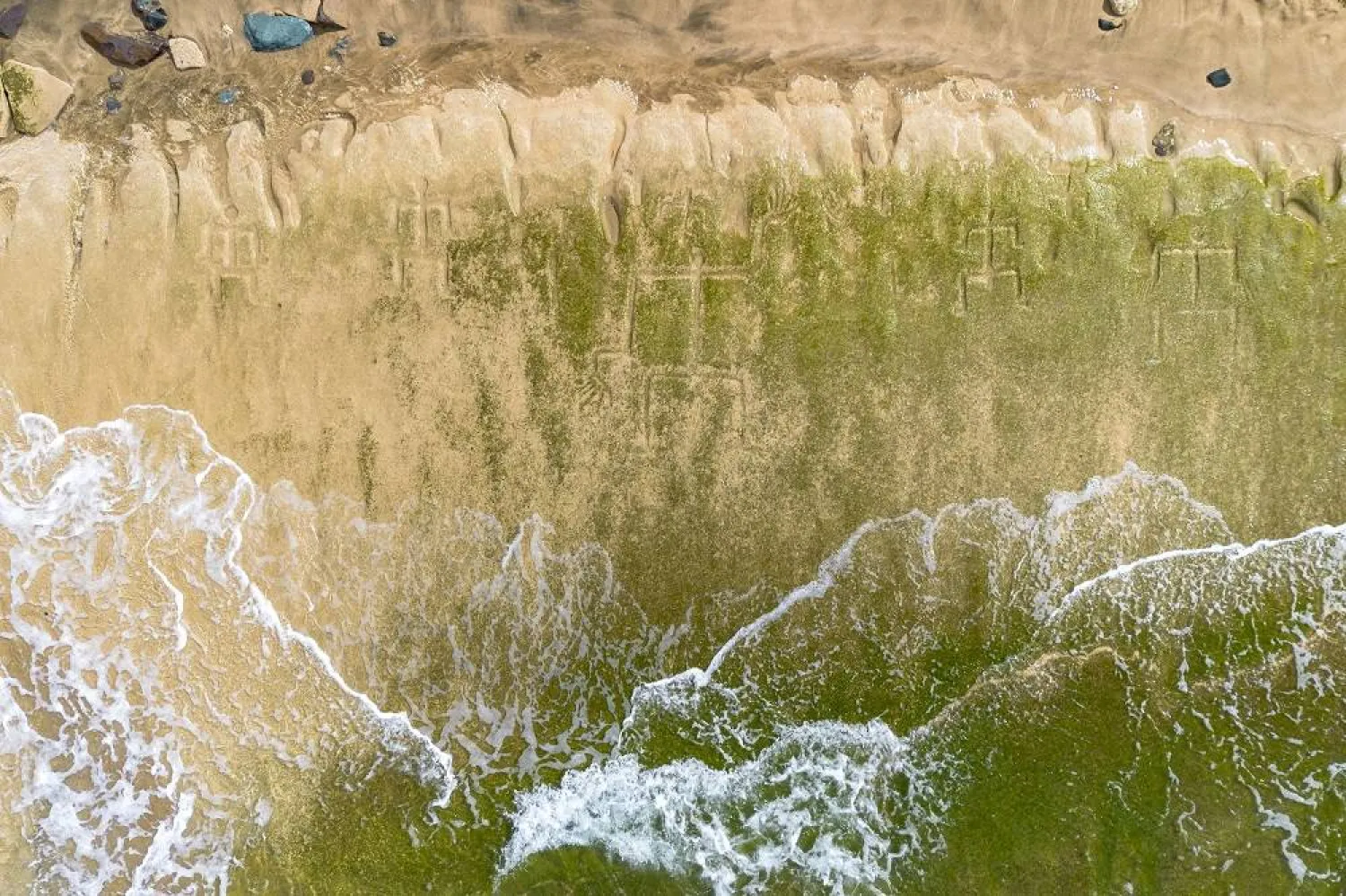
A drone view shows petroglyphs carved into the rock surface at Pokai Bay, July 22, 2025, in Waianae, Hawaii. (AP)
TT

Early Hawaiian Petroglyphs on a Beach Are Visible Again with Changing Tides and Shifting Sands 

A drone view shows petroglyphs carved into the rock surface at Pokai Bay, July 22, 2025, in Waianae, Hawaii. (AP)

Hawaiian petroglyphs dating back at least a half-millennium are visible on Oahu for the first time in years, thanks to seasonal ocean swells that peel away sand covering a panel of more than two dozen images of mostly human-looking stick figures.

The petroglyphs are easy to spot during low tide when gentle waves ebb and flow over slippery, neon-green algae growing on a stretch of sandstone. This is the first time the entire panel of petroglyphs are visible since they were first spotted nine years ago by two guests staying at a bayside US Army recreation center in Waianae, about an hour’s drive from Honolulu.

Native Hawaiian cultural practitioner Glen Kila, who traces his lineage to the aboriginal families of this coastal Hawaii community, said he believes the resurfacing of the traditional marvels are his ancestors sending a message.

"It's telling the community that the ocean is rising," said Kila, a recognized expert on the local culture and history of Waianae who is consulting with the Army on the protection of the petroglyphs.

Army officials are trying to balance protecting the petroglyphs with their accessibility on a public beach.

John and Sandy Stone consulted tide charts and drove about 30 minutes from their home early Tuesday to get a glimpse after watching a local TV report about the petroglyphs.

"It was so interesting to touch them," said John Stone, who splits his time between Hawaii and California. "It felt interesting to kind of have a connection with the past like that."

It is difficult to date petroglyphs, but an archaeological site in the area is from about 600 years ago, said Laura Gilda, an archaeologist with US Army Garrison Hawaii. According to Kila, Hawaiians arrived in Waianae at least 1,000 years ago.

Shift in waves caused petroglyphs to appear

The beach here fluctuates in size and profile each year, with low-pressure weather systems that form in the eastern Pacific between May and November causing waves that cut away loose sand from shorelines and redeposit them further out, according to an Army report on the petroglyphs. That shift is likely what causes their temporary exposure.

Archaeologists identified a total of 26 petroglyphs. Of the 18 anthropomorphic stick figures, eight are possibly male and the remainder are of undetermined gender, the report said.

The entire panel stretches about 115 feet (35 meters) long, Gilda said.

When the petroglyphs first reemerged in July 2016, it was after late spring and early summer storms, including hurricanes, with a lot of wave action that swept the sand away, Gilda said.

They remained visible for a period and then got covered again.

"So there's been portions that have ... been exposed since then, but this is the first summer that the whole panel has been exposed again," Gilda said.

Petroglyphs are telling a ceremonial story, expert says

Based on the teachings Kila learned, the lineal petroglyphs appear to be telling a ceremonial story. He interprets the largest figure, which appears to include hands and fingers with one arm raised and the other down, to represent the rising and setting sun.

Kila said that when the military in the 1930s took over the area and evicted Native Hawaiians, including his family who lived there for generations, his great-great grandmother refused to leave so his family exchanged mountain lands with a coffee plantation so she could remain near the bay.

In an interview included in the Army's report, he recalled growing up in Waianae without television. So "the ocean and mountains were our playground," he said. The Army recreation center was off-limits to the public, and the seawall was the barrier between Native Hawaiians and the military, Kila said.

Kila, now 72, recalled that if they walked on top of the wall, they were clubbed and pushed off by military police.

"We were proud and knew where we came from, so we never fostered any hatred for the military because one day we believed that the land will eventually return to us," he said.

Kila, while visiting the petroglyphs earlier this week, told The Associated Press that the Army's protection of them represents a shift in that community relationship.

Officials have been grappling with how to share the petroglyphs with the community while also protecting them, Gilda said.

"How much attention do you want to bring to this area? You don’t really want people to go digging for them when they’re not exposed," she said. "But they’re certainly awesome to come and see on the public beachscape."

Donald Kauliʻa, a Native Hawaiian who was born and raised in Waianae, snapped photos of the petroglyphs Tuesday. Seeing them, he said, feels like "validation that our ancestors were from here."


French TV Broadcasts Louvre Robbery Images

People wait for the Louvre museum to open as employees at the Louvre Museum vote to extend a strike that has disrupted operations at the world's most visited museum, Thursday, Dec. 18, 2025 in Paris. (AP)
TT

French TV Broadcasts Louvre Robbery Images

People wait for the Louvre museum to open as employees at the Louvre Museum vote to extend a strike that has disrupted operations at the world's most visited museum, Thursday, Dec. 18, 2025 in Paris. (AP)

Footage of the spectacular robbery at the Louvre Museum has been broadcast for the first time on French television, showing the brazen jewel thieves breaking into display cases.

The images, filmed by surveillance cameras, were shown by the TF1 and public France Televisions channels on Sunday evening, three months after the hugely embarrassing break-in in October.

They show the two burglars, one wearing a black balaclava and a yellow high-visibility jacket, the other dressed in black with a motorcycle helmet, as they force their way into the Apollo Gallery.

After breaking in through a reinforced window with a high-powered disk cutters, they begin slicing into display cases under the eyes of several staff members who do not intervene.

Managers at the Louvre have stressed that staff are not trained to confront thieves and are asked to prioritize the evacuation of visitors.

During the roughly four minutes that the two men were inside the gallery, one staff member can be seen holding a bollard used to orient visitor through the gallery, according to France Televisions.

The images form a key part of the ongoing criminal investigation into the October 19 heist.

Details of the footage have been reported in French newspapers, including Le Parisien.

Four suspects are in police custody, including the two suspected thieves, but the eight stolen items of French crown jewels worth an estimated $102 million have not been found.

The security failures highlighted by the break-in on a Sunday morning in broad daylight have lead to major pressure on director Laurence des Cars, who has apologized.

Metal bars have since been installed over the windows of the Apollo Gallery.


Cultural Development Fund Highlights Economic Value of Saudi Culture in Davos

The Cultural Development Fund (CDF) logo
TT

Cultural Development Fund Highlights Economic Value of Saudi Culture in Davos

The Cultural Development Fund (CDF) logo

The Cultural Development Fund (CDF) is participating in the Saudi House pavilion initiative, led by the Ministry of Economy and Planning, during the Annual Meeting of the World Economic Forum 2026, held in Davos, Switzerland, from January 19 to 23.

Through this participation, CDF aims to showcase the economic value of Saudi culture, highlight its role in diversifying the national economy and enhancing quality of life, attract international investment in the cultural sector, and spotlight Saudi cultural entrepreneurship.

According to a statement from the fund, the CDF’s participation includes a networking breakfast bringing together global economic leaders and investors from various countries, with the aim of raising awareness of Saudi culture as an economic force and a key pillar of Saudi Vision 2030.

The event will also provide a platform for exchanging perspectives and opportunities with international investors and financial institutions, while offering a closer look at the enablers of the Saudi cultural sector and its investment opportunities.

As part of the event, the CDF will host a panel discussion titled “Investing in Culture as an Economic Engine” that will feature CEO of the Cultural Development Fund Majed bin Abdulmohsen Al-Hugail, alongside Deputy Minister of Cultural Strategies and Policies at the Ministry of Culture Albara Al-Auhali.

The discussion will address the economic value of culture globally and locally, highlighting the CDF’s role in providing financial solutions that support cultural enterprises and enable their contribution to GDP growth and quality of life. The session will also explore cultural policies and their impact on strengthening the sector’s economic and investment potential.

Within the NextOn dialogue series organized by the Saudi House in Davos, the Cultural Development Fund will enable supported cultural projects to share their success stories and highlight their role in enhancing cultural production and increasing its economic value.

Participating entrepreneurs include Co-Founder of AlMashtal Creative Incubator Princess Noura bint Saud bin Naif, and CEO of Arabian Housing and Building company (AHB) Khalid Henaidy, who will speak about the role of entrepreneurship in shaping the future of the Kingdom’s cultural economy.

‏This participation underscores the CDF’s role as a center of excellence and financial enabler for the cultural sector in the Kingdom, and forms part of its efforts to strengthen the presence of Saudi cultural dynamism on the global stage. It aligns with the CDF’s objectives to maximize the cultural sector’s economic and social impact, increase its contribution to GDP, quality of life, and advance the goals of Saudi Vision 2030.


Red Sea Museum Signs Cooperation Agreement to Support Artisans and Designers

The cooperation agreement aims to support local and regional artisans and designers. SPA
TT

Red Sea Museum Signs Cooperation Agreement to Support Artisans and Designers

The cooperation agreement aims to support local and regional artisans and designers. SPA

Saudi Arabia’s Museums Commission announced the signing of a cooperation agreement between the Red Sea Museum and Ahmed Angawi Studio to launch the "Made in the Red Sea" initiative at the Red Sea Museum in the heart of Historic Jeddah, aiming to support local and regional artisans and designers.

The initiative aims to preserve traditional skills and develop contemporary products inspired by the rich heritage, traditions and the tangible and intangible culture of the Red Sea region, for sale at the museum gift shop.

It builds on the momentum of the Saudi Ministry of Culture's Year of Handicrafts 2025 initiative launched to reinforce pride in national identity and support artisans, as one of the goals of the National Culture Strategy.

The partnership includes content development, the delivery of workshops and the selection of participating artists and artisans, in addition to promoting the "Made in the Red Sea" initiative and overseeing specialized workshops in traditional wood designs inspired by the historic Bab Al Bunt building, which now houses the Red Sea Museum. These efforts contribute to a contemporary reinterpretation of its architectural elements.
