


Ciara Is Among the First Descendants of Enslaved People Granted Citizenship by Benin

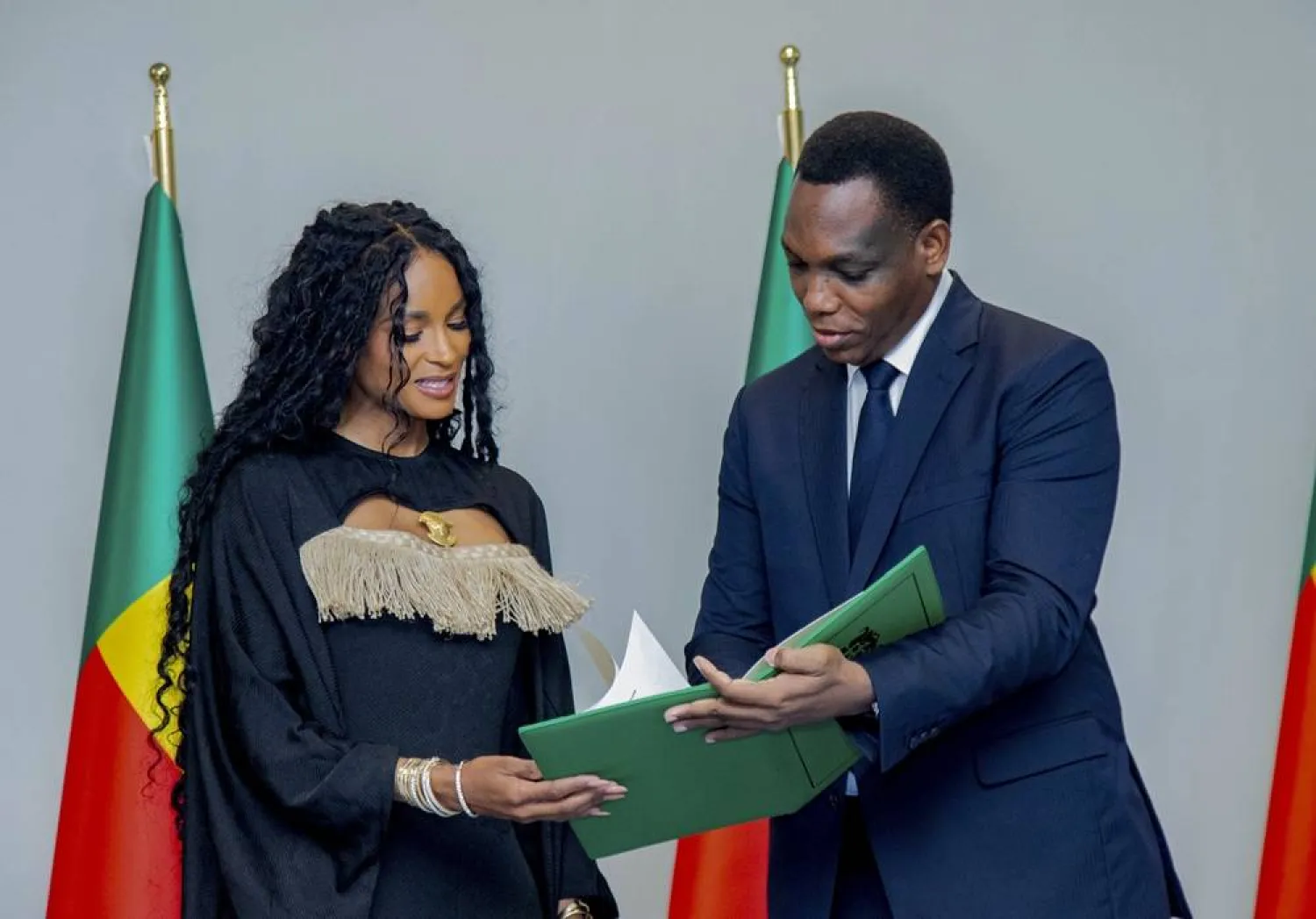
 Yvon Detchenou, Benin's Minister of Justice and Legislation, right, presents citizenship documents to singer Ciara at a ceremony in Cotonou, Benin, Saturday July 26, 2025. (Benin Presidency via AP)
Yvon Detchenou, Benin's Minister of Justice and Legislation, right, presents citizenship documents to singer Ciara at a ceremony in Cotonou, Benin, Saturday July 26, 2025. (Benin Presidency via AP)
TT

Ciara Is Among the First Descendants of Enslaved People Granted Citizenship by Benin

 Yvon Detchenou, Benin's Minister of Justice and Legislation, right, presents citizenship documents to singer Ciara at a ceremony in Cotonou, Benin, Saturday July 26, 2025. (Benin Presidency via AP)
Yvon Detchenou, Benin's Minister of Justice and Legislation, right, presents citizenship documents to singer Ciara at a ceremony in Cotonou, Benin, Saturday July 26, 2025. (Benin Presidency via AP)

US singer Ciara is one of the first public figures to become a citizen of Benin under a recent law by the small West African country granting citizenship to descendants of enslaved people.

The Grammy-winning performer's acquisition of citizenship at a ceremony Saturday in the city of Cotonou is part of a broader initiative by Benin to attract the Black diaspora, acknowledge the country’s role in the transatlantic slave trade, and promote tourism focused on slavery-related sites of remembrance.

“By legally recognizing these children of Africa, Benin is healing a historical wound. It is an act of justice, but also one of belonging and hope,” Justice Minister Yvon Détchénou said at the ceremony.

Here's what to know about Benin's efforts to welcome descendants of enslaved people:

Benin's Afro-descendant citizenship law In September, Benin passed a law granting citizenship to those who can trace their lineage to the slave trade.

It is open to anyone above 18 who doesn't already hold other African citizenship and can provide proof that an ancestor was deported via the slave trade from anywhere in sub-Saharan Africa. Beninese authorities accept DNA tests, authenticated testimonies and family records.

Last week, the government launched My Afro Origins, the digital platform that processes applications.

While Benin is not the first country to grant citizenship to descendants of enslaved people, its citizenship law carries added significance, in part because of the role it played in the transatlantic slave trade.

A national reckoning with its role in the slave trade European merchants deported an estimated 1.5 million enslaved people from the Bight of Benin — a region that includes present-day Benin, Togo and parts of Nigeria — to the Americas.

Beninese kings actively participated in capturing and selling enslaved people to Portuguese, French and British merchants. The former kingdoms and the communities they raided still exist today as tribal networks.

Benin has long been working to reconcile with its legacy of complicity. It has openly acknowledged its role in the slave trade, a stance not shared by many other African nations that participated.

In the 1990s, it hosted an international conference to examine how and where enslaved people were sold. In 1999, then-President Mathieu Kérékou apologized to African Americans during a visit to a church in Baltimore.

‘Memorial tourism’ Alongside this national reckoning, “memorial tourism” around the legacy of the slave trade has become a key approach of Benin’s government to attract Afro-descendants.

Memorial sites are mostly in Ouidah, one of Africa’s most active slave-trading ports in the 18th and 19th centuries. They include the Slave Route, which was the path marking enslaved people’s final journey to ships, and the Door of No Return, a haunting doorway that opens to the Atlantic Ocean where they left Africa, and their families, for the last time.

Sindé Chekete, the head of Benin’s state-run tourism agency, said these sites give Afro-descendants the opportunity to learn about and honor the struggles and resilience of their ancestors.

“It may inspire some people to say ‘I want to return to Africa and choose Benin to understand this history’,” Chekete said.

Following her citizenship ceremony, Ciara toured the historic city, where she walked the Slave Route to the Door of No Return.

“Between emotion, reflection and heritage, I experienced a profound return to what truly matters,” she said.

Ciara is best known for chart-topping hits like “Goodies” and “Level Up,” her dynamic choreography, and her work in fashion and philanthropy.



New Rome Metro Stations Showcase Ancient Treasures After Years of Delays

People examine artifacts on display during the inauguration of the Colosseo Fori Imperiali stop on Metro Line C in Rome, Italy, 16 December 2025. (EPA)
TT

New Rome Metro Stations Showcase Ancient Treasures After Years of Delays

People examine artifacts on display during the inauguration of the Colosseo Fori Imperiali stop on Metro Line C in Rome, Italy, 16 December 2025. (EPA)

After years of delays and spiraling costs, Rome inaugurated two new metro stations on Tuesday, including one by the Colosseum, showcasing archaeological discoveries that might become tourist attractions in their own right.

The driverless Metro C line now stretches from the Italian capital's eastern suburbs to Porta Metronia and the Colosseum, extending its reach into the historic city center.

Future plans will take it even deeper under Rome's baroque heart, beneath the river Tiber and onto the Vatican, though the next stop at Piazza Venezia is not expected to open before 2032.

Excavations for the new stations revealed remarkable finds, which slowed work as archaeologists painstakingly preserved layers of ancient Rome they hadn't known were there.

At Porta Metronia, drilling rigs uncovered a military barracks dating back 2,000 years, as well as a residential house, complete with frescoed rooms and mosaics, which are preserved in a museum within the station.

During the Colosseum excavations, workers discovered 28 ancient wells and hundreds of everyday artifacts, including hairpins, oil lamps, irrigation pipes, knives, and statues, many of which are on show.

"These two stations will travel around the world," Transport Minister Matteo Salvini said on Tuesday, predicting they would soon flood social media.

"Beyond serving commuters and Romans, anyone who comes here from Italy or from abroad will stop in these stations. They might take the metro even if they don't need it, just to enjoy the ride," he added.

LONG DELAYS, COST HIKES

Rome's Metro C was meant to link the city's two main Basilicas by the year 2000. Instead, the line only reached the imposing San Giovanni Basilica in 2018, and the Vatican station near St. Peter's Basilica won't be ready for at least another decade.

The initial plan to build 24 stations to the Colosseum was priced at 2.23 billion euros ($2.63 billion), but costs have surged past 3 billion euros, and the entire line could exceed 6 billion by the time the final seven stations are completed.

Engineers say Rome is among the most challenging cities in the world for metro construction, due to buried archaeological sites that require safeguarding and concerns that vibrations could damage the heritage above ground.

At the next stop, at Piazza Venezia, a construction team is digging an 85-meter deep (280 feet) ring around the site which will be filled with reinforced concrete to protect the six underground floors of the station that are being dug out.

Rome Mayor Roberto Gualtieri said it was worth the effort.

"Without these major works, we would never have discovered the barracks at Porta Metronia, we would never have found these wells, and today we would have known far less about our extraordinary past," he said.

Metro C is intended to carry 600,000 passengers a day, easing Rome's notorious traffic and speeding tourists between major landmarks. At present it carries 41,000 daily, but the new openings should see numbers climb.


New Discoveries Bridge Chronological Gap between Nabataean, Early Islamic Periods in AlUla’s Wadi al-Qura

The study presents, for the first time, detailed evidence documenting a historical phase in Wadi al-Qura (modern-day AlUla) spanning the 3rd to 7th centuries CE. (SPA)
TT

New Discoveries Bridge Chronological Gap between Nabataean, Early Islamic Periods in AlUla’s Wadi al-Qura

The study presents, for the first time, detailed evidence documenting a historical phase in Wadi al-Qura (modern-day AlUla) spanning the 3rd to 7th centuries CE. (SPA)

A joint research team from the Saudi Arabia’s Royal Commission for AlUla (RCU) and the French National Centre for Scientific Research (CNRS) published a new peer-reviewed paper in “Arabian Archaeology and Epigraphy, one of the leading international journals dedicated to Arabian Peninsula and Middle Eastern archaeology.

The study presents, for the first time, detailed evidence documenting a historical phase in Wadi al-Qura (modern-day AlUla) spanning the 3rd to 7th centuries CE.

An RCU statement said the research focuses on a period long regarded as a knowledge gap between the end of the Nabataean era and the beginning of the early Islamic period in northwest Arabia, a time traditionally assumed to have witnessed a widespread decline in settled occupation across sites such as Tayma, Khaybar, and Hegra.

Building on fieldwork from the Dadan Archaeological Project, a collaboration between RCU, CNRS, and AFALULA, the study compiles findings from three consecutive excavation seasons (2021–2023) at an archaeological mound located within the boundaries of the Dadan site, less than one kilometer south of ancient Dadan.

Excavations uncovered a substantial structure built in the late 3rd or early 4th century CE and occupied continuously until the first half of the 7th century CE. This discovery provides the first integrated archaeological evidence of sustained settlement in the region from the early 5th to the early 7th century CE.

The findings reveal a clear architectural and cultural sequence, featuring a network of organized rooms and courtyards, a central square equipped with a well, basin, and water channels, as well as evidence of agricultural practices, crop storage, food production, and craft activities, indicating a stable, structured community.

The study adopts a multidisciplinary approach, incorporating ceramic and lithic analysis, archaeobotany, zooarchaeology, and geoarchaeology. Together, these methods offer new insights into diet, agriculture, and the oasis environment during this extended period.

Collectively, the results challenge long-held assumptions about the history of Wadi al-Qura. Rather than experiencing a complete interruption in settlement between the 4th and 6th centuries CE, the region appears to have hosted a continuous, well-organized community with advanced architectural planning and internal water-management systems, illustrating social and economic continuity up to the eve of the Islamic era.

Commenting on the study, Vice President of Culture within RCU’s Tourism Sector Dr. Abdulrahman AlSuhaibani, who is also a principal contributor to the research, said that "these findings reveal an important chapter in the history of Wadi al-Qura and show that AlUla was part of a vibrant settlement network in the centuries preceding the rise of Islam.”

“This research enriches our understanding of local communities in northwest Arabia and further reinforces AlUla’s position as a place of enduring cultural continuity,” he added.

This achievement reflects RCU’s commitment to advancing world-class archaeological research and building international partnerships with leading scientific institutions.

It supports the ongoing rediscovery of AlUla’s heritage and strengthens its role as a global reference for the study of Arabian history, aligning with Saudi Vision 2030 objectives to boost cultural tourism, grow the knowledge economy, and protect natural and cultural heritage.


King Salman Global Academy for Arabic Language Launches Framework on Multilingualism at UNESCO

The UNESCO logo is seen during the 39th session of the General Conference at the UNESCO headquarters in Paris, Saturday, Nov. 4, 2017. (AP)
TT

King Salman Global Academy for Arabic Language Launches Framework on Multilingualism at UNESCO

The UNESCO logo is seen during the 39th session of the General Conference at the UNESCO headquarters in Paris, Saturday, Nov. 4, 2017. (AP)

Saudi Arabia's King Salman Global Academy for the Arabic Language (KSGAAL) launched its Framework on Multilingualism Framework at the UN Educational, Scientific, and Cultural Organization (UNESCO) headquarters in Paris, reported the Saudi Press Agency on Monday.

The launch took place during a symposium titled “Multilingualism in International Organizations.”

The event was attended by senior UNESCO officials, ambassadors of the Arab Group, experts from international organizations, participating delegations, and specialists in language policy.

The initiative is part of the academy's activities marking World Arabic Language Day.

KSGAAL Secretary-General Dr. Abdullah Al-Washmi said the launch of the framework represents a practical step reflecting the academy’s commitment to promoting multilingualism within international institutions and contributing to the development of linguistic work environments.

He expressed his gratitude for the continued support by Minister of Culture and academy Board Chairman Prince Bader bin Abdullah bin Farhan, underlining Saudi Arabia's dedication to supporting the Arabic language and its sciences and strengthening its global presence.

The framework aims to support UNESCO’s policies in empowering official languages within its institutional work in line with the objectives of the Human Capability Development Program, one of the Kingdom’s Vision 2030 programs, and within the academy's international initiatives, particularly those associated with World Arabic Language Day, he added.

It also aims to meet the linguistic needs of the Arab Group, boost institutional practices that contribute to developing the linguistic landscape, and expand Arab participation in UNESCO’s programs and activities.

The first session of the symposium was dedicated to presenting the framework, outlining its main components, and highlighting its role in supporting multilingualism and strengthening the presence of the Arabic language within the organization’s institutional and digital environments.

The framework is the result of joint efforts between the academy and the Saudi delegation to UNESCO.

The launch of the framework falls within the academy’s broader efforts to bolster the presence of the Arabic language in international organizations, support joint initiatives aimed at developing linguistic practices, and unify Arab efforts in the field of international language planning, helping consolidate the status of Arabic at both the international and institutional levels.