

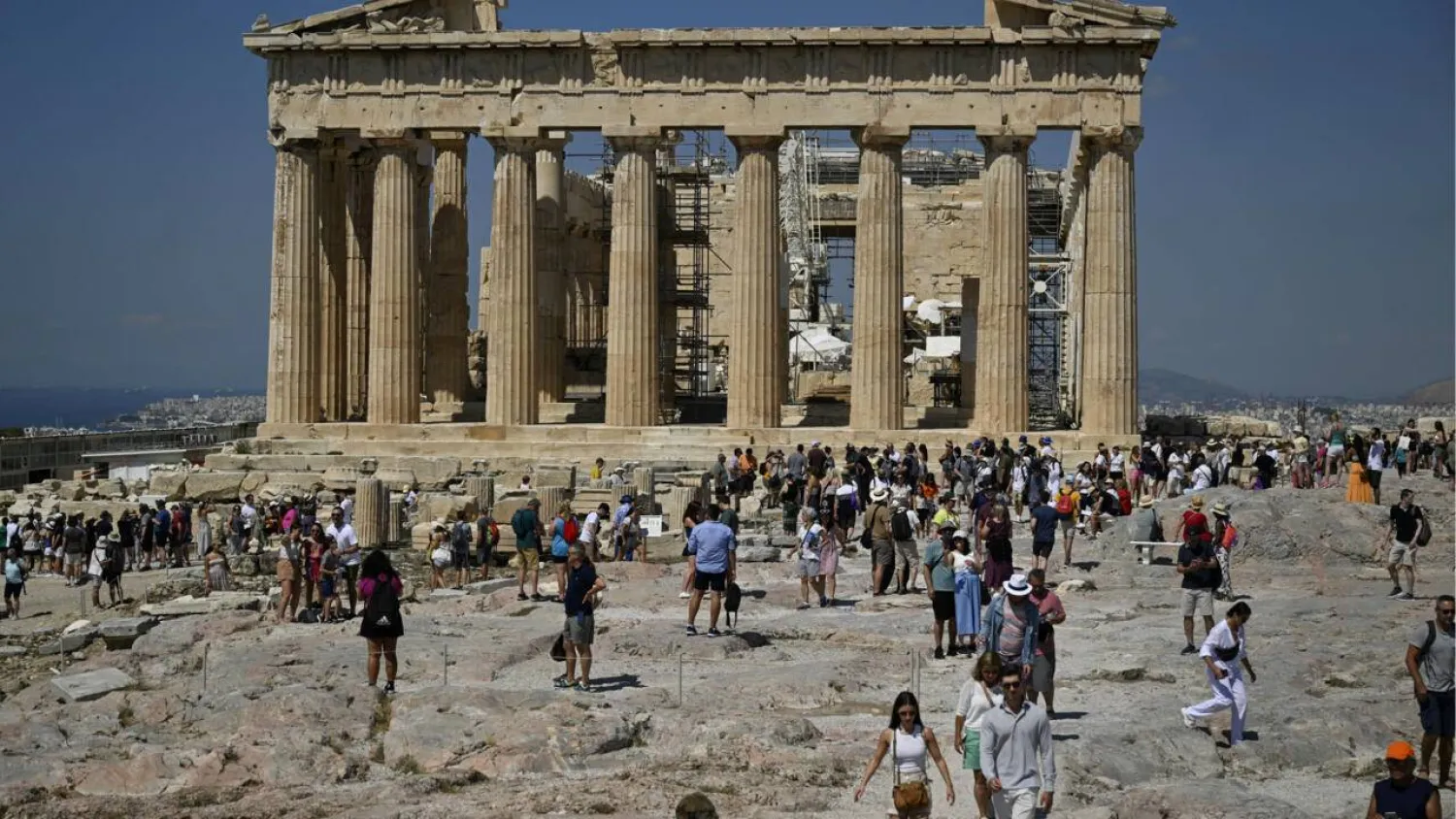

Tourism Boom Sparks Backlash in Historic Heart of Athens

Ten million people are expected to visit Athens in 2025. Louisa GOULIAMAKI / AFP/File
TT

Tourism Boom Sparks Backlash in Historic Heart of Athens

Ten million people are expected to visit Athens in 2025. Louisa GOULIAMAKI / AFP/File

Surrounded by a hubbub of blaring music, restaurant terraces and rumbling suitcase wheels slaloming between overflowing litter bins, Giorgos Zafeiriou believes surging tourism has made his historic Athens neighborhood unrecognizable.

The Greek capital's Plaka district "is threatened by overtourism", said Zafeiriou, who has lived there for more than three decades and leads its residents' association.

This year, 10 million people are expected to visit Athens, an increase of two million from 2024 which reflects the city's growing popularity as a tourist destination since the Covid-19 pandemic ended.

Despite its label as the cradle of Western civilization, Athens was previously regarded as a mere stopping point between the airport and the port of Piraeus, from where tourists explore Greece's myriad of picturesque islands.

Nicknamed "the neighborhood of the gods", Plaka is nestled below the ancient Acropolis hill, a world heritage site hosting the millennia-old Parthenon temple which welcomed almost 4.5 million visitors last year.

Plaka is now awash with tourists who navigate its warren of narrow streets lined with cafes, taverns, souvenir shops, small Byzantine churches and relics from Antiquity and the Ottoman era.

Plaka "is Europe's oldest neighborhood which has been inhabited continuously since Antiquity", said Lydia Carras, head of the Ellet association working to preserve the environment and cultural heritage.

"We cannot see it lose its soul," she added.

'Saturated with tourists'

Tourism is a pillar of the Greek economy, which endured years of painful austerity following the 2008 global financial crash and the ensuing eurozone debt crisis.

For souvenir shop seller Konstantinos Marinakis, "Greece is finally doing better thanks to the good health of tourism which allowed the economy to recover and create jobs."

But the flourishing sector has generated a backlash in Europe's most sought-after locations, with locals complaining of soaring housing prices and the impact on their neighborhoods.

Protesters have targeted tourists with water pistols in Spain's Barcelona, while the Italian city of Venice has introduced a charge in a bid to control visitor numbers.

Mayor Haris Doukas told AFP with pride that Athens was now one of the world's 10 most-visited cities, but acknowledged "areas like Plaka which are saturated with tourists".

"We are not yet at the stage of Barcelona, but we must act before it is too late," he said.

An "intervention unit" for Plaka was recently created to enforce rules with the support of the police.

Any resident who spots a restaurant terrace encroaching on public space or cars parked on the pavement can report the offenders to this team.

"Between 1960 and 1980, Plaka was overwhelmed by discos and bouzoukias," and "many residents had already left," explained Carras, referring to clubs that play traditional Greek music.

A 1993 presidential decree shut the clubs, protected homes and specified the use of each building in the neighborhood, with hotels only allowed on certain streets.

Rules 'dodged'

But "these rules have been dodged", with "entire houses converted into several apartments" advertised on short-term rental platforms, said Dimitris Melissas, a lawyer specializing in urban planning.

Plaka's population of 2,000 can be swamped by up to four times as many tourists in the summer, added Melissas, although no official statistics exist because the census measures Athens as a whole.

Representing Ellet, the lawyer has taken a case over the legality of 16 buildings converted entirely into seasonal rentals to the Council of State, Greece's top administrative court.

He argued they are actually hotel premises in disguise because they have receptions or serve breakfast on terraces. A decision, which could set an important legal precedent, is expected by the end of September.

The conservative government has banned new registrations of apartments on short-term rental platforms for at least a year in central Athens, where more than 12,000 seasonal lets existed in 2024, fueling rent rises.

"But when I still read adverts in newspapers to invest in apartments that can be converted into Airbnbs, I doubt the effectiveness of this measure," said Melissas.

"The problem in Greece is not voting laws but enforcing them."


WAMY: Saudi Pavilion at Cairo International Book Fair 2026 Reflects Saudi Cultural Leadership

File photo of the Saudi flag/AAWSAT
TT

WAMY: Saudi Pavilion at Cairo International Book Fair 2026 Reflects Saudi Cultural Leadership

File photo of the Saudi flag/AAWSAT

The World Assembly of Muslim Youth (WAMY) praised the Kingdom of Saudi Arabia’s distinguished participation in the 57th Cairo International Book Fair, held in January 2026, affirming that it reflects a balanced civilizational model that combines the authenticity of cultural heritage with a forward-looking vision of knowledge for future generations, SPA reported.

WAMY noted that this participation contributed to strengthening the Kingdom’s standing as an influential cultural force at the regional and international levels.

WAMY also commended the diversity of the content presented, which ranged from the latest scientific and literary publications to a rich cultural program that included seminars and poetry evenings.

These activities enhance cultural dialogue and promote the values of moderation, underscoring the Kingdom’s commitment to supporting the publishing industry, empowering youth through knowledge, and raising awareness.


Fragmentary Sculptures from the Umayyad Palace of Qasr al-Mshatta

Five sculptures from Qasr al-Mshatta are preserved in the Museum of Islamic Art in Berlin, while a sixth sculpture is preserved in the Jordan Archaeological Museum in Amman.
TT

Fragmentary Sculptures from the Umayyad Palace of Qasr al-Mshatta

Five sculptures from Qasr al-Mshatta are preserved in the Museum of Islamic Art in Berlin, while a sixth sculpture is preserved in the Jordan Archaeological Museum in Amman.

by Mahmoud Zibawi

The Jordanian desert contains a series of Umayyad palaces, the largest of which is Qasr al-Mshatta, located in the Jiza District. Western Orientalist scholars first drew attention to this site in the late nineteenth century, and a German mission succeeded in transporting its massive southern facade to Berlin at the beginning of the twentieth century, after Sultan Abdulhamid II presented it as a gift to his ally, Kaiser Wilhelm II of Prussia.

The facade entered the Kaiser Friedrich Museum in 1903 and was later transferred to the Museum of Islamic Art in 1932. This museum is regarded as the oldest and largest institution dedicated exclusively to Islamic art in Europe and North America. The facade of Qasr al-Mshatta occupies the largest portion of this European complex, alongside a small, independent group of damaged sculptures that originally formed part of the palace’s furnishings. This group bears witness to a distinct Umayyad sculptural tradition, whose artistic identity became clearly defined through comparable assemblages discovered in other Umayyad palaces excavated during the 1930s.

The sculptures from Qasr al-Mshatta are displayed on white rectangular plinths in a corner of the gallery dedicated to the palace’s monumental facade at the Museum of Islamic Art in Berlin. At first glance, they resemble fragmented stone blocks positioned at the margins of this facade, which is adorned with limestone relief carvings that have largely preserved their original features. In this corner, one piece stands out for having retained most of its original form: a carved and polished block of limestone depicting a lion crouching on a white base, measuring 72 centimeters in length and 122 centimeters in width.

The lion appears firmly grounded on its folded hind legs atop a thin rectangular base devoid of ornament, with its front legs extended forward. Despite the loss of most of the head and the extremities of the forelegs, the sculptural composition remains clear and legible. The facial features have largely disappeared, making them difficult to reconstruct; however, the posture suggests an upright head pressed close to the chest, encircled by a dense mane composed of compact, parallel locks of hair that extend to include the beard, together forming a collar encircling the oval mass of the chin.

The body is elongated and smooth, with limbs clearly articulated in a manner that approaches naturalistic realism, as evidenced by the precise modeling of the joints. This approach is especially apparent in the treatment of the hind legs and is further emphasized by the pronounced protrusion of the claws marking their extremities. It is worth noting the existence of a small carved fragment originating from Qasr al-Mshatta in which these claws appear in a similar manner. It remains unclear whether this fragment originally belonged to the same sculpture or to a companion piece that formed a paired composition, in keeping with an artistic convention prevalent in the provinces of the Sasanian Empire. Although this empire came to an end with the Islamic conquest of Persia, its cultural legacy remained vibrant and left a profound imprint on Umayyad artistic production; the lion of Qasr al-Mshatta stands as compelling evidence of this cultural synthesis.

Facing this lion are several damaged sculptural fragments, each representing a small portion of a female figure whose original configuration is now difficult to reconstruct. One fragment preserves a head, retaining the wide eye sockets, the lower portion of the nose, and lips closed in a subtle smile. The cheeks are broad, suggesting that this youthful face belonged to a woman crowned by a voluminous mass of thick hair, whose upper surface is approximately twice the area of the face itself. By contrast, two additional fragments reveal a full and fleshy female torso.

A third fragment preserves the thighs of two closely set legs, which share the same robust character. This piece has retained its polished surface and is of medium scale, measuring 70 centimeters in height and 50 centimeters in width, indicating that it belonged to a statue conceived on a near life-size scale. This three-dimensional form preserves fine details of its execution, revealing a thin garment slipping away from the buttocks, with its edge still visible at the upper part of the left thigh. On this thigh appear traces of an inscription carved in Kufic script, running from top to bottom. Unfortunately, specialists have been unable to decipher the text, though one hypothetical reading suggests that it records the name of the woman represented by the statue.

The Jordan Archaeological Museum houses a comparable fragment uncovered during restoration and cleaning campaigns conducted by the Department of Antiquities in 1962 at Qasr al-Mshatta. This piece, likewise executed at near life size, measures 75 centimeters in height and 52 centimeters in width and represents the pelvis and upper portions of the legs. Here, the garment drapes over the right thigh, revealing the left thigh beneath, with sharply defined folds executed in accordance with the classical Greek style. The statue has lost its arms; however, the remaining lower portions indicate hands that once held objects whose identities can no longer be determined.

These sculptures attest to an Umayyad female sculptural ideal, whose formal characteristics first emerged through the study of the murals at an Umayyad desert site known as Qusayr ʿAmra, documented by the Czech scholar Alois Musil in a major two-volume publication issued in 1907. These characteristics were subsequently confirmed in the medium of sculpture through the discovery of similar female figures from an Umayyad palace located at Khirbat al-Mafjar, north of Jericho, during excavations conducted by a mission affiliated with the British Department of Antiquities in the mid-1930s.

This ideal is distinguished by a full, fleshy body inclined toward corpulence, as well as facial features that mirror this physical quality. The type recurs in multiple sculptural variants, and their study reveals the use of diverse hairstyles and ornamental schemes, forming a visual vocabulary that parallels the literary lexicon for which this remarkably productive period is renowned.


Olympic Visitors to Milan Get a Rare Chance to Glimpse Restoration of a Long-Hidden Leonardo Gem

Marina Vece works on restoring the Sala delle Asse, part of the newly created Leonardo da Vinci itineraries inside Milan's Sforza Castle, Italy, Tuesday, Jan. 20, 2026. (AP)
TT

Olympic Visitors to Milan Get a Rare Chance to Glimpse Restoration of a Long-Hidden Leonardo Gem

Marina Vece works on restoring the Sala delle Asse, part of the newly created Leonardo da Vinci itineraries inside Milan's Sforza Castle, Italy, Tuesday, Jan. 20, 2026. (AP)

In honor of the Milan Cortina Olympics, Milan cultural officials are for a brief time only allowing visitors access to a long-hidden wall and ceiling painting by Leonardo da Vinci while restoration work is underway.

The vast painting of a pergola covered with intertwined flowering branches inside Milan’s Sforza Castle is concealed behind a six-meter (nearly 20-foot) towering scaffolding in the Sala delle Asse. Letters establish that Leonardo started the work, but it's one he left unfinished.

“In 1498, he had to flee because the French arrived in Milan, and after that date it was covered over, hidden,” said Luca Tosi, heritage curator at Milan’s landmark Sforza Castle, which is in the same Sempione Park where the Olympic flame will burn during the Feb. 6-22 Winter Games.

In another sign of Leonardo's impact on Milan, the Olympic cauldron itself is inspired by the Renaissance genius' geometric studies, officials announced this week.

Under the French, the castle became a military barracks and the painting, which covers the ceiling and part of the wall, was covered with plaster. The work was only rediscovered early last century, when restorers removed the plaster and filled in color to match Leonardo’s work.

“As a result, Leonardo scholars no longer recognized them as a true Leonardo, but rather as a repainted Leonardo, somewhat a fake, to use a popular term,” Tosi added.

Visitors will be able to climb up the scaffolding and view the restorers at work during a brief window from Feb. 7-March 14, after which it will be closed to the public again for another 18 months to complete the work.

Restorers are using Japanese rice paper with demineralized water to remove salts that have seeped into the walls, gradually cleaning the surface of the painting.

“The hardest part is that Leonardo’s painting is very delicate, there are some liftings, there are more fragile parts and therefore the work must be done centimeter by centimeter, with the utmost attention and care,” Tosi said.

The painting is a study of leaves and plant species that provides yet more evidence of Leonardo’s infamous scientific inquiry, said Tomasso Sacchi, Milan’s top culture official.

“It’s a thrill to know another Leonardo and to experience this extraordinary dedication to various forms of knowledge by this fundamental figure in our history,” Sacchi said.
