


Mexican Authorities Accuse Adidas of Cultural Appropriation in Their Sandal Design

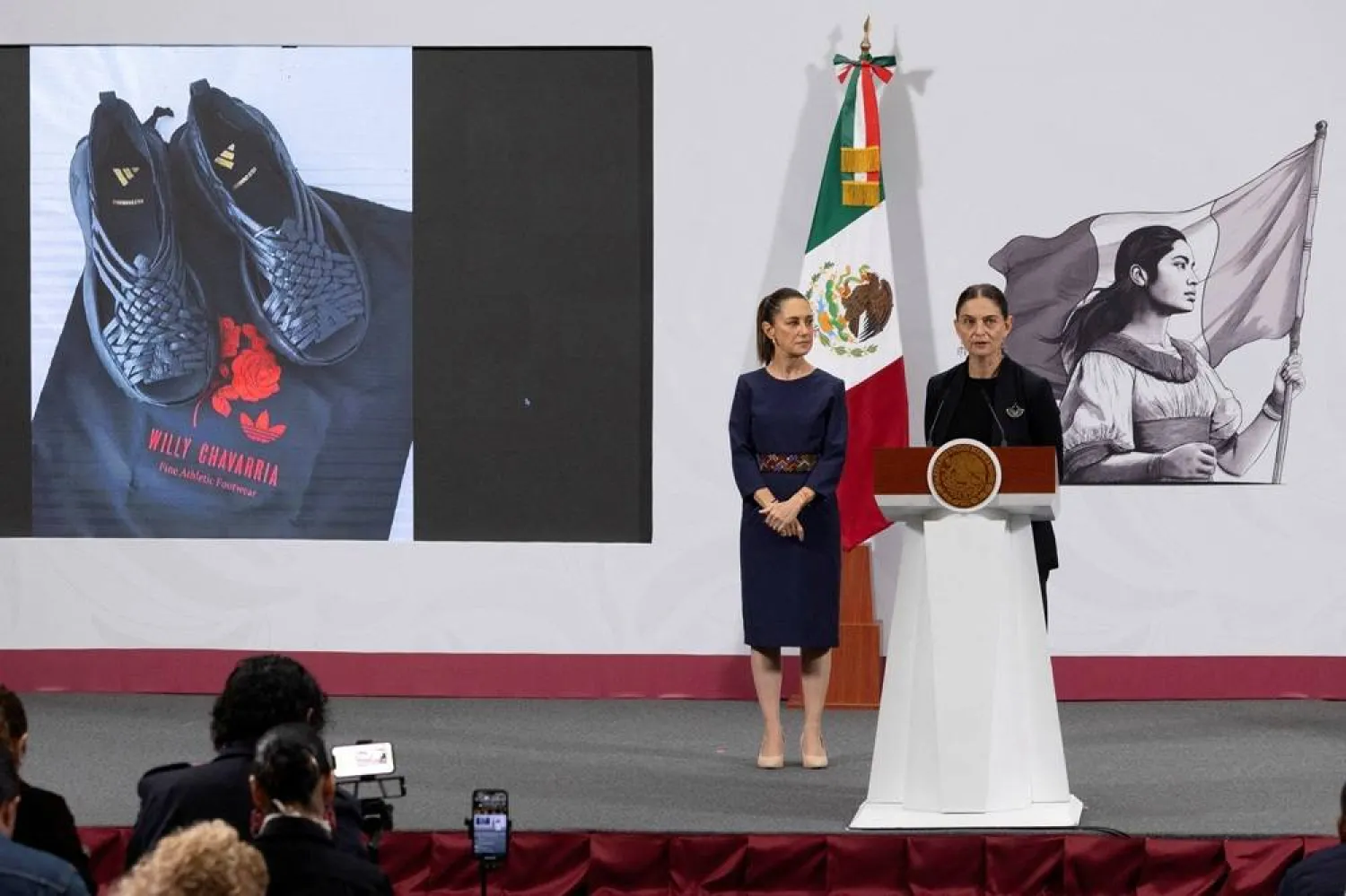
Marina Nunez Bespalova, Mexico’s Undersecretary of Cultural Development, speaks during President Claudia Sheinbaum’s morning press conference at the National Palace to condemn Adidas and US designer Willy Chavarria over the “Oaxaca Slip On” shoe, accused of misappropriating a sandal design rooted in Zapotec Indigenous heritage, in Mexico City, Mexico, August 8, 2025. (Presidencia de Mexico/Handout via Reuters)
TT

Mexican Authorities Accuse Adidas of Cultural Appropriation in Their Sandal Design

Marina Nunez Bespalova, Mexico’s Undersecretary of Cultural Development, speaks during President Claudia Sheinbaum’s morning press conference at the National Palace to condemn Adidas and US designer Willy Chavarria over the “Oaxaca Slip On” shoe, accused of misappropriating a sandal design rooted in Zapotec Indigenous heritage, in Mexico City, Mexico, August 8, 2025. (Presidencia de Mexico/Handout via Reuters)

Mexican authorities are accusing sportswear company Adidas of plagiarizing artisans in southern Mexico, alleging that a new sandal design is strikingly similar to the traditional Indigenous footwear known as huaraches.

The controversy has fueled accusations of cultural appropriation by the footwear brand, with authorities saying this is not the first time traditional Mexican handicrafts have been copied. Citing these concerns, local authorities have asked Adidas to withdraw the shoe model.

Mexican President Claudia Sheinbaum said on Friday that Adidas was already in talks with authorities in the southern Mexican state of Oaxaca to provide "compensation for the people who were plagiarized," and that her government was preparing legal reforms to prevent the copying of Mexican handicrafts.

The design at the center of the controversy is the "Oaxaca Slip-On," a sandal created by US designer Willy Chavarría for Adidas Originals. The sandals feature thin leather straps braided in a style that is unmistakably similar to the traditional Mexican huaraches. Instead of flat leather soles, the Adidas shoes tout a more chunky, sports shoe sole.

According to Mexican authorities, Adidas' design contains elements that are part of the cultural heritage of the Zapotec Indigenous communities in Oaxaca, particularly in the town of Villa Hidalgo de Yalálag. Handicrafts are a crucial economic lifeline in Mexico, providing jobs for around half a million people across the country. The industry accounts for around 10% of the gross domestic product of states like Oaxaca, Jalisco, Michoacán and Guerrero.

For Viridiana Jarquín García, a huaraches creator and vendor in Oaxaca's capital, the Adidas shoes were a "cheap copy" of the kind of work that Mexican artists take time and care to craft.

"The artistry is being lost. We're losing our tradition," she said in front of her small booth of leather shoes.

Authorities in Oaxaca have called for the "Oaxaca Slip-On" to be withdrawn and demanded a public apology from Adidas, with officials describing the design as "cultural appropriation" that may violate Mexican law.

In a public letter to Adidas leadership, Oaxaca state Gov. Salomón Jara Cruz criticized the company’s design, saying that "creative inspiration" is not a valid justification for using cultural expressions that "provide identity to communities."

"Culture isn't sold, it's respected," he added.

Adidas responded in a letter Friday afternoon, saying that the company "deeply values the cultural wealth of Mexico’s Indigenous people and recognizes the relevance" of the criticisms. It requested to sit down with local officials and to discuss how it can "repair the damage" to Indigenous populations.

The controversy follows years of efforts by Mexico's government and artisans to push back on major global clothing brands who they say copy traditional designs.

In 2021, the federal government asked manufacturers including Zara, Anthropologie and Patowl to provide a public explanation for why they copied clothing designs from Oaxaca's Indigenous communities to sell in their stores.

Now, Mexican authorities say they're trying to work out stricter regulations in an effort to protect artists. But Marina Núñez, Mexico's undersecretary of cultural development, noted that they also want to establish guidelines to not deprive artists of "the opportunity to trade or collaborate with several of these companies that have very broad commercial reach."



Saudi Arabia: King Abdulaziz Library to Launch 26th Free Reading Festival

The King Abdulaziz Public Library. SPA
TT

Saudi Arabia: King Abdulaziz Library to Launch 26th Free Reading Festival

The King Abdulaziz Public Library. SPA

The King Abdulaziz Public Library, in cooperation with the Riyadh Education Department, will launch its 26th annual Free Reading Festival for public school students on Sunday.

Running from May 10 to 14 in Riyadh, the festival will bring together more than 100 schools, over 1,550 students, and a number of educators and teachers.

It aims to foster a love of reading and learning, expand students’ literary, scientific, and cultural horizons, and encourage teachers to promote independent reading. It will also provide a platform to showcase student talents and strengthen Arabic language skills.

Through initiatives like this festival, the King Abdulaziz Public Library promotes reading through diverse programs and a wide range of books that foster pride in the Kingdom’s heritage.


Qassim's Monday Market Retains Heritage Role as Economic and Cultural Hub

The Monday market in the governorate of Uyun Al-Jiwa. (SPA)
TT

Qassim's Monday Market Retains Heritage Role as Economic and Cultural Hub

The Monday market in the governorate of Uyun Al-Jiwa. (SPA)

The Monday market in the governorate of Uyun Al-Jiwa, north of Qassim Region, stands as one of the oldest traditional weekly markets, enduring through changing times while maintaining its role as a vibrant economic and cultural hub.

The market draws a growing number of visitors from across Qassim and beyond, supported by the governorate’s strategic location.

During a field tour, the Saudi Press Agency observed lively activity throughout the market, with stalls displaying a diverse range of products. These include agricultural goods such as almonds and dried figs; animal products like ghee and milk, for which the region is renowned; as well as handicrafts and natural items such as henna and sidr.

Visitors noted that the market has retained its authentic character, continuing to serve as a vital source of income for small vendors and families working in the cottage industry, reinforcing its role as a key platform for preserving traditional culture while supporting the local rural economy.


Heritage Commission Revives Al-Nasb Heritage District as Abha Cultural Tourism Destination

The district’s significance lies in its unique architectural composition - SPA
TT

Heritage Commission Revives Al-Nasb Heritage District as Abha Cultural Tourism Destination

The district’s significance lies in its unique architectural composition - SPA

Al-Nasb Heritage District in Abha is one of the most prominent living examples of traditional architecture in Aseer Region, preserving its long history and architectural details that embody people’s connection to their local environment and document the social and cultural patterns that have shaped the identity of the place across generations.

The district’s significance lies in its unique architectural composition, where mud and stone buildings stand side by side in visual harmony. They were built using local materials such as stone, clay, and juniper trunks, while the narrow alleyways and closely set buildings give the district a cohesive social character that reflects the spirit of past communities in the region and the close relationship between people and place.

The Heritage Commission has revived the district through an integrated restoration and rehabilitation project aimed at preserving its original elements and enhancing its sustainability, as part of national efforts to protect urban heritage and highlight it as a cultural and tourism asset, SPA reported.

The site is also distinguished by its natural setting, as the district overlooks the banks of Abha Valley and surrounding farms, giving it a distinctive visual and aesthetic dimension. Its narrow passageways and closely set buildings illustrate a traditional urban pattern that strengthens ties among residents and captures the nature of social life in that era.

The district is now a growing destination for culture and tourism in Abha, attracting visitors and heritage enthusiasts who come to explore the details of authentic architecture and learn about the traditional ways of life that have shaped Aseer Region’s identity across generations. The project helps raise awareness of the importance of preserving archaeological sites as a key pillar in forming national memory.

The project is part of the Kingdom’s efforts to protect and effectively manage cultural heritage, in line with the targets of Saudi Vision 2030, which gives special attention to the cultural sector. It seeks to turn heritage sites into vibrant spaces that support cultural tourism and sustainable development while reconnecting society with its historical roots.