


How Millennia of History Vanished in Sudan’s War 

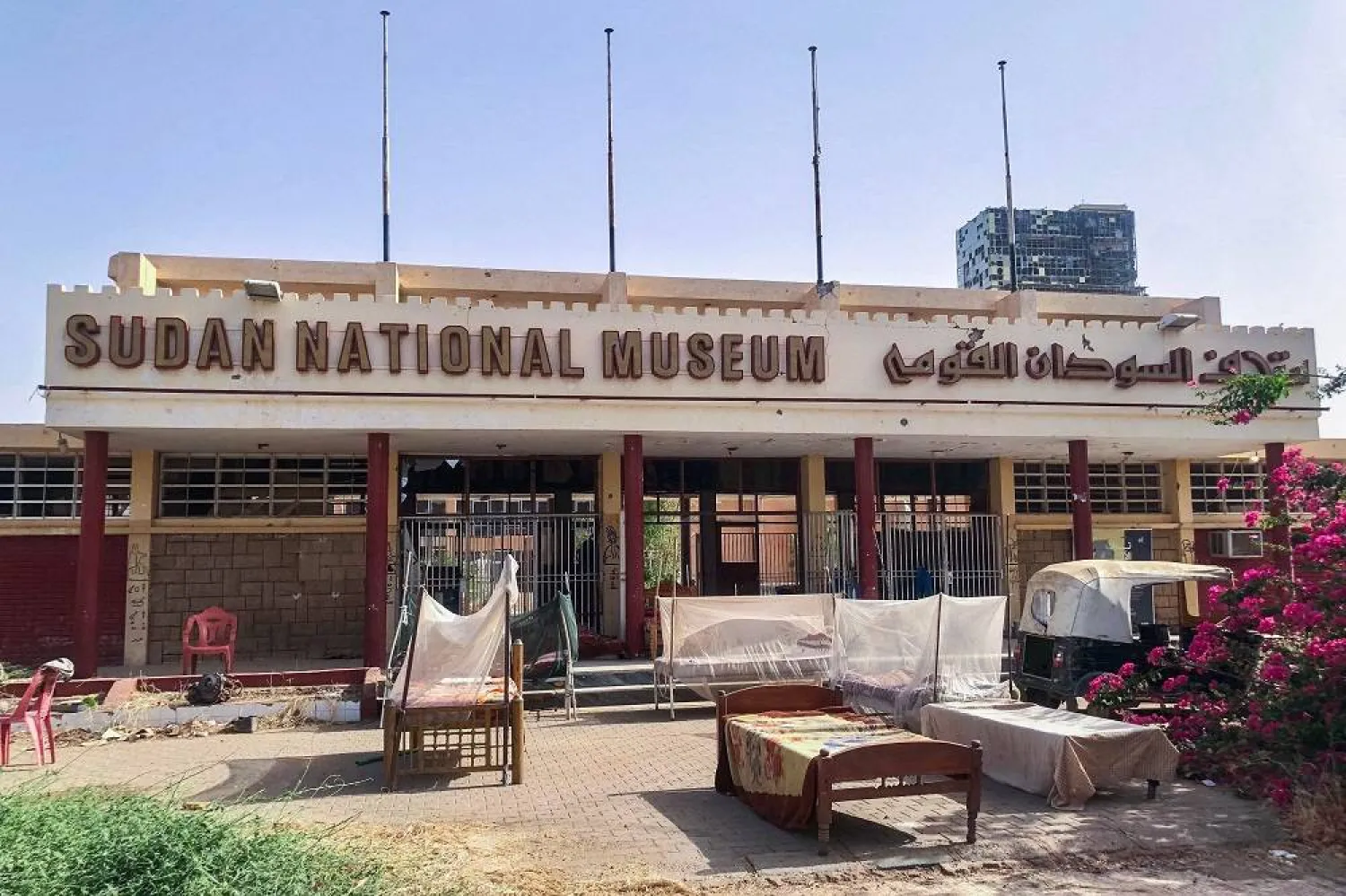
A picture shows a view of the damage at the Sudan National Museum in Khartoum on April 11, 2025, after the army recaptured the country's capital from RSF paramilitaries the previous month. (AFP)
TT

How Millennia of History Vanished in Sudan’s War 

A picture shows a view of the damage at the Sudan National Museum in Khartoum on April 11, 2025, after the army recaptured the country's capital from RSF paramilitaries the previous month. (AFP)

In the scorched courtyard of Sudan's National Museum in Khartoum, a towering black granite statue of Kush Pharaoh Taharqa now stands alone, surrounded by shards of broken glass and shattered stone.

Since the museum was looted in the early days of Sudan's war between the army and paramilitaries in April 2023, thousands of priceless antiquities, many dating back to the 3,000-year-old Kingdom of Kush, have vanished.

Officials believe that some have been smuggled across borders into Egypt, Chad and South Sudan, but there is no trace of the vast majority of the pieces.

"Only the large, heavy objects that couldn't be carried off were left behind," said Rawda Idris, a public prosecutor and member of Sudan's Committee for the Protection of Museums and Archeological Sites.

At its height, the museum housed over half a million artifacts spanning 7,000 years of African history that, according to former antiquities director Hatim al-Nour, "shaped the deep history of Sudanese identity".

Colossal statues of Kushite war deities now stand sentinel over the neglected grounds, beneath a ceiling bearing the blackened scars of shelling.

The rest of the museum's precious contents have disappeared, the vast majority seemingly without a trace.
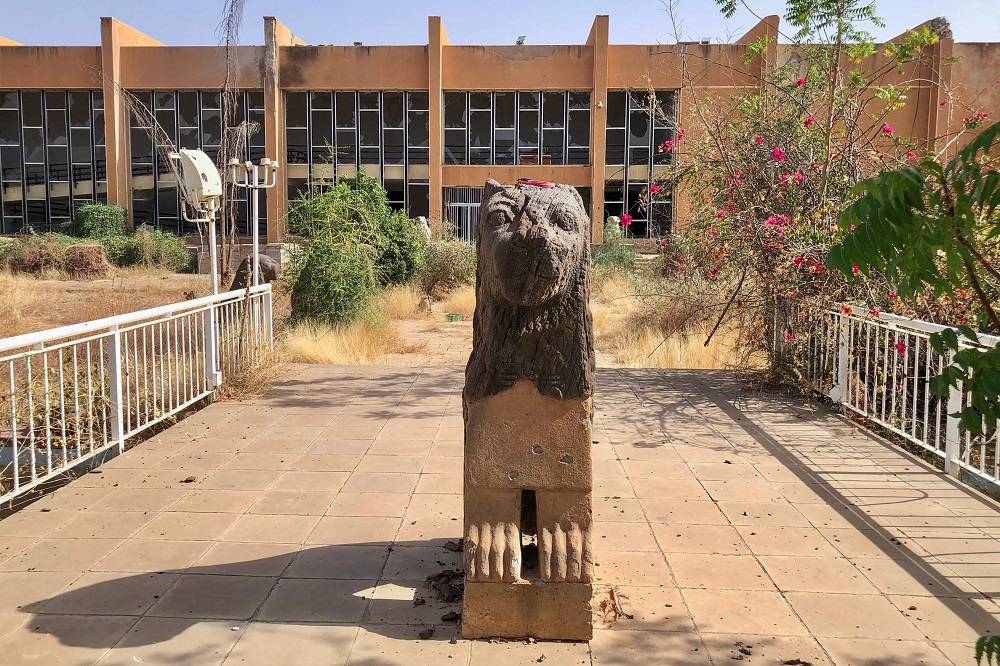
A picture shows a view of the damage at the Sudan National Museum in Khartoum on April 11, 2025, after the army recaptured the country's capital from the RSF the previous month. (AFP)

- 'War crime' -

Central Khartoum, where the museum stands along with Sudan's main state institutions, was a battlefield from April 2023, when the paramilitary Rapid Support Forces (RSF) swept through town.

It was only after the army recaptured the capital in March that Sudan's antiquities officials returned for the first time to find their precious museum in ruins.

The worst blow, they say, was the loss of its famed "Gold Room", which had housed solid-gold royal jewellery, figurines and ceremonial objects.

"Everything in that room was stolen," said Ikhlas Abdel Latif, director of museums at the Sudanese antiquities authority.

According to her, the artifacts were transported in large trucks, through Khartoum's twin city of Omdurman, westwards to the RSF stronghold region of Darfur, before some emerged across the South Sudanese border.

The bulk of the stolen artifacts were from the Kingdom of Kush, a Nubian civilization that once rivalled ancient Egypt in wealth, power and influence.

Its legacy -- preserved in artifacts sculpted from stone and bronze and adorned with gemstones -- has now been gutted, one of countless victims of Sudan's war between rival generals.

The conflict between army chief Abdel Fattah al-Burhan and his former deputy, RSF commander Mohamed Hamdan Daglo, has killed tens of thousands and created the world's largest hunger and displacement crises.

Army-aligned government officials accuse RSF fighters of looting the National Museum and other heritage sites, calling their destruction of artifacts a "war crime" -- an accusation the paramilitary group denies.

- Black market offers -

In September last year, UNESCO issued a global alert, urging museums, collectors and auction houses to "refrain from acquiring or taking part in the import, export or transfer of ownership of cultural property from Sudan".

An official at Sudan's antiquities authority told AFP that Sudan is working with neighboring countries to track stolen items.

Interpol also confirmed to AFP it is involved in efforts to locate the missing artifacts, but declined to provide further details.

Last spring, "a group of foreigners were arrested" in Sudan's northern River Nile state with antiquities in their possession, said Idris, the public prosecutor.

Two sources at the antiquities authority said another group had communicated with the Sudanese government from Egypt, offering to return looted antiquities in exchange for money. It remains unclear how the government responded to the offer.
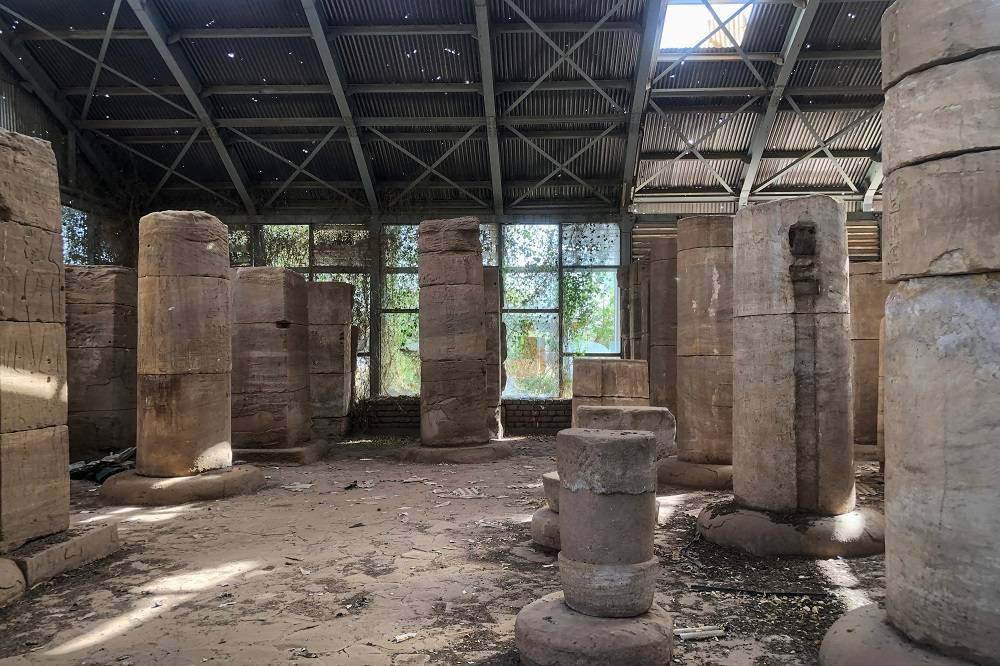
A picture shows a view of the damage at the Sudan National Museum in Khartoum on April 11, 2025, after the army recaptured the country's capital from the RSF the previous month. (AFP)

Kushite funerary statues are particularly sought after on the black market because they are "beautiful, small and portable", Abdel Latif says.

But specialists have so far been unable to trace them or the contents of the Gold Room anywhere.

According to Abdel Latif, sales are mostly happening in tightknit smuggling circles behind closed doors.

- $110 million and counting -

The National Museum in Khartoum is by no means the only cultural casualty of the Sudan war.

The scale of losses wrought upon it "can't make us forget the destruction of all the other museums, no less important" as repositories of Sudanese heritage, Nour, the former antiquities director, told AFP.

More than 20 museums across Sudan have been looted or destroyed, according to officials, who estimate the total value of the losses to be around $110 million so far.

In Omdurman, the Khalifa House Museum stands battered and bruised, its walls pocked with bullet holes and the jagged lesions of artillery fire.

The seat of power in 18th-century Sudan, the building now houses broken glass and splintered relics, its collections smashed to bits.

In Darfur, the besieged city of El-Fasher's Ali Dinar Museum, the largest in the western region, has reportedly been destroyed by fighting.

In South Darfur state capital Nyala, a local source said the city's museum has become impossible to access.

"The area is now completely destroyed," said the source. "Only RSF fighters can move there."

Abdel Latif said the museum, renovated after years of closure, "has now become a military base".



Saudi Arabia: Ship of Tolerance Initiative Promotes Cultural Dialogue in Jeddah

The Royal Institute of Traditional Arts (Wrth) will offer traditional craft workshops throughout Ramadan. SPA
TT

Saudi Arabia: Ship of Tolerance Initiative Promotes Cultural Dialogue in Jeddah

The Royal Institute of Traditional Arts (Wrth) will offer traditional craft workshops throughout Ramadan. SPA

The Saudi Ministry of Culture, in collaboration with the "Lenobadir" volunteer and community partnership program and the Athr Foundation, has launched the Ship of Tolerance initiative in Historic Jeddah during Ramadan.

The initiative aims to enhance shared human values through arts, and promote tolerance and coexistence among children and families. It provides an educational and cultural experience aligned with the area’s unique character as a UNESCO World Heritage site.

As part of this global art project, children will create artworks that represent acceptance and dialogue.

The Royal Institute of Traditional Arts (Wrth) will offer traditional craft workshops throughout Ramadan, linking the initiative's values with local heritage and enriching visitors' connection to the region's identity.

This effort supports cultural programs with educational and social dimensions in Historic Jeddah, activating local sites for experiences that combine art, crafts, and community participation. It aligns with the National Strategy for Culture under Saudi Vision 2030, focusing on heritage preservation and expanding culture's impact on daily life.


Oscar Contender ‘Hamnet’ Boosts Tourism at Shakespeare Heritage Sites 

A view of Shakespeare’s Birthplace, William Shakespeare's childhood home, in Stratford-upon-Avon, Britain, February 9, 2026. (Reuters)
TT

Oscar Contender ‘Hamnet’ Boosts Tourism at Shakespeare Heritage Sites 

A view of Shakespeare’s Birthplace, William Shakespeare's childhood home, in Stratford-upon-Avon, Britain, February 9, 2026. (Reuters)

On a cloudy winter's day, visitors stream into what was once William Shakespeare's childhood home in Stratford-upon-Avon and the nearby Anne Hathaway's cottage, family residence of the bard's wife.

Hathaway's cottage is one of the settings for the BAFTA and Oscar best film contender "Hamnet", and the movie's success is drawing a new wave of tourists to Shakespeare sites in the town in central England.

Shakespeare's Birthplace is the house the young William once lived in and where his father worked as a glove maker, while Hathaway's cottage is where he would have visited his future wife early in their relationship.

Typically, around 250,000 visitors, from the UK, Europe, the United States, China and elsewhere, walk through the locations each year, according to the Shakespeare Birthplace Trust. ‌The charity looks after ‌Shakespeare heritage sites, which also include Shakespeare's New Place, the site of ‌the ⁠Stratford home where the ⁠bard died in 1616.

Visitors are flocking in this year thanks to "Hamnet", the film based on Maggie O'Farrell's 2020 novel, which gives a fictional account of the relationship between Shakespeare and Hathaway, also known as Agnes, and the death of their 11-year-old son Hamnet in 1596.

"Visitor numbers have increased by about 15 to 20% across all sites since the film was released back in January. I think that will only continue as we go throughout the year," Richard Patterson, chief operating officer for the Shakespeare Birthplace Trust, said.

"They particularly want ⁠to look (at) Anne Hathaway's cottage and the specifics around how the family ‌engaged in the spaces and the landscape in and around ‌the cottage... you can see why he would have been inspired."

NEW ACCESS TO SHAKESPEARE

"Hamnet" has 11 nominations at ‌Sunday's British BAFTA awards, including best film and leading actress for Jessie Buckley, who plays Agnes. It ‌also has eight Oscar nominations, with Buckley seen as the frontrunner to win best actress.

"Hamnet" is set in Stratford-upon-Avon and London although it was not filmed in Stratford.

It sees Paul Mescal's young Shakespeare fall for Agnes while teaching Latin to pay off his father's debts. The drama, seen mainly through Agnes' eyes, focuses on their ‌life together and grief over Hamnet's death, leading Shakespeare to write "Hamlet".

"Shakespeare... is notoriously enigmatic. He writes about humanity, about feeling, about emotion, about conflict, ⁠but where do we understand ⁠who he is in that story?" said Charlotte Scott, a professor of Shakespeare studies and interim director of collections, learning and research at the Shakespeare Birthplace Trust.

"And that's driven people creative and otherwise for hundreds and hundreds of years. Where is Shakespeare's heart? And this is what the film I think has so beautifully opened up."

Little is known about how the couple met. Shakespeare was 18 and Hathaway 26 when they married in 1582. Daughter Susanna arrived in 1583 and twins Judith and Hamnet in 1585.

The film acknowledges the names Hamnet and Hamlet were interchangeable back then. While grief is a dominant theme, audiences also see Shakespeare in love and as a father.

"A lot of people will see this film not necessarily having... had any kind of relationship with Shakespeare," Scott said.

"So people will come to this film, I hope, and find a new way of accessing Shakespeare that is about creativity, that is about understanding storytelling as a constant process of regeneration, but also crucially, looking at it from that kind of emotive angle."


Culture Ministry Continues Preparations in Historic Jeddah to Welcome Visitors during Ramadan 

Historic Jeddah has emerged as a leading cultural tourism destination during Ramadan. (SPA)
TT

Culture Ministry Continues Preparations in Historic Jeddah to Welcome Visitors during Ramadan 

Historic Jeddah has emerged as a leading cultural tourism destination during Ramadan. (SPA)

The Saudi Ministry of Culture is continuing its efforts to revitalize Historic Jeddah in preparation for welcoming visitors during the holy month of Ramadan, offering cultural programs, events, and heritage experiences that reflect the authenticity of the past.

The district has emerged as a leading cultural tourism destination at this time of year as part of the “The Heart of Ramadan” campaign launched by the Saudi Tourism Authority.

Visitors are provided the opportunity to explore the district’s attractions, including archaeological sites located within the geographical boundaries of the UNESCO World Heritage-listed area, which represent a central component of the Kingdom’s urban and cultural heritage.

The area also features museums that serve as gateways to understanding the city’s rich heritage and cultural development, in addition to traditional markets that narrate historical stories through locally made products and Ramadan specialties that reflect authentic traditions.

These initiatives are part of the ministry’s ongoing efforts to revitalize Historic Jeddah in line with the objectives of Saudi Vision 2030 and aiming to transform it into a vibrant hub for arts, culture, and the creative economy, while preserving its tangible and intangible heritage.