

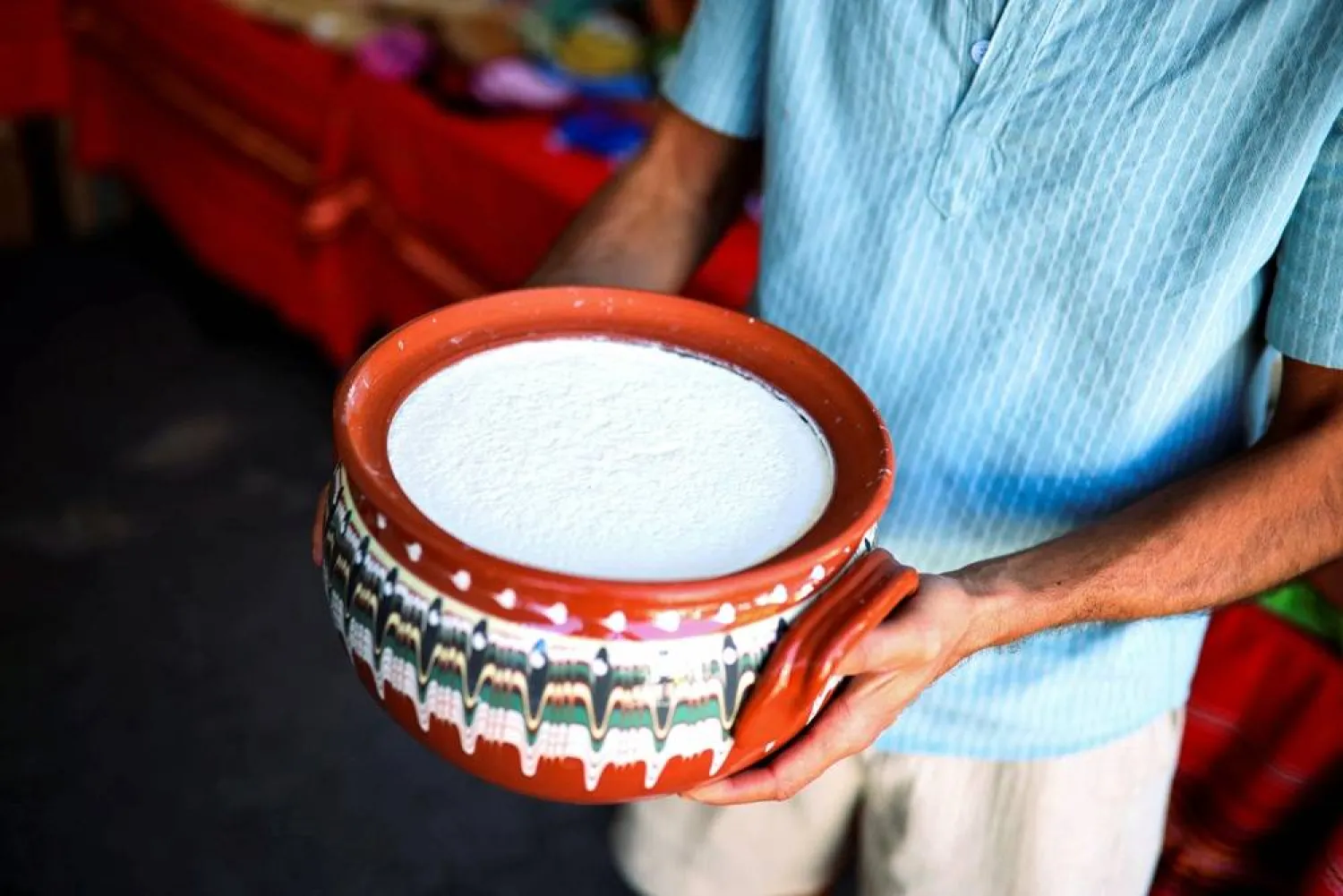

Bulgarian Village Draws Chinese Tourists for Its Famed Yogurt

A local producer shows Bulgarian yogurt displayed during the Yogurt Festival in the village of Momchilovtsi, Bulgaria, August 30, 2025. (Reuters)
TT

Bulgarian Village Draws Chinese Tourists for Its Famed Yogurt

A local producer shows Bulgarian yogurt displayed during the Yogurt Festival in the village of Momchilovtsi, Bulgaria, August 30, 2025. (Reuters)

Every year, hundreds of Chinese tourists flock to the Bulgarian mountain village of Momchilovtsi for a festival celebrating the local yogurt, which is renowned for its health benefits and has become a hit among consumers in China.

The Chinese visitors mingle with locals in the village in the Rhodope Mountains near the Greek border. On a stage in the village square, singers and bagpipers in traditional embroidered costumes perform folk songs in the late summer sun.

Yogurt and cheese producers from the region, many of whom speak some Chinese, offer samples and products for sale.

"Bulgarian yogurt is very popular in China ... so we want to try the pure yogurt here," said Ge Lin, 37, a tourist from China.

Chinese tourists have been visiting Momchilovtsi since 2009, when a Chinese dairy company first imported the bacteria found in the local yogurt. The company's product, branded Mosilian, is now sold in most Chinese supermarkets.

In the early 20th century, Bulgarian microbiologist Stamen Grigorov and Russian zoologist Élie Metchnikoff found that consuming yogurt helped Bulgarian peasants to live longer.

Bulgarian yogurt contains Lactobacillus bulgaricus and other bacteria unique to the region, which boost health, immunity, and longevity, said Prof. Dr. Penka Petrova, director of the Institute of Microbiology at the Bulgarian Academy of Sciences.

"Bulgarian yogurt may be the world's first probiotic and has been used to treat various ailments. Each bacterial strain isolated from homemade yogurt has distinct properties," she said.

A number of recent scientific studies have found fermented dairy products from Bulgaria have beneficial health properties.

Dimitar Danchev, 37, a fourth-generation livestock breeder from the region, said local yogurt is made from both cows' and sheep's milk and its properties vary according to the season.

"In spring, when animals graze on fresh grass, the yogurt has specific characteristics, ... while in autumn, when the grass is drier, the milk is thicker."

Mitra Pareva, 95, said yogurt has been part of her daily diet for her whole life.

"Yogurt is good for me. The first foods on my table are bread and yogurt," she said.



Saudi Arabia: King Abdulaziz Library to Launch 26th Free Reading Festival

The King Abdulaziz Public Library. SPA
TT

Saudi Arabia: King Abdulaziz Library to Launch 26th Free Reading Festival

The King Abdulaziz Public Library. SPA

The King Abdulaziz Public Library, in cooperation with the Riyadh Education Department, will launch its 26th annual Free Reading Festival for public school students on Sunday.

Running from May 10 to 14 in Riyadh, the festival will bring together more than 100 schools, over 1,550 students, and a number of educators and teachers.

It aims to foster a love of reading and learning, expand students’ literary, scientific, and cultural horizons, and encourage teachers to promote independent reading. It will also provide a platform to showcase student talents and strengthen Arabic language skills.

Through initiatives like this festival, the King Abdulaziz Public Library promotes reading through diverse programs and a wide range of books that foster pride in the Kingdom’s heritage.


Qassim's Monday Market Retains Heritage Role as Economic and Cultural Hub

The Monday market in the governorate of Uyun Al-Jiwa. (SPA)
TT

Qassim's Monday Market Retains Heritage Role as Economic and Cultural Hub

The Monday market in the governorate of Uyun Al-Jiwa. (SPA)

The Monday market in the governorate of Uyun Al-Jiwa, north of Qassim Region, stands as one of the oldest traditional weekly markets, enduring through changing times while maintaining its role as a vibrant economic and cultural hub.

The market draws a growing number of visitors from across Qassim and beyond, supported by the governorate’s strategic location.

During a field tour, the Saudi Press Agency observed lively activity throughout the market, with stalls displaying a diverse range of products. These include agricultural goods such as almonds and dried figs; animal products like ghee and milk, for which the region is renowned; as well as handicrafts and natural items such as henna and sidr.

Visitors noted that the market has retained its authentic character, continuing to serve as a vital source of income for small vendors and families working in the cottage industry, reinforcing its role as a key platform for preserving traditional culture while supporting the local rural economy.


Heritage Commission Revives Al-Nasb Heritage District as Abha Cultural Tourism Destination

The district’s significance lies in its unique architectural composition - SPA
TT

Heritage Commission Revives Al-Nasb Heritage District as Abha Cultural Tourism Destination

The district’s significance lies in its unique architectural composition - SPA

Al-Nasb Heritage District in Abha is one of the most prominent living examples of traditional architecture in Aseer Region, preserving its long history and architectural details that embody people’s connection to their local environment and document the social and cultural patterns that have shaped the identity of the place across generations.

The district’s significance lies in its unique architectural composition, where mud and stone buildings stand side by side in visual harmony. They were built using local materials such as stone, clay, and juniper trunks, while the narrow alleyways and closely set buildings give the district a cohesive social character that reflects the spirit of past communities in the region and the close relationship between people and place.

The Heritage Commission has revived the district through an integrated restoration and rehabilitation project aimed at preserving its original elements and enhancing its sustainability, as part of national efforts to protect urban heritage and highlight it as a cultural and tourism asset, SPA reported.

The site is also distinguished by its natural setting, as the district overlooks the banks of Abha Valley and surrounding farms, giving it a distinctive visual and aesthetic dimension. Its narrow passageways and closely set buildings illustrate a traditional urban pattern that strengthens ties among residents and captures the nature of social life in that era.

The district is now a growing destination for culture and tourism in Abha, attracting visitors and heritage enthusiasts who come to explore the details of authentic architecture and learn about the traditional ways of life that have shaped Aseer Region’s identity across generations. The project helps raise awareness of the importance of preserving archaeological sites as a key pillar in forming national memory.

The project is part of the Kingdom’s efforts to protect and effectively manage cultural heritage, in line with the targets of Saudi Vision 2030, which gives special attention to the cultural sector. It seeks to turn heritage sites into vibrant spaces that support cultural tourism and sustainable development while reconnecting society with its historical roots.