

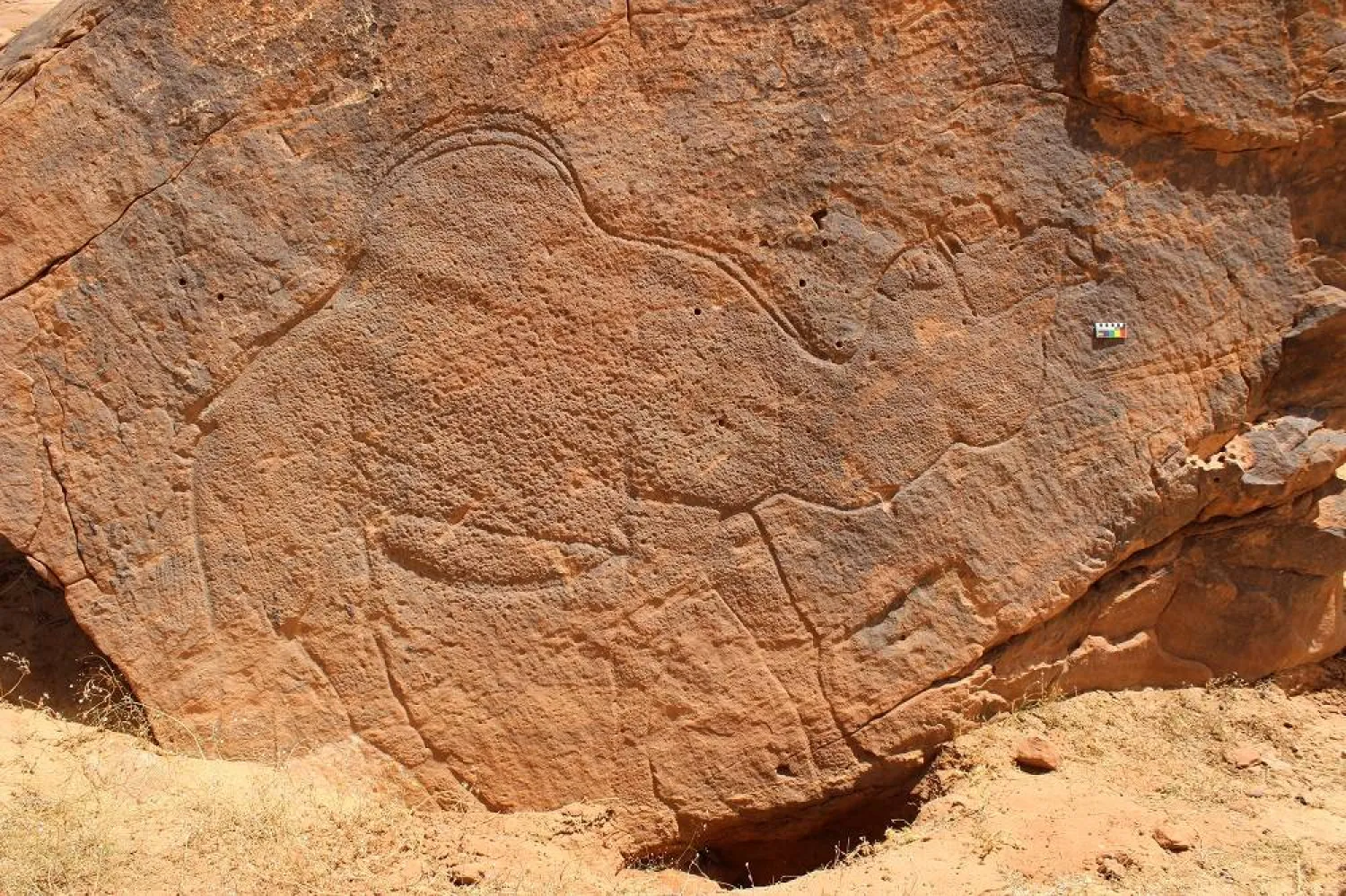

Early Rock Art Engravings Dating 12,000 Years Discovered in Saudi Arabia’s Al-Nafud Desert 

This image provided by Sahout Rock Art and Archaeology Project shows a life-size rock carving of a camel, in a desert in northern Saudi Arabia in 2023. (Maria Guagnin/Sahout Rock Art and Archaeology Project via AP)
TT

Early Rock Art Engravings Dating 12,000 Years Discovered in Saudi Arabia’s Al-Nafud Desert 

This image provided by Sahout Rock Art and Archaeology Project shows a life-size rock carving of a camel, in a desert in northern Saudi Arabia in 2023. (Maria Guagnin/Sahout Rock Art and Archaeology Project via AP)

Saudi Arabia’s Heritage Commission announced on Tuesday the discovery and documentation of an exceptional group of life-size early rock art engravings, estimated to date back between 11,400 and 12,800 years.

The findings, published in Nature Communications, were identified at sites south of Al-Nafud Al-Kabir desert in the Hail Region. The work was carried out under the "Green Arabia Project," in collaboration with an international research team from several local and global universities and research centers.

The discovery represents the earliest scientifically dated phase of rock art in Saudi Arabia.

About 12,000 years ago, hunter-gatherers who inhabited a swathe of Arabian desert carved life-sized images of camels and other animals on sandstone cliffs and boulders, using rock art to mark the location of water sources in an illustration of how ancient people tackled some of Earth's most inhospitable environs.

Researchers said the monumental rock art was found south of the Al-Nafud Desert of northern Saudi Arabia at locales spanning a distance of about 20 miles (30 km) in mountainous terrain.

About 60 rock art panels bear more than 130 images of animals - primarily camels, but also ibex, gazelles, wild donkeys and an aurochs, a bovine thought to be the wild ancestor of modern domestic cattle. Some of the camel engravings were more than 7 feet (2 meters) tall and 8-1/2 feet (2.6 meters) long.

While many of the images were situated on boulders within easy reach of the ground, some were crafted on towering cliffs including one that was about 128 feet (39 meters) off the ground and was engraved with 19 camels and three donkeys.

"The engravers would have had to stand on a ledge directly in front of the cliff," said archaeologist and rock art researcher Maria Guagnin of the University of Sydney and the Max Planck Institute of Geoanthropology in Germany, lead author of the study.

"It would have been extremely dangerous to make these engravings as the ledge is very narrow and slopes downwards. Standing on this ledge, the engravers would also not have been able to see the whole image they were creating. But they had the skill to still produce a naturalistic representation," Guagnin added.

The researchers said the rock art marked the location of transient water sources on the harsh desert landscape.

"These ancient communities survived in the desert by moving between seasonal lakes, and they marked these water sources, and the paths leading to them, with monumental rock art," Guagnin said.

The researchers used a technique called luminescence dating on simple stone tools they discovered that were used to make the rock art in order to determine that the engravings were made between 12,800 and 11,400 years ago.

"The findings show that communities were able to become fully established in desert environments much earlier than previously thought," Guagnin said. "They must have known the landscape incredibly well."

"Most of the camels show male camels in rut, identifiable by the straining neck muscles as they make a rumbling noise during the mating season, which is normally during the wet season. So the rock art links to the rainy season and marks locations where water pools," Guagnin added.

There also is evidence that these people added to the rock art for two to three millennia, Guagnin said.

The researchers do not know if the art originally was colorfully decorated with paint.

"The engravings are exposed to the elements, and if they were once painted the pigment would have washed off long ago," Guagnin said.

During the height of the last Ice Age some 20,000 to 25,000 years ago, Arabia was so arid that there was no known human habitation. But about 15,000 years ago a period of higher rainfall began, forming some wetlands and ponds in a desert environment that was getting a bit greener. The rock art reveals the timing of the hunter-gatherers who subsequently inhabited the region, the researchers said.

"This story resonates today in that these people show remarkable abilities to expand, cope and survive in marginal landscapes," said anthropologist and study co-author Michael Petraglia, director of the Australian Research Center for Human Evolution at Griffith University.

Some artifacts recovered in the excavations resemble those found in the broader region, suggesting a degree of interaction between these hunter-gatherers and other peoples. But the monumental rock art is unlike anything else known in the broader region.

"These communities had contact with neighboring groups in the Levant over 400 km (250 miles) away, but they also had their own identity," Guagnin said. "They clearly marked water sources with rock art, but we can't be sure if that marks access rights, or perhaps also expresses a wish for the water to return in the next season. Perhaps there were multiple reasons. From the sheer effort that was required, we can tell this rock art was very important to them."


Jeddah Book Fair Highlights Saudi Manga and Comics’ Rise from Hobby to Professionalism

Manga zone at Jeddah Book Fair captivates visitors with creative content, comics. (SPA)
TT

Jeddah Book Fair Highlights Saudi Manga and Comics’ Rise from Hobby to Professionalism

Manga zone at Jeddah Book Fair captivates visitors with creative content, comics. (SPA)

A dialogue session held on the main stage of the Jeddah Book Fair 2025, organized by the Literature, Publishing and Translation Commission, discussed the rapid transformations taking place in the manga and comics sector in the Kingdom of Saudi Arabia, under the title "The Saudi Manga and Comics Wave: From Hobby to Professionalism."

The session began by outlining the features of the creative renaissance in these art forms, explaining how they evolved in just a few years from individual initiatives and youthful hobbies to a mature artistic movement and a cultural vision embraced by institutions, the Saudi Press Agency reported.

The session highlighted the development of manga and comics in Saudi Arabia and the challenges and opportunities artists face as they transition from hobby to professional practice. It reviewed the local scene, which has seen a broad presence, bolstered by media platforms that support Saudi productions and help spread this art form among the public.

The session explained that manga and comics in Saudi Arabia have developed a clear artistic identity that reflects Saudi cultural values such as generosity, courage, and humanity. It emphasized that professionalism depends on an integrated system encompassing concept, story writing, illustration, and design.

The session concluded by highlighting the most prominent professional challenges in this field, while stressing that human creativity remains the key factor of manga and comics production and the true engine of this art form's development.


Red Sea Film Festival Partners with Annecy to Boost Saudi Animation Industry and Talent

The MoU aims to support the animation industry in the Kingdom and enhance its global presence. SPA
TT

Red Sea Film Festival Partners with Annecy to Boost Saudi Animation Industry and Talent

The MoU aims to support the animation industry in the Kingdom and enhance its global presence. SPA

The Red Sea International Film Festival has announced a strategic three-year partnership with the CITIA, organizer of the Annecy International Animation Film Festival, formalized by a memorandum of understanding signed in Jeddah by Red Sea Film Foundation CEO Faisal Baltyuor and CITIA CEO Mickaël Marin.

The MoU aims to support the animation industry in the Kingdom and enhance its global presence.

The partnership will launch key initiatives starting in 2026, including developing Saudi talent and expanding international collaboration through professional networking and knowledge exchange, and establishing an annual program at the Culture Square in Historic Jeddah featuring Annecy Festival works, workshops, and family events.

The initiatives also include the implementation of training workshops and exchange programs in collaboration with CITIA's network.


Seminar Highlights Saudi Sports as Medium for Global Cultural and Media Exchange

The seminar highlighted the significant advancement in the Saudi sports sector since 2017. SPA
TT

Seminar Highlights Saudi Sports as Medium for Global Cultural and Media Exchange

The seminar highlighted the significant advancement in the Saudi sports sector since 2017. SPA

The Jeddah International Book Fair 2025 hosted a seminar on the role of sports as a medium for cultural and media exchange, highlighting the significant advancement in the Saudi sports sector since 2017, driven by official support that has attracted global talents.

By attracting global stars, Saudi Arabia is building new communication bridges worldwide, establishing Saudi sports as a key destination for millions of international viewers. This movement confirms the Kingdom's growing presence as a global cultural and sports destination.

The Jeddah International Book Fair serves as a prominent platform supporting this intellectual and cultural exchange.
