


Ukraine's 'Origami Deer' Sculpture Rescued from Frontline Tours Europe

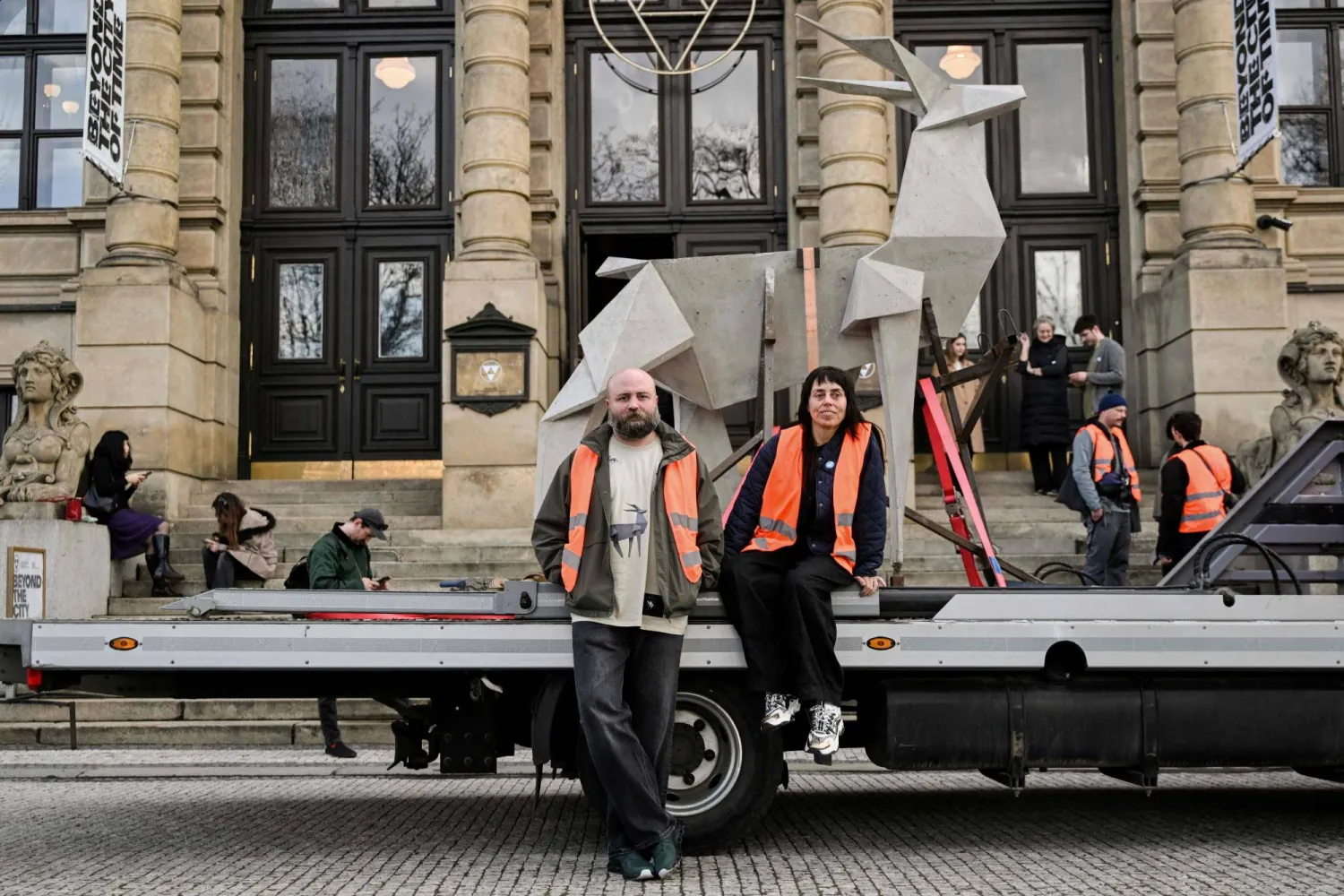
Ukrainian artist Zhanna Kadyrova (R) and Ukrainian curator of the 'Security Guarantees' project Leonid Marushchak pose in front of the 'Origami Deer' sculpture in Prague on March 12, 2026. (Photo by Michal Cizek / AFP)
TT

Ukraine's 'Origami Deer' Sculpture Rescued from Frontline Tours Europe

Ukrainian artist Zhanna Kadyrova (R) and Ukrainian curator of the 'Security Guarantees' project Leonid Marushchak pose in front of the 'Origami Deer' sculpture in Prague on March 12, 2026. (Photo by Michal Cizek / AFP)

An "Origami Deer" statue rescued from a Ukrainian city destroyed and occupied by Moscow's army is touring six European countries before featuring at the 61st Venice Biennale, which has sparked outrage over the inclusion of Russian artists.

Ukrainian artist Zhanna Kadyrova created the concrete work with her colleague Denys Ruban in 2019 for a park in the eastern city of Pokrovsk to replace a Soviet-era military plane displayed there.

In 2024, Kadyrova and historian Leonid Marushchak removed the deer, shaped like a paper origami, as Russian troops closed in and then occupied Pokrovsk.

The sculpture will be the main feature of the Ukrainian pavilion, named Security Guarantees, at the Venice Biennale.

It will feature alongside Russian exhibits at the event that started in 1895 and comprises festivals, art and architecture exhibitions running from May 9 to November 22.

The decision to invite Russian artists, banned from the 2022 and 2024 editions after Moscow's full-scale invasion of Ukraine, has sparked international uproar with the European Union threatening to cut funding for the Biennale.

"It's very important for us to see how the entire world reacts to the situation, supporting us and opposing Russia's participation," Marushchak told AFP.

"If the Russians want to show their culture, they might as well organize a biennale in Pokrovsk which they have destroyed," he added.

En route to Venice, the deer has been exhibited in Warsaw, Vienna and Prague and will continue on to Berlin, Brussels and Paris.

Displaced from its pedestal, the deer symbolizes "millions of Ukrainians who have lost their home" and moved abroad, Kadyrova told AFP during a stopover in Prague.

The resemblance to paper origami refers to the Budapest Memorandum of 1994 which saw Ukraine yielding its nuclear arsenal to Russia in exchange for security guarantees that did not materialize.

"So it's no more than paper," Kadyrova said.

Marushchak has been evacuating works of art from eastern Ukraine since the war started.

He has saved scores of objects, often taking huge risk with his team, to protect them from looting or theft.

One of the most dramatic rescue operations involved a 700-year-old stone lion statue evacuated from a museum in Bakhmut in 2023, just before the Russian army took the city, as Marushchak's car was hit by a shell on the way out.

"Other evacuations were difficult in that we didn't succeed as much as we wanted because the front line was too close and the danger was too big," Marushchak told AFP.

The Venice Biennale typically attracts more than 600,000 visitors to pavilions set up by participating countries.

Kadyrova said the Ukrainian team was not planning any protest over Russia's participation as "it's up to politicians".

"But I hope that some community will gather to pressure the Biennale, pressure Italy, and I hope that it will not happen."



Saudi Arabia: King Abdulaziz Library to Launch 26th Free Reading Festival

The King Abdulaziz Public Library. SPA
TT

Saudi Arabia: King Abdulaziz Library to Launch 26th Free Reading Festival

The King Abdulaziz Public Library. SPA

The King Abdulaziz Public Library, in cooperation with the Riyadh Education Department, will launch its 26th annual Free Reading Festival for public school students on Sunday.

Running from May 10 to 14 in Riyadh, the festival will bring together more than 100 schools, over 1,550 students, and a number of educators and teachers.

It aims to foster a love of reading and learning, expand students’ literary, scientific, and cultural horizons, and encourage teachers to promote independent reading. It will also provide a platform to showcase student talents and strengthen Arabic language skills.

Through initiatives like this festival, the King Abdulaziz Public Library promotes reading through diverse programs and a wide range of books that foster pride in the Kingdom’s heritage.


Qassim's Monday Market Retains Heritage Role as Economic and Cultural Hub

The Monday market in the governorate of Uyun Al-Jiwa. (SPA)
TT

Qassim's Monday Market Retains Heritage Role as Economic and Cultural Hub

The Monday market in the governorate of Uyun Al-Jiwa. (SPA)

The Monday market in the governorate of Uyun Al-Jiwa, north of Qassim Region, stands as one of the oldest traditional weekly markets, enduring through changing times while maintaining its role as a vibrant economic and cultural hub.

The market draws a growing number of visitors from across Qassim and beyond, supported by the governorate’s strategic location.

During a field tour, the Saudi Press Agency observed lively activity throughout the market, with stalls displaying a diverse range of products. These include agricultural goods such as almonds and dried figs; animal products like ghee and milk, for which the region is renowned; as well as handicrafts and natural items such as henna and sidr.

Visitors noted that the market has retained its authentic character, continuing to serve as a vital source of income for small vendors and families working in the cottage industry, reinforcing its role as a key platform for preserving traditional culture while supporting the local rural economy.


Heritage Commission Revives Al-Nasb Heritage District as Abha Cultural Tourism Destination

The district’s significance lies in its unique architectural composition - SPA
TT

Heritage Commission Revives Al-Nasb Heritage District as Abha Cultural Tourism Destination

The district’s significance lies in its unique architectural composition - SPA

Al-Nasb Heritage District in Abha is one of the most prominent living examples of traditional architecture in Aseer Region, preserving its long history and architectural details that embody people’s connection to their local environment and document the social and cultural patterns that have shaped the identity of the place across generations.

The district’s significance lies in its unique architectural composition, where mud and stone buildings stand side by side in visual harmony. They were built using local materials such as stone, clay, and juniper trunks, while the narrow alleyways and closely set buildings give the district a cohesive social character that reflects the spirit of past communities in the region and the close relationship between people and place.

The Heritage Commission has revived the district through an integrated restoration and rehabilitation project aimed at preserving its original elements and enhancing its sustainability, as part of national efforts to protect urban heritage and highlight it as a cultural and tourism asset, SPA reported.

The site is also distinguished by its natural setting, as the district overlooks the banks of Abha Valley and surrounding farms, giving it a distinctive visual and aesthetic dimension. Its narrow passageways and closely set buildings illustrate a traditional urban pattern that strengthens ties among residents and captures the nature of social life in that era.

The district is now a growing destination for culture and tourism in Abha, attracting visitors and heritage enthusiasts who come to explore the details of authentic architecture and learn about the traditional ways of life that have shaped Aseer Region’s identity across generations. The project helps raise awareness of the importance of preserving archaeological sites as a key pillar in forming national memory.

The project is part of the Kingdom’s efforts to protect and effectively manage cultural heritage, in line with the targets of Saudi Vision 2030, which gives special attention to the cultural sector. It seeks to turn heritage sites into vibrant spaces that support cultural tourism and sustainable development while reconnecting society with its historical roots.