


Egypt Opens One of Valley of the Kings' Largest Tombs to Public

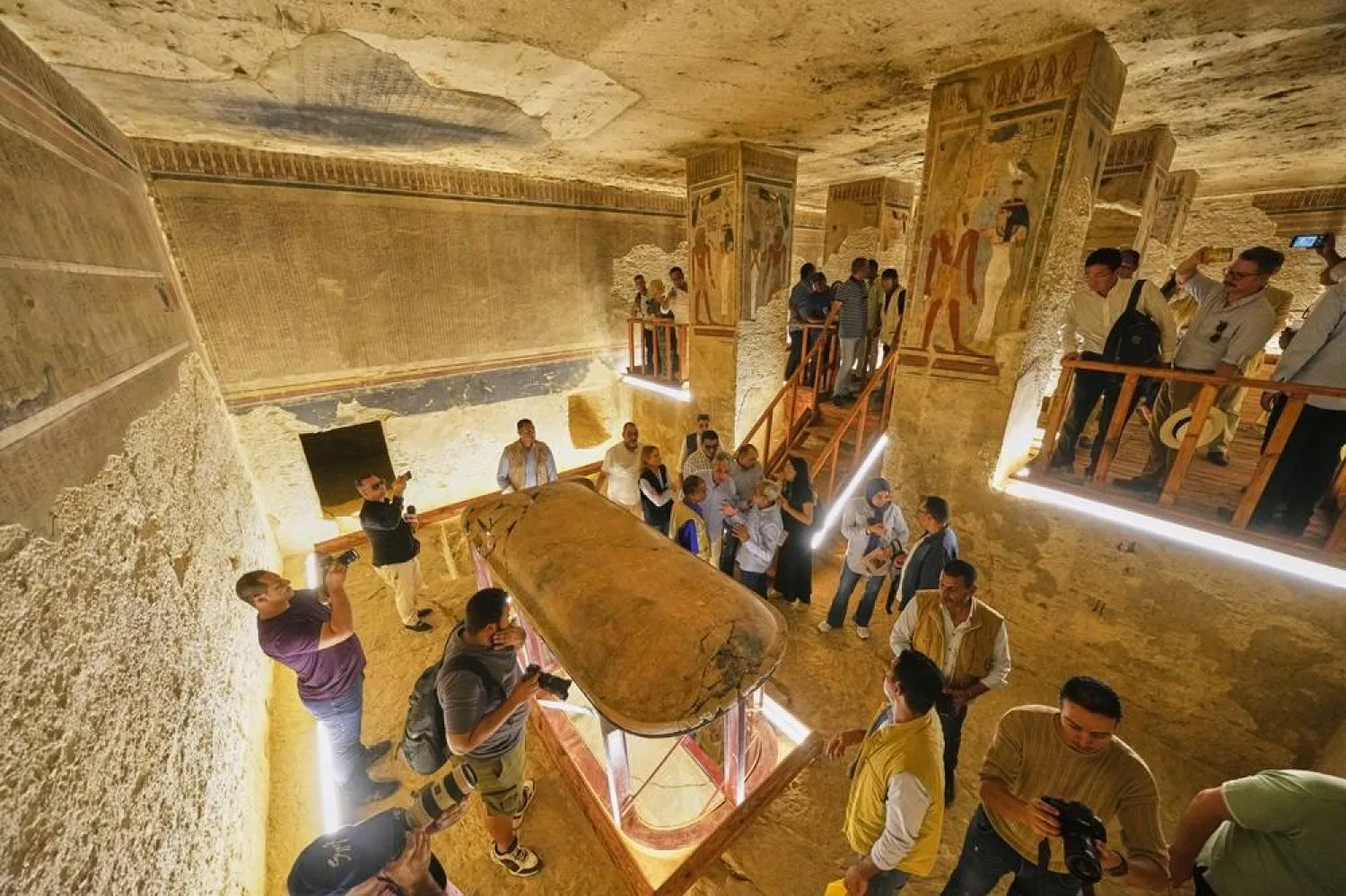
 Visitors view the tomb of Amenhotep III in the Valley of Kings in the southern city of Luxor, Egypt, Saturday, Oct. 4, 2025, as it opened to visitors for the first time in more than two decades. (AP Photo/Amr Nabil)
Visitors view the tomb of Amenhotep III in the Valley of Kings in the southern city of Luxor, Egypt, Saturday, Oct. 4, 2025, as it opened to visitors for the first time in more than two decades. (AP Photo/Amr Nabil)
TT

Egypt Opens One of Valley of the Kings' Largest Tombs to Public

 Visitors view the tomb of Amenhotep III in the Valley of Kings in the southern city of Luxor, Egypt, Saturday, Oct. 4, 2025, as it opened to visitors for the first time in more than two decades. (AP Photo/Amr Nabil)
Visitors view the tomb of Amenhotep III in the Valley of Kings in the southern city of Luxor, Egypt, Saturday, Oct. 4, 2025, as it opened to visitors for the first time in more than two decades. (AP Photo/Amr Nabil)

The tomb of Pharoah Amenhotep III, one of the largest in southern Egypt's Valley of the Kings and Queens, was officially opened to the public Saturday, after years of restoration.

Egypt's tourism and antiquities minister, Sherif Fathy, unveiled to reporters the newly refurbished tomb, which dates back more than 3,000 years.

It was first documented in 1799 during the brief Napoleonic conquest of Egypt. After a long history of excavation, looting and heavy damage, it was restored with support from the Japanese government and UNESCO.

Carved into the hillside on the west bank of the Nile River opposite the city of Luxor, the tomb is "decorated with wall paintings that are among the most exquisite of those surviving in the royal tombs of the Eighteenth Dynasty," according to Japan's UNESCO mission.

Decades of deterioration had left the structure at risk of collapse.

Amenhotep III ascended the throne as a teenager and ruled for around four decades of prosperity, stability and artistic grandeur before dying in 1349 BC at the age of 50.

He was buried in the famed Theban Necropolis, where Ancient Egyptian kings, queens, priests and royal scribes were buried between the 16th and 11th centuries BC.

Following French and British excavations in 1799 and 1915, most of the tomb's contents were carted away to the Louvre Museum in Paris, the Metropolitan Museum in New York and Highclere Castle in the United Kingdom, according to Waseda University in Japan.

His mummy and sarcophagus are housed in Cairo's National Museum of Egyptian Civilizations, while the Egyptian Museum in Tahrir and the capital's new Grand Egyptian Museum house colossal statues of the pharaoh seated next to his wife.

Near his tomb, Amenhotep's massive mortuary temple known as Kom al-Hetan has suffered extensive damage from annual Nile flooding, but two giant granite statues known as the Colossi of Memnon survive, greeting visitors into the ancient valley.



Red Sea Fund Launches Second Round to Support Film Projects in Production Stage

File photo of the fifth day of the Red Sea International Film Festival - SPA
TT

Red Sea Fund Launches Second Round to Support Film Projects in Production Stage

File photo of the fifth day of the Red Sea International Film Festival - SPA

The Red Sea Fund, affiliated with the Red Sea Film Foundation, announced the opening of applications to support film projects in the production stage within the second round of this year’s support program, which will continue until March 21, as part of its efforts to enhance the cinema industry and empower innovators in the region, SPA reported.

The round aims to support promising cinematic voices from the Kingdom and the Arab world, as well as filmmakers from Africa and Asia, through financial grants that help complete film projects and present their creative narratives globally, with a special focus on projects ready to enter production and begin filming.


Prince Mohammed bin Salman Project Restores Historic Al-Jami' Mosque in Tabuk Region

The renovation utilized modern technologies to restore the mosque's original identity - SPA
TT

Prince Mohammed bin Salman Project Restores Historic Al-Jami' Mosque in Tabuk Region

The renovation utilized modern technologies to restore the mosque's original identity - SPA

The Prince Mohammed bin Salman Project for the Development of Historical Mosques has completed the restoration of Al-Jami' Mosque in Duba, Tabuk Region, as part of its mission to preserve the Kingdom's architectural heritage under Vision 2030.

As one of Duba’s oldest landmarks, the mosque is deeply intertwined with the city’s maritime history, traditionally serving as a central meeting point for sailors. Throughout its history, the mosque underwent several construction phases, including significant contributions by King Abdulaziz and King Fahd, before its selection for the current national development project, SPA reported.

The renovation utilized modern technologies to restore the mosque's original identity, increasing its area to 972.23 square meters and its capacity to 779 worshippers. The architectural style is inspired by traditional Red Sea heritage, incorporating natural materials like stone, mud, and wood for intricate mashrabiyas.

Executed by specialized Saudi firms, the project balances traditional standards with sustainability to rehabilitate the site for worship while highlighting its cultural significance. By restoring such landmarks, the project ensures the preservation of the Kingdom’s diverse architectural and social memory for future generations.


Leading Portraiture Competition Celebrates Saudi Heritage Through Art

Throughout its history, the award has emphasized themes rooted in Saudi heritage and national initiatives - SPA
TT

Leading Portraiture Competition Celebrates Saudi Heritage Through Art

Throughout its history, the award has emphasized themes rooted in Saudi heritage and national initiatives - SPA

The Dia Aziz Dia Award for Portrait, hosted by the Saudi Arabian Society for Culture and Arts in Jeddah, is a leading platform for portraiture and the only competition of its kind in the Middle East. It fosters national identity through contemporary art, connecting veteran and emerging artists.

Throughout its history, the award has emphasized themes rooted in Saudi heritage and national initiatives, including Saudi women, the Arabian horse, the Saudi Green Initiative, and King Abdulaziz.

These themes highlight art's role in reflecting social transformations and contributing to the cultural goals of Saudi Vision 2030, SPA reported.

The current ninth edition, with a theme focused on King Salman, invited artists to depict the leadership and humanity of the Custodian of the Two Holy Mosques. This edition attracted significant participation, with 787 submissions from 42 cities, including international entries.

Of these, 61 works were shortlisted for the final competition, with prizes totaling SAR170,000 awarded to three main winners and seven incentive recipients.