

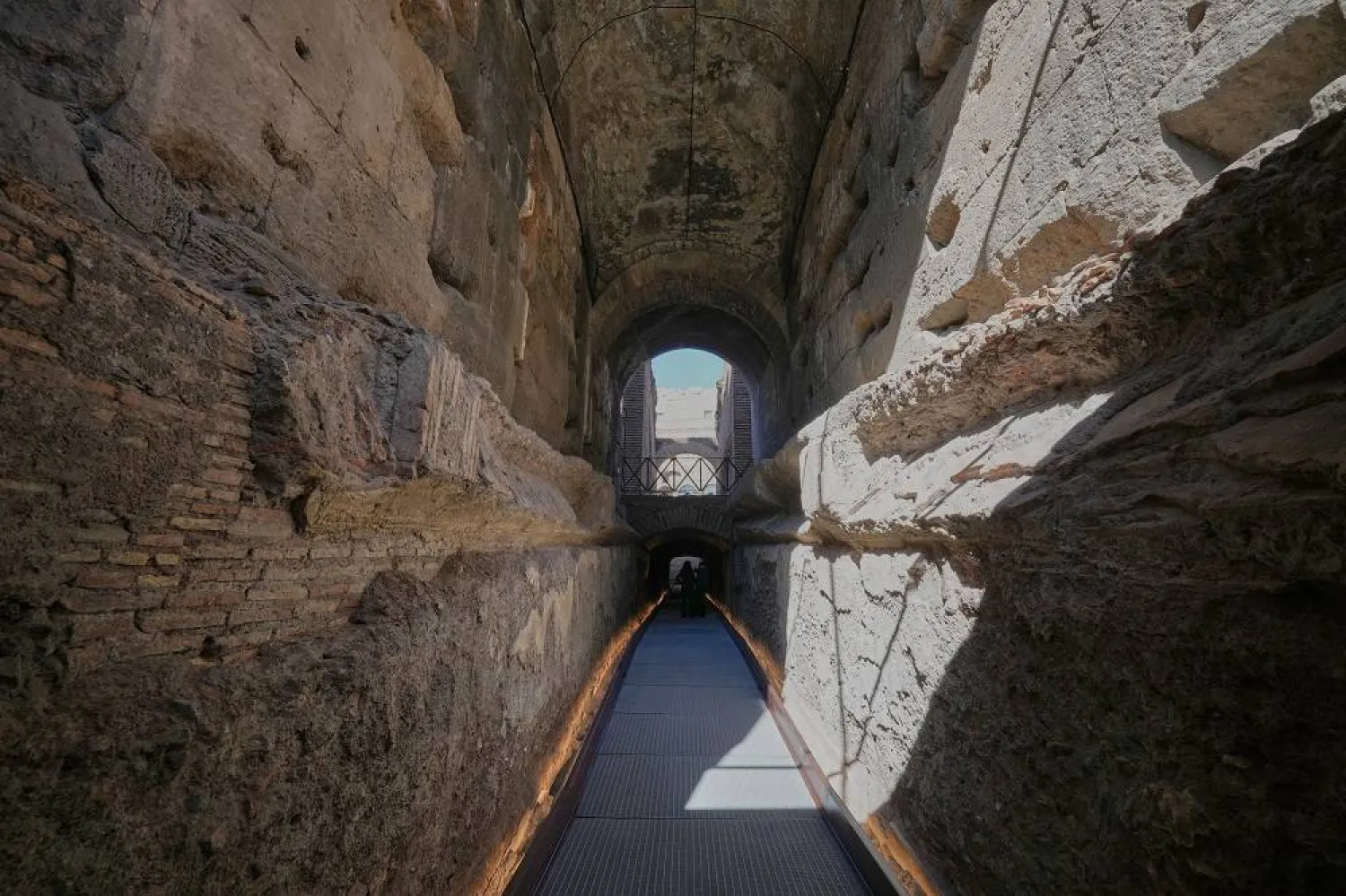

Once-Secret Emperor Commodus’ Passage to Rome Colosseum Opens to Public for the First Time 

A view of the so-called "Passage of Emperor Commodus", a newly restored tunnel ancient Roman emperors would use to enter the Colosseum unseen and protected, that will open to visitors at the end of the month, in Rome, Wednesday, Oct. 8, 2025. (AP)
TT

Once-Secret Emperor Commodus’ Passage to Rome Colosseum Opens to Public for the First Time 

A view of the so-called "Passage of Emperor Commodus", a newly restored tunnel ancient Roman emperors would use to enter the Colosseum unseen and protected, that will open to visitors at the end of the month, in Rome, Wednesday, Oct. 8, 2025. (AP)

For the first time in nearly 2,000 years, visitors to Rome’s world-renowned Colosseum will have the opportunity to walk through a hidden imperial passage that once allowed Roman emperors to reach the ancient amphitheater unseen.

The once-secret corridor — known as the “Commodus Passage” and named after the Roman emperor turned into a pop icon by Ridley Scott’s movie “Gladiator” — opens to the public on Oct. 27, marking an extraordinary milestone in archaeological preservation and access.

Archaeologists at the Colosseum Archaeological Park explained that Roman emperors would use the passage to enter the arena unseen and protected, leading them directly to their reserved honor box overlooking the games.

The passage was named after Emperor Commodus, who ruled alone between 180 A.D. and 192 A.D., when it was initially discovered in the 1810s. Commodus was known to be passionate about gladiators’ games and history relates that while he was passing through the tunnel, someone attempted to assassinate him, but was unsuccessful.

At the passage entrance, archaeologists discovered remnants of decorative elements directly related to arena spectacles, including depictions of boar hunts, bear fights and acrobatic performances. These artistic elements provided a fitting prelude to the brutal entertainments that awaited beyond, they noted.

The corridor is shaped as an “S” and continues outside the Colosseum arena, but its final destination remains uncertain.

“Visitors can now have a taste of what it was like to be an emperor entering the arena,” said Barbara Nazzaro, the architect who oversaw the restoration works. “With a little effort of imagination and the help of a virtual reconstruction, they can appreciate the decorations, stuccoes, frescoes and marbles that covered the walls.”

The project — completed between Oct. 2024 and Sept. 2025 — included structural conservation, restoration of decorative stuccoes and plasters and the installation of a new walkway.

A new lighting system recreates the natural light that once filtered through small vault openings, and a digital reconstruction helps visitors visualize the passage’s original appearance.

A second restoration project, expected to begin in early 2026, will involve the section of the tunnel extending beyond the perimeter of the Colosseum.


Traditional Bedouin Tents Preserve Heritage in Saudi Arabia's Northern Borders

The tents maintain historical symbolism, embodying the generosity and hospitality that have characterized Bedouin life for generations - SPA
TT

Traditional Bedouin Tents Preserve Heritage in Saudi Arabia's Northern Borders

The tents maintain historical symbolism, embodying the generosity and hospitality that have characterized Bedouin life for generations - SPA

With the arrival of winter, traditional Bedouin tents, a quintessential symbol of Bedouin heritage, once again dot the plains and plateaus of Northern Borders Region, as residents eagerly set them up to create warm and welcoming spaces for family and social gatherings, SPA reported.

Crafted primarily from goat's wool, these tents are distinguished by their excellent insulation against the cold and wind, making them ideal shelters in the harsh northern climate. They also maintain their historical symbolism, embodying the generosity and hospitality that have characterized Bedouin life for generations.

The craft of tent-making is a cherished traditional skill, often mastered by women and passed down through generations. Craftswoman Umm Ahmed explained that making a tent takes several days, with types varying based on shape and the number of poles. She noted that she learned the skill from her mother and is actively teaching her granddaughter to ensure the heritage survives.

Craftswoman Umm Sultan added that tents can range in price from SAR1,500 to over SAR6,000, depending on size and quality.
In recent years, these traditional tents have become a significant tourist attraction.


They draw visitors from across the Kingdom and the Gulf countries eager to experience authentic Bedouin life, including heritage activities, the preparation of Arabic coffee over a wood fire, and cozy evening gatherings on cool desert nights.


Indian Culture Week Brings Color, Celebration to Families at ‘Global Harmony 2’

Festivities opened with a performance by students of Dunes International School in Riyadh - SPA
TT

Indian Culture Week Brings Color, Celebration to Families at ‘Global Harmony 2’

Festivities opened with a performance by students of Dunes International School in Riyadh - SPA

The Global Harmony 2 initiative on Thursday welcomed thousands of visitors and families who gathered to enjoy a rich blend of cultural and entertainment activities presented during the Indian Culture Week.

The initiative is organized by the Ministry of Media in partnership with the General Entertainment Authority (GEA), SPA reported.

The event, one of the initiatives under the Quality of Life Program aimed at realizing Saudi Vision 2030, featured a diverse artistic lineup of live performances by Indian troupes as part of Indian Culture Week, drawing enthusiastic interaction from visitors and families alike.

Festivities opened with a performance by students of Dunes International School in Riyadh, followed by two shows highlighting traditional Indian heritage, a visually captivating circus filled with acrobatics and excitement, and a colorful carnival parade that filled the park with festive energy, traditional Indian costumes, and vibrant decorations.

A children’s stage also offered young visitors fun-filled entertainment areas featuring engaging games and lively performances.


Saudi Pavilion Showcases Rich Cultural Heritage at Sharjah Book Fair

Saudi Arabia's participation aims to enhance its cultural presence. SPA
TT

Saudi Pavilion Showcases Rich Cultural Heritage at Sharjah Book Fair

Saudi Arabia's participation aims to enhance its cultural presence. SPA

The Literature, Publishing, and Translation Commission has inaugurated the Saudi pavilion at the Sharjah International Book Fair 2025, held at Sharjah Expo Center in the UAE from November 5 to 16.

The fair provides a vital opportunity for Saudi publishers to engage in knowledge exchange with global counterparts.

Led by the commission, the Kingdom’s participation aims to enhance its cultural presence and showcase the development of its publishing and translation sectors.

The pavilion features several national cultural and educational institutions, including the Ministry of Islamic Affairs, Dawah and Guidance; King Abdulaziz University; King Fahd National Library; and King Salman Global Academy for Arabic Language.

This initiative reflects the strong cultural ties between the Kingdom and the UAE, stressing their commitment to cooperate in publishing, translation, and knowledge production, while enhancing Arab and international cultural communication. It aligns with Saudi Vision 2030’s goal of building a sustainable cultural industry.

The Saudi pavilion will host a diverse cultural program, featuring literary seminars, dialogue sessions, workshops, and poetry evenings, showcasing prominent Saudi writers and thinkers and the richness of Saudi literature within the contemporary Arab cultural scene.
