
Louvre Director Acknowledges Failure After Jewel Heist and Says She Offered to Resign

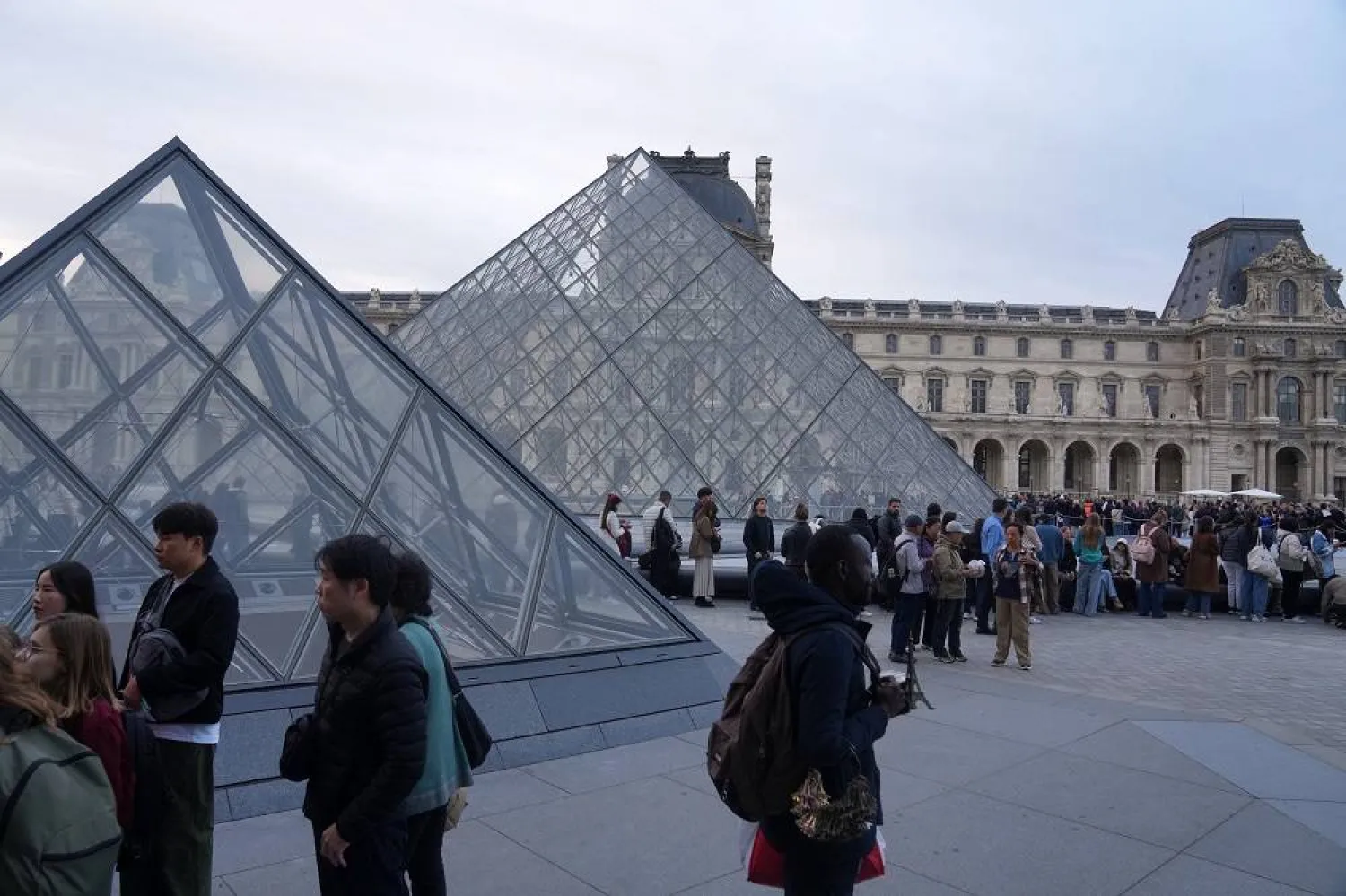
Visitors queue to enter the Louvre museum three days after historic jewels were stolen in a daring daylight heist, Wednesday, Oct. 22, 2025 in Paris. (AP)
TT

Louvre Director Acknowledges Failure After Jewel Heist and Says She Offered to Resign

Visitors queue to enter the Louvre museum three days after historic jewels were stolen in a daring daylight heist, Wednesday, Oct. 22, 2025 in Paris. (AP)

The director of the Louvre Museum on Wednesday acknowledged a ″terrible failure″ at the Paris monument after a stunning daylight crown jewel heist at the world's most-visited museum, and said she offered to resign, but it was refused. 

The Louvre reopened earlier in the day to long lines beneath its landmark Paris glass pyramid for the first time since one of the highest-profile museum thefts of the century stunned the world with its audacity and scale. 

In testimony to the French Senate, Louvre director Laurence des Cars said the museum had a damaging shortage of security cameras outside the monument and other ″weaknesses″ exposed by Sunday’s theft. 

Under heavy pressure over a theft that stained France’s global image, she testified to a Senate committee that she submitted her resignation but that the culture minister refused to accept it. 

″Today we are experiencing a terrible failure at the Louvre, which I take my share of responsibility in,″ she said. 

The thieves slipped in and out, making off with eight pieces from France’s Crown Jewels at the world’s most-visited museum — a cultural wound that some compared to the burning of Notre-Dame cathedral in 2019. 

The Sunday raid — steps from the Mona Lisa and valued at over $100 million — has put embattled President Emmanuel Macron, Des Cars and others under fresh scrutiny. It comes just months after employees went on strike, warning of chronic understaffing and under-resourced protections, with too few eyes on too many rooms. 

Crowds bunched at the barriers as they were being removed Wednesday, a coda to frantic forensic work and staff briefings that had taken place. Inside, the scene of the crime — the Apollo Gallery housing the Crown Diamonds — stayed sealed, a folding screen obscuring the doorway at the gallery’s rotunda entrance. 

Disbelief among visitors  

Three days on, the jewels remain missing and the thieves are still at large and reactions are divided. 

"For a place like the Louvre, it’s unfathomable,” said Amanda Lee, 36, an art teacher from Chicago. “I heard it took under four minutes. How is that possible here, with no police in sight?” 

Others were unperturbed. 

“We told the kids it’s a history lesson. The Apollo Room is shut, but we saw the masterpieces,” said Claire Martin, 41, a French lawyer from Versailles visiting with her two children during a school holiday. 

“We came for the art," she said. "The police can deal with the thieves.” 

France acknowledges failings  

Authorities say the thieves spent less than four minutes inside the Louvre on Sunday morning: a freight lift was wheeled to the Seine-facing façade, a window was forced open and two vitrines were smashed. 

Then came the getaway on motorbikes through central Paris. Alarms had gone off, drawing agents to the gallery and forcing the intruders to bolt. 

As it reopened, the Louvre declined questions from The Associated Press to detail any reinforced protocols. It said no uniformed police were posted in the corridors. With school holidays swelling demand, the day was fully booked and access limited. 

“I didn’t notice extra security — guards as always, and no police inside. It felt like a normal day,” said Tomás Álvarez, 29, a software engineer from Madrid. 

The loot  

The thieves made away with a total of eight objects, including a sapphire diadem, necklace and single earring from a set linked to 19th-century queens Marie-Amélie and Hortense. 

They also made off with an emerald necklace and earrings tied to Empress Marie-Louise, Napoleon Bonaparte’s second wife, as well as a reliquary brooch. Empress Eugénie’s diamond diadem and her large corsage-bow brooch — an imperial ensemble of rare craftsmanship — were also part of the loot. 

One piece — Eugénie's emerald-set imperial crown, with more than 1,300 diamonds — was later found outside the museum, damaged but recoverable. 

Fears the jewels will be destroyed  

Prosecutor Laure Beccuau valued the haul at about €88 million ($102 million), a “spectacular” figure that still fails to capture the works’ historical weight. She warned the thieves would be unlikely to realize anything close to that sum if they pry out stones or melt the metals — a fate curators fear would pulverize centuries of meaning into anonymous gems for the black market. 

Beccuau said expert analyses are underway; four people have been identified as present at the scene, and roughly 100 investigators are mapping the crew and any accomplices. 

The heist has intensified scrutiny of the Louvre’s security. 

Culture Minister Rachida Dati drew fire Tuesday after telling lawmakers there had been no security failings. 

Questions about Louvre’s security overhaul 

All this comes after Macron announced new measures in January for the Louvre — complete with a new command post and expanded camera grid that the culture ministry says is being rolled out. 

It also raises hard questions, including whether Sunday’s breach is tied to staffing levels, and how uniformly the upgrades in the overhaul are being applied. 

“It’s a scandal of planning,” said Luca Romano, 52, a civil engineer from Milan visiting Paris with his wife. “If you can plant a freight lift at a palace and no one stops you, that’s a system failure.” 

Protection for headline works is airtight — the Mona Lisa is behind bulletproof glass in a climate-controlled case — yet the break-in exposed seams elsewhere in a 33,000-object labyrinth. For many French, the contrast is a public embarrassment at the landmark. 

It touches a raw nerve: the issue of swelling crowds and overstretched staff. 

In June, a staff walkout over overcrowding and chronic understaffing delayed opening. Unions argue that mass tourism leaves too few eyes on too many rooms and creates pressure points where construction zones, freight access and visitor flows intersect. 

On Wednesday, the Louvre’s other star attractions — from the Venus de Milo to the Winged Victory of Samothrace — were open again. But the cordoned-off vitrines in the Apollo Room, guarded and empty, told a different story: one of a breach measured not just in minutes and euros, but in the fragility of a nation’s patrimony. 


Jeddah's Red Sea Museum Announces Ramadan Program 

The Red Sea Museum. (Red Sea Museum)
TT

Jeddah's Red Sea Museum Announces Ramadan Program 

The Red Sea Museum. (Red Sea Museum)

Jeddah's Red Sea Museum announced on Thursday a curated program of creative and cultural activities for the holy month of Ramadan, running from February 22 to March 14.

Led by local artists, artisans, and cultural practitioners, the museum's Ramadan program includes contemplative workshops, storytelling sessions, outdoor community gatherings, and musical performances that honor the spirit of reflection, creativity, and connection.

The series of engaging sessions creates space for visitors to explore traditional crafts, contemporary storytelling, and cultural heritage through hands-on experiences blending creativity and reflection.

Curated for families, artists, and visitors of all backgrounds, the program runs alongside "Sunken Treasures: The Maritime Heritage of the Red Sea," the museum's major temporary exhibition opening on February 25, which explores how archaeological discoveries reveal centuries of trade, navigation, and human connection across the Red Sea.

In celebration of Founding Day on February 22, the "Inspirational Threads: Makkah & Madinah" contemplative embroidery workshop invites participants to engage with archival black-and-white photographs of the Red Sea, Makkah, and Madinah. Through basic embroidery techniques, participants can embellish these images with Islamic geometric and symbolic motifs, adding layers of color, texture, and meaning while reflecting on devotion, memory, and connection.

The "Radiance in Pieces: Mosaic Lantern" hands-on workshop on February 24 explores the tradition of Islamic mosaic art through the creation of illuminated lanterns inspired by Red Sea heritage. Children and families will learn how small, colorful pieces come together to form meaningful geometric designs, blending creativity, cultural heritage, and reflection.

The opening evening of "Sunken Treasures: The Maritime Heritage of the Red Sea" on February 25 features a panel discussion with archaeologists, scientists, and historians exploring the maritime heritage of the Red Sea.

The "One Big Table - Ramadan Gathering" on March 5 brings everyone together in a shared space where families, friends, and neighbors celebrate the spirit of Ramadan.

On March 7, the "From Sand to Porcelain" painting workshop invites participants to paint calligraphy on fine porcelain using natural sand collected from Jeddah to add subtle texture and depth. While learning basic porcelain painting techniques, participants will engage in a reflective, hands-on experience that encourages mindful creation, resulting in a personal keepsake that embodies devotion, place, and the spirit of Ramadan.

In the spirit of International Women's Day on March 8, the "Ramadan Spirit: Thread & Needle" hands-on punch needling workshop explores Ramadan iconography through traditional symbols, including the crescent, star, and lantern. Participants will create textured textile pieces while learning basic punch needle techniques, celebrating both the holy month and the creative contributions of women to traditional textile arts.

On March 14, the "Spirit of Ramadan and the Tale of Jabir Al-Khawatir" storytelling session for children and families explores Ramadan as a season of compassion and healing, reminding people that the spirit of the holy month lives in small acts of care and human connection.


Saudi Arabia: Ship of Tolerance Initiative Promotes Cultural Dialogue in Jeddah

The Royal Institute of Traditional Arts (Wrth) will offer traditional craft workshops throughout Ramadan. SPA
TT

Saudi Arabia: Ship of Tolerance Initiative Promotes Cultural Dialogue in Jeddah

The Royal Institute of Traditional Arts (Wrth) will offer traditional craft workshops throughout Ramadan. SPA

The Saudi Ministry of Culture, in collaboration with the "Lenobadir" volunteer and community partnership program and the Athr Foundation, has launched the Ship of Tolerance initiative in Historic Jeddah during Ramadan.

The initiative aims to enhance shared human values through arts, and promote tolerance and coexistence among children and families. It provides an educational and cultural experience aligned with the area’s unique character as a UNESCO World Heritage site.

As part of this global art project, children will create artworks that represent acceptance and dialogue.

The Royal Institute of Traditional Arts (Wrth) will offer traditional craft workshops throughout Ramadan, linking the initiative's values with local heritage and enriching visitors' connection to the region's identity.

This effort supports cultural programs with educational and social dimensions in Historic Jeddah, activating local sites for experiences that combine art, crafts, and community participation. It aligns with the National Strategy for Culture under Saudi Vision 2030, focusing on heritage preservation and expanding culture's impact on daily life.


Oscar Contender ‘Hamnet’ Boosts Tourism at Shakespeare Heritage Sites 

A view of Shakespeare’s Birthplace, William Shakespeare's childhood home, in Stratford-upon-Avon, Britain, February 9, 2026. (Reuters)
TT

Oscar Contender ‘Hamnet’ Boosts Tourism at Shakespeare Heritage Sites 

A view of Shakespeare’s Birthplace, William Shakespeare's childhood home, in Stratford-upon-Avon, Britain, February 9, 2026. (Reuters)

On a cloudy winter's day, visitors stream into what was once William Shakespeare's childhood home in Stratford-upon-Avon and the nearby Anne Hathaway's cottage, family residence of the bard's wife.

Hathaway's cottage is one of the settings for the BAFTA and Oscar best film contender "Hamnet", and the movie's success is drawing a new wave of tourists to Shakespeare sites in the town in central England.

Shakespeare's Birthplace is the house the young William once lived in and where his father worked as a glove maker, while Hathaway's cottage is where he would have visited his future wife early in their relationship.

Typically, around 250,000 visitors, from the UK, Europe, the United States, China and elsewhere, walk through the locations each year, according to the Shakespeare Birthplace Trust. ‌The charity looks after ‌Shakespeare heritage sites, which also include Shakespeare's New Place, the site of ‌the ⁠Stratford home where the ⁠bard died in 1616.

Visitors are flocking in this year thanks to "Hamnet", the film based on Maggie O'Farrell's 2020 novel, which gives a fictional account of the relationship between Shakespeare and Hathaway, also known as Agnes, and the death of their 11-year-old son Hamnet in 1596.

"Visitor numbers have increased by about 15 to 20% across all sites since the film was released back in January. I think that will only continue as we go throughout the year," Richard Patterson, chief operating officer for the Shakespeare Birthplace Trust, said.

"They particularly want ⁠to look (at) Anne Hathaway's cottage and the specifics around how the family ‌engaged in the spaces and the landscape in and around ‌the cottage... you can see why he would have been inspired."

NEW ACCESS TO SHAKESPEARE

"Hamnet" has 11 nominations at ‌Sunday's British BAFTA awards, including best film and leading actress for Jessie Buckley, who plays Agnes. It ‌also has eight Oscar nominations, with Buckley seen as the frontrunner to win best actress.

"Hamnet" is set in Stratford-upon-Avon and London although it was not filmed in Stratford.

It sees Paul Mescal's young Shakespeare fall for Agnes while teaching Latin to pay off his father's debts. The drama, seen mainly through Agnes' eyes, focuses on their ‌life together and grief over Hamnet's death, leading Shakespeare to write "Hamlet".

"Shakespeare... is notoriously enigmatic. He writes about humanity, about feeling, about emotion, about conflict, ⁠but where do we understand ⁠who he is in that story?" said Charlotte Scott, a professor of Shakespeare studies and interim director of collections, learning and research at the Shakespeare Birthplace Trust.

"And that's driven people creative and otherwise for hundreds and hundreds of years. Where is Shakespeare's heart? And this is what the film I think has so beautifully opened up."

Little is known about how the couple met. Shakespeare was 18 and Hathaway 26 when they married in 1582. Daughter Susanna arrived in 1583 and twins Judith and Hamnet in 1585.

The film acknowledges the names Hamnet and Hamlet were interchangeable back then. While grief is a dominant theme, audiences also see Shakespeare in love and as a father.

"A lot of people will see this film not necessarily having... had any kind of relationship with Shakespeare," Scott said.

"So people will come to this film, I hope, and find a new way of accessing Shakespeare that is about creativity, that is about understanding storytelling as a constant process of regeneration, but also crucially, looking at it from that kind of emotive angle."