


Istanbul’s Porters Keep Centuries-Old Trade Moving 

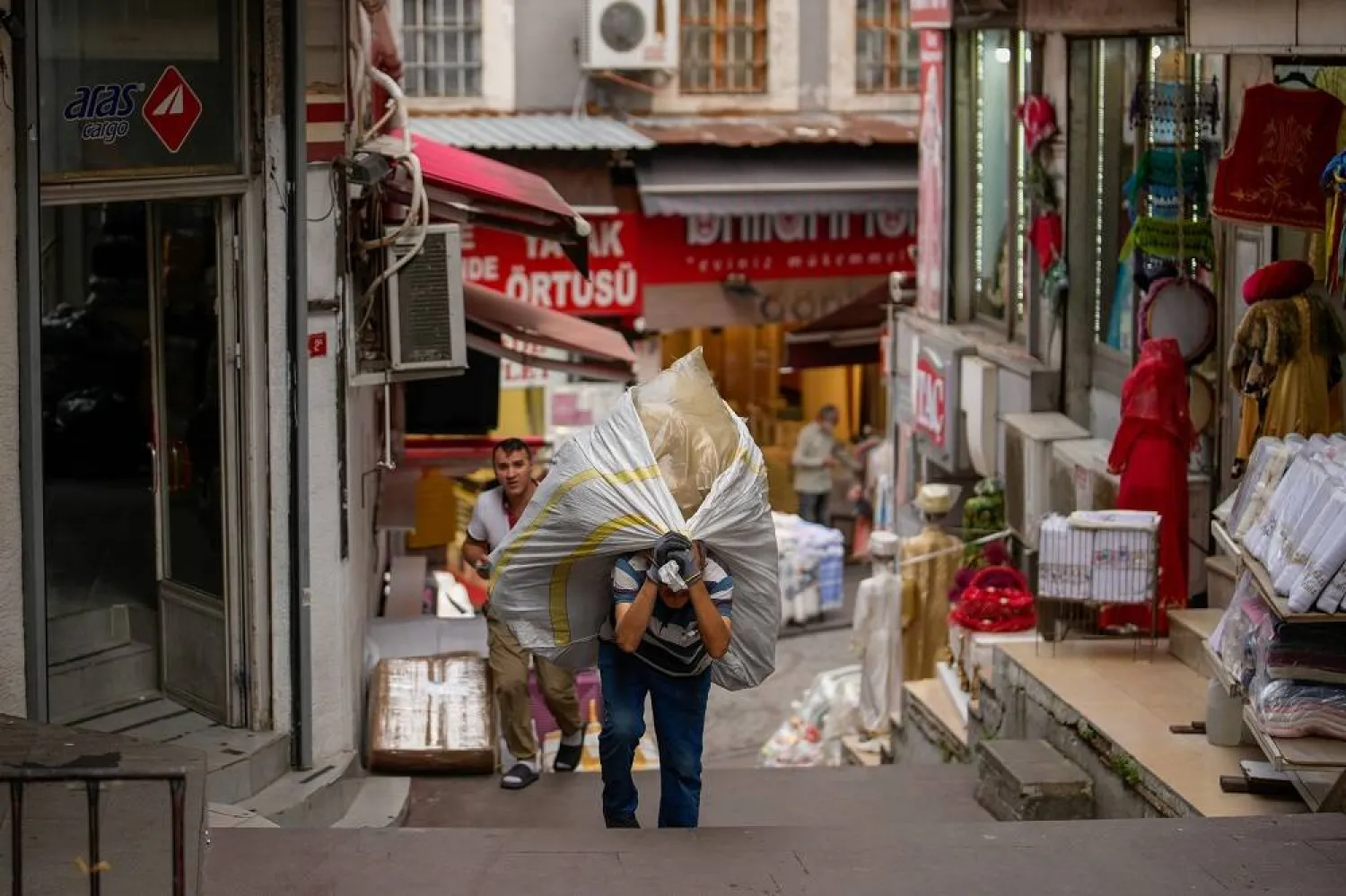
A porter carries a load on his back up the stairs in the Eminönü commercial area of Istanbul, Türkiye, Thursday, Oct. 2, 2025. (AP)
TT

Istanbul’s Porters Keep Centuries-Old Trade Moving 

A porter carries a load on his back up the stairs in the Eminönü commercial area of Istanbul, Türkiye, Thursday, Oct. 2, 2025. (AP)

On the streets of Istanbul, porters hauling massive sacks wrapped in white plastic — on their backs or in handcarts — are a ubiquitous yet often overlooked part of the city’s fabric.

Known as hamallık in Turkish, porterage is a profession that has endured from the Ottoman Empire to the present day.

It remains especially common in Istanbul’s historic trade quarters — the Egyptian Bazaar, the Grand Bazaar, and the Eminönü district — where traditional commercial buildings known as hans contain workshops and businesses that produce jewelry, textiles and other goods.

Because many of these centuries-old hans lack elevators and are surrounded by narrow streets inaccessible to vehicles, porters remain indispensable. In Eminönü, many streets are closed to traffic during the day, making their work even more essential.

A porter can carry between 200 and 300 kilograms (440–660 pounds) of goods up to the fifth floor of a han using a semer — a traditional wooden-and-leather harness worn on the back. These semers are often passed down from father to son, reflecting the generational nature of the trade. (The profession is traditionally male; female porters are extremely rare.)

Porters are organized into divisions, with leaders who are responsible for distributing work fairly among members, who earn daily wages based on the number and weight of the loads they carry.

It’s a grueling job that demands extraordinary strength and endurance, and only a few can meet its physical challenges. The porters take pride in their craft and are selective about who joins their ranks.

Omer Okan, 60, has been working as a porter for three decades, often carrying more than 500 kilograms (1,100 pounds) on his back in a day.

The job is precarious. Okan notes that most porters work without insurance and can’t earn money if they’re sick or injured. Work has begun to dry up as large wholesale merchants have moved out of the Eminönü area, where he works.

“Some days we return home without earning any money,” he said.

The profession was passed down from his grandfather. Okan takes pride in his work, but sometimes he feels overlooked by the society that relies on it.

“When I started this profession, people treated us with great respect,” he said. “Now, no one in Türkiye has any respect for anyone else.”



Louvre Museum Says Shutting for the Day Due to Strike

People walk next to the Louvre Museum covered in snow in Paris, France, 07 January 2026. (EPA)
TT

Louvre Museum Says Shutting for the Day Due to Strike

People walk next to the Louvre Museum covered in snow in Paris, France, 07 January 2026. (EPA)

The Louvre Museum was forced to close on Monday due to strike action from staff in the latest disruption at the world's most-visited museum, management said.

"Due to public strikes, the Musee du Louvre is closed today," the museum said in a message posted on its website, informing disappointed tourists and art lovers that their entry tickets would be automatically reimbursed.

The museum closed for a full day last month and has been only partially open on several other days since.

Nearly three months after an embarrassing daylight heist, which has heaped pressure on Louvre bosses, staff are calling for more recruitment and better maintenance of the vast former royal palace.

Questions continue to swirl since the October 19 break-in over whether it was avoidable and why thieves were able to steal crown jewels worth more than $100 million.

Two intruders used a truck-mounted extendable platform to access a gallery containing the jewels, slicing through a glass door with disk-cutters in front of startled visitors before stealing eight priceless items.

As well as the robbery, two other recent incidents have highlighted maintenance problems inside the building, which chief architect Francois Chatillon has described as "not in a good state".

A water leak in November damaged hundreds of books and manuscripts in the Egyptian department, while management had to shut a gallery housing ancient Greek ceramics in October because ceiling beams above it risked giving way.


20-Year-Olds Gathering in Kimonos for Coming of Age Day Ceremony in Japan

Kimono-clad Japanese young women take pictures after attending a Coming-of-Age Day ceremony in Yokohama, near Tokyo, Japan, 12 January 2026. EPA/FRANCK ROBICHON
TT

20-Year-Olds Gathering in Kimonos for Coming of Age Day Ceremony in Japan

Kimono-clad Japanese young women take pictures after attending a Coming-of-Age Day ceremony in Yokohama, near Tokyo, Japan, 12 January 2026. EPA/FRANCK ROBICHON

Young women in brightly colored long-sleeved kimonos and young men in formal suits or traditional hakama and haori gathered Monday at Yokohama Arena to mark Coming-of-Age Day, an annual celebration for those who have turned 20.

The ceremonies, which are a widely observed public rite of passage in Japan, lasted less than an hour. Before and after the events, young adults gathered near the arena entrance, sidewalks and nearby train stations, greeting friends they had not seen for a long time. Smartphones were raised repeatedly as participants took pictures of each other and themselves.

Among the many participants wearing black and navy suits, a large number of young men chose traditional hakama trousers and haori jackets.

Legally, adulthood in Japan now begins at 18, following a revision of the Civil Code in April 2022. Even so, most local governments continue to hold Coming-of-Age ceremonies for 20-year-olds.

Inside Yokohama Arena, participants stood for the national anthem, then sang Yokohama’s city song together. Many then switched on the lights of their mobile phones, illuminating the hall.


Saudi Pavilion at Makkah's Global Village Showcases the Kingdom’s Culture

Saudi Pavilion at Makkah's Global Village Showcases the Kingdom’s Culture
TT

Saudi Pavilion at Makkah's Global Village Showcases the Kingdom’s Culture

Saudi Pavilion at Makkah's Global Village Showcases the Kingdom’s Culture

The Saudi pavilion at Global Village in Makkah, part of the Makkah winter season, reflects the richness and uniqueness of the Kingdom's culture and heritage.

It features interactive and engaging sections that introduce visitors to the Kingdom’s cultural heritage, including live demonstrations of traditional handicrafts and artwork inspired by the local environment, SPA reported.

The pavilion’s presence at Global Village reflects ongoing efforts to highlight the nation’s cultural heritage, promote its civilizational legacy, and strengthen its cultural presence at major events.