
Count of Paris Urges Louvre Thieves to ‘Give Us Back Our Jewels’ 

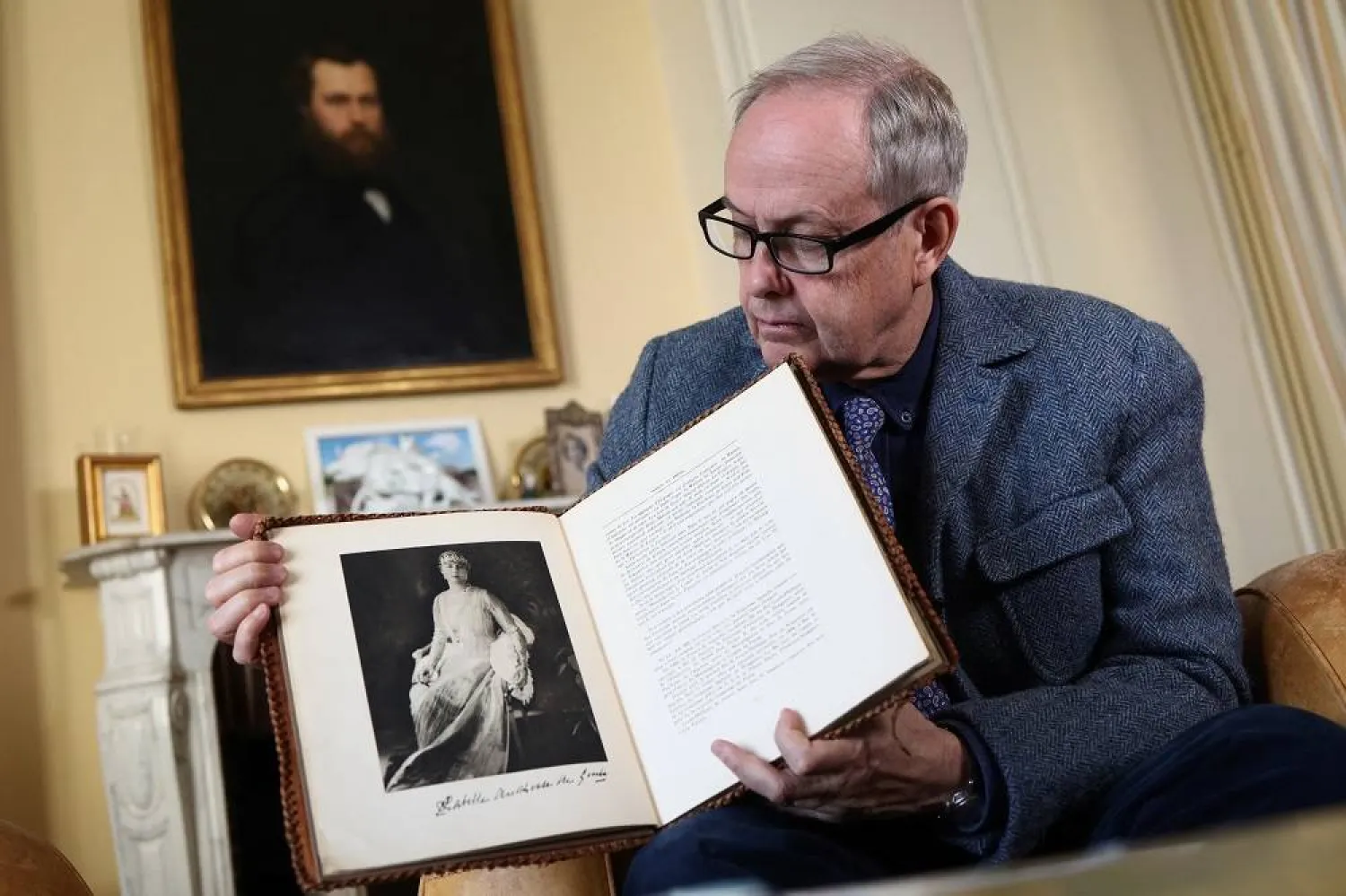
Count of Paris Jean d'Orleans, Head of the Royal House of France, whose grandmother and great grandmother wore the jewels stolen from the Louvre Museum, holds a book with a photo of his great grandmother Marie-Isabelle d'Orleans, during an interview with Reuters in his house next to the Royal Chapel of Dreux, France, October 30, 2025. (Reuters) 
TT

Count of Paris Urges Louvre Thieves to ‘Give Us Back Our Jewels’ 

Count of Paris Jean d'Orleans, Head of the Royal House of France, whose grandmother and great grandmother wore the jewels stolen from the Louvre Museum, holds a book with a photo of his great grandmother Marie-Isabelle d'Orleans, during an interview with Reuters in his house next to the Royal Chapel of Dreux, France, October 30, 2025. (Reuters) 

The Count of Paris, whose great-grandmother once wore the sapphire tiara stolen from the Louvre Museum, has pleaded with the robbers to return the stolen jewels intact for the sake of France's heritage - and for his family.

"Give us back our jewels, there's still time," said Jean d'Orleans, a direct descendant of French kings, speaking to Reuters at the royal domain of Dreux, 70 kilometers (43 miles) southwest of Paris.

"It's both personal and intimate," said d'Orleans, 60, as he leafed through family photographs showing his great-grandmother, the Duchess of Guise, wearing the Ceylon sapphire and diamond tiara in 1931. "These jewels were worn on special occasions, family events, sometimes also to create a specific portrait."

Another picture showed the tiara being worn by d'Orleans' grandmother Isabelle d'Orleans-Bragance for the last time at Princess Astrid of Belgium's 1984 wedding, before it was sold to the museum by his grandfather in 1985 for 5 million francs.

$102 MILLION HEIST

The heist in broad daylight has stunned France and left the nation reeling at its audacity, and at the security failures that allowed the intruders to make off with national treasures worth more than $100 million in an operation that lasted just a few minutes.

It was the biggest robbery at the Louvre since the Mona Lisa was stolen in 1911. Police have made multiple arrests.

The eight stolen items were from the 19th century and once belonged to French royalty or the country's imperial rulers.

They included the tiara, a necklace and a single earring from the sapphire set that belonged to Queen Marie-Amelie and Queen Hortense.

A tiara and brooch belonging to Empress Eugenie as well as an emerald necklace and a pair of emerald earrings gifted to Empress Marie Louise by Napoleon for their marriage were also among the thieves' loot.

The sapphire set, acquired in 1821 by King Louis-Philippe from Queen Hortense, remained in the Orleans family for more than a century before going on public display.

'PRICELESS HERITAGE'

The count urged the thieves to return the jewels intact.

"For our family, for the French people, it's important that these jewels return to their display case at the Louvre," he said in a grand living room lined with portraits of French monarchs including Henri IV, Louis XIII, Louis XIV and Marie-Antoinette. A renovated, more secure room should be used, he added.

The count, who implored the authorities to hold accountable anyone found to have been negligent in the October 19 theft, likened the public reaction to the heist to the outpouring of emotion after the Notre-Dame Cathedral blaze in 2019.

"It's priceless heritage," he said, "we need to recover that."


Arab League Calls for Promoting Values of Coexistence, Inter-cultural dialogue

The League of Arab States logo
TT

Arab League Calls for Promoting Values of Coexistence, Inter-cultural dialogue

The League of Arab States logo

The League of Arab States affirmed the importance of consolidating the values of coexistence and mutual respect, promoting a culture of dialogue, and enhancing social cooperation, as these represent the foundation for building stable and prosperous societies amid the increasing cultural and religious diversity witnessed around the world, Emirates News Agency (WAM) reported.

In a statement issued ahead of the International Day for Tolerance, observed annually on November 16, the Cairo-based pan-Arab organization explained that respecting the right of others to differ and believing that diversity is a source of civilizational richness constitute a fundamental pillar for achieving true peace and strengthening social stability, WAM said. It stressed that tolerance is a human and ethical value that no society aspiring to progress can dispense with.

The League stressed the need to integrate the values of tolerance, dialogue, and coexistence into the vision of societies and the mission of their institutions, considering tolerance a bridge toward a safer, more just, and more humane future.

In this context, the League of Arab States is working on adopting the “Arab Declaration on Tolerance and Peace” as a guiding framework to support future efforts to anchor mutual respect and peaceful coexistence. The declaration also aims to enhance communication between different cultures and reject all forms of hatred, extremism, and discrimination, ensuring the preservation of human dignity regardless of religion, color, language, or culture.

The International Day for Tolerance is an annual observance day declared by UNESCO in 1995 to generate and raise public awareness about intolerance and promoting mutual respect, human rights, and cultural diversity.


Vatican Returns to Canada Artifacts Connected to Indigenous People

A pair of gauntlets made in the late 19th-century Cree-Metif native Canadian traditional style by indigenous activist Gregory Scofield. Gregory Scofield, AP
TT

Vatican Returns to Canada Artifacts Connected to Indigenous People

A pair of gauntlets made in the late 19th-century Cree-Metif native Canadian traditional style by indigenous activist Gregory Scofield. Gregory Scofield, AP

The Vatican on Saturday returned 62 artifacts connected to the Indigenous peoples of Canada to the country's Catholic bishops, offering what it called "a concrete sign of dialogue, respect and fraternity", a statement said.

Pope Leo gifted the objects to the Canadian Conference of Catholic Bishops following a meeting with their representatives including their president, Bishop Pierre Goudreault, said Reuters.

"The CCCB will proceed, as soon as possible, to transfer these artifacts to the National Indigenous Organizations (NIOs). The NIOs will then ensure that the artifacts are reunited with their communities of origin," the Canadian bishops said.

Catholic missionaries sent the artifacts to Rome on the occasion of a 1925 exhibition held by Pope Pius XI that displayed more than 100,000 objects. Nearly half of them later formed a new Missionary Ethnological Museum and were transferred to the Vatican Museums in the 1970s.

In 2022, the late Pope Francis issued a historic apology to Canada's Indigenous peoples ahead of his visit to the country for the Catholic Church's role in residential schools where many children suffered abuse and were buried in unmarked graves.

The repatriation of the native artifacts held at the Vatican Museums was also part of the talks between the Church and the Indigenous leaders.


Rebooted Harlem Museum Celebrates Rise of Black Art

To mark its reopening, the Studio Museum is mounting a retrospective on Ton Lloyd, whose works were shown in the museum's 1968 inaugural show. TIMOTHY A. CLARY / AFP
TT

Rebooted Harlem Museum Celebrates Rise of Black Art

To mark its reopening, the Studio Museum is mounting a retrospective on Ton Lloyd, whose works were shown in the museum's 1968 inaugural show. TIMOTHY A. CLARY / AFP

As the Studio Museum reopens this weekend in its gleaming new building, New York's premier institution for Black art finds itself looking back and looking forward at the same time.

Colorful signs featuring permanent works have sprouted near the museum's home in Harlem, a center point in Black life and imagination in America for more than a century, AFP said.

The museum, closed for the more than seven-year project, has commissioned new works to commemorate the reboot, which features expanded studios for the institution's artists-in-residence program.

But the 57-year-old museum is also hearkening back to its roots with a retrospective of the late Tom Lloyd, whose electronically programmed wall sculptures anticipated today's digital age.

Some of the same pieces were hung in the museum's inaugural 1968 show back when works by artists of African descent were mostly absent from New York's leading museums.

Today's art scene is very different.

Rashid Johnson, Amy Sherald and others are regularly showcased in shows at the Guggenheim, Whitney and other nameplate New York museums, which have also hosted retrospectives belatedly recognizing Black movements.

"In the time of the museum's life, we have seen this incredible trajectory and some of that is a result of the work that the museum did in its establishment and its early years," said Studio Museum director Thelma Golden, who oversaw a more than $300 million drive to finance a teardown and newbuild project that cements the museum's ties to Harlem.

"The aperture opens, but even with that, we still believe deeply in the work that continues to need to be done."

'Truly current work'

The museum's history is laid out in photos of the 1968 groundbreaking, and there are posters of jazz nights, "Uptown Friday" gatherings, high school programs and of shows such as a retrospective of James Van Der Zee, a famed photographer during the Harlem Renaissance.

The founders' ambitions included creating a place distinct from New York establishments like the Museum of Modern Art.

The Studio Museum will present "truly current work," founders wrote in 1966. The work "could turn out to be a flash in the pan or could conceivably begin an entire new school or new direction in art."

Backers also sought to redefine Harlem, "which is all too often equated with slums, violence and other evils," and to deepen the commitment of supporters -- some white -- to "make New York City a united city rather than one which is currently divided by an invisible Berlin wall."

Key turning points included 1981, when the Studio Museum broke ground at its current address at 144 West 125th Street.

Another shift came after Golden joined in 2000, when the mission statement was expanded beyond US-born creators to artists of African descent "locally, nationally and internationally."

Signature works

That broadened scope is boldly expressed on the building's exterior with a red, black and green flag by David Hammons inspired by the Pan-African flag of the 1920s associated with activist Marcus Garvey.

Another signature work is Houston Conwill's "The Joyful Mysteries," containing statements by seven prominent Black Americans written for future generations. The time capsules will be opened in September 2034, 50 years after their creation.

The new edifice itself nods to Harlem's architectural vernacular, with a mass of geometries in gray concrete and glass. The building has received rapturous reviews, and this weekend offers the public a first look.

Golden described the site as aiming to "redefine what a museum can be in its space and content."

She credited her predecessors, not all of whom lived to see Black art achieve mainstream acceptance.

"I am well aware that they did not get to see the fruits of the labor," Golden told AFP. "The inheritance I have from them is that they believed so deeply that that belief carries from '68 to this moment."