King Tut’s Collection Displayed for First Time at Egypt’s Grand Museum 

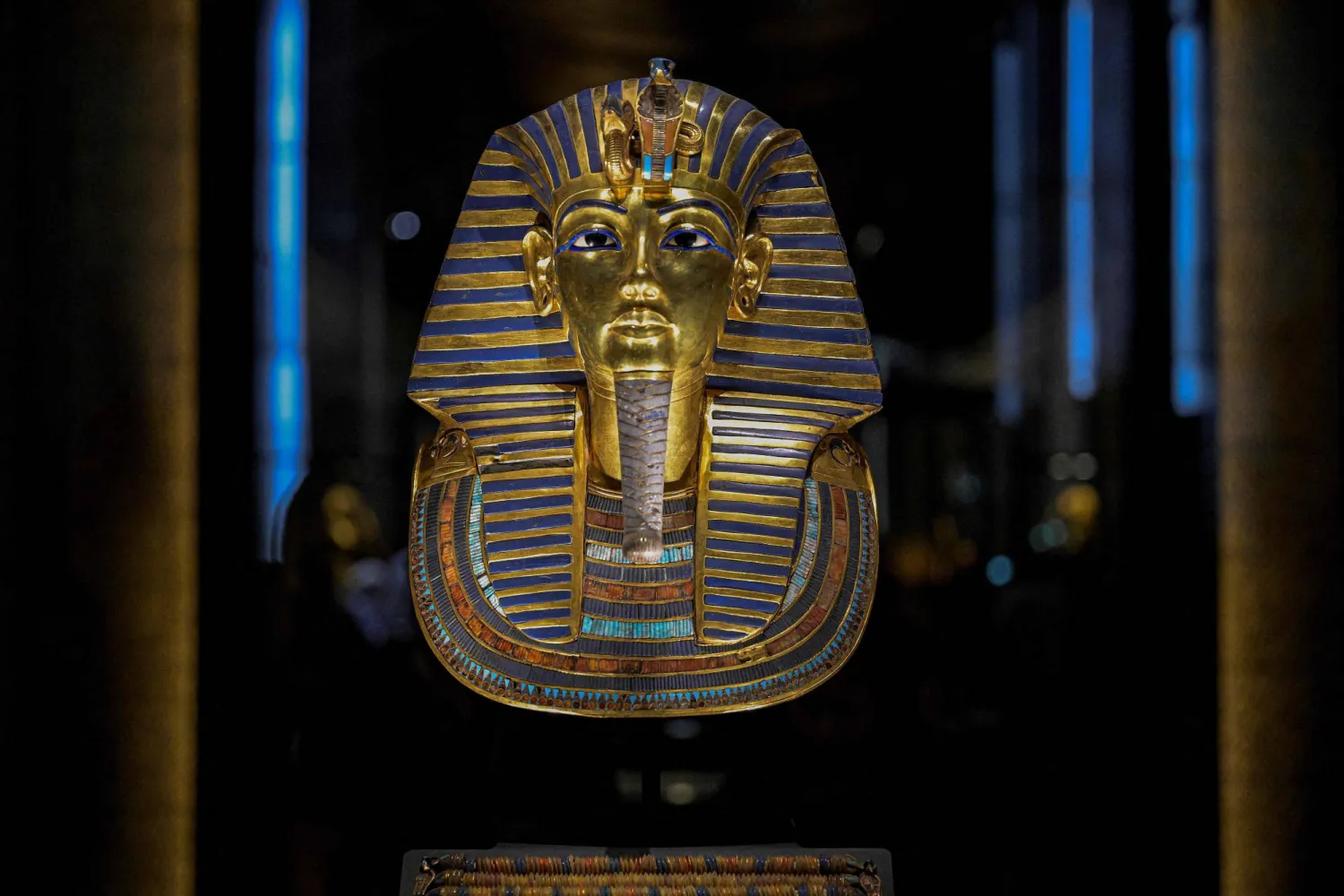
The golden funerary mask of ancient Egyptian King Tutankhamun is displayed inside the Tutankhamun Gallery at the Egyptian Grand Museum near the Giza pyramids in Cairo on November 4, 2025. (AFP)
TT

King Tut’s Collection Displayed for First Time at Egypt’s Grand Museum 

The golden funerary mask of ancient Egyptian King Tutankhamun is displayed inside the Tutankhamun Gallery at the Egyptian Grand Museum near the Giza pyramids in Cairo on November 4, 2025. (AFP)

Thousands of visitors streamed through the Grand Egyptian Museum on Tuesday as almost the entire collection of King Tutankhamun's treasures -- over 4,500 artifacts -- was displayed together for the first time since the young pharaoh's tomb was discovered in 1922.

Curated and conserved over nearly two decades, the collection was unveiled to the public two days after the museum's lavish opening ceremony on Saturday.

In a vast, dimly lit main hall spanning four levels, visitors gazed at chariots, household items, jewelled ornaments and, at the center, Tutankhamun's iconic golden mask.

The mask sits surrounded by personal belongings, gilded tools, family heirlooms and funerary statues.

An adjacent room showcases two small mummified princesses -- Tutankhamun's daughters who died before birth -- also on public display for the first time.

Tutankhamun died aged 18 or 19 between 1323 and 1324 BC, with genetic and radiological studies suggesting malaria combined with a bone disorder as his cause of death.

He was mummified and buried in Luxor's Valley of the Kings inside three nested coffins, the smallest weighing 110kg, all placed within four gilded shrines like matryoshka dolls.

While the coffins are now at the museum, the mummy remains in Luxor.

Visitors can also see the Khufu Sun Boat, described as the oldest and largest wooden artifact in human history, while a second solar boat is being restored.

These 4,600-year-old funerary boats, made of cedar and acacia, were intended to transport the king into the afterlife.

The first, measuring 43.5 meters, was discovered in 1954 at the base of the Great Pyramid; the second will soon be displayed behind glass in a live restoration lab.

The museum, a monumental structure overlooking the Giza Plateau, contrasts sharply with the colonial-era, cramped Egyptian Museum in central Cairo.

Natural light filters through vast triangular windows, illuminating both colossal statues and delicate jewellery from Egypt's ancient civilization.

President Abdel Fattah al-Sisi officially opened the $1-billion museum on Saturday in a ceremony attended by kings, queens, heads of state and other dignitaries.

Egypt hopes the museum will revive tourism and bolster its economy.

Egyptian Tourism Minister Sherif Fathy expects five million annual visitors, which would make it among the most visited museums in the world.

So far, he said, it had welcomed 5,000-6,000 visitors each day.


Benin Leans into Painful Past to Attract Tourists

 A general view of the Door of No Return monument in Ouidah on April 7, 2026. (AFP)
A general view of the Door of No Return monument in Ouidah on April 7, 2026. (AFP)
TT

Benin Leans into Painful Past to Attract Tourists

 A general view of the Door of No Return monument in Ouidah on April 7, 2026. (AFP)
A general view of the Door of No Return monument in Ouidah on April 7, 2026. (AFP)

Tourists crowded beneath the Door of No Return, an arch built by the beach at Ouidah in southern Benin in memory of those crammed onto slave ships bound for the New World.

Benin, which holds a presidential election on Sunday, has in recent years leaned into its painful past to encourage tourism.

Once a key departure point in the transatlantic slave trade, the coastal town of Ouidah lies at the heart of the push to reclaim the country's history, culture and heritage.

Standing nearly 17 meters (56 feet) tall on the seafront, the Door of No Return has been fully restored, now a must-see landmark for visitors.

Its ochre-and-gold facade is carved with figures of chained slaves, frozen mid-stride towards the ocean.

Nearby, a life-size replica of L'Aurore -- one of the last three-masted ships to leave Ouidah for Cuba around 1860 -- is set to open soon as an immersive museum of the slave trade.

"It reminds us of where we come from. It's important to develop tourism around our history because it's very rich, little known, and we want to showcase it," said Arsene Ahounou, an engineer from the commercial capital Cotonou visiting for the day.

"For us natives, understanding our history matters," he added.

Pausing for selfies with friends visiting from Nigeria, Onyinye Anumba said that seeing the site with her own eyes was "awesome".

"As an African, I've read many things about this place... so just being here makes me proud about what Africa has," she said.

- 'Demystify Vodun' -

Elsewhere, tourists explored the 13th-century Python Temple to learn about Voodoo culture -- the popular animist religion rooted in Ouidah.

As many posed for photos with snakes draped around their shoulders, guides explained the reptile's spiritual significance in Voodoo (Vodun in the local Fon language) beliefs.

Having worked in Beninese tourism for more than 35 years, Modeste Zinsou, the temple's head guide, said the sector had evolved.

"This isn't mass tourism, it's cultural tourism. The sacred element remains. We're reconstructing our own history, in which we completely demystify Vodun and the cliches around it," he said.

Benin is the birthplace of Voodoo, which now has its own international festival, the Vodun Days.

The three days of dancing, mask parades and traditional ceremonies have become a major tourist attraction.

This year it drew around two million visitors, most of them Beninese.

"The government has worked to encourage domestic tourism, meaning Beninese people going out and reclaiming their identity," added Zinsou.

- 'Our Eiffel Tower' -

To boost tourism, Benin has launched major infrastructure projects, including road and hotel renovations.

A Club Med resort is planned for 2027 and visa procedures have been eased for many nationalities.

"We're not a country with mineral wealth, so we had to identify where our wealth lies," said Alain Godonou, an adviser to the president on heritage and museums.

"History shows that Benin is a land of great cultures and traditions, and a witness to a pivotal moment in human history -- the slave trade," he said.

Godonou hopes tourism will account for 10 to 15 percent of GDP within a decade, up from about six percent today.

Sunday's election in the west African country is to replace the architect of this tourism drive, outgoing president Patrice Talon, who is stepping down after two five-year terms.

The frontrunner to succeed him, Romuald Wadagni, the finance minister from the ruling party, has pledged to carry the projects forward.

Since 2024, Benin has allowed anyone with an African ancestor who was enslaved and shipped to the Americas to acquire Beninese nationality.

"It was important for Benin to do justice to this diaspora by granting the nationality that should have been theirs," Godonou said.

In the heart of Cotonou, the country's largest city, the Amazon Monument is now a major attraction.

The towering 30-meter metal statue depicts a warrior of the Dahomey kingdom, rifle at her side and dagger in hand.

On Easter Monday, a public holiday, crowds of Beninese visitors strolled through the plaza, snapping pictures of the statue.

"It's a source of pride! We don't have the money to go on holiday in France or elsewhere," said vendor Geraldine Sedami Yagbo.

"This statue is our Eiffel Tower."


Hira Cultural District Hosts Symposium on Arabic Language and Identity

The Hira Cultural District in Makkah organized a literary symposium on Friday at Hira Café. (SPA)
TT

Hira Cultural District Hosts Symposium on Arabic Language and Identity

The Hira Cultural District in Makkah organized a literary symposium on Friday at Hira Café. (SPA)

The Hira Cultural District in Makkah organized a literary symposium on Friday at Hira Café, where scholars, writers, and language enthusiasts gathered to discuss the importance of the Arabic language. the Saudi Press Agency reported.

The event highlighted Arabic not only as a means of communication, but as a fundamental pillar of cultural identity and a vital source of knowledge, deeply connected to history, heritage, and intellectual traditions.

Discussions highlighted the necessity of preserving linguistic integrity against contemporary challenges and the responsibility of cultural institutions in promoting standard Arabic.

Participants emphasized that language remains a fundamental element in building national identity and consolidating cultural values.

This symposium is part of a broader series of initiatives by the Hira Cultural District to enrich Makkah’s cultural and intellectual landscape.


Saudi Ministry Launches ‘Cultural Experiences’ Program to Promote Local Arts and Heritage

Riyadh, Saudi Arabia (Reuters)
TT

Saudi Ministry Launches ‘Cultural Experiences’ Program to Promote Local Arts and Heritage

Riyadh, Saudi Arabia (Reuters)

The Saudi Ministry of Culture unveiled the “Cultural Experiences” program to raise awareness of local culture and arts through interactive public experiences.

The initiative targets all segments of society and offers activities that enable participants to explore Saudi heritage and traditional arts in engaging ways, the Saudi Press Agency said on Thursday.

In its first phase, the program will feature two main trails.

The first, “Cooking Experiences,” will be held in April at the Hotel and Tourism Management Institute (HTMi Saudi Arabia) in Riyadh, Al-Baha, and Jazan.

It showcases Saudi cuisine through hands-on sessions where participants learn to prepare traditional dishes under the guidance of professional chefs.

Participants will explore the stories, ingredients, and cultural significance of these dishes, strengthening their connection to local culinary heritage.

The second trail focuses on handicraft experiences. It highlights traditional crafts through interactive workshops led by skilled artisans.

Participants will learn various handicraft techniques and create artistic pieces, promoting appreciation of crafts, and their role in preserving cultural identity.

The program will be rolled out in multiple phases. Experiences will be announced through the ministry’s official platforms and the hosting platform “Webook,” where participants can view schedules and register.

Registered participants will receive confirmation messages with details of the experience, including location, timing, and attendance requirements.