


Mexican Art Historians Weigh in on Upcoming Kahlo’s Auction That Could Fetch up to $60 Million 

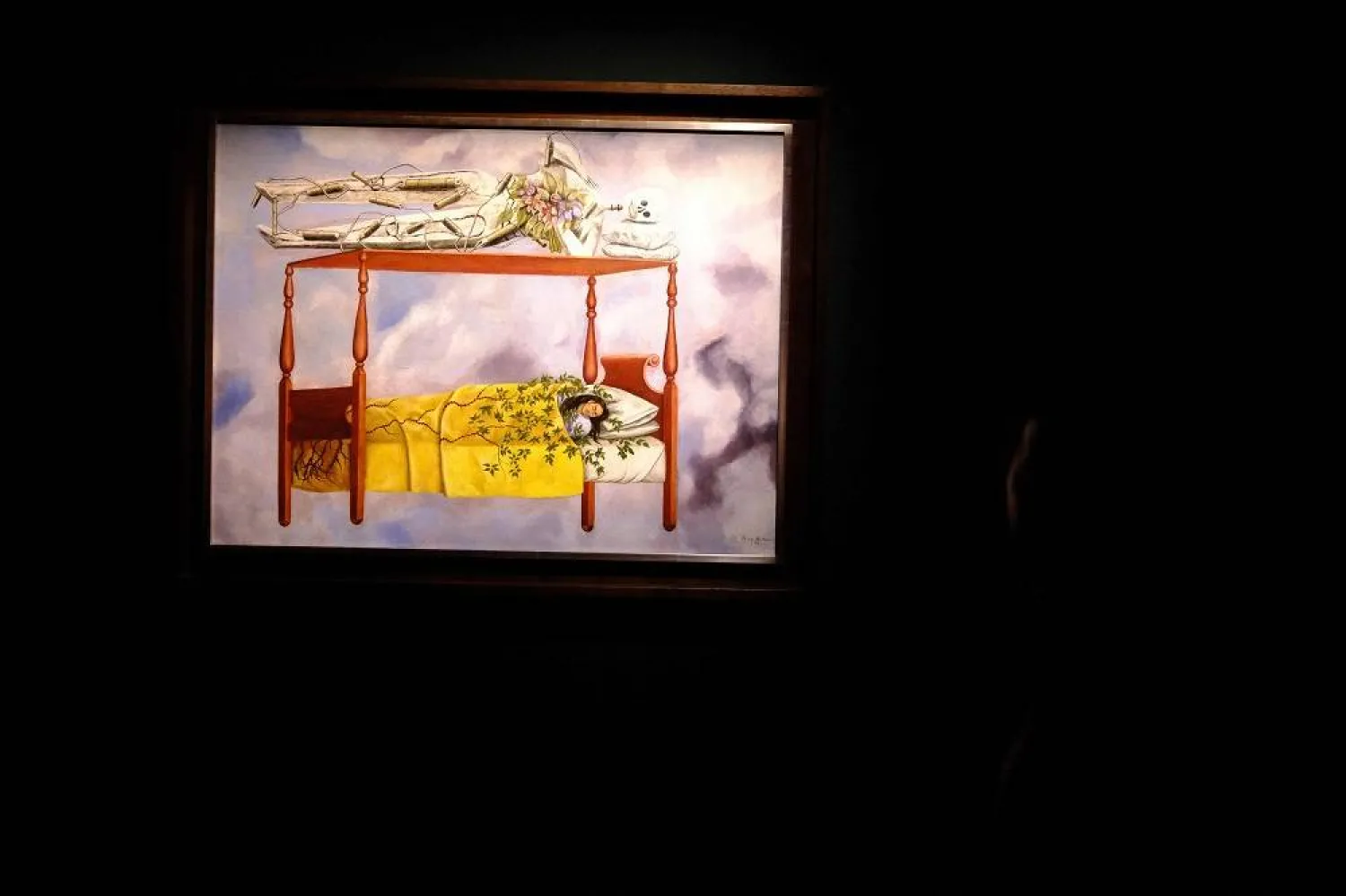
"El sueno" by Frida Kahlo is pictured at Sotheby's Marquee Sales Series in New York on November 8, 2025. (AFP)
TT

Mexican Art Historians Weigh in on Upcoming Kahlo’s Auction That Could Fetch up to $60 Million 

"El sueno" by Frida Kahlo is pictured at Sotheby's Marquee Sales Series in New York on November 8, 2025. (AFP)

Frida Kahlo’s “El sueno (La cama)” — in English, “The Dream (The Bed)” — is causing a stir among art historians as its estimated $40 million to $60 million price tag would make it the most expensive work by any female or Latin American artist when it goes to auction later this month.

Sotheby’s auction house will put the painting up for sale on Nov. 20 in New York after exhibiting it in London, Abu Dhabi, Hong Kong and Paris.

“This is a moment of a lot of speculation,” said Mexican art historian Helena Chavez Mac Gregor, a researcher at UNAM’s Institute of Aesthetic Research and author of “El liston y la bomba. El arte de Frida Kahlo.” (The ribbon and the bomb. The art of Frida Kahlo).

In Mexico, Kahlo’s work is protected by a declaration of artistic monument, meaning pieces within the country cannot be sold or destroyed. However, works from private collections abroad, like the painting in question, whose owner remains unrevealed, are legally eligible for international sale.

“The system of declaring Mexican modern artistic heritage is very anomalous,” said Mexican curator Cuauhtemoc Medina, an art historian and specialist in contemporary art.

Judas in bed “El sueno (La cama)” was created in 1940 following Kahlo's trip to Paris, where she came into contact with the surrealists.

Contrary to contemporary belief, the skull on the bed’s canopy is not a Day of the Dead skeleton, but a Judas — a handmade cardboard figure. Traditionally lit with gunpowder during Easter, this effigy symbolizes purification and the triumph of good over evil, representing Judas Iscariot who betrayed Jesus.

In the painting, the skeleton is detailed with firecrackers, flowers on its ribs and a smiling grimace — a detail inspired by a cardboard skeleton Kahlo actually kept in the canopy of her own bed.

Kahlo “spent a lot of time in bed waiting for death,” said Chavez Mac Gregor. “She had a very complex life because of all the illnesses and physical challenges with which she lived.”

Although Kahlo’s painting is being auctioned alongside works by surrealists like Salvador Dali, Rene Magritte, Max Ernst and Dorothea Tanning, she did not consider herself a member of the movement, despite having met its founder, Andre Breton, in Mexico and had an exhibition organized by him in Paris in 1939.

“Breton was fascinated by Frida’s work, because he saw that surrealist spirit there,” said Chavez Mac Gregor.

Kahlo, a committed communist, considered surrealism — a movement proposing a revolution of consciousness — to be bourgeois. As Chavez Mac Gregor noted, “Frida always had a critical distance from that.”

Despite this, specialists have found elements of surrealism in Kahlo’s work related to the dreamlike, to an inner world and to a revolutionary freedom — a concept visible in a bed suspended in the sky with Kahlo sleeping among a vine.

‘Crazy-priced purchases’

“El sueno (La cama)” was last exhibited in the 1990s, and after the auction, it could disappear from public view once again, a fate shared by many paintings acquired for large sums at auction.

There are exceptions, including “Diego y yo” (“Diego and I”), which set Kahlo’s record sale price when it sold for $34.9 million in 2021.

The painting, depicting the artist and her husband muralist Diego Rivera, was acquired by Argentine business owner Eduardo Costantini and then lent to the Museum of Latin American Art of Buenos Aires (Malba) where it remains on exhibit.

Medina, the art historian, regretted that the “crazy-priced” purchases have reduced art to a mere economic value.

He lamented that when funds purchase art as mere investments, like buying shares in a public company, the works are often relegated to tax-free zones to avoid costs. Their fate, he said, “may be worse; they may end up in a refrigerator at Frankfurt airport for decades to come.”

The current sale record for a work by a female artist is held by Georgia O’Keeffe’s “Jimson Weed/White Flower No. 1,” which fetched $44.4 million at Sotheby’s in 2014.

However, the auction market still reflects a profound disparity as no female artist has yet exceeded the maximum sale price of a male artist. The current benchmark is “Salvator Mundi,” attributed to Leonardo da Vinci, which was auctioned by Christie’s for $450.3 million in 2017.




Louvre Museum Says Shutting for the Day Due to Strike

People walk next to the Louvre Museum covered in snow in Paris, France, 07 January 2026. (EPA)
TT

Louvre Museum Says Shutting for the Day Due to Strike

People walk next to the Louvre Museum covered in snow in Paris, France, 07 January 2026. (EPA)

The Louvre Museum was forced to close on Monday due to strike action from staff in the latest disruption at the world's most-visited museum, management said.

"Due to public strikes, the Musee du Louvre is closed today," the museum said in a message posted on its website, informing disappointed tourists and art lovers that their entry tickets would be automatically reimbursed.

The museum closed for a full day last month and has been only partially open on several other days since.

Nearly three months after an embarrassing daylight heist, which has heaped pressure on Louvre bosses, staff are calling for more recruitment and better maintenance of the vast former royal palace.

Questions continue to swirl since the October 19 break-in over whether it was avoidable and why thieves were able to steal crown jewels worth more than $100 million.

Two intruders used a truck-mounted extendable platform to access a gallery containing the jewels, slicing through a glass door with disk-cutters in front of startled visitors before stealing eight priceless items.

As well as the robbery, two other recent incidents have highlighted maintenance problems inside the building, which chief architect Francois Chatillon has described as "not in a good state".

A water leak in November damaged hundreds of books and manuscripts in the Egyptian department, while management had to shut a gallery housing ancient Greek ceramics in October because ceiling beams above it risked giving way.


20-Year-Olds Gathering in Kimonos for Coming of Age Day Ceremony in Japan

Kimono-clad Japanese young women take pictures after attending a Coming-of-Age Day ceremony in Yokohama, near Tokyo, Japan, 12 January 2026. EPA/FRANCK ROBICHON
TT

20-Year-Olds Gathering in Kimonos for Coming of Age Day Ceremony in Japan

Kimono-clad Japanese young women take pictures after attending a Coming-of-Age Day ceremony in Yokohama, near Tokyo, Japan, 12 January 2026. EPA/FRANCK ROBICHON

Young women in brightly colored long-sleeved kimonos and young men in formal suits or traditional hakama and haori gathered Monday at Yokohama Arena to mark Coming-of-Age Day, an annual celebration for those who have turned 20.

The ceremonies, which are a widely observed public rite of passage in Japan, lasted less than an hour. Before and after the events, young adults gathered near the arena entrance, sidewalks and nearby train stations, greeting friends they had not seen for a long time. Smartphones were raised repeatedly as participants took pictures of each other and themselves.

Among the many participants wearing black and navy suits, a large number of young men chose traditional hakama trousers and haori jackets.

Legally, adulthood in Japan now begins at 18, following a revision of the Civil Code in April 2022. Even so, most local governments continue to hold Coming-of-Age ceremonies for 20-year-olds.

Inside Yokohama Arena, participants stood for the national anthem, then sang Yokohama’s city song together. Many then switched on the lights of their mobile phones, illuminating the hall.


Saudi Pavilion at Makkah's Global Village Showcases the Kingdom’s Culture

Saudi Pavilion at Makkah's Global Village Showcases the Kingdom’s Culture
TT

Saudi Pavilion at Makkah's Global Village Showcases the Kingdom’s Culture

Saudi Pavilion at Makkah's Global Village Showcases the Kingdom’s Culture

The Saudi pavilion at Global Village in Makkah, part of the Makkah winter season, reflects the richness and uniqueness of the Kingdom's culture and heritage.

It features interactive and engaging sections that introduce visitors to the Kingdom’s cultural heritage, including live demonstrations of traditional handicrafts and artwork inspired by the local environment, SPA reported.

The pavilion’s presence at Global Village reflects ongoing efforts to highlight the nation’s cultural heritage, promote its civilizational legacy, and strengthen its cultural presence at major events.