
Culture Being Strangled by Kosovo's Political Crisis

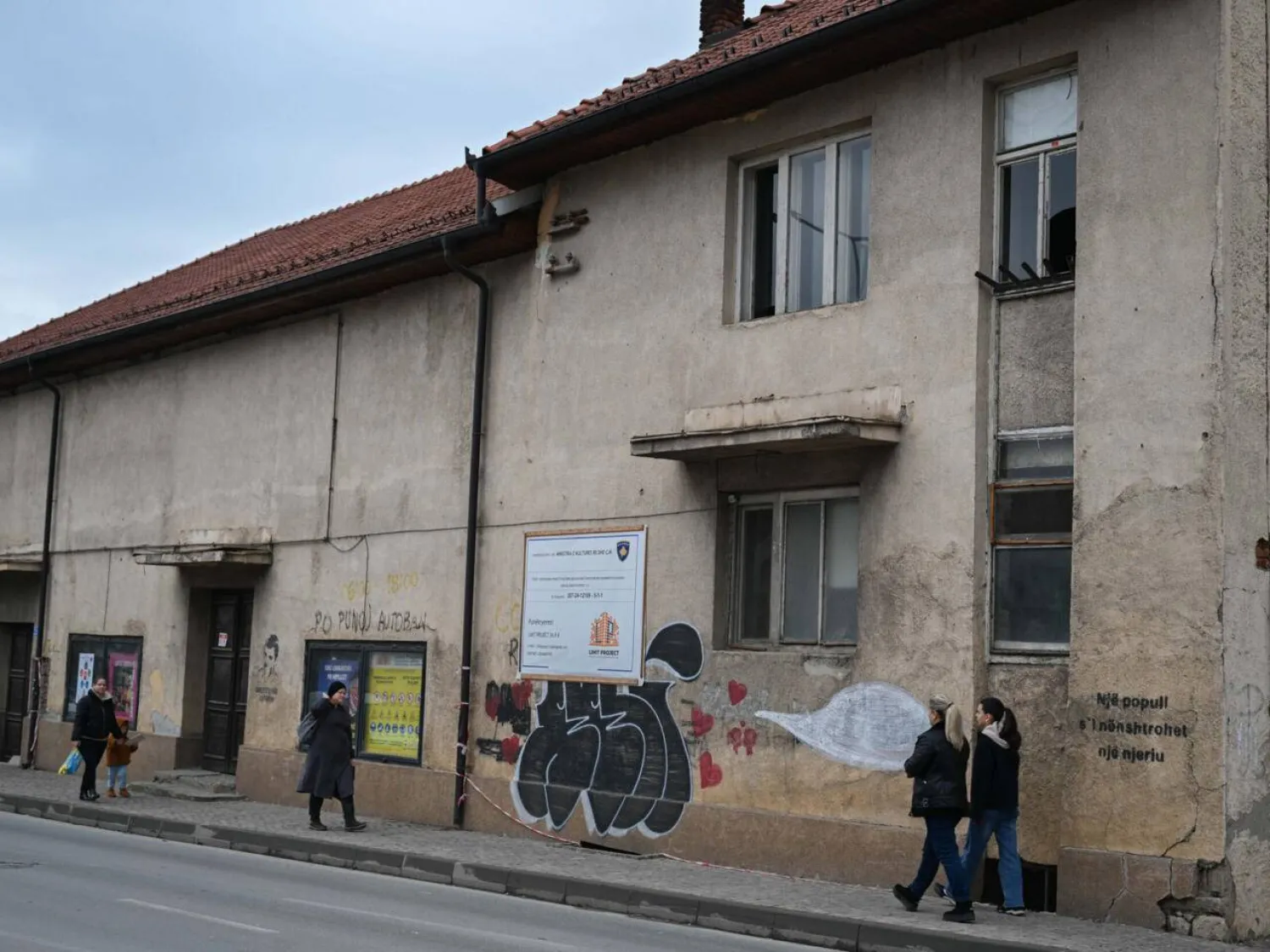
The cinema has been waiting for much-needed repairs for years. Armend NIMANI / AFP
TT

Culture Being Strangled by Kosovo's Political Crisis

The cinema has been waiting for much-needed repairs for years. Armend NIMANI / AFP

Kosovo's oldest cinema has been dark and silent for years as the famous theater slowly disintegrates under a leaky roof.

Signs warn passers-by in the historic city of Prizren that parts of the Lumbardhi's crumbling facade could fall while it waits for its long-promised refurbishment.

"The city deserves to have the cinema renovated and preserved. Only junkies gathering there benefit from it now," nextdoor neighbor butcher Arsim Futko, 62, told AFP.

For seven years, it waited for a European Union-funded revamp, only for the money to be suddenly withdrawn with little explanation.

Now it awaits similar repairs promised by the national government that has since been paralyzed by inconclusive elections in February.

And it is anyone's guess whether the new government that will come out of Sunday's snap election will keep the promise.

'Collateral damage'

Cinema director Ares Shporta said the cinema has become "collateral damage" in a broader geopolitical game after the EU hit his country with sanctions in 2023.

The delayed repairs "affected our morale, it affected our lives, it affected the trust of the community in us," Shporta said.

Brussels slapped Kosovo with sanctions over heightened tensions between the government and the ethnic Serb minority that live in parts of the country as Pristina pushed to exert more control over areas still tightly linked to Belgrade.

Cultural institutions have been among the hardest-hit sectors, as international funding dried up and local decisions were stalled by the parliamentary crisis.

According to an analysis by the Kosovo think tank, the GAP Institute for Advanced Studies, sanctions have resulted in around 613 million euros ($719 million) being suspended or paused, with the cultural sector taking a hit of 15-million-euro hit.

'Ground zero'

With political stalemate threatening to drag on into another year, there are warnings that further funding from abroad could also be in jeopardy.

Since February's election when outgoing premier Albin Kurti topped the polls but failed to win a majority, his caretaker government has been deadlocked with opposition lawmakers.

Months of delays, spent mostly without a parliament, meant little legislative work could be done.

Ahead of the snap election on Sunday, the government said that more than 200 million euros ($235 million) will be lost forever due to a failure to ratify international agreements.

Once the top beneficiary of the EU Growth Plan in the Balkans, Europe's youngest country now trails most of its neighburs, the NGO Group for Legal and Political Studies' executive director Njomza Arifi told AFP.

"While some of the countries in the region have already received the second tranches, Kosovo still remains at ground zero."

Although there have been some enthusiastic signs of easing a half of EU sanctions by January, Kurti's continued push against Serbian institutions and influence in the country's north continues to draw criticism from both Washington and Brussels.

'On the edge'

Across the river from the Lumbardhi, the funding cuts have also been felt at Dokufest, a documentary and short film festival that draws people to the region.

"The festival has had to make staff cuts. Unfortunately, there is a risk of further cuts if things don't change," Dokufest artistic director Veton Nurkollari said.

"Fortunately, we don't depend on just one source because we could end up in a situation where, when the tap is turned off, everything is turned off."

He said that many in the cultural sector were desperate for the upcoming government to get the sanctions lifted by ratification of the agreements that would allow EU funds to flow again.

"Kosovo is the only one left on the edge and without these funds."


Red Sea Fund Launches Second Round to Support Film Projects in Production Stage

File photo of the fifth day of the Red Sea International Film Festival - SPA
TT

Red Sea Fund Launches Second Round to Support Film Projects in Production Stage

File photo of the fifth day of the Red Sea International Film Festival - SPA

The Red Sea Fund, affiliated with the Red Sea Film Foundation, announced the opening of applications to support film projects in the production stage within the second round of this year’s support program, which will continue until March 21, as part of its efforts to enhance the cinema industry and empower innovators in the region, SPA reported.

The round aims to support promising cinematic voices from the Kingdom and the Arab world, as well as filmmakers from Africa and Asia, through financial grants that help complete film projects and present their creative narratives globally, with a special focus on projects ready to enter production and begin filming.


Prince Mohammed bin Salman Project Restores Historic Al-Jami' Mosque in Tabuk Region

The renovation utilized modern technologies to restore the mosque's original identity - SPA
TT

Prince Mohammed bin Salman Project Restores Historic Al-Jami' Mosque in Tabuk Region

The renovation utilized modern technologies to restore the mosque's original identity - SPA

The Prince Mohammed bin Salman Project for the Development of Historical Mosques has completed the restoration of Al-Jami' Mosque in Duba, Tabuk Region, as part of its mission to preserve the Kingdom's architectural heritage under Vision 2030.

As one of Duba’s oldest landmarks, the mosque is deeply intertwined with the city’s maritime history, traditionally serving as a central meeting point for sailors. Throughout its history, the mosque underwent several construction phases, including significant contributions by King Abdulaziz and King Fahd, before its selection for the current national development project, SPA reported.

The renovation utilized modern technologies to restore the mosque's original identity, increasing its area to 972.23 square meters and its capacity to 779 worshippers. The architectural style is inspired by traditional Red Sea heritage, incorporating natural materials like stone, mud, and wood for intricate mashrabiyas.

Executed by specialized Saudi firms, the project balances traditional standards with sustainability to rehabilitate the site for worship while highlighting its cultural significance. By restoring such landmarks, the project ensures the preservation of the Kingdom’s diverse architectural and social memory for future generations.


Leading Portraiture Competition Celebrates Saudi Heritage Through Art

Throughout its history, the award has emphasized themes rooted in Saudi heritage and national initiatives - SPA
TT

Leading Portraiture Competition Celebrates Saudi Heritage Through Art

Throughout its history, the award has emphasized themes rooted in Saudi heritage and national initiatives - SPA

The Dia Aziz Dia Award for Portrait, hosted by the Saudi Arabian Society for Culture and Arts in Jeddah, is a leading platform for portraiture and the only competition of its kind in the Middle East. It fosters national identity through contemporary art, connecting veteran and emerging artists.

Throughout its history, the award has emphasized themes rooted in Saudi heritage and national initiatives, including Saudi women, the Arabian horse, the Saudi Green Initiative, and King Abdulaziz.

These themes highlight art's role in reflecting social transformations and contributing to the cultural goals of Saudi Vision 2030, SPA reported.

The current ninth edition, with a theme focused on King Salman, invited artists to depict the leadership and humanity of the Custodian of the Two Holy Mosques. This edition attracted significant participation, with 787 submissions from 42 cities, including international entries.

Of these, 61 works were shortlisted for the final competition, with prizes totaling SAR170,000 awarded to three main winners and seven incentive recipients.