

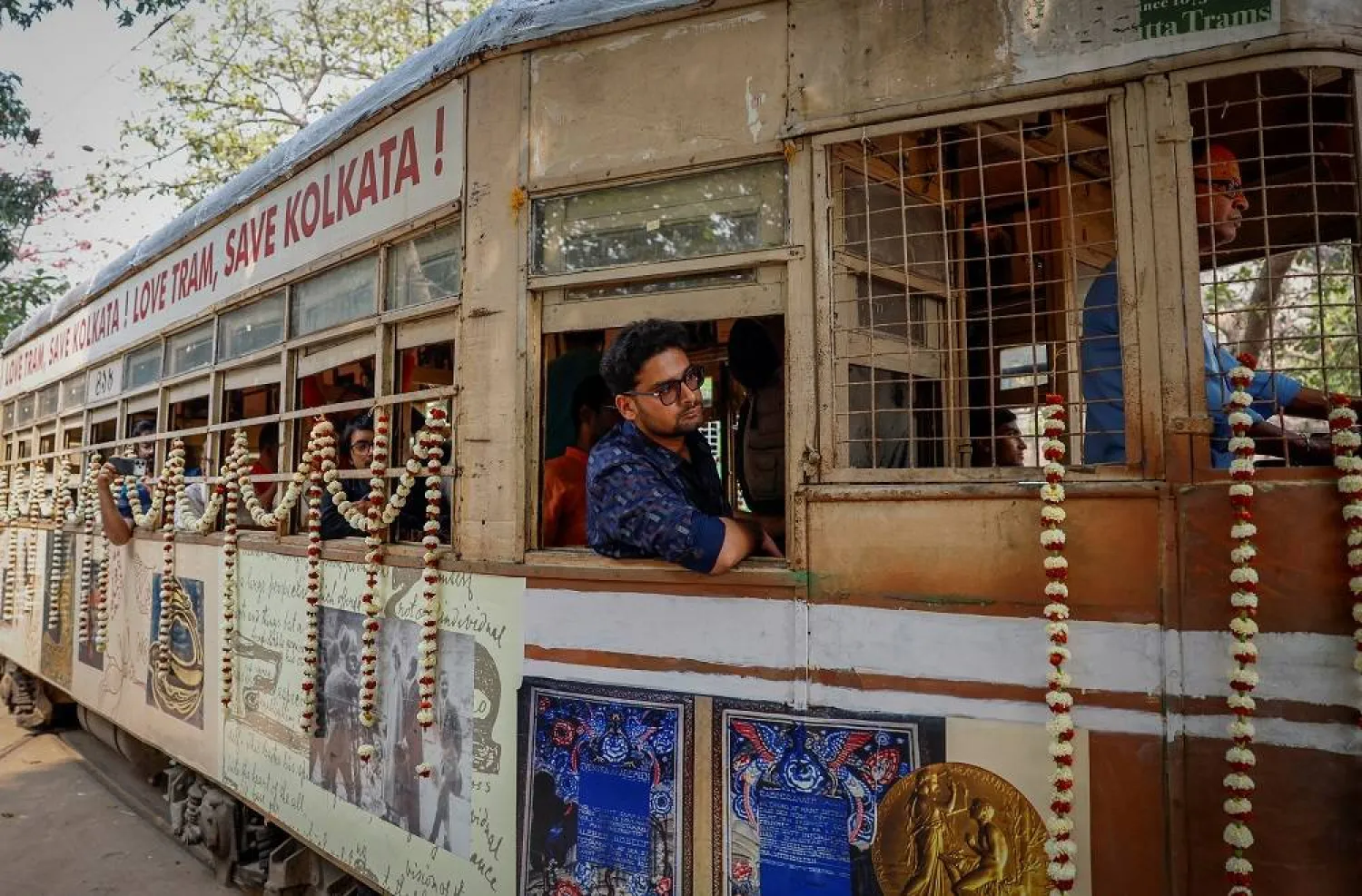

Kolkata’s Iconic Trams Face Final Stop as Modernization Rolls in

Passengers sit inside a decorated tram during the 152nd anniversary celebrations of trams in Kolkata, India, February 24, 2025. (Reuters)
TT

Kolkata’s Iconic Trams Face Final Stop as Modernization Rolls in

Passengers sit inside a decorated tram during the 152nd anniversary celebrations of trams in Kolkata, India, February 24, 2025. (Reuters)

For more than a century, trams have rumbled past Kolkata's crumbling colonial facades, with their chiming bells contributing to the city's soundtrack as they ferried generations of ​commuters.

Now, Asia's oldest tram network is on the brink of disappearing as authorities consider pulling the plug on a mode of transport that has become more nostalgia than necessity.

The West Bengal government plans to shut down the 152-year-old system, keeping only a short heritage route. The decision has sparked a court battle as residents and heritage advocates fight to keep ‌the trams ‌rolling.

"As children, we would take the ‌trams ⁠for ​fun, ‌but as I grew older it became a necessity," said Abha Maity, 44, recalling rides to school and college. "I can’t imagine Kolkata without them."

Once a highlight of the city's streets, the wobbly trams now struggle for space amid traffic jams - competing with buses and yellow taxis - as Kolkata builds modern infrastructure and seeks faster transport.

Kolkata introduced ⁠horse-drawn trams in 1873 and electrified them in 1902. At its peak, the ‌network boasted more than 340 trams and ‍covered the entire city. Today, ‍only two routes remain, with a fleet of about 10.

"When ‍I joined, more than 340 trams were running. Now it's down to seven or eight," said Bacchu Sidda, a conductor for 36 years who still checks his duty roster pinned on a board ​at the last functioning depot in Gariahat.

The government began selling depots and scrapping cars years ago, prompting a citizens' ⁠group called Calcutta Tram Users Association (CTUA) to take the fight to court. CTUA has campaigned since 2016 to save what remains of the system.

"I love my trams more than myself," said Deep Das, 19, a journalism student and CTUA member. "If they disappear, it will be like a part of my body has left me."

Despite resistance, authorities are pouring billions into upgrading Kolkata's infrastructure, focusing on metro expansion, wider roads and new highways to ease congestion.

For now, the fate of Kolkata's aging trams awaits a ‌court review, as they continue carrying some passengers who view them as living memories of the city's past.




Red Sea Fund Launches Second Round to Support Film Projects in Production Stage

File photo of the fifth day of the Red Sea International Film Festival - SPA
TT

Red Sea Fund Launches Second Round to Support Film Projects in Production Stage

File photo of the fifth day of the Red Sea International Film Festival - SPA

The Red Sea Fund, affiliated with the Red Sea Film Foundation, announced the opening of applications to support film projects in the production stage within the second round of this year’s support program, which will continue until March 21, as part of its efforts to enhance the cinema industry and empower innovators in the region, SPA reported.

The round aims to support promising cinematic voices from the Kingdom and the Arab world, as well as filmmakers from Africa and Asia, through financial grants that help complete film projects and present their creative narratives globally, with a special focus on projects ready to enter production and begin filming.


Prince Mohammed bin Salman Project Restores Historic Al-Jami' Mosque in Tabuk Region

The renovation utilized modern technologies to restore the mosque's original identity - SPA
TT

Prince Mohammed bin Salman Project Restores Historic Al-Jami' Mosque in Tabuk Region

The renovation utilized modern technologies to restore the mosque's original identity - SPA

The Prince Mohammed bin Salman Project for the Development of Historical Mosques has completed the restoration of Al-Jami' Mosque in Duba, Tabuk Region, as part of its mission to preserve the Kingdom's architectural heritage under Vision 2030.

As one of Duba’s oldest landmarks, the mosque is deeply intertwined with the city’s maritime history, traditionally serving as a central meeting point for sailors. Throughout its history, the mosque underwent several construction phases, including significant contributions by King Abdulaziz and King Fahd, before its selection for the current national development project, SPA reported.

The renovation utilized modern technologies to restore the mosque's original identity, increasing its area to 972.23 square meters and its capacity to 779 worshippers. The architectural style is inspired by traditional Red Sea heritage, incorporating natural materials like stone, mud, and wood for intricate mashrabiyas.

Executed by specialized Saudi firms, the project balances traditional standards with sustainability to rehabilitate the site for worship while highlighting its cultural significance. By restoring such landmarks, the project ensures the preservation of the Kingdom’s diverse architectural and social memory for future generations.


Leading Portraiture Competition Celebrates Saudi Heritage Through Art

Throughout its history, the award has emphasized themes rooted in Saudi heritage and national initiatives - SPA
TT

Leading Portraiture Competition Celebrates Saudi Heritage Through Art

Throughout its history, the award has emphasized themes rooted in Saudi heritage and national initiatives - SPA

The Dia Aziz Dia Award for Portrait, hosted by the Saudi Arabian Society for Culture and Arts in Jeddah, is a leading platform for portraiture and the only competition of its kind in the Middle East. It fosters national identity through contemporary art, connecting veteran and emerging artists.

Throughout its history, the award has emphasized themes rooted in Saudi heritage and national initiatives, including Saudi women, the Arabian horse, the Saudi Green Initiative, and King Abdulaziz.

These themes highlight art's role in reflecting social transformations and contributing to the cultural goals of Saudi Vision 2030, SPA reported.

The current ninth edition, with a theme focused on King Salman, invited artists to depict the leadership and humanity of the Custodian of the Two Holy Mosques. This edition attracted significant participation, with 787 submissions from 42 cities, including international entries.

Of these, 61 works were shortlisted for the final competition, with prizes totaling SAR170,000 awarded to three main winners and seven incentive recipients.