

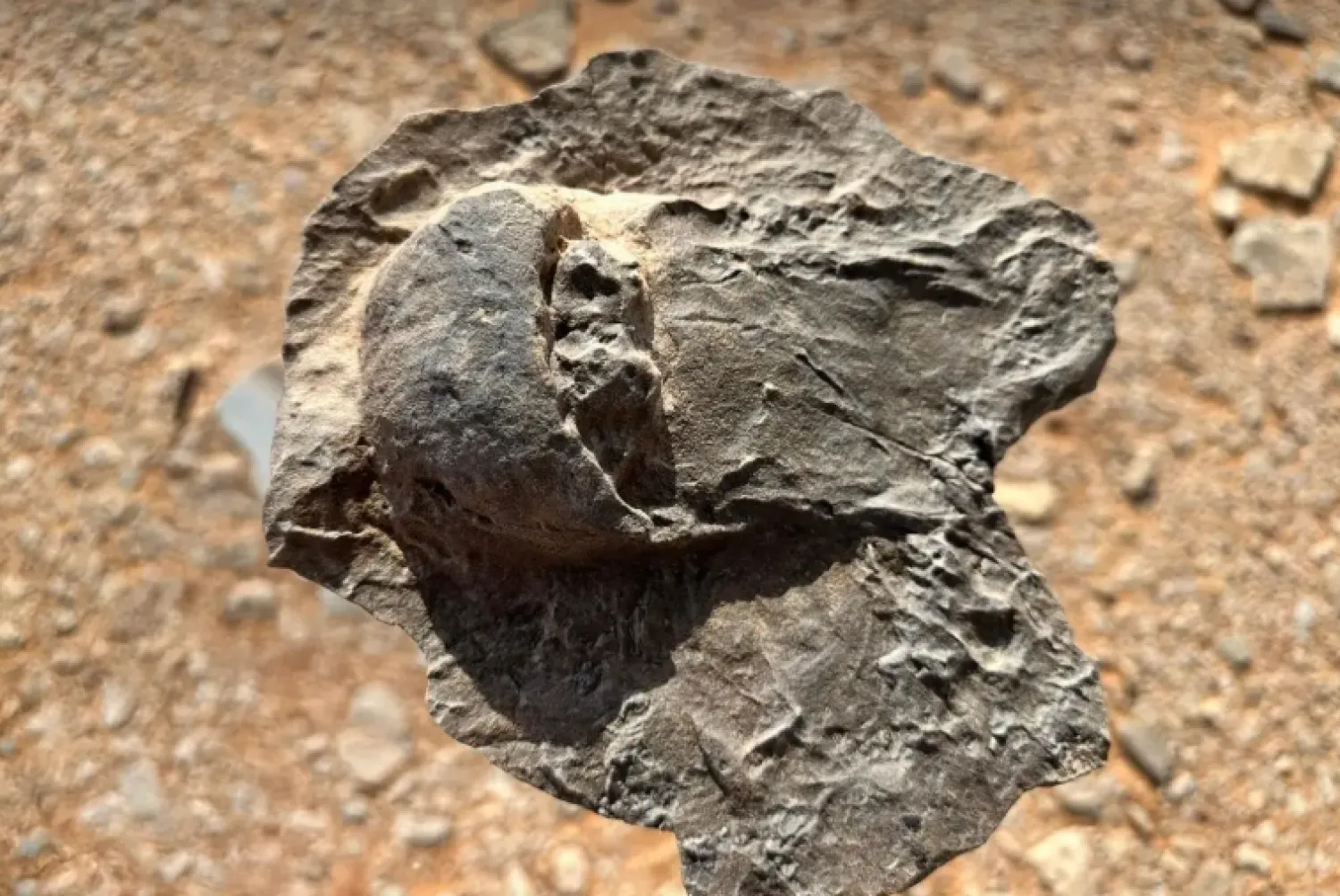

Royal Commission for AlUla Discovers Rare Fossils Dating Back 465 Million Years

The fossils date to the Middle Ordovician period - SPA
TT

Royal Commission for AlUla Discovers Rare Fossils Dating Back 465 Million Years

The fossils date to the Middle Ordovician period - SPA

The Royal Commission for AlUla (RCU) has announced the documentation and international publication of a scientific discovery of rare horseshoe crab fossils dating back approximately 465 million years, as part of a peer-reviewed study published in Gondwana Research, a leading international journal specialising in geological sciences.

This unique fossil discovery has been published globally for the first time, reinforcing AlUla’s position as a world-class center for geological and scientific research related to Earth’s history and biodiversity. The fossils were discovered in AlGharameel Nature Reserve in AlUla, adding a significant scientific dimension to the understanding of the region’s natural history, SPA reported.

The fossils date to the Middle Ordovician period, approximately 485–444 million years ago, making them among the oldest known horseshoe crab fossils worldwide. They are distinguished by their exceptionally large size compared to other specimens from the same period. All fossils were found preserved upside down, a mode of preservation not previously recorded, alongside trace fossils indicating attempts by the organisms to return to their natural position. This provides rare evidence of ancient behavioural patterns and enables their interpretation in light of contemporary biological knowledge, supporting advanced scientific research.

According to SPA, geological stratigraphic analysis indicated the recurrence of intense seasonal storms during that period, suggesting that these organisms congregated in shallow coastal environments affected by such events, which contributed to their preservation within sedimentary deposits.

These findings offer a clear picture of AlUla’s ancient coastal environment and add a new scientific perspective to understanding its geological and environmental history. They also highlight the commission’s capacity to provide accurate data that supports scientific research and innovation in the study of AlUla’s natural heritage.

The discovery also represents a previously unclassified species, investigated through two research phases in collaboration with a team led by Dr Russell Bicknell, an academic at Flinders University in Adelaide. The second phase, scheduled for the first half of 2026, will include the collection of additional samples and further study of the new species in preparation for its formal scientific classification. The fossil specimens have been preserved within RCU’s museum collections to support future research and public engagement.

The findings reflect the Royal Commission for AlUla’s commitment to advancing scientific transformation, strengthening AlUla’s position as a global destination for scientific discovery and geological research, enabling international partnerships, and developing research and educational programmes related to natural heritage.




Louvre Museum Says Shutting for the Day Due to Strike

People walk next to the Louvre Museum covered in snow in Paris, France, 07 January 2026. (EPA)
TT

Louvre Museum Says Shutting for the Day Due to Strike

People walk next to the Louvre Museum covered in snow in Paris, France, 07 January 2026. (EPA)

The Louvre Museum was forced to close on Monday due to strike action from staff in the latest disruption at the world's most-visited museum, management said.

"Due to public strikes, the Musee du Louvre is closed today," the museum said in a message posted on its website, informing disappointed tourists and art lovers that their entry tickets would be automatically reimbursed.

The museum closed for a full day last month and has been only partially open on several other days since.

Nearly three months after an embarrassing daylight heist, which has heaped pressure on Louvre bosses, staff are calling for more recruitment and better maintenance of the vast former royal palace.

Questions continue to swirl since the October 19 break-in over whether it was avoidable and why thieves were able to steal crown jewels worth more than $100 million.

Two intruders used a truck-mounted extendable platform to access a gallery containing the jewels, slicing through a glass door with disk-cutters in front of startled visitors before stealing eight priceless items.

As well as the robbery, two other recent incidents have highlighted maintenance problems inside the building, which chief architect Francois Chatillon has described as "not in a good state".

A water leak in November damaged hundreds of books and manuscripts in the Egyptian department, while management had to shut a gallery housing ancient Greek ceramics in October because ceiling beams above it risked giving way.


20-Year-Olds Gathering in Kimonos for Coming of Age Day Ceremony in Japan

Kimono-clad Japanese young women take pictures after attending a Coming-of-Age Day ceremony in Yokohama, near Tokyo, Japan, 12 January 2026. EPA/FRANCK ROBICHON
TT

20-Year-Olds Gathering in Kimonos for Coming of Age Day Ceremony in Japan

Kimono-clad Japanese young women take pictures after attending a Coming-of-Age Day ceremony in Yokohama, near Tokyo, Japan, 12 January 2026. EPA/FRANCK ROBICHON

Young women in brightly colored long-sleeved kimonos and young men in formal suits or traditional hakama and haori gathered Monday at Yokohama Arena to mark Coming-of-Age Day, an annual celebration for those who have turned 20.

The ceremonies, which are a widely observed public rite of passage in Japan, lasted less than an hour. Before and after the events, young adults gathered near the arena entrance, sidewalks and nearby train stations, greeting friends they had not seen for a long time. Smartphones were raised repeatedly as participants took pictures of each other and themselves.

Among the many participants wearing black and navy suits, a large number of young men chose traditional hakama trousers and haori jackets.

Legally, adulthood in Japan now begins at 18, following a revision of the Civil Code in April 2022. Even so, most local governments continue to hold Coming-of-Age ceremonies for 20-year-olds.

Inside Yokohama Arena, participants stood for the national anthem, then sang Yokohama’s city song together. Many then switched on the lights of their mobile phones, illuminating the hall.


Saudi Pavilion at Makkah's Global Village Showcases the Kingdom’s Culture

Saudi Pavilion at Makkah's Global Village Showcases the Kingdom’s Culture
TT

Saudi Pavilion at Makkah's Global Village Showcases the Kingdom’s Culture

Saudi Pavilion at Makkah's Global Village Showcases the Kingdom’s Culture

The Saudi pavilion at Global Village in Makkah, part of the Makkah winter season, reflects the richness and uniqueness of the Kingdom's culture and heritage.

It features interactive and engaging sections that introduce visitors to the Kingdom’s cultural heritage, including live demonstrations of traditional handicrafts and artwork inspired by the local environment, SPA reported.

The pavilion’s presence at Global Village reflects ongoing efforts to highlight the nation’s cultural heritage, promote its civilizational legacy, and strengthen its cultural presence at major events.