
Michelangelo’s Works Hidden in ‘Secret Room’, Researcher Says

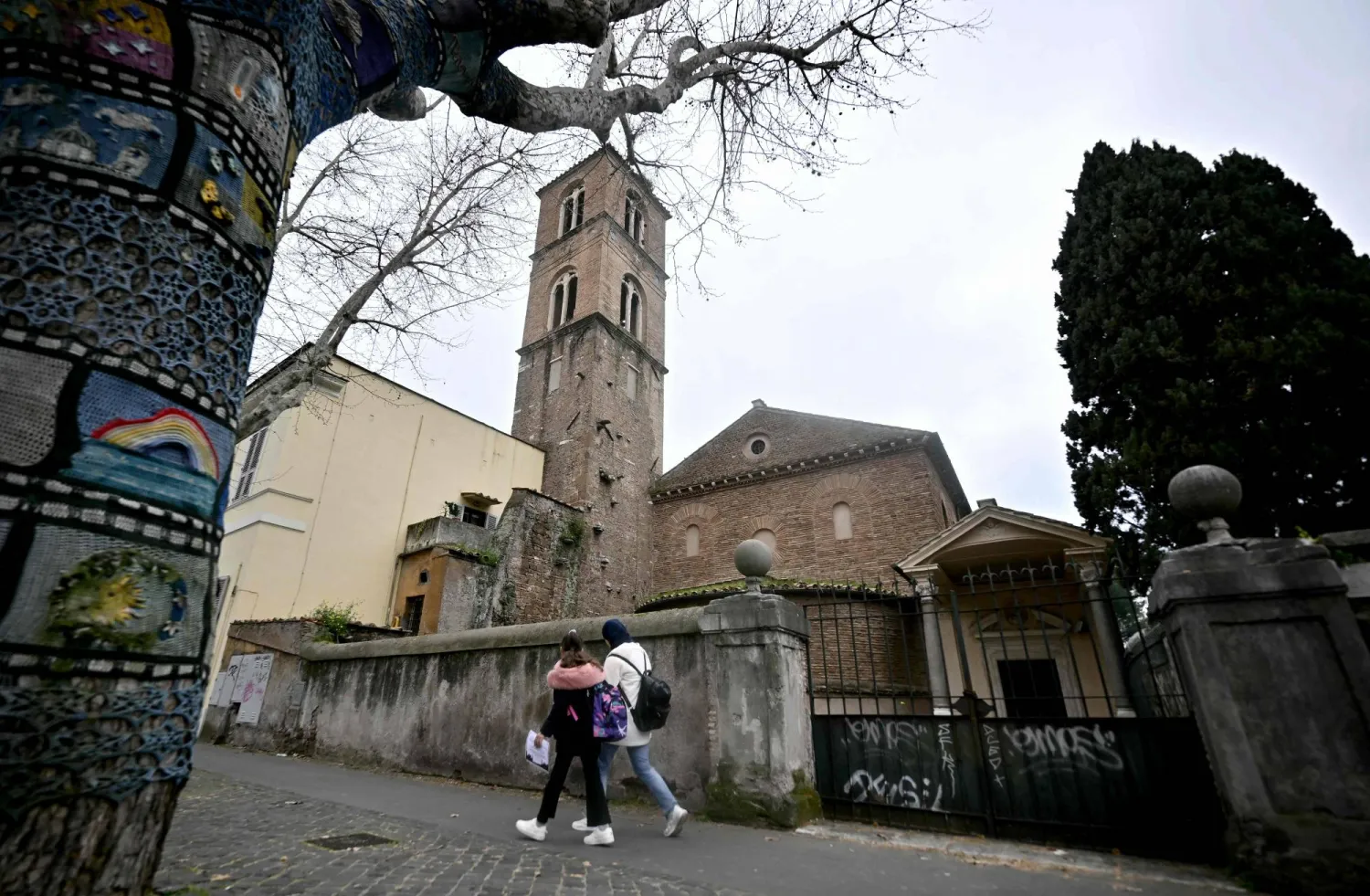
Pedestrians walk past the Basilica of Santa Agnese Outside the Walls as a marble bust is displayed inside after being identified as a work by Michelangelo Buonarroti after centuries without attribution, following a decade of archival research by Italian researcher Valentina Salerno in Rome on March 4, 2026. (AFP)
TT

Michelangelo’s Works Hidden in ‘Secret Room’, Researcher Says

Pedestrians walk past the Basilica of Santa Agnese Outside the Walls as a marble bust is displayed inside after being identified as a work by Michelangelo Buonarroti after centuries without attribution, following a decade of archival research by Italian researcher Valentina Salerno in Rome on March 4, 2026. (AFP)

Renaissance artist Michelangelo ordered many of his artworks to be hidden by his pupils in a secret room to protect them for posterity, an Italian researcher claimed Wednesday.

According to renowned art historian Giorgio Vasari, the Italian genius burned a large number of his own drawings and sketches before his death in Rome in 1564.

But researcher Valentina Salerno says she has unearthed unpublished archival documents that reveal a plot to squirrel away his works.

"One of these three unpublished documents I found in the archives speaks of a room" kept by students of the Michelangelo school, the origins of which "can be traced back" to the artist, Salerno told AFP on the sidelines of a press conference in Rome.

"Assets are hidden inside this room. These assets are locked away so tightly that they require a system of multiple keys, so that no one can access them without the permission of others," she said.

Salerno was researching a book on Michelangelo when she came across a document that showed the artist had in 1550 joined the Brotherhood of the Most Holy Crucifix. Those close to him in his final years were members too.

Over a decade of research, she followed the document trail between a series of archives in the Vatican, Italy and European cities including Paris.

As part of what she called a "maniacal plan" cooked up by Michelangelo, his works were to be hidden "because otherwise it would all end up with a nephew he detested".

"The goal was to pass on to his poor, vulnerable, non-noble descendants the material to be able to continue studying, to transmit his art to future generations," she said.

Those involved in the plan went on to form the famous art Academy of San Luca in the 16th century, she added. It still exists today.

Salerno believes the secret room designed to safeguard the artist's creations was likely somewhere inside the Saint Peter in Chains church in central Rome.

- Michelangelo bust -

During her research, she also stumbled across a reference to a bust at the Basilica of Sant'Agnese, also in Rome, currently attributed to an anonymous artist.

She found documents attributing the white bust to Michelangelo down the centuries.

In the 1930s it appears to disappear from documentation, only to reappear in the 1980s, attributed to a minor artist.

Italy's cultural authorities later declared it to be a work by an unknown sculptor instead.

But Salerno insists the bust is a genuine Michelangelo, not just due to the paper trail, but also because it shares a striking resemblance to Tommaso dei Cavalieri, a young nobleman.

Salerno's work has not yet been peer reviewed, but she is a member of the Vatican committee for the celebrations marking the 500th anniversary of Michelangelo's birth.
Prince Mohammed bin Salman Project Restores Al-Hawza Mosque in Aseer

Following its inclusion in the project in 2022, the mosque's area was expanded to 293 square meters - SPA
TT

Prince Mohammed bin Salman Project Restores Al-Hawza Mosque in Aseer

Following its inclusion in the project in 2022, the mosque's area was expanded to 293 square meters - SPA

The Prince Mohammed bin Salman Project for the Development of Historical Mosques is rehabilitating Al-Hawza Mosque in Dhahran Al-Janoub, Aseer, as part of its mission to preserve Islamic heritage under Vision 2030.

Built in 8 AH by Ali ibn Abi Talib during his trip to Yemen to spread Islam, the mosque is one of the oldest in the region and has undergone expansions in 1213 AH and 1353 AH. Its unique architectural identity reflects the Sarawat region's style, utilizing layered mud bricks and local wood to harmonize with the mountainous environment, SPA reported.

Following its inclusion in the project in 2022, the mosque's area was expanded to 293 square meters, increasing its capacity to 148 worshippers while maintaining authentic features like its historic internal well.

By utilizing specialized Saudi companies and engineers, the project achieves a balance between traditional sustainability and modern standards, fulfilling strategic goals to restore architectural authenticity and highlight the Kingdom’s civilizational depth.


'Moon Spotter': AlUla's Enduring Tradition of Crescent Sighting

The people of AlUla in Saudi Arabia have long maintained a close relationship with nature, reflected in their careful observation of crescent moons. (SPA)
TT

'Moon Spotter': AlUla's Enduring Tradition of Crescent Sighting

The people of AlUla in Saudi Arabia have long maintained a close relationship with nature, reflected in their careful observation of crescent moons. (SPA)

The people of Saudi Arabia’s AlUla have long maintained a close relationship with nature, reflected in their careful observation of crescent moons and the determination of lunar months, particularly Ramadan and Shawwal (Eid). This tradition was carried out through a role locally known as the “Moon Spotter,” reflecting inherited astronomical knowledge passed down through generations.

Known for sharp eyesight and precise knowledge of celestial timings, the Moon Spotter relied on traditional methods, including placing a copper vessel filled with water at an elevated position to observe the reflections of the sun and moon, which helped determine the crescent's position with accuracy.

Upon sighting the crescent, he would mark the reflected point with a palm frond before notifying the relevant court to contribute to the official announcement, the Saudi Press Agency said.

This heritage is closely tied to AlUla's historically clear skies, which enabled residents to observe celestial bodies with clarity and fostered a lasting connection to astronomy as part of their cultural legacy.


Dutch Museum Makes ‘Needle in a Haystack’ Confirmation of Rembrandt Painting

Poeple look at Rembrandt's famed Night Watch, which is back on display in what researchers say in its original size, with missing parts temporarily restored in an exhibition aided by artificial intelligence, at Rijksmuseum in Amsterdam, Netherlands June 23, 2021. REUTERS/Piroschka van de Wouw/File Photo
TT

Dutch Museum Makes ‘Needle in a Haystack’ Confirmation of Rembrandt Painting

Poeple look at Rembrandt's famed Night Watch, which is back on display in what researchers say in its original size, with missing parts temporarily restored in an exhibition aided by artificial intelligence, at Rijksmuseum in Amsterdam, Netherlands June 23, 2021. REUTERS/Piroschka van de Wouw/File Photo

A painting that was once rejected as a work by Rembrandt van Rijn has now been acknowledged as a work by the Dutch master, thanks to two years of scrutiny in the city where the then-27-year-old artist painted it in 1633, a museum announced Monday. 

The Netherlands' national art and history museum, the Rijksmuseum, unveiled the work, “Vision of Zacharias in the Temple,” and said painstaking analysis including high-tech scans has confirmed it was painted by Rembrandt after he moved to the capital, Amsterdam. 

The painting hasn't been on public display in decades after being bought by a private collector in 1961, a year after it was deemed not to be a Rembrandt, the museum said in a statement. From Wednesday, will go on show among other masterpieces at the Rijksmusuem, where it is on long-term loan. 

Director Taco Dibbits said the museum often gets emails from people asking if the painting they own might just be by the Golden Age master. 

“We always hope to find a new Rembrandt, but this happens rarely," he told The Associated Press. He said making such a discovery “is just like (finding) a needle in a haystack.” 

The owner, who has remained anonymous, initially asked the museum only if the painting was Dutch. 

“He really didn’t know what he had. And then to discover that it’s a Rembrandt is something that’s amazing to experience,” Dibbits said. 

An in-depth study of the work, including macro X-ray fluorescence scans and comparisons with other works by the artist, confirmed Rembrandt painted it, said the museum’s curator of 17th century Dutch paintings, Jonathan Bikker. 

“So the wood that was used for the panel on which it’s painted, that is definitely from a tree that was cut down before 1633, the date on the painting,” he said. 

"All the pigments, the paint in the painting were used by Rembrandt in other paintings. And the layers of paint and how he painted it, that is also precisely the same as in other works by Rembrandt,” he added. 

The work joins about 350 known Rembrandt paintings and raised the hope that there may be more. 

“We’re not actively looking for new paintings by Rembrandt, but I think this gives us hope — not just us, but everyone who’s interested in Rembrandt,” Bikker said.