


Study Suggests Younger Age for Chile's Important Monte Verde Archaeological Site

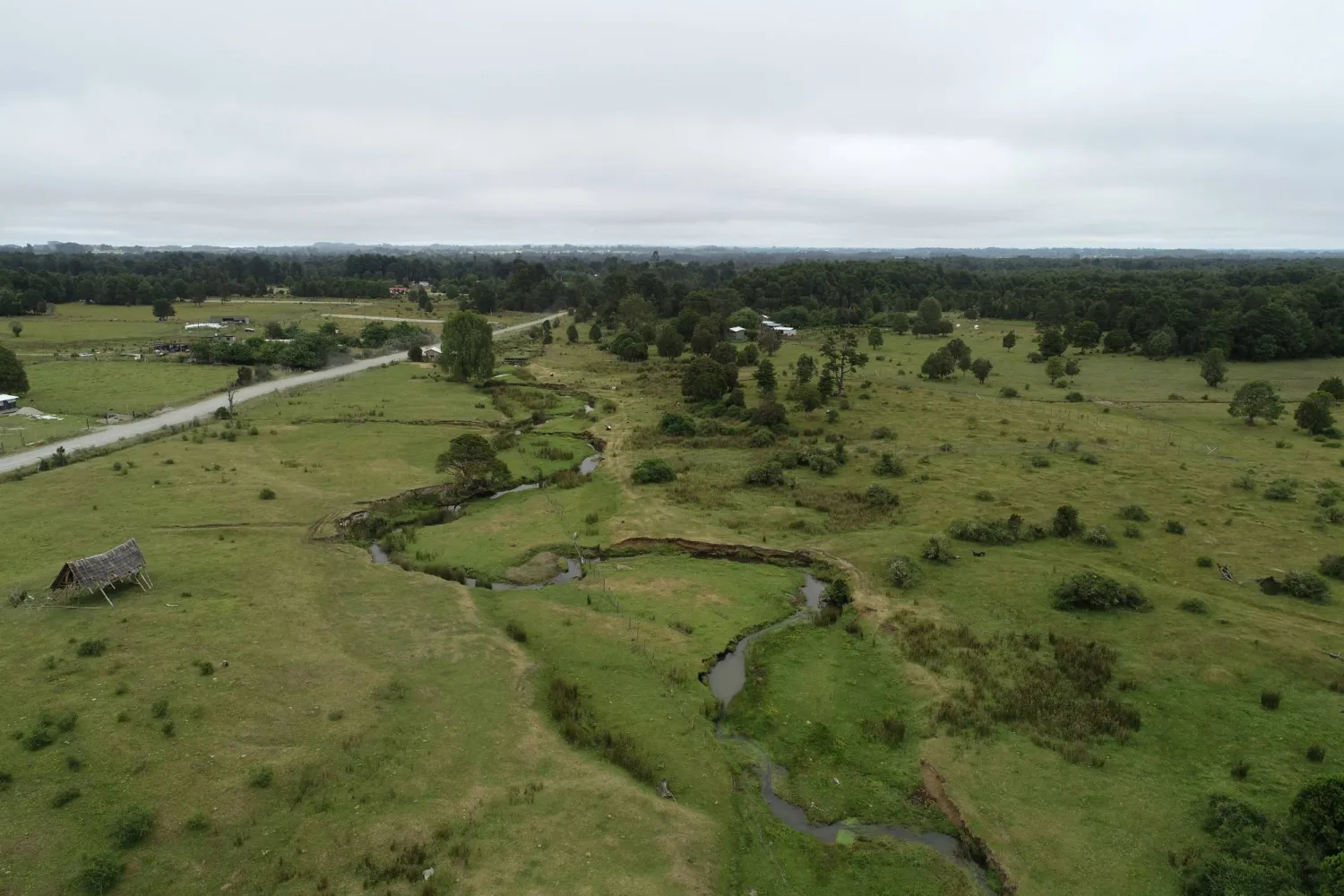
An aerial view of the of the Monte Verde archaeological site in southern Peru, in this 2023 photograph released on March 18, 2026. Todd Surovell/via REUTERS
TT

Study Suggests Younger Age for Chile's Important Monte Verde Archaeological Site

An aerial view of the of the Monte Verde archaeological site in southern Peru, in this 2023 photograph released on March 18, 2026. Todd Surovell/via REUTERS

The Monte Verde archaeological site in Chile, discovered in the 1970s, revolutionized the thinking about when humans entered the Americas, with scientists calculating decades ago that this former abode for ancient hunter-gatherers was about 14,500 years old. But a new study suggests it is much more recent than that.

Researchers said a fresh analysis of this Ice Age creek valley site found it dates to between 4,200 and 8,200 years ago. Such a date would make Monte Verde irrelevant to the longstanding scientific debate about when the initial peopling of the Western Hemisphere occurred.

"This finding suggests a later date of human arrival to the Americas than is widely believed," said University of Wyoming archaeologist Todd Surovell, lead author of the research published on Thursday in the journal Science.

The researchers used three scientific dating methods on material from in and around Monte Verde, located in southern Chile about 36 miles (58 km) from the Pacific coast.

"We sampled in the site area. We also sampled the same landforms upstream and downstream of the site," Reuters quoted Surovell as saying.

"These landforms are continuous throughout ⁠the valley, and our ⁠dating of them was consistent in all locations. We placed these into stratigraphic (soil and rock layers) context, and the dating errors of the previous investigators were immediately apparent," Surovell said.

Testing in 1997 concluded the site was 14,500 years old. That would make it more than 1,500 years older than the previous earliest-known human occupation sites south of the continental ice sheets that covered parts of North America at the time. Those sites were associated with North America's Clovis culture, known for distinctive stone tools and named for a locale in New Mexico.

Because Monte Verde was considered older and was thousands of miles south of the Clovis locations, scientists saw it as evidence that people must ⁠have been in the Americas much earlier than the Clovis sites had indicated.

Humans are thought to have crossed from Siberia into Alaska over an Ice Age land bridge, then later journeyed south.

The new research dated pieces of wood, sand deposited by the creek and a layer of ancient volcanic ash.

"The dating of the volcanic ash was especially important," Surovell said.

The ash was determined to have been deposited about 11,000 years ago. It was in a layer that was below the evidence of occupation, showing that the human presence must have come after that date, Surovell said.

Within the age range indicated by the new testing, Surovell said the Monte Verde human occupation most likely dates to 6,000 to 8,000 years ago.

Surovell said the site's older age was calculated using a technique called radiocarbon dating on wood recovered there. Surovell said while the wood indeed was 14,500 years old, it greatly predated the human occupation and was simply mixed among older material trapped in the banks of the creek.

"Imagine the stream undercutting the bank as ⁠it meanders in the valley. Materials ⁠in the bank then get transported and redeposited by the stream," Surovell said.

Vanderbilt University anthropologist Tom Dillehay, who has studied Monte Verde extensively since the 1970s, cited "many methodological and empirical errors" in the new study.

Its interpretation of the wood, Dillehay said, "disregards a vast body of well-dated cultural evidence associated with Monte Verde, including stone tools, wooden and bone artifacts, edible plant remains including seaweed and potatoes, hearths, human footprints, and animal meat and hide remains."

"These and other elements constitute a complex cultural context that has been extensively documented over five decades of interdisciplinary archaeological research," Dillehay said. "In turning to their data, it is a mixture of inventions and misunderstandings. They saw what they wanted to see, and came to the site with predetermined conclusions."

The timing of the peopling of the Americas remains contentious.

"Monte Verde is internationally recognized as one of the most significant archaeological sites on the American continent, having played a decisive role in replacing the longstanding 'Clovis First' paradigm," Dillehay said, a theory positing that the first inhabitants of the Americas arrived approximately 12,800 years ago.

Surovell said the new findings show Monte Verde postdates the Clovis sites.

"The Monte Verde site is still important for understanding the Holocene (geological epoch, beginning 11,700 years ago) human occupation of its region, but it no longer has much significance for understanding the initial peopling of the Americas," Surovell said.



Saudi Culture Ministry Launches UK-KSA Arabian Peninsula Cultural Research Fellowships

The Saudi flag. Asharq Al-Awsat
TT

Saudi Culture Ministry Launches UK-KSA Arabian Peninsula Cultural Research Fellowships

The Saudi flag. Asharq Al-Awsat

The Ministry of Culture has launched the UK-KSA Arabian Peninsula Cultural Research Fellowships in partnership with Effat University and the National Archives of the United Kingdom, to support archival-based research, advance cultural inquiry on the Arabian Peninsula, and strengthen collaboration between researchers and institutions in Saudi Arabia and the United Kingdom.

The program includes a 10-week research residency at the National Archives of the United Kingdom, where participants receive hands-on training in archival methods and gain access to a wide range of archival collections and cultural institutions across the UK. It supports diverse areas of cultural research related to the Arabian Peninsula.

This initiative aligns with the Ministry of Culture’s strategic vision for advancing cultural research, reflecting its commitment to fostering both local and international collaboration and promoting meaningful cultural exchange.

The fellowship is open to researchers and cultural heritage specialists capable of conducting independent research in English, regardless of their professional level.


Culture Ministry Signs Partnership with Guildhall School of Music & Drama for Riyadh University of Arts

Culture Ministry Signs Partnership with Guildhall School of Music & Drama for Riyadh University of Arts
TT

Culture Ministry Signs Partnership with Guildhall School of Music & Drama for Riyadh University of Arts

Culture Ministry Signs Partnership with Guildhall School of Music & Drama for Riyadh University of Arts

The Ministry of Culture signed on Thursday a partnership with Guildhall School of Music & Drama for Riyadh University of Arts (RUA)’s College of Music. The partnership aims to further develop cultural and artistic talent and drive cultural exchange.

Under the terms of the partnership, Guildhall School will work with RUA to co-design undergraduate, postgraduate and research programs spanning music performance, production and education, in addition to training and capability development opportunities for RUA’s faculty body.

The programs will help cultivate and support Saudi talent across a wide range of musical disciplines, as well as provide students with a firm understanding of creative processes, research pathways and professional skills.

Founded in 1880, Guildhall School is a vibrant, international community of musicians, actors and production artists. Ranked as number one in Arts, Drama and Music by the Complete University Guide 2025, and in the top three in the world for Music by the QS World University Rankings 2025, Guildhall delivers world-class professional training in partnership with distinguished artists, companies and ensembles, SPA reported.

The partnership with Guildhall School sits within a series of partnerships for the Riyadh University of Arts and its colleges with leading international institutions to co-design academic programs, collaborate in research, and offer enriching programs in cultural education and development.

In December 2025, RUA announced partnerships between their College of Film and the University of Southern California’s (USC) School of Cinematic Arts (SCA); between SOAS University of London and their College of Heritage and Civilization Studies; AMDA College of the Performing Art and RUA’s College of Theater and Performing Art; and between ESSEC Business School and RUA’s College of Cultural Management. A further agreement was signed with the Royal College of Art (RCA) and RUA’s College of Architecture and Design and College of Visual Arts and Photography in January 2026.

Riyadh University of Arts was established by royal decree and is headquartered in Riyadh. Its Board of Trustees is chaired by Minister of Culture Prince Bader bin Abdullah bin Farhan. The university is dedicated to advancing education in the fields of culture and the arts, serving as a cornerstone for creative learning and cultural innovation. It aims to empower students with the knowledge, skills, and vision needed to shape the future of Saudi Arabia’s creative economy.

The university will launch its programs in phases, gradually expanding to cover a wide range of fields and specialized disciplines. It will offer a comprehensive academic portfolio that supports continuous education across the arts and culture sectors, including short courses, diplomas, bachelor’s degrees, higher diplomas, master’s degrees, and PhDs.


Czech ‘Arks’ Help Preserve Ukraine’s Cultural Heritage

A photo taken in Prague's National Museum shows a 3D scanner in the Archa III (Ark Project) truck on March 24, 2026 in Prague, Czech Republic. (AFP)
TT

Czech ‘Arks’ Help Preserve Ukraine’s Cultural Heritage

A photo taken in Prague's National Museum shows a 3D scanner in the Archa III (Ark Project) truck on March 24, 2026 in Prague, Czech Republic. (AFP)

The National Museum in Prague on Tuesday unveiled a van containing a 3D scanning device that will soon travel to war-ravaged Ukraine to help preserve its cultural artifacts.

The Archa (Ark) III is a Volkswagen van comprising a studio equipped with a robot and three cameras to create precise models of endangered historic items in Ukraine, which has been battling a full-scale Russian invasion since 2022.

"Archa III is a unique mobile digitization device enabling us to create high-quality 3D images of endangered artifacts and collection items out in the field," National Museum director Michal Lukes told reporters.

He added the scanners could handle both tiny objects and more sizeable items even inside museums.

"In this way, we can create precise digital copies of items that can then serve for documentation and research purposes, but also for restoration, potential reconstruction, or the production of copies," he added.

Museum staff will drive the van to Kyiv in early April and hand it over to Ukrainian partners under the project carried out in cooperation with the foundation of Czech billionaire Karel Komarek.

It follows an Archa I container equipped to conserve and restore books and an Archa II van digitizing two-dimensional items, which Prague sent to Ukraine earlier.

The foundation, which worked on the first two "Arks" with other institutions, said they have so far handled almost 40,000 pages of documents, such as historic newspapers retrieved from the Regional Scientific Library in Kherson.

"The van comprises an autonomous robotic system designed for photogrammetry and 3D output," said the museum's IT director Martin Soucek.

Speed is crucial, and the robot moving along three axes can generate thousands of high-quality photographs within minutes.

"It then uses the photographs to create a hyper-realistic model with high detail, a so-called digital twin," Soucek added.

The project also involves expert training and a website on which the scanned artifacts will be exhibited.

Vitalii Usatyi, the charge d'affaires at the Ukrainian embassy in Prague, hailed the van for being able to work across Ukraine, "including regions exposed to risks related to the Russian aggression".

"This is crucial for preserving cultural heritage," he added.

A recent UNESCO report said that 523 cultural sites had been verified as damaged as of March 11, including 153 religious sites, 273 buildings of historical or artistic interest, 39 museums, 33 monuments, 20 libraries, four archaeological sites and one archive.