


India’s Historic Haveli Homes Caught Between Revival and Ruin

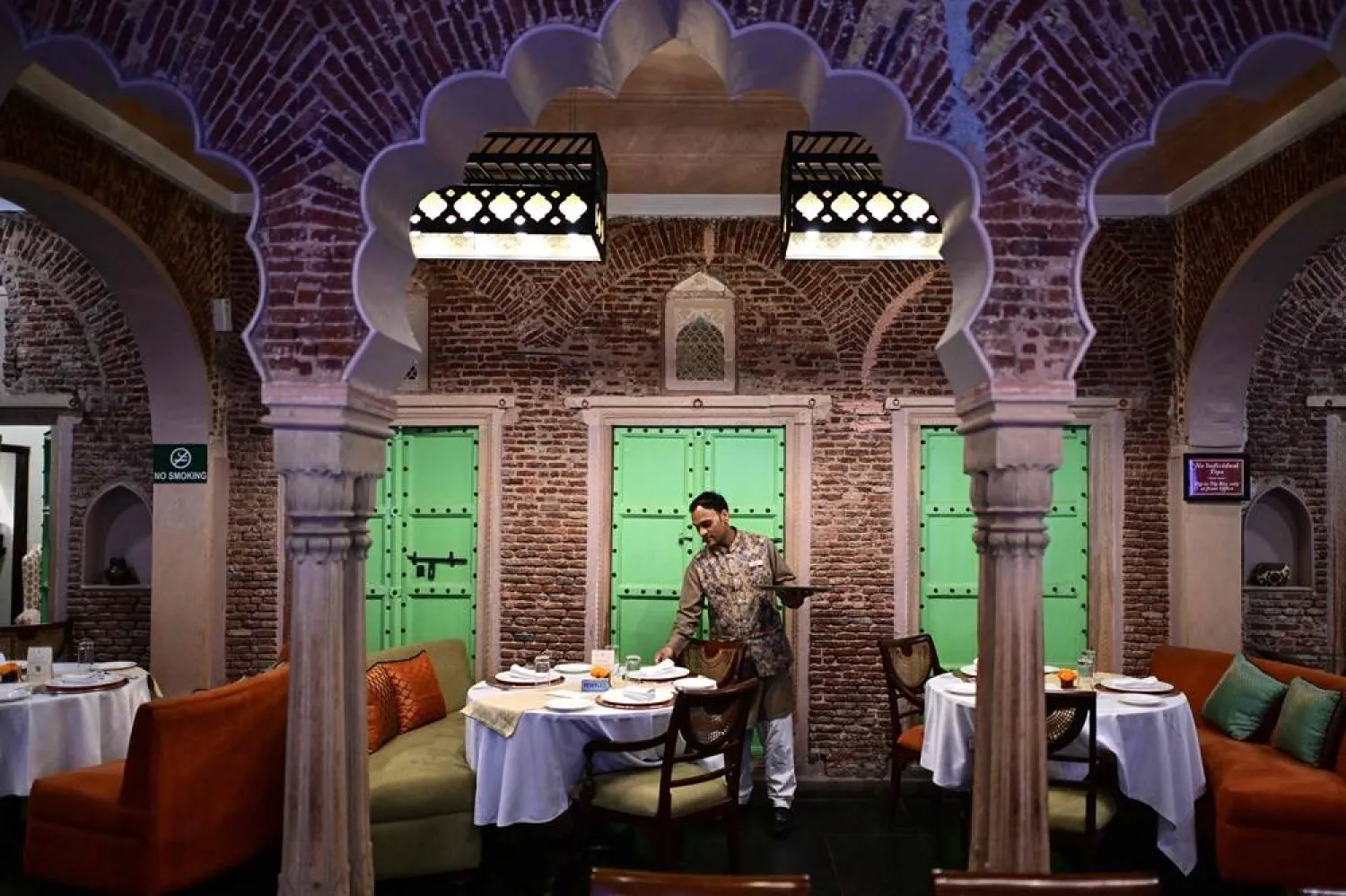
 This photograph taken on February 2, 2026 shows a hospitality staff arranging tableware at the Dharampura Haveli, an 18th-century haveli-turned-heritage hotel in the old quarters of Delhi. (AFP)
This photograph taken on February 2, 2026 shows a hospitality staff arranging tableware at the Dharampura Haveli, an 18th-century haveli-turned-heritage hotel in the old quarters of Delhi. (AFP)
TT

India’s Historic Haveli Homes Caught Between Revival and Ruin

 This photograph taken on February 2, 2026 shows a hospitality staff arranging tableware at the Dharampura Haveli, an 18th-century haveli-turned-heritage hotel in the old quarters of Delhi. (AFP)
This photograph taken on February 2, 2026 shows a hospitality staff arranging tableware at the Dharampura Haveli, an 18th-century haveli-turned-heritage hotel in the old quarters of Delhi. (AFP)

Once the grand residences of Mughal-era nobility, the Indian capital's haveli homes now stand at a fragile crossroads -- a handful lovingly restored but many more sliding quietly into ruin.

Across Old Delhi -- the 17th century walled city founded as the Mughal capital Shahjahanabad -- cracked facades, shuttered gateways and sagging balconies tell the story of a heritage under siege from neglect, inheritance battles and relentless urban pressure.

Only a few restored pockets provide a glimpse of what once was -- airy courtyards, carved sandstone pillars and homes built around a deeply social way of life.

Inside one restored mansion that now houses a cultural center, sunlight filters through stained glass onto carved sandstone arches, the air infused with freshly polished wood and rosewater.

Musicians tune their instruments in a frescoed courtyard, where nobles may once have entertained guests, offering a rare peek into Old Delhi's rich architectural past.

But outside in the narrow lanes of Old Delhi's Chandni Chowk district, the contrast is stark.

Many havelis are abandoned or on the verge of collapsing, their carved facades fading beneath peeling paint.

The contrast reflects two futures -- one of careful restoration and the other of gradual decay.

- 'Who will pay?' -

The Kathika Cultural Centre's founder Atul Khanna said his initiative hoped to create an immersive cultural space inside a restored structure.

But he admitted that conservation in Old Delhi remains a huge challenge.

Many havelis are split among multiple heirs, with no single stakeholder willing or able to invest in costly upkeep.

"When there are multiple ownerships, that becomes a challenge," he said.

"If the haveli is decaying, who is going to spend the money?"

Khanna also blamed bureaucratic hurdles for discouraging restoration.

"There should be some kind of a single window for anyone who is working with heritage," he said, arguing that easing red tape would be more effective than offering subsidies for restoration.

Another prominent restoration is the 18th century Haveli Dharampura, now converted into a heritage hotel.

"Restoration in Old Delhi is still isolated unless there is sustained support and awareness," said Vidyun Goel, whose family owns the property.

Residents say family disputes and the push to convert properties into shops or apartments have led to rapid decline.

In nearby Roshanpura, only a scattering of old homes still stand. Among them, the century-old Mathur ki Haveli is a rare example of a lived-in heritage home.

- Showpiece projects -

"We are in love with this house," said Ashok Mathur, a fourth-generation resident who continues to live in the ancestral property despite mounting challenges.

Wooden ceilings are deteriorating, floors are wearing thin and doors require constant repair, he said, walking through rooms that bear only traces of intricate craftsmanship.

Still, he said he has never considered leaving -- although he can only imagine the social world that once defined haveli life.

"There is no community left," Mathur, 56, said. "We are living in a cocoon."

Conservationist K. T. Ravindran said that while Old Delhi is economically vibrant, its havelis suffer from unclear titles and multiple claimants.

"Often buildings that look intact from outside conceal deeper damage," he said, noting that the condition was worse in the inner lanes hidden from public view.

Ravindran said revival was still possible, but only through neighborhood-level regeneration rather than isolated showpiece projects.

Oral historian Sohail Hashmi said each haveli once formed part of "a larger social ecosystem of neighborhoods, crafts and traditions", with architecture and community deeply intertwined.

As Khanna put it, the loss goes beyond architecture.

"When you lose a haveli, you are not only losing the structure," he said.

"Every element in it is a piece of art."


UK Proposal to Charge Tourists to Visit Museums Sparks Backlash

FILE PHOTO: People walk in front of the British Museum in London, Britain, September 28, 2023. REUTERS/Hollie Adams/File Photo
TT

UK Proposal to Charge Tourists to Visit Museums Sparks Backlash

FILE PHOTO: People walk in front of the British Museum in London, Britain, September 28, 2023. REUTERS/Hollie Adams/File Photo

Britain is considering introducing entry fees for tourists visiting some of England's most renowned museums, a proposal that has drawn criticism from restitution groups and countries while disputed artefacts remain on display.

Free admission to Britain's national museums and galleries was introduced in 2001 by former Labour Prime Minister Tony Blair in a bid to make culture more accessible to all.

Last month, the UK government said it would work with the museum sector to explore the potential benefits of charging international visitors at ⁠national museums, including how ⁠this could support the arts sector. It would provide an update of the consultation before the end of the year, it said.

However, the proposal is facing backlash amid growing calls worldwide for artefacts to be sent back to their communities or countries of origin, Reuters reported.

Although some efforts have been made to confront the long-standing issue, artifacts as well as human ⁠remains taken during the colonial era are still held in various museums across Europe. Some long-standing claims for artifacts involving the British Museum include Greece's Parthenon Sculptures, known as Elgin marbles, and Nigeria's Benin Bronzes.

The British Museum has previously said that the strength of its collection lies in enabling millions of visitors to understand the world's cultures and how they are interconnected.

Ghana, which has some of its regalia and other artifacts in British institutions, said charging foreign visitors to view such objects raises issues of "fairness," particularly where restitution discussions remain ongoing, ⁠foreign minister ⁠Samuel Okudzeto Ablakwa told Reuters.

The proposal, if implemented, would be "unethica," said Eric Phillips, vice chair of the Caribbean Community's reparations commission, a bloc of 15 member states including Jamaica and Barbados.

"Why should we have to pay to see our heritage?" Phillips said.

Arley Gill, chairman of Grenada's national reparations committee, said the priority should be to return the artifacts to their "rightful owners."

Open Restitution Africa (ORA) said Africans and others already face barriers to accessing artifacts taken from their countries and held in Western museums, including visa requirements and travel costs.

"Introducing entry fees further compounds these inequalities," ORA said.

Meanwhile, the US-based non-profit Restitution Study Group said a fee exemption for such visitors would be a "meaningful gesture."

The government declined to comment on the criticism.


Riyadh Art Unveils 75 Works in Expanding Public Art Collection Across Capital

The artworks are strategically distributed across major streets, public squares, cultural centers, and key urban hubs. SPA
TT

Riyadh Art Unveils 75 Works in Expanding Public Art Collection Across Capital

The artworks are strategically distributed across major streets, public squares, cultural centers, and key urban hubs. SPA

The Royal Commission for Riyadh City, through its “Riyadh Art” program, has unveiled 75 new artworks as part of a growing permanent collection installed across key locations in the capital.

The initiative forms part of broader efforts to expand the presence of public art in urban spaces, with additional installations planned in the coming period.

The program aims to enrich daily life in Riyadh by integrating art into the urban fabric, contributing to a dynamic cultural environment that reflects the capital's regional and international stature.

As one of the world’s largest public art initiatives, the Riyadh Art program now features 75 installations, with plans to expand the collection by adding 115 more works. The current collection includes contributions from 35 Saudi artists and 100 international artists representing 45 countries.

Among the internationally renowned artists featured are Anish Kapoor, Giuseppe Penone, and Jeff Koons, alongside prominent Saudi artists such as Zaman Jassim, Mohammed Alsaleem, and Manal AlDowayan.

The artworks are strategically distributed across major streets, public squares, cultural centers, and key urban hubs, enabling residents and visitors to engage with them as part of their everyday environment and reinforcing the role of art in public life.

The collection comprises both commissioned and acquired works. Commissioned pieces are specifically designed to respond to their surroundings, integrating with the urban context and patterns of movement within each location.

Recent commissions were selected through an international competition that attracted 161 artists, with 72 shortlisted participants submitting 70 proposals. These contributions have helped shape a diverse and evolving collection spanning the city’s main axes and public spaces.


New Tools Rescue Old Art at Madrid’s Prado Museum

A conservator works on the restoration of gilded moldings at the Prado museum's sculpture restoration department in Madrid on October 23, 2025. (Pierre-Philippe Marcou/ AFP)
TT

New Tools Rescue Old Art at Madrid’s Prado Museum

A conservator works on the restoration of gilded moldings at the Prado museum's sculpture restoration department in Madrid on October 23, 2025. (Pierre-Philippe Marcou/ AFP)

In a quiet space secluded from the throngs of daily visitors to Madrid's Prado art museum, a team of experts perpetuate an ancient tradition of restoring centuries-old European cultural treasures.

Creations by some of art's most illustrious names -- Goya, Velazquez, Rubens, Caravaggio, Bosch and El Greco -- are conserved in the vast, bright space at one of the world's most-visited museums.

The Prado has always put an emphasis on the conservation and restoration of art since it opened to the public in 1819.

Cutting-edge technology and modern tools to analyze and treat paintings and sculptures allow Almudena, Marta, Maria, Alvaro, Alicia, Elena, Sonia and Eva to maintain the tradition.

The team is capable of caring for the museum's most prized collections as well as works from other institutions.

In February, the Prado launched the restoration of "Pablo de Valladolid", an emblematic portrait that Spanish master Velazquez produced in the 17th century.

But the work will first undergo a deep technical analysis by new equipment, the museum said in a statement.

Scanning technology will allow the experts to identify and locate the materials used by the artist, while multispectral infrared reflectography will reveal details invisible to the naked eye.

Everything contributes to a deeper understanding of the artist's technique, the work's state of conservation and preparing its restoration.
