
In Lebanon’s Tyre, Ancient Site Threatened by Israeli Bombs

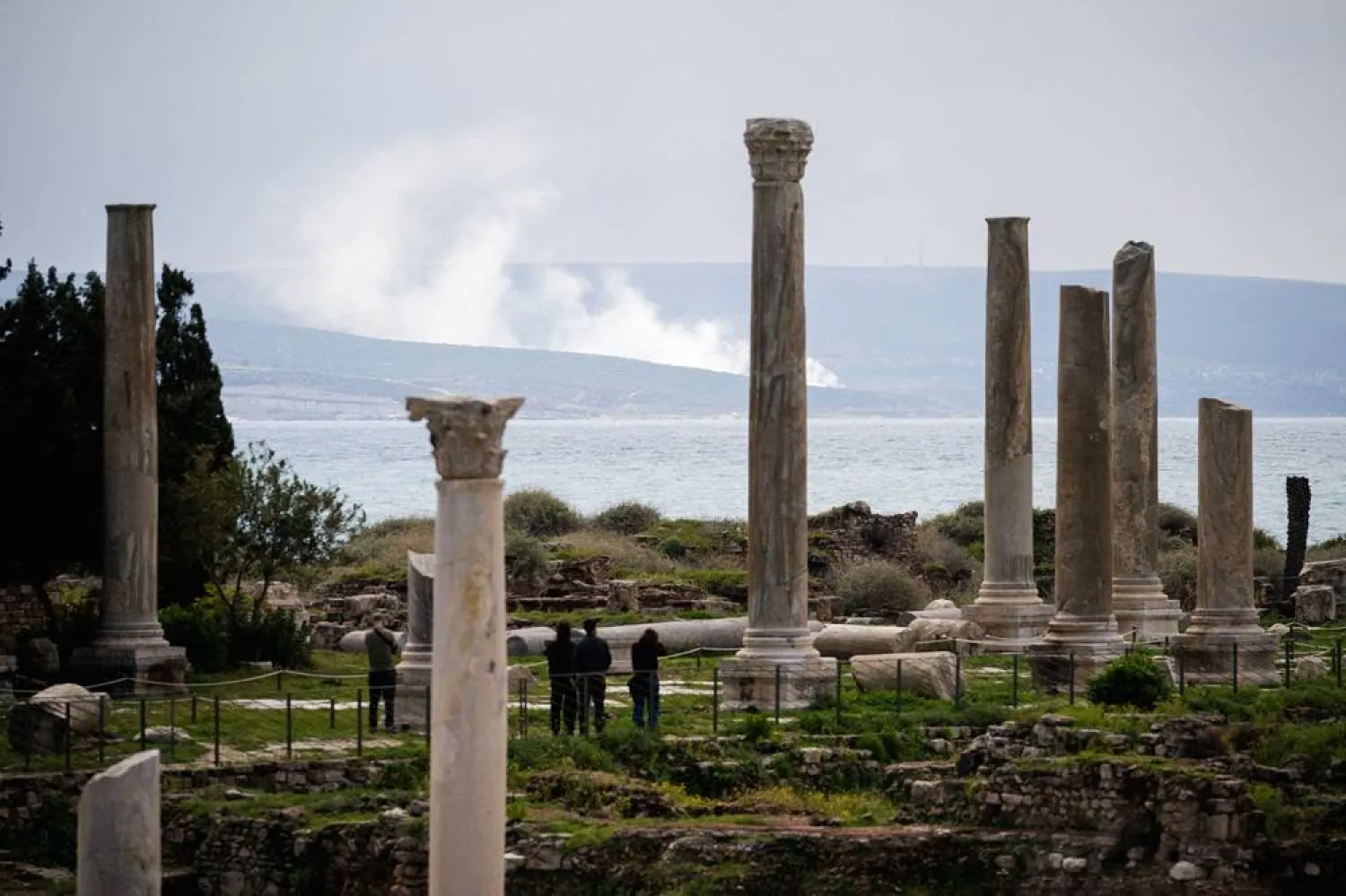
This photograph taken on March 23, 2026, shows smoke as it rises from the site of an Israeli air strike at the background of the archaeological site of the ruins of the Phoenician Port in the southern Lebanese city of Tyre. (AFP)
TT

In Lebanon’s Tyre, Ancient Site Threatened by Israeli Bombs

This photograph taken on March 23, 2026, shows smoke as it rises from the site of an Israeli air strike at the background of the archaeological site of the ruins of the Phoenician Port in the southern Lebanese city of Tyre. (AFP)

At an archaeological site in southern Lebanon's Tyre, small signs bearing a blue and white emblem provide a symbolic shield, meant to protect the ancient ruins from bombardment.

One of the oldest cities on the Mediterranean coast, Tyre is located around 20 kilometers (12 miles) from the Israeli border, and has been the target of several strikes since Lebanon was drawn into the Middle East war by Hezbollah's March 2 rocket attack on Israel.

The Al-Bass site is centered on a necropolis that dates back three millennia to Tyre's time as a major Phoenician city and was still in use until the Arab conquests of the 7h Century.

An organization linked to UNESCO, the United Nations' cultural heritage agency, launched the signs initiative near the site, part of a push that covers more than 30 locations across the country.

It is a reminder that the 1954 Hague Convention obliges warring parties to protect cultural property.

On March 6, an Israeli strike hit just a few meters away, killing eight people according to Lebanon's health ministry.

The target, a family home, is now a pile of rubble.

"They were our neighbors... They thought that being close to an archaeological site protected them, that because this is a World Heritage site it would not be struck," said Nader Saqlawi, director of archaeological excavations in the south for Lebanon's culture ministry.
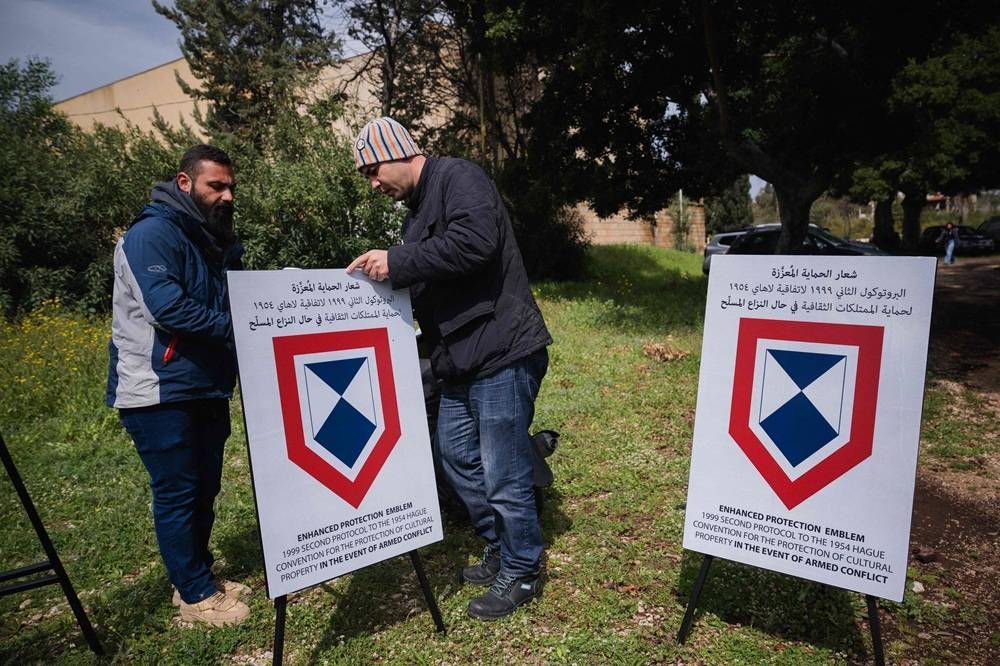
Museum employees place Enhanced Protection Emblems, a special symbol used under international humanitarian law to protect critical sites during armed conflict, at the archaeological site of the Roman hippodrome in the southern Lebanese city of Tyre, on March 23, 2026. (AFP)

- Human remains -

The team from the ministry that came to inspect possible damage to the monuments found human remains -- "a hand and pieces of flesh" -- on the roof of the site's museum, which is still under construction, he said.

The museum suffered damage, its windows were blown out, but the explosion did not reach the necropolis nor the Roman-era triumphal arch, aqueducts and hippodrome that are also part of the site.

In antiquity, the city of Tyre was at various times Phoenician, Persian, Hellenistic, Roman and Byzantine.

While many of its inhabitants have fled the latest war, others remain alongside the city's precious relics.

Lebanese Culture Minister Ghassan Salame condemned what he called Israel's aggression.

"The archaeological sites do not contain any military or security presence. Therefore, this argument cannot be used to justify their bombing," he said.

There was no immediate comment in response to AFP's request from the Israeli army, which usually says it is targeting Hezbollah sites or operatives with its attacks.

"Lebanon is full of archaeological riches... and the Beirut depots do not have the capacity to accommodate all these threatened objects," said David Sassine, an expert at the International Alliance for the Protection of Heritage.
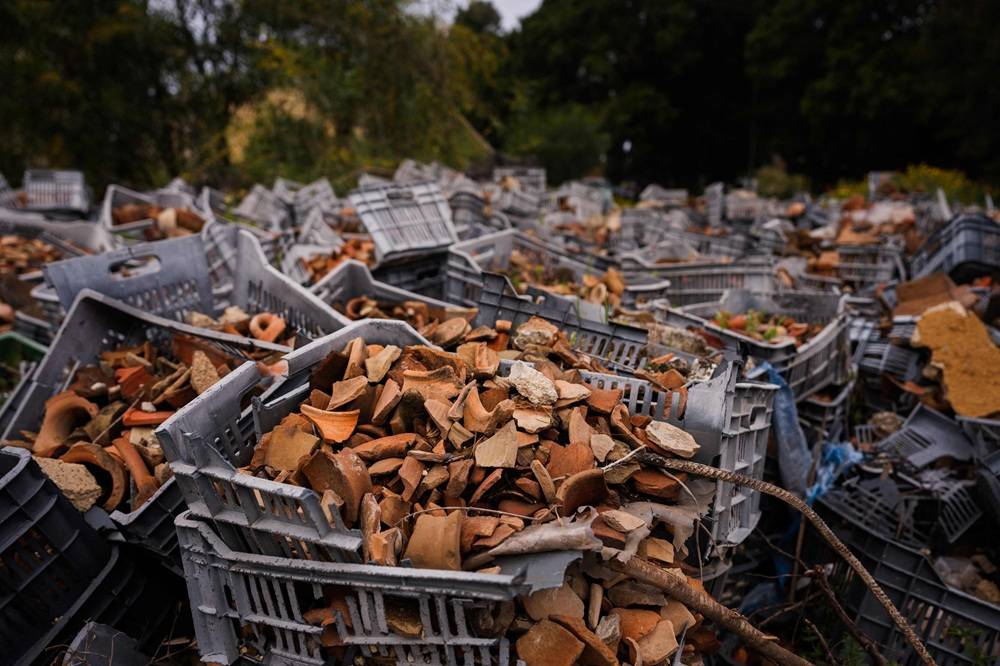
This photograph taken on March 23, 2026, shows boxes filled with fragments of ancient pottery collected after an Israeli strike near the archaeological site of the Roman hippodrome in the southern Lebanese city of Tyre. (AFP)

- 'No one cares' -

There is also no guarantee that the objects would be safer in the capital, which is itself regularly bombed by Israel, and transporting the items from the south of the country, even under military escort, "remains risky", Sassine said.

During the previous Israel-Hezbollah conflict in 2024, gold coins, millennia-old amphorae and valuable sarcophagi were transferred to Beirut, where they have remained.

Tyre was heavily damaged by Israeli strikes during that war, while much of the population evacuated at the time.

Closer to the border, the citadel in the village of Shamaa was also partly destroyed by the Israeli military.

Saqlawi of the culture ministry said he believed attacks on historic sites were intentional.

"The Israelis know everything. They know your shoe size... and they know very well this is an archaeological site," he said.

Mustapha Najdi, a guard at the archaeological sites, was at the Al-Bass site when the March 6 strike hit.

"I heard a very violent impact. I fled and alerted the authorities," he said.

"No one cares about us," Najdi lamented, calling on "everyone who can to exert pressure to stop this barbarity".

"This civilization represents history, represents us all, Lebanese and non-Lebanese."


In East Libya, Archaeologists Fight to Save 'Breathtaking' Ancient Greek Ruins

(FILES) A man holds a preserved artifact from the Cyrene archaeological site near the ancient historical town of Shahat in the northeastern Mediterranean coast of Libya on May 17, 2026. (Photo by Abdullah DOMA / AFP)
TT

In East Libya, Archaeologists Fight to Save 'Breathtaking' Ancient Greek Ruins

(FILES) A man holds a preserved artifact from the Cyrene archaeological site near the ancient historical town of Shahat in the northeastern Mediterranean coast of Libya on May 17, 2026. (Photo by Abdullah DOMA / AFP)

In eastern Libya, a small group of passionate archaeologists are striving to safeguard the ancient ruins of Cyrene and Apollonia -- sites first targeted by militant groups, then ravaged by Storm Daniel.

The UNESCO-listed ruins were once at the heart of a unique network of Greek colonies in North Africa, according to AFP.

"Breathtaking," tour guide Hamdi Al-Kailani said, surveying the imposing Temple of Zeus at Cyrene. The monument, he added, is slightly bigger than the Parthenon in Athens.

While calm reigns there today, Cyrene -- much like other sites across eastern Libya -- was the target of looting by terrorists, including the ISIS group, when the country descended into chaos following the fall of longtime ruler Muammar Gaddafi in 2011.

With state institutions largely absent, local experts and aficionados had to improvize.

"We were so afraid," recalled Smail Dakhil, who oversees the dilapidated Museum of Cyrene, which houses statues of Apollo and Zeus, and a storage of more than 40,000 rare artifacts salvaged from the ancient city.

"We came up with a plan among colleagues to hide the small statues, gold coins and archives in our homes," he told AFP.

Larger sculptures that could not be moved, including a rare female sphinx, were protected by volunteer archaeologists and residents who "stood watch over the sites around the clock so no thefts were recorded in Cyrene", Dakhil added.

In 631 BC, settlers from the Greek island of Thera, now Santorini, founded Cyrene and four other colonies -- Apollonia, Ptolemais, Arsinoe and Berenice -- along the coast of today's eastern Libya.

At its height, Cyrene had as many as 100,000 inhabitants and developed a rich intellectual life centred on the arts, music and science, with theatres and a renowned school of philosophy.

Earthquakes and wars eventually reduced the cities to ruins, and they were only rediscovered in the 18th century.

Then came Storm Daniel in 2023, with major floods sweeping through Derna, about 100 kilometres (60 miles) east of Cyrene, and killing thousands of people.

"The day after, everyone who loves this site came by," said Anis Hamid Younes, who oversees renovation works along a sacred pathway linking upper Cyrene to the Temple of Apollo.

"We were in shock," he added.

Younes leads a team that has spent months clearing fallen blocks and rubble, salvaging valuable objects and rebuilding a sanctuary and nearly 60 metres (200 feet) of an antique wall.

Despite what he described as "outdated equipment" and "a lack of resources", Younes said he hoped the area would reopen to visitors in September.

Storm Daniel brought destruction and death -- but also new discoveries.

Archaeologists have since unearthed engravings and funerary offerings hidden among thousands of Green and Roman tombs.

- 'Change of attitude' -

Some 20 kilometres away, experts are increasingly concerned about Apollonia, Cyrene's former port, a third of which has already been submerged by the sea over the centuries.

"Before Daniel, we estimated the risk of losing the site at 50 percent," said Talal Al-Hasey, a local official at the Department of Antiquities. "Now it's 80 percent."

"Urgent intervention is needed... Some structures are completely exposed to marine erosion," he added.

Sitting on one of the rock-cut seats of a Greek theatre, Ahmad Essa Abdulkariem, a senior Department of Antiquities official, lamented "the absence of assistance from UNESCO and other international organizations".

He said the department had made "repeated requests" for help with sites listed as endangered since 2016, but in vain.

Charaf Ahmimed, UNESCO's new director for the Maghreb, told AFP he was "not aware" of the requests, noting "UNESCO's desire to return in force" to Libya. He said he planned to visit Cyrene and Apollonia this summer.

Fresh from a trip to Paris, Essa said he dreamt of having a museum of comparable stature to the Louvre in Libya's eastern region of Cyrenaica.

Such space could also help Libya recover hundreds of ancient items now held abroad, including around 250 in Paris and another 200 at the British Museum in London.


Culinary Arts Commission Documents Saudi Food Heritage Through Global Ark of Taste Initiative

Culinary Arts Commission Documents Saudi Food Heritage Through Global Ark of Taste Initiative
TT

Culinary Arts Commission Documents Saudi Food Heritage Through Global Ark of Taste Initiative

Culinary Arts Commission Documents Saudi Food Heritage Through Global Ark of Taste Initiative

The Culinary Arts Commission has registered 180 Saudi products representing the Kingdom's 13 administrative regions within the global Ark of Taste initiative, as part of its efforts to document national food heritage, SPA reported.

The Ark of Taste is a global initiative dedicated to documenting food products threatened with disappearing, aiming to highlight local food diversity, support traditional producers, and promote sustainable production methods.

The Kingdom registered approximately 120 products between 2022 and 2024, before adding 60 new items this year, bringing the total to 180, spanning 16 categories including animal breeds, baked goods, dairy products, local coffee, honey, spices, and traditional vinegar.

The commission continues to support the documentation and registration of the Kingdom's food and cultural elements, preserving Saudi culinary heritage for future generations.


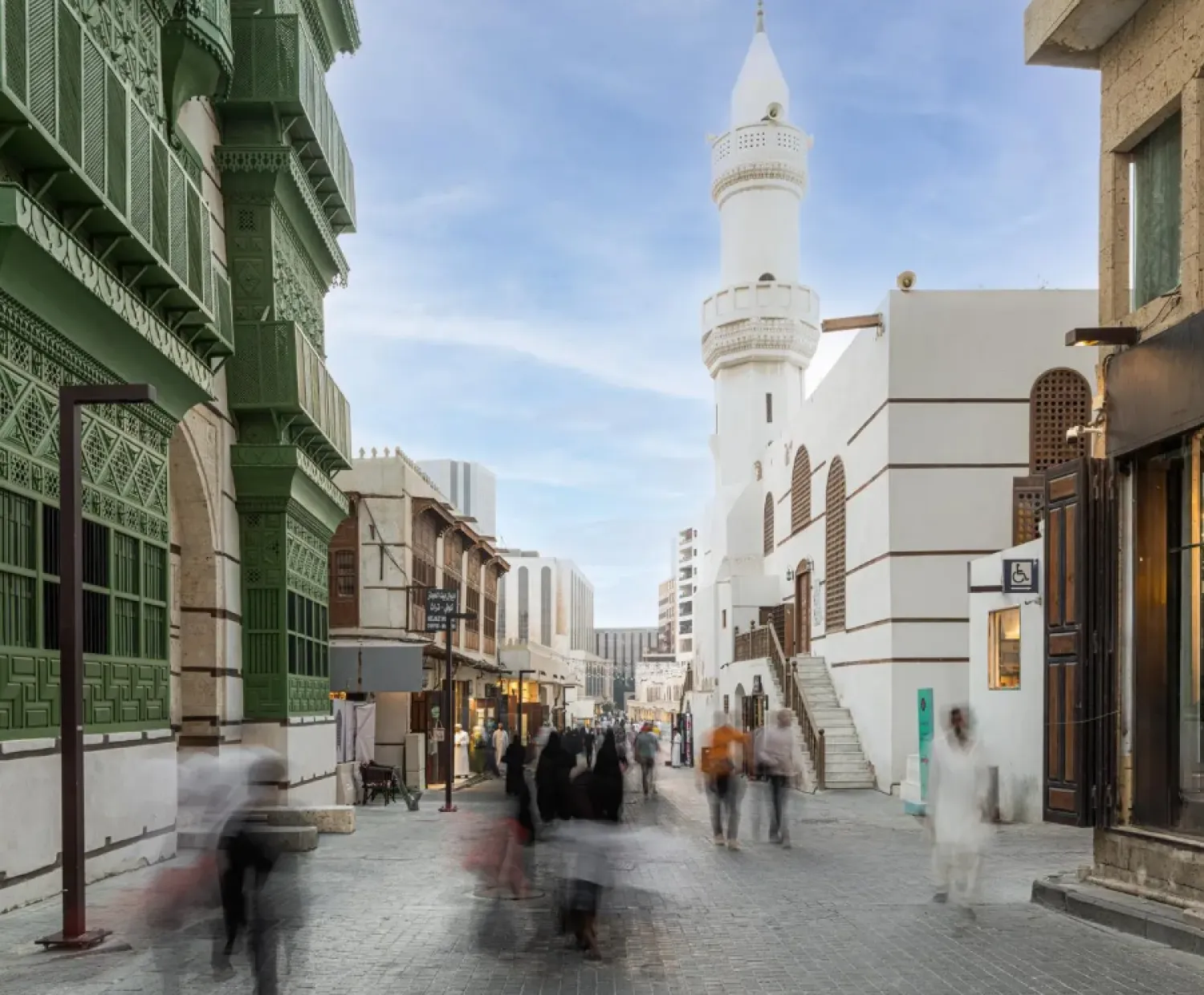
Historic Jeddah Marks 12 Years on UNESCO World Heritage List

Historic Jeddah was inscribed on the UNESCO World Heritage List after meeting three criteria of Outstanding Universal Value - SPA
TT

Historic Jeddah Marks 12 Years on UNESCO World Heritage List

Historic Jeddah was inscribed on the UNESCO World Heritage List after meeting three criteria of Outstanding Universal Value - SPA

This June marks the 12th anniversary of Historic Jeddah's inscription on the UNESCO World Heritage List, reflecting the Ministry of Culture's continued efforts to revitalize the area as part of Saudi Arabia's ongoing commitment to protecting and preserving cultural heritage and national identity.

Historic Jeddah was inscribed on the UNESCO World Heritage List after meeting three criteria of Outstanding Universal Value.

The site reflects the exchange of human values, building materials, and architectural styles across the Red Sea region. It also highlights its historic role as a center for trade and pilgrimage, enhancing its historical connection to Hajj from both architectural and urban perspectives, SPA reported.

The 12th anniversary of Historic Jeddah's presence on the UNESCO World Heritage List further reinforces its global status as a living heritage site, a distinctive cultural and tourism destination, and a vibrant center for culture, arts, and creativity.